
9 BEST Wireless Keyboard and Mouse Combo (2026)
 Editorial Team
We are reader supported and may earn a commission when you buy through links on our site

A keyboard and mouse combo uses one matching set for typing and pointer control. Most wireless sets connect through a small USB receiver, while some also support Bluetooth. This guide compares nine choices for office work, home use, gaming, and switching between devices. Seven are wireless. The Logitech Mk120 and Redragon S101 are wired alternatives for buyers who value a fixed USB connection.
Our Top Recommendation: Logitech MK270 is the best wireless keyboard and mouse combo for a simple home or office desk. It gives you a full-size keyboard, a compact mouse, one USB-A receiver, media controls, and long maker-rated battery life without adding setup steps. Read more…

9 Products Reviewed

80+ Hours of Research

1.4k+ Reviews Examined

Unbiased Reviews
Best Wireless Keyboard and Mouse Combo: Top Picks!
| Product | Connection | Best for | Product Link |
|---|---|---|---|
 Logitech MK120 |
Wired USB-A | Low-cost fixed desks | Check Price |
 Lenovo 510 |
2.4 GHz USB-A receiver | Basic Windows office work | Check Price |
 Logitech MK270 Wireless Keyboard |
2.4 GHz USB-A receiver | Best overall wireless value | Check Price |
 RAPOO Keyboard and Mouse Wireless |
Bluetooth 5.0/4.0 and 2.4 GHz | Office desks and tablets | Check Price |
 Dell Pro KM5221W Keyboard & Mouse |
2.4 GHz USB-A receiver | Office desks and adjustable mouse DPI | Check Price |
1) Logitech Mk120
Best wired budget alternative
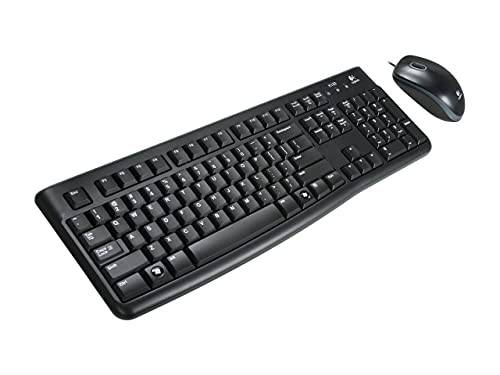
Logitech Mk120 is a corded keyboard and mouse set, so it does not remove cables from your desk. It suits a fixed workstation where low cost and simple setup matter. Both devices use USB-A and work without batteries, pairing, or a wireless receiver. You can move the set between shared Windows computers, but each computer needs two free USB ports.
The keyboard has a full-size layout with a number pad, easy-to-read keys, a curved spacebar, and adjustable tilt legs. Logitech says its spill-resistant design was tested with up to 60 ml of liquid. The included mouse has a simple three-button layout, 1,000 DPI optical tracking, and a shape made for either hand. Logitech also lists a three-year limited hardware warranty.
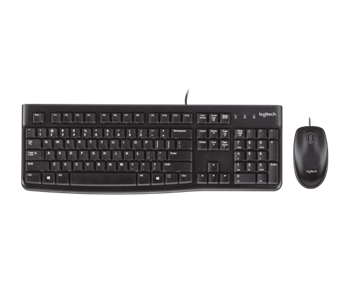
The fixed cables remove battery changes and lost-receiver problems. They also limit where you can place the devices and add more wires than any wireless set in this list. There is no backlight, multi-device switching, or button software. Buy it for a basic desk, classroom, front counter, or backup computer. Skip it if the main reason you are shopping is to get rid of cables.
Unlike a battery-powered set, MK120 stays ready after long periods in storage. Its simple design also makes troubleshooting easy: if a port works, the keyboard and mouse should work without a pairing app or charging cable.
Pros
Cons
Who should buy it: Anyone who wants an inexpensive set for one fixed computer.
Skip it if: You need wireless freedom, Bluetooth, or multi-device controls.
2) Lenovo 510
Best for a simple Windows office desk
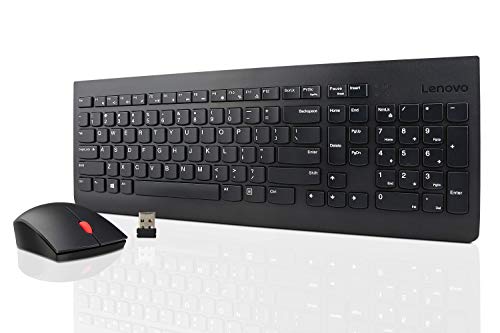
Lenovo 510 gives you a full-size wireless keyboard and a three-button mouse that share one small USB-A receiver. The black set is part GX30N81775. It uses a 2.4 GHz connection, so there is no Bluetooth menu to manage. Plug in the receiver, add the included batteries, and the set is ready for normal office work.
The keyboard uses flat island-style keys and includes a number pad. Lenovo lists a 2.5-zone layout and a body about 17 inches wide. The current store listing describes the keyboard as spill resistant and gives the mouse a 1,200 DPI optical sensor. The mouse is ambidextrous and has its own power switch, which helps when you carry it in a bag or leave the desk for several days.
This set suits a Windows desktop or docked laptop where one USB-A port can stay occupied. It lacks Bluetooth, backlighting, rechargeable batteries, and device switching. If the receiver is lost, the set cannot connect through another method. Lenovo lists a one-year warranty. Choose it for a plain full-size layout and a matching mouse; skip it if you regularly move between a computer, tablet, and phone.
Compared with a compact travel board, Lenovo 510 keeps the keys used for spreadsheets and data entry in their normal places. That familiarity is useful at a shared desk, though the wider keyboard leaves less room for mouse movement.
Pros
Cons
Who should buy it: Windows users who want a basic full-size wireless set.
Skip it if: Your computer has no free USB-A port or you need to switch devices.
3) Logitech MK270
Top Recommendation: Best overall wireless value
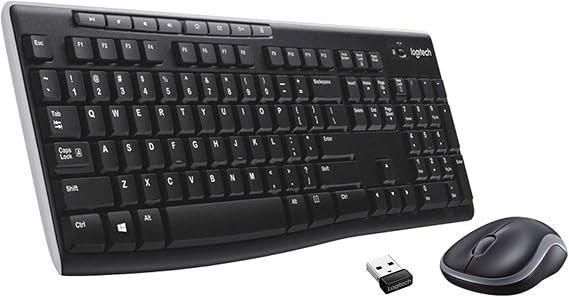
Logitech MK270 is the top recommendation because it covers the basics without making setup complicated. Its full-size keyboard and compact mouse share one USB-A nano receiver. Logitech rates the 2.4 GHz connection for up to 10 meters, although walls, radio traffic, and desk placement can shorten that distance. The set works well for routine typing, web use, spreadsheets, and home-office tasks.
The keyboard includes a number pad, arrow cluster, full function row, and eight media controls. Logitech lists two tilt positions and a spill-resistant design tested with up to 60 ml of liquid. The compact mouse is ambidextrous and uses a 1,000 DPI optical sensor. Logitech estimates up to 36 months for the keyboard battery and 12 months for the mouse; real battery life depends on use.
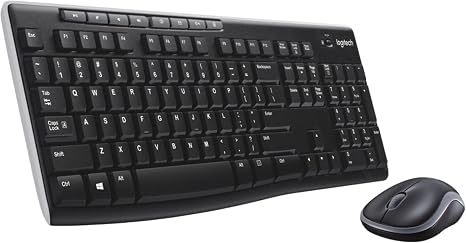
MK270 is a better fit than the Lenovo 510 when you want dedicated media keys and longer maker-rated keyboard battery life. Reviewed reported typing speeds above 80 words per minute during its test. TechGearLab also placed the keyboard near the top of its typing-accuracy results, although its reviewers sometimes noticed wireless delay.
Both reviews point to the same limits: the mouse is small, the set supports one computer at a time, and there is no Bluetooth or backlight. The receiver stores inside the mouse, but your laptop still needs USB-A or a suitable adapter.
Pros
Cons
Who should buy it: Home and office users who want a straightforward wireless set for one computer.
Skip it if: You need Bluetooth, backlighting, or a larger mouse.
4) RAPOO Keyboard and Mouse Wireless
Best for switching between several devices
RAPOO Keyboard and Mouse Wireless uses the compact Rapoo 9010M set, which has more connection choices than basic USB-only combos. It supports Bluetooth 5.0, Bluetooth 4.0, and 2.4 GHz wireless through the included nano receiver. Rapoo says the keyboard can remember up to four devices, while the mouse can pair with up to two. It works well on a desk shared by a computer and tablet.
The keyboard has 78 low-profile scissor keys, 12 multimedia shortcuts, and an aluminum-alloy base. It is only 284 mm wide, so it saves room by leaving out the number pad and wide navigation block. The ambidextrous mouse has silent clicks and five sensor settings from 800 to 2,400 DPI. Rapoo lists support for Windows, macOS, ChromeOS, Android, and iOS.
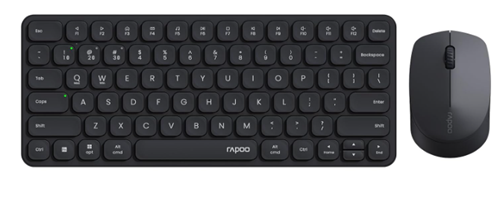
Rapoo estimates up to 12 months of battery life for both devices, using two AAA batteries in the keyboard and two AA batteries in the mouse. Those figures vary with connection type and use. The main tradeoff is the compact layout: people who enter numbers all day may miss a dedicated keypad. The mouse also remembers fewer devices than the keyboard, so changing both together can take an extra button press.
The thin board is easier to carry than a full-size model, but it has no built-in palm rest. Buyers who type for long periods may want to add a separate wrist support.
Pros
Cons
Who should buy it: People who work across computers, tablets, or phones.
Skip it if: You need a full-size keyboard or a built-in number pad.
5) Dell Pro KM5221W Keyboard & Mouse
Best for office desks and adjustable mouse DPI
Dell Pro KM5221W Keyboard & Mouse is a full-size office set that connects through one 2.4 GHz USB-A receiver. The keyboard has a number pad and dedicated keys for volume and mute. Dell Peripheral Manager can change supported shortcuts and the mouse button on Windows. The hardware also works with several other operating systems, but Dell’s customization software is Windows-only.
The three-button mouse lets you choose 1,000, 1,600, 2,400, or 4,000 DPI. A higher setting moves the pointer farther with the same hand motion, which can help on a large or high-resolution screen. Dell lists AES-128 wireless encryption, a three-year advanced exchange warranty, and up to 36 months of battery life for the set. Battery life is a maker estimate and will change with use.
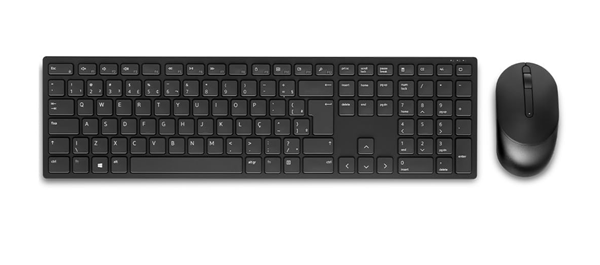
KM5221W is a good desk choice when you want a full layout and more mouse sensitivity choices than the MK270 provides. It still relies on one receiver and has no Bluetooth, so it is not the best match for tablets or quick changes between computers. The keyboard uses plunger switches rather than mechanical switches, and it has no backlight. Choose it for an office computer where the receiver can remain installed.
The receiver-first design keeps deployment simple for a group of desks. However, a buyer using macOS or Linux should expect the basic hardware to work without every shortcut or customization option offered in Dell Peripheral Manager.
Pros
Cons
Who should buy it: Office users who want a full-size board and adjustable mouse tracking.
Skip it if: You need Bluetooth, backlighting, or regular device switching.
6) Logitech Wireless Combo
Model MK670: Best wave-shaped ergonomic combo
Logitech Wireless Combo is the Wave Keys MK670 set. It pairs Logitech’s wave-shaped Wave Keys keyboard with the Signature M550 L mouse. The keyboard keeps a number pad but uses a narrower frame than many full-size boards. Its curved rows and cushioned palm rest are designed to keep hands and wrists in a more natural position at a desk.
MK670 connects through Bluetooth 5.1 or the included Logi Bolt USB-A receiver. Logitech rates the wireless range at up to 10 meters in open conditions. The 99-key US layout uses deep-profile plunger keys, has a four-degree tilt setting, and includes a Caps Lock light. Logi Options+ can change supported shortcuts on Windows and macOS.
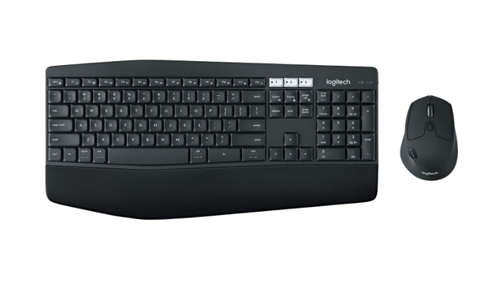
The Signature M550 L mouse is sized for medium to large hands. It uses optical tracking from 400 to 4,000 DPI and a SmartWheel that changes between precise and faster scrolling. Logitech estimates up to three years for the keyboard batteries. It rates the mouse for up to 20 months over Bluetooth or 24 months with the receiver; actual life varies.
Compared with MK270, MK670 adds Bluetooth, a cushioned palm rest, a wave layout, and a wider mouse sensitivity range. It also costs more and has no keyboard backlight. The wave shape takes more depth than a flat compact board, and it may not suit buyers who prefer straight key rows. Buy it for comfort-focused office use; skip it for travel or mechanical switches.
Pros
Cons
Who should buy it: Office users who want a wave-shaped keyboard and a larger mouse.
Skip it if: You prefer straight key rows, mechanical switches, or a travel-size set.
7) Amazon Basics
Best for a plain full-size setup
Amazon Basics is a full-size wireless keyboard and mouse combo for a basic desk. It uses one 2.4 GHz USB-A receiver for both devices and follows a standard QWERTY layout. The keyboard has a number pad and a full function row, so it feels familiar on a home computer, reception desk, or shared workstation. Setup is plug-and-play on a compatible computer.
This set focuses on basic input rather than extra controls. The keyboard has low-profile keys and common shortcut functions, while the mouse uses a simple ambidextrous shape. Because both devices share one receiver, the set takes only one USB port. There is no Bluetooth connection, multi-device button, keyboard backlight, or rechargeable battery built into the combo.
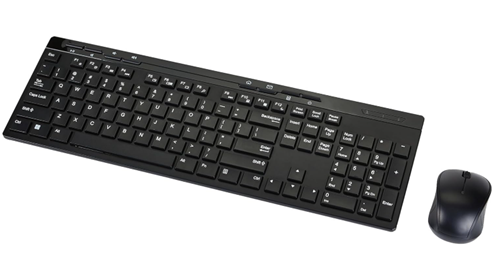
Amazon Basics is easy to understand, but it offers fewer published details and fewer customization choices than the Logitech, Dell, or Rapoo sets. Check the operating-system list and keyboard layout shown on the current US listing before buying, since similar Amazon Basics combos may use different receivers or regional layouts. Choose it for ordinary typing and pointer control. Look elsewhere for device switching, gaming controls, or an ergonomic palm rest.
This is also a sensible spare set for a family computer or guest workstation. Keep the receiver with the mouse when moving it, because the keyboard has no Bluetooth fallback if that small part is lost.
Pros
Cons
Who should buy it: Buyers who need a simple wireless set for normal home or office work.
Skip it if: You need detailed customization, backlighting, or several device connections.
8) Redragon S101 Wired Gaming Keyboard
Best wired gaming alternative
Redragon S101 Wired Gaming Keyboard comes with the S101-3 Pro mouse in a wired gaming set. Both devices use USB connections, so this is an alternative rather than a wireless pick. The full-size membrane keyboard has RGB lighting, a number pad, a wrist rest, and five dedicated macro keys. It suits a desktop gaming setup where cables matter less than battery charging or radio interference.
The mouse has selectable sensitivity from 800 to 7,200 DPI and ten lighting effects. The keyboard offers six backlight modes, and the current listing says macro and lighting settings can be stored in the hardware. Redragon lists Windows 10 and Windows 11 support for the software. Basic keys may work elsewhere, but buyers should not assume that every lighting or macro setting will work on macOS.
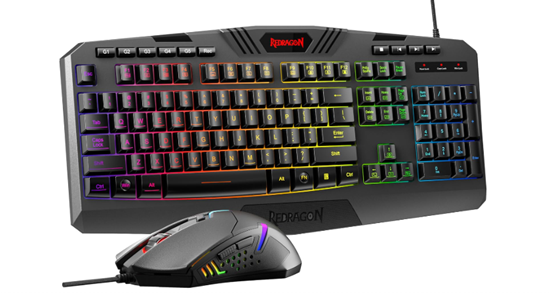
S101 gives you more gaming controls than the office sets, but it also takes more desk room and adds two cables. The keyboard uses membrane switches, so buyers looking for a mechanical feel should choose another model. RGB lighting is useful in a dim room, although it does not change typing quality. Buy this set for a budget gaming desktop; skip it when a clean wireless desk or easy travel matters more.
The wired connection also avoids charging during play, but you should confirm that the computer has two open USB ports and enough space for the full-size board.
Pros
Cons
Who should buy it: PC gamers who want lighting and macro controls at a lower cost.
Skip it if: You need wireless devices, mechanical switches, or broad macOS software support.
9) HP USB Wireless Spill Resistance
Model: HP 230 Wireless Mouse and Keyboard Combo
HP USB Wireless Spill Resistance is the requested display name for the HP 230 Wireless Mouse and Keyboard Combo, product 18H24AA#ABA. It connects both devices through one 2.4 GHz USB-A receiver. The keyboard uses a full-size three-zone layout with low-profile chiclet keys, a number pad, and 12 function-key controls. HP describes the keys as quiet, which suits shared offices and home work areas.
The mouse has three buttons and a 1,600 DPI optical sensor. HP estimates up to 16 months of keyboard battery life and 12 months for the mouse, based on two AAA batteries for the keyboard and one AA for the mouse. Actual life changes with use and conditions. The current US maker page lists Windows 10 and Windows 11, so check compatibility before using it with another operating system.
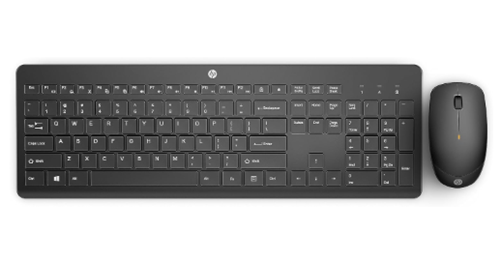
The requested display name includes "Spill Resistance," but HP’s current US specifications for model 18H24AA do not make that claim. TechGearLab’s keyboard test also placed the HP 230 near the bottom for typing speed and accuracy. Its testers found the keypress awkward. That is their result, not a Guru99 measurement, and typing feel varies by user.
The set has no Bluetooth, backlight, or multi-device switching. Its low-profile board fits a shallow desk better than a model with a large palm rest. Buyers who need verified liquid protection, an ergonomic curve, or programmable keys should choose another set.
Pros
Cons
Who should buy it: Windows users who want a quiet full-size wireless set.
Skip it if: You need verified spill protection, Bluetooth, or a backlit keyboard.
How We Researched These Keyboard and Mouse Combos
We checked the nine selections on October 8, 2026, using US product listings, manufacturer pages, support pages, and technical data sheets. We compared connection type, operating-system support, keyboard layout, mouse tracking, power needs, maker-rated battery life, software, warranty, and the main limit of each set. The provided short links were opened through a US browser session to confirm their destinations.
This was a product-page and specification review, not a hands-on test. We did not measure typing feel, noise, wireless range, battery life, click delay, durability, or spill protection. Battery and range figures are identified as manufacturer estimates. Prices were left out because they change often.
How to Choose a Keyboard and Mouse Combo
- Connection: A USB receiver is simple and keeps both devices together, but it takes a USB-A port. Bluetooth works better with tablets and computers that have few ports.
- Layout: A full-size board includes a number pad. A compact board saves desk space but may remove the pad and navigation keys.
- Device switching: Choose a multi-device set if you move between a work computer, personal computer, or tablet.
- Mouse size and DPI: A compact mouse travels well. A larger contoured mouse may suit long desk sessions. Adjustable DPI changes pointer speed.
- Power: Check the battery type, maker estimate, power switches, and whether you can replace the receiver if it is lost.
- Software: Extra button and macro settings may only work on Windows or macOS, even when the basic hardware works on other systems.
Keyboard size and key type
A full-size keyboard includes the number pad, arrow keys, and navigation block. It suits spreadsheet work and frequent number entry, but it also pushes the mouse farther to the side. A compact keyboard brings the mouse closer and fits a smaller desk. The Rapoo 9010M uses a 78-key layout, so it saves space by removing the separate number pad.
Key type changes the feel and sound. The budget office sets in this guide use membrane or plunger switches. Rapoo uses low-profile scissor switches similar to many laptop keyboards. The Redragon S101 is a membrane gaming board, even though it has RGB lighting and macro keys. None of these choices gives you the switch options or replaceable key switches found on many mechanical keyboards.
When a keyboard and mouse combo makes sense
A matched combo is useful when you want one purchase, one receiver, and a consistent design. It can also cost less than buying two separate products. The tradeoff is choice. A good keyboard does not guarantee that the included mouse will fit your hand, and a small mouse is the main weakness of the Logitech MK270.
Buy the devices separately when you need a specific keyboard layout, a left-handed or vertical mouse, mechanical switches, or gaming features. A combo makes more sense for a shared computer, a basic office desk, or a spare setup where easy installation matters more than custom parts.
Wireless Receiver vs. Bluetooth
A 2.4 GHz receiver usually gives the easiest setup: plug it into a USB-A port and use the matching keyboard and mouse. It also keeps the two devices on one connection. The downside is that a lost receiver can make the set unusable, and thin laptops may need a USB-C adapter.
Bluetooth does not need a receiver, so it leaves ports free and works well with tablets. Multi-device Bluetooth sets can also change between paired devices. Setup takes a few more steps, and waking or switching may feel different from a dedicated receiver. The Rapoo 9010M and Logitech MK670 offer both methods.
Verdict:
These nine combos cover simple desks, multi-device work, gaming, and wired setups. The three strongest wireless choices are:
- Logitech MK270 is the top recommendation for one home or office computer. It combines a full-size layout, media keys, a compact mouse, and one receiver at a sensible feature level.
- RAPOO Keyboard and Mouse Wireless, model 9010M, is the better fit for several devices because it supports Bluetooth and a 2.4 GHz receiver.
- Logitech Wireless Combo, model MK670, suits buyers who want a wave-shaped keyboard, a cushioned palm rest, and a mouse for medium to large hands.
