
Cognos Tutorial
 Editorial Team
⚡ Smart Summary
Cognos, now known as IBM Cognos Analytics, is a web-based business intelligence platform for reporting, dashboards, and data analysis. This overview covers its history, components, installation steps, strengths, and comparisons with other reporting tools.
What is Cognos?
IBM Cognos is a business intelligence tool for web-based reporting and analytics. This enterprise software provides various features to perform data aggregation and create user-friendly detailed reports. Cognos also offers an option to export reports in XML or PDF format and view the reports in XML format.
History of Cognos BI
The table below shows how Cognos evolved from a Canadian consulting firm into the IBM Cognos Analytics platform of today.
| Year | Milestone |
|---|---|
| 1969 | Cognos software was founded by Alan Rushforth and Peter Glenister. |
| 1979 | It began as a consulting firm for the Canadian Government and offered its first software product, QUIZ. |
| 1982 | Originally Quasar Systems Limited, the company adopted the name Cognos, derived from the Latin word “cognosco,” meaning “knowledge from personal experience.” |
| 1995 | Ron Zambonini was appointed CEO of Cognos. |
| 2007 | IBM formally announced its acquisition of Cognos for the sum of $4.9 billion. |
| 2009 | From 2009, the software was called “Cognos BI and Financial Performance Management,” or Cognos BI and FPM. |
| 2010 | Cognos and the newly acquired SPSS were brought together to create IBM’s Business Analytics division. |
| 2015 | At the IBM Insight conference in Las Vegas, IBM announced a redesigned version 11, upgraded from the Cognos BI software, and renamed it Cognos Analytics. |
| 2018 | IBM released Cognos Analytics 11.1, which introduced AI-assisted analytics and natural language queries. |
| 2021 | IBM released Cognos Analytics 11.2 with a refreshed user interface and a simplified installation process. |
| 2023 | IBM released Cognos Analytics 12.0, expanding the AI assistant and forecasting capabilities. |


Features of IBM Cognos
Following are important features of Cognos:
- Offers in-memory streaming analytics
- Provides real-time events, alerts, and notifications
- Intuitive, appealing web interface
- Personalized and progressive interaction
- Drag-and-drop, free-form assembly, and search-assisted authoring
- Wizard-driven external data
- Automatic access to SAP BW queries
- Allows features like scenario modeling, real-time monitoring, and predictive analytics
- Users can edit existing data
- Drill-through capability
- Potential image documentation integration
- It is platform independent, scalable, and reliable
- Offers secure data as it is guarded by a firewall
Components of Cognos
Here are the important components of the Cognos software:
Cognos Connection
Cognos Connection is a web portal that allows users to access Cognos 10 and its studios. Based on your assigned role, you can use this component to retrieve, view, publish, manage, and organize a company’s reports, scorecards, and agents.
The Administrator also uses Cognos Connection to establish roles and user permissions and to manage the Cognos Connection content.
Cognos Business Insight
Cognos Business Insight allows users to create their own dashboard using any object. All content which the user is permitted to view will be presented as an object. This can be used in your workspace to create a fully personalized dashboard.
Cognos Query Studio
Cognos Query Studio helps business users to get fast answers to business-related queries. It helps organizations to better understand the product, customer, and organizational needs. It also helps them to react quickly and stay ahead of the competition.
Cognos Analysis Studio
Cognos Analysis Studio helps businesses to find and focus on things which are important to the business. It also helps to understand the latest trends, compare data, and assess business performance for multidimensional analysis.
Cognos Business Insight Advanced
Cognos Business Insight Advanced is a newer module included in Cognos 10. It combines Cognos Query Studio and Cognos Analysis Studio, and it offers a robust authoring environment for business users.
Cognos Report Studio
Using the Cognos reporting tool, you can create pixel-perfect reports for your organization. It allows you to create charts, maps, lists, or any other available report type using relational or multidimensional data sources.
Cognos Event Studio
This tool allows you to assign a specific event that sends a notification to the stakeholder in your organization. You can create agents that enable you to define your events and thresholds. When the event occurs or the threshold is reached, the agent sends the notification.
Cognos Metric Studio
Cognos Metric Studio allows you to monitor and analyze business metrics of your organization by building a scorecard environment. It also helps you to establish criteria and then monitor your organization to see how it is responding as changes are made to the criteria.
Types of Cognos
Alongside the studios, Cognos relies on three content-tier components that store and manage published content:
Content Store
It is a set of database tables which are used by the Content Manager to store the application data of Cognos.
Content Manager
The Content Manager helps you to manage the storage and retrieval of report specifications, configuration data, and published packages from the content store database.
Cognos Content Database
Cognos Content Database is a self-contained database server which is used to host the content store database in demo environments when an enterprise DBMS is unavailable.
Cognos BI vs Cognos Analytics: What is the Difference?
Beginners often mix up the two names. Cognos BI is the classic platform (version 10.x and earlier) built around separate studios, while Cognos Analytics (version 11 onward) unifies those studios into one web interface and adds AI-driven features:
| Aspect | Cognos BI (10.x and earlier) | Cognos Analytics (11.x and 12.x) |
|---|---|---|
| Interface | Separate studios for each task | Single unified web interface |
| Authoring | Report Studio, Query Studio, Analysis Studio | Reporting, Dashboards, and Explorations tools |
| AI support | None | AI assistant, natural language queries, forecasting |
| Deployment | Mainly on-premises | On-premises, cloud hosted, and cloud on demand |
| Status | Legacy, replaced by Cognos Analytics | Actively developed by IBM |
If you start today, learn Cognos Analytics; studio concepts still help with older deployments.
How to Download and Install Cognos
Follow these steps to access the browser-based Cognos Analytics free trial:
Step 1) Open Cognos analytics link
Visit Cognos analytics link – https://www.ibm.com/products/cognos-analytics
Step 2) Click on start your free trial
In the Home screen select “Start your free trial” button.

Step 3) Register yourself
Register yourself by filling the below-given form.

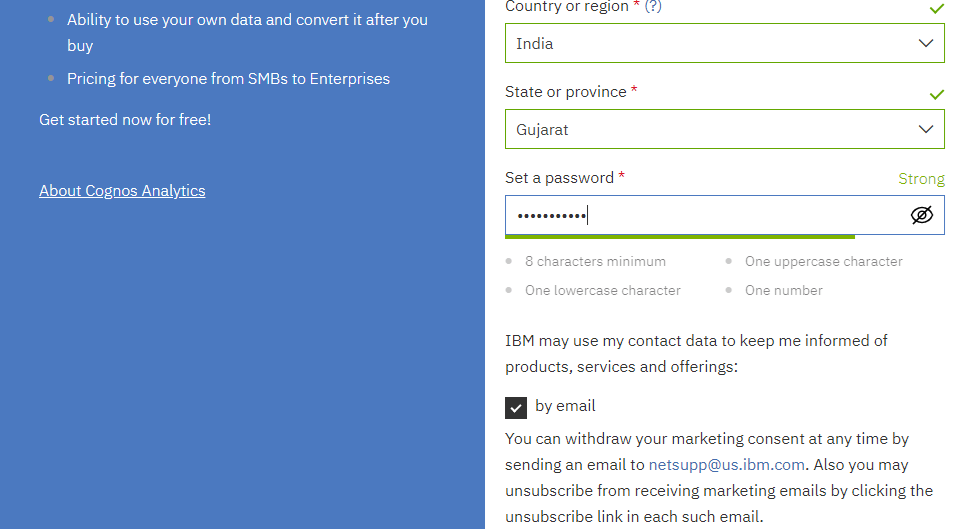
Step 4) Click on Proceed button
Select the “Proceed” button at the bottom of the screen.

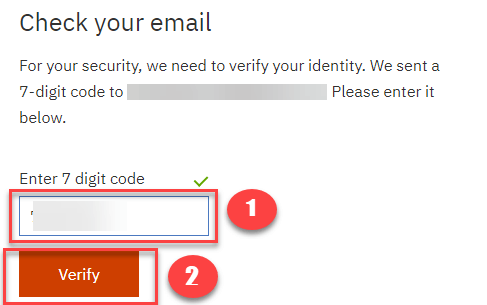
Step 5) Code verification
Enter the code received in your Inbox and click the Verify button.
Step 6) Cognos installation is done
You will see the Home Screen with the message “Welcome to IBM Cognos Analytics.”

Who Uses Cognos? Common Use Cases
Organizations apply Cognos to a wide range of reporting needs, including:
- Financial reporting: Consolidated statements, budgeting packs, and variance reports for finance teams.
- Operational dashboards: Sales, inventory, and supply chain dashboards refreshed from enterprise data sources.
- Regulatory and compliance reporting: Pixel-perfect, scheduled reports for auditors and regulators.
- Scorecards and KPIs: Tracking business metrics against targets across departments.
- Distributed report delivery: Bursting personalized reports to thousands of users by email or portal.
Cognos is especially common in banking, insurance, healthcare, government, and retail, where governed, auditable reporting matters. These concepts also appear frequently in Cognos interview questions for BI reporting roles.
Other Major BI Vendors
Cognos competes with several other enterprise BI platforms, including:
- Business Objects (owned by SAP)
- Information Builders – Focus & WebFocus
- Microsoft – SSRS/SSIS/SSAS
- MicroStrategy
- OBIEE (Oracle)
- QlikTech – QlikView
- SAS
Advantages of using Cognos
Here are the pros/benefits of using Cognos software:
- You can publish Cognos-enabled files to the secure BI portal.
- Provides a limitless workspace to support how people think and work.
- Offers query and reporting, analysis, and scorecarding in a single architecture.
- Easily view, assemble, and personalize information.
- Helps you analyze facts and anticipate tactical and strategic implications.
- Supports decision networks to share insights and drive collective intelligence.
- Offers transparency and accountability to drive alignment and consensus.
- Coordinates tasks to engage the right people at the right time.
- Integrates analytics with business workflow solutions and processes.
- Reduces time to decision and boosts productivity by accessing data with no latency.
- Lets users share and modify Cognos BI content through familiar applications.
- Supports leading RDBMS platforms for content management and reporting data.
- Improves productivity through proactive, real-time notifications and workflow.
- Distributes business intelligence to everyday users.
Disadvantages of Cognos
Here are the cons/drawbacks of using Cognos:
- Cognos BI has not been accepted very eagerly in departmental or divisional deployments.
- Multidimensional analysis requires properly modeled OLAP sources, such as PowerCubes or TM1 cubes.
