
Mantis Bug Tracker Tutorial
 Editorial Team
⚡ Smart Summary
Mantis Bug Tracker is a free, open-source issue tracking system that software teams use to report defects, assign owners, attach evidence, and follow every fix through to closure across multiple projects and releases.



What is Mantis Bug Tracker?
Mantis, released under its official name MantisBT, is an open source bug tracking software that can be used to track software defects for various software projects. You can easily download and install MantisBT for your own use, and the project also offers a hosted version of the same software through MantisHub. You can easily customize Mantis to map your software development workflow.
MantisBT is a PHP application and stores its data in MySQL, PostgreSQL or Microsoft SQL Server, with the server itself running on Linux, Windows or macOS. The current stable release is MantisBT 2.28.4; the older 1.3.x branch (1.3.20) is still supported but receives only security and critical bug fixes, so a new installation should start on the 2.x line.
Some salient features of MantisBT are
- Email notifications: It sends out emails of updates, comments, resolutions to the concerned stakeholders.
- Access Control: You can control user access at a project level
- Customize: You can easily customize Mantis as per your requirements.
- Mobile Support: Mantis supports iPhone, Android, and Windows Phone Platforms.
- Plugins: An ever-expanding library of plugins to add custom functionality to Mantis Issue Tracker.
The rest of this walkthrough follows the order a new team usually works in: log a first defect, then create the project, the users and the custom fields that keep the queue organised.
How to Report an Issue
You do not have to install anything to try MantisBT. The official demo page hands out a free hosted MantisHub trial instance and also lets you browse the MantisBT team’s own public tracker in read-only mode. A well-formed bug report is what makes the rest of the workflow useful, so start there.
Step 1) Log into Mantis
The login screen asks for a username and password, and offers links for signing up and for recovering a lost password.

Step 2) Once you login to Mantis your username will be displayed on the top of the Mantis main screen and now you can report your issue into the Mantis by clicking on the option "Report Issue" as shown below.

Step 3) In the next Screen
- Enter Bug Category
- Enter Reproducibility
- Enter Severity
- Enter Priority
- Enter Platform Details
- Enter Summary of the Bug Report
- Enter Description
- Enter Steps to reproduce the error
- Click Submit Report
The numbered callouts in the screenshot below map one to one onto that list, from Category at the top to Submit Report at the foot of the form.

NOTE: The fields you see in your version of Mantis will differ. Refer our section on Custom Fields for the same.
Step 4) After entering all the details in the report window, we will submit a report and soon our report will be displayed on the main window. As shown in the screenshot below, when you click on view issue, the issue will appear on the screen with the id "0017896" also, it shows the status as new and also the date when it was created.
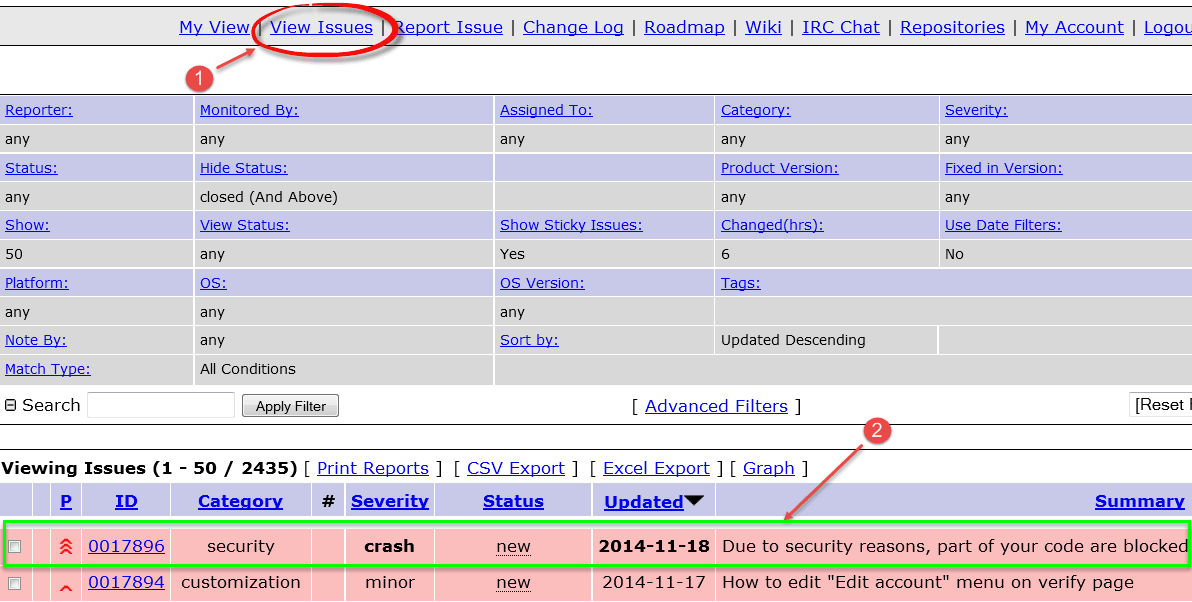
The issues in the Mantis Tool are highlighted according to the status of an issue. For example here the issue is in acknowledged status, therefore, highlighted in light orange.

For different statuses, different colors are allotted. The table below lists the default colour that MantisBT ships for each workflow status, which an administrator can override through the $g_status_colors configuration setting.
| Status | Default colour | What the row is telling you |
|---|---|---|
| new | Light red / pink | Reported, and nobody has picked it up yet. |
| feedback | Purple | The handler needs more information from the reporter. |
| acknowledged | Orange | The team accepts the report as valid. |
| confirmed | Yellow | A second person has reproduced the defect. |
| assigned | Blue | A named handler is working on the fix. |
| resolved | Green | A fix is in place and is waiting for verification. |
| closed | Grey | Verified and archived, no further action expected. |
Reading a queue by colour is the quickest way to see where a release is stuck, and it maps directly onto the wider defect life cycle your team already follows.
Step 5) When you click on your issue #id 0017896, it will show the issue in more details like project reporter, its status, date submitted and last updated.

Step 6) Apart from these, you can add a file, documents, images to your bug as shown below –

Step 7) You can also add comments addressing your issue as shown in the screenshot below.

Step 8) You can click history at top of the Issue Report, to see issue history. This issue history has details like when the issue was created, or when the file was added to the issue or if there is any note added to the issue.

Step 9) Once the issue is submitted the developer receives an email.
The notification below is the message Mantis sends when the issue changes hands, and it repeats the reporter, handler, project, category, severity, priority and status in plain text.


How to Add a Project
Every issue in Mantis belongs to a project, so the next task is to create one for the product under test.
Step 1) Under Manage Tab, go to Manage Projects
- Enter Project Name
- Select Status
- Enter Description
- Click Add Project
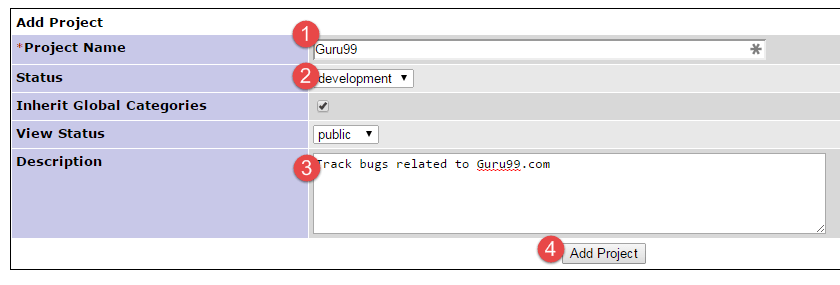
Step 2) Project is created.

How to Create a User
With a project in place, the reporters, developers and managers who will work on it each need an account.
Step 1) Go to Manage > Manage Users. Click "Create New Account"

Step 2) Enter the account details, then create the user
- Username
- Real Name
- Access Level
- Click Create User
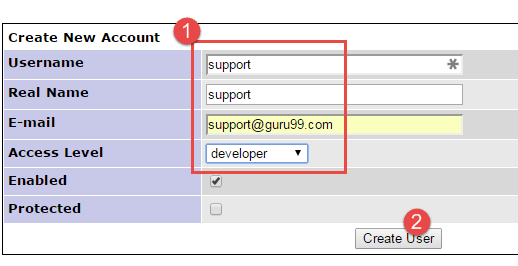
Step 3) In the next screen assign user to the desired project.

Step 4) Update Email and other Account Preferences as desired

Step 5) Login credentials are sent to the user by email.

How to Create Custom Field
When the standard report form does not capture everything your process needs, Mantis lets you define extra fields and attach them to individual projects.
Step 1) Create the field
- Go to Manage Custom Fields
- Enter Field Name
- Click Button "New Custom Field"

Step 2) Configure how the field behaves
- Select Field Type
- Enter Field Specific Data
- Hit Update Custom Field

Step 3) Custom Field is created

Step 4) Click the Custom Field Again and Link Custom Field to your Project

Step 5) In the Report Issue section, the new custom field is reflected

Custom fields, projects and access levels together give a small team the same control that heavier bug tracking tools provide, without leaving the defect management process you already run.
