
Qlikview Tutorial
 Editorial Team
⚡ Smart Summary
QlikView is a classic business intelligence platform that converts raw data into interactive dashboards through an in-memory associative engine. Explore its features, architecture, installation, applications, and how it compares with newer analytics platforms.
What is QlikView?
QlikView is a business intelligence tool for data integration, conversational analytics, and converting raw data into a knowledge base. QlikView offers features for ad hoc queries and facilitates quick decision-making based on easily accessible information. This software works on an associative model that lets users explore data in any direction to find answers.
QlikView is now a legacy product: Qlik has shifted its development focus to the successor platform, Qlik Sense.


Why is QlikView widely used?
Here are the major benefits/advantages of using QlikView:
- The platform is simple and very intuitive to use.
- Offers data visualization in a meaningful and innovative way
- Immediate response time with no restrictions on the amount of data
- Allows you to search across all data directly and indirectly
- QlikView provides support for dynamic applications, dashboards, and analyses, etc.
- Facilitates fast integration of data from various sources into a single application.
- Helps you to identify trends and information to make the most innovative decisions.
- Allows you to access, analyze, and retrieve data from mobile devices.
- Provides a quick return on investment, because of a short implementation period.
- Faster development and change management
- Self-service business intelligence for end users
Features of QlikView
1) Associative Data Modeling:
QlikView works on an in-memory Associative Model. So you do not need dedicated IT professionals if you can write a SQL SELECT query and understand your data.
2) Platform:
QlikView is a Windows-only product, but it is genuinely optimized for 64-bit systems and multiple processors.
3) Cost effective:
QlikView is a memory resident app, so it is a highly cost-effective option for your organization.
4) Economical:
QlikView is very economical with disk space as the amount of memory depends upon the amount of data you want for each application.
Other Important Features of QlikView
- Data Association is maintained automatically
- Data is stored in memory for multiple users, to offer a super-fast user experience
- Data can be compressed to around 10% of its original size
- Transparent reporting and Scalability with Data Integration
- Various forms of data presentation
- Fast implementation
- Unique Data Discovery & Global Search
- Collaboration
- Secure Working Environment
- Visual Analytics & In-Direct Searches
- Flexibility & Integrations
- Consistent reporting
Associative vs. Traditional Search
Because the associative model is QlikView’s defining concept, let us compare associative and traditional, query-based search:

| Traditional | Associative |
|---|---|
| IT-Driven | User Driven |
| Linear, pre-defined thinking | Follows the user |
| It takes months to change. | It just takes minutes to change. |
| Data-centric approach. | Insight-driven |
History of QlikView
Here are some key milestones in the history of QlikView:
- QlikView was founded in Sweden in 1993 by Staffan Gestrelius and Bjorn Berg.
- Qlik is a software firm headquartered in King of Prussia, Pennsylvania, USA.
- Earlier it was called “QuikView,” as in “Quality, Understanding, Interaction, Knowledge,” and it was later renamed “QlikView.”
- The first two versions were written in Excel using VLOOKUPs.
- Qlik established partnerships with famous IT companies like HP and Intel.
- Today, Qlik serves around 40,000 customers in over 100 countries with more than 1,500 partners worldwide.
- In 2014, Qlik launched Qlik Sense, the modern successor platform that is now the company’s primary focus.
- In 2016, the private equity firm Thoma Bravo acquired Qlik for approximately $3 billion.
- In 2019, QlikTech received a license from the RBI to operate a liaison office in Bangalore.
Architecture of QlikView
Next, let us look at the architecture of QlikView.
The QlikView architecture comprises three main components, namely
- QlikView Server
- QlikView Publisher
- QlikView Desktop
All these components collectively help in designing, developing, and implementing the QlikView application.
Let’s learn all these components in detail:

QlikView Desktop
The QlikView Desktop is a Windows-based development tool. Developers use it to create the QlikView data model and the GUI layout that the application uses at the frontend.
The developer prepares the data for users in this desktop environment, manipulating data sets with SQL-like scripting.
Using code scripts, developers can establish linkages/associations between data fields and values, and the data can also be transformed. The files prepared using QlikView Desktop can be used and shared in other QlikView applications.
QlikView Server (QVS)
Applications created in the desktop version are hosted on the QlikView Server (QVS) so that users can access and use them anywhere. A QlikView Server maintains communication between clients/end users.
The QlikView Server is supported by the powerful QIX engine, which provides efficient in-memory data analysis, data management, distribution, consolidation, scaling, and data access. It is the QVS that provides data files from the backend to frontend users.
QlikView Publisher
The QlikView Publisher is an optional module of the QlikView server-side components. This component allows you to fetch data from data sources such as standard data files and Salesforce, and load that data directly into QlikView files.
It also allows you to conduct data distribution through scheduling and administering tasks. QlikView Publisher helps you to reduce unnecessary data load and traffic through efficient distribution.
QlikView Management Console
The QlikView Management Console (QMC) is a platform that centrally manages all the other QlikView components. It is a web-based interface and a server-side application controlled by IT professionals.
QlikView User Access
QlikView User Access allows customers to access and manipulate data files. The access points for the user are mostly web browsers, which can be opened on desktops, laptops, and mobile devices.
When the user opens a document in QlikView and requests a data file, the file fetched by the service from the backend is always in its original format. However, the QlikView document made using that file still uses the .qvw extension.
How to Download and Install QlikView
Next, let’s learn how to download and install QlikView.
Note: Qlik has retired the free QlikView Personal Edition download, and qlik.com now directs visitors toward Qlik Sense trials. The classic QlikView 12 installation flow is shown below for reference:
Step 1) Open QlikView Website & Fill the registration form
Open QlikView Website Fill the registration form and click send form button.

Step 2) Download Now
Click on the Download Now button at the bottom of your screen.

Step 3) Click on the downloaded file
Click on the downloaded file. In the following screen, Select the language – English (United States). Click on Ok button.

Step 4) Click on Next
In the installation wizard screen, click on Next button.

Step 5) Accept the terms in the license agreement
In the User License Agreement screen.
- Click on the first option “I accept the terms in the license agreement.”
- Click on Next button.

Step 6) Add User Name and Organization
- Add your user name and organization name in the Customer Information screen
- Click on Next button

Step 7) Select the destination folder
- Select the destination folder where you want to install QlikView
- Click on Next button to continue.

Step 8) Select a Setup Type
- Select set up type Complete
- Then click on Next button

Step 9) Click on the Install button
In the ready to Install program screen, Click on the Install button.

Step 10) Install process
Next screen displays the status of your install process.

Step 11) Click on the finish button
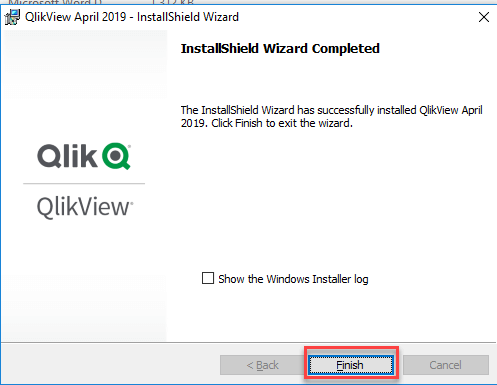
In the InstallShield wizard screen and Click on the finish button to complete the installation process.
Step 12) Open QlikView
Click on the QlikView 12 icon on your Windows desktop, and you will see this welcome screen.

Applications of QlikView
- Helps you to analyze revenue data based on various filters for a large multinational corporation.
- Allows you to create detailed visualization reports based on social media responses from customers all over the world.
- The QlikView tool allows you to make decisions by predicting cause and effect with diagrams that use historical data.
- QlikView allows you to analyze inventories, work orders, sales, and staffing utilization – all focused on improving performance.
- The tool allows you to analyze information on sales, production, shipping, and product performance.
- You will be able to easily and quickly create reports and analyses on a strategic, operational, and tactical level.
- Canon, Panasonic, Shell, FILA, and ING Lease are some well-known companies using QlikView for their businesses, as shown in the figure below.

QlikView vs. Tableau
The table below compares QlikView and Tableau across key parameters:
| Parameters | QlikView | Tableau |
|---|---|---|
| Support for Data Modeling | It supports powerful Data Modeling | Offers only basic data modeling through relationships and joins. |
| Speed of Implementation | Excellent | Good |
| Customization | Possible | Not possible |
| User-friendliness | Less user-friendly | More user-friendly |
| Price | Medium | High |
| Dashboard support | Excellent | Good |
| Database connectivity | Good | Offers Enhanced Database connectivity |
| Visual Controls | Very Good | Best |
| Understanding of Scripting | Basic SQL | R programming |
Also Check: Top Qlikview Interview Questions and Answers
QlikView vs Qlik Sense
Many learners confuse QlikView with Qlik Sense, the modern platform from the same company. Both share the associative engine but sit at very different points in their life cycles, as the comparison below shows:
| Parameters | QlikView | Qlik Sense |
|---|---|---|
| Launched | 1990s | 2014 |
| Primary approach | Developer-driven guided analytics built with scripts | Self-service analytics with drag-and-drop authoring |
| Layout | Fixed, pixel-perfect dashboards | Responsive design for any screen size |
| AI capabilities | None | Insight Advisor provides AI-generated charts and natural-language search |
| Deployment | Windows desktop and client-managed servers | Client-managed or SaaS via Qlik Cloud |
| Product status | Legacy; end of support announced | Actively developed |
For new projects, Qlik Sense is the clear choice; QlikView skills remain useful for maintaining and migrating legacy deployments.
Disadvantages of QlikView
Here are the major cons/drawbacks of using the QlikView tool:
- As QlikView needs to bulk-load all data into system RAM, reloading data creates a considerable workload and can take a large amount of time.
- It doesn’t offer any advanced ETL capabilities that are needed for more complex data integration.
- QlikView doesn’t offer some advanced capabilities required for developing highly formatted reports.
- QlikView is a specially designed tool for interactive analysis and not for report writing.
- If you want to create a formatted report in QlikView, you need to use macros and the duplication and maintenance of QlikView objects.
- It is just a simple reporting & analysis tool and does not allow WRITE BACK to the database.
- QlikView is now in legacy status: Qlik has announced its end of support and focuses new development on Qlik Sense.
What is the Future of QlikView?
Qlik has formally announced the end of support for client-managed QlikView, effective December 31, 2025. After this date, the product receives no updates, security patches, or technical assistance, although existing installations continue to run. New feature development stopped years earlier, as Qlik concentrates on Qlik Sense and Qlik Cloud Analytics.
For organizations, migration is now a priority rather than an option. Qlik offers an Analytics Modernization Program that converts QlikView licenses into Qlik Sense subscriptions and provides tooling to move existing documents. Most QlikView concepts, including load scripts, the associative model, and set analysis, transfer directly to the newer platform.
