
SAP Crystal Reports Tutorial
 Editorial Team
⚡ Smart Summary
SAP Crystal Reports is a business intelligence solution that creates analytical reports from SAP and non-SAP data sources. It supports Oracle, SQL Server, MySQL, Excel, and XML, enabling pixel-perfect reporting for accurate business decisions.
What is SAP Crystal Reports?
SAP Crystal Reports is a BI tool for generating analytical reports from SAP and other non-SAP data sources like Oracle, SQL Server, MySQL, XML Data Source, Microsoft Excel, and more. Knowledge of this tool helps businesses develop advanced reports and make accurate, profitable business decisions based on those reports.
In this SAP Crystal Reports tutorial for beginners, you will learn Crystal Reporting basics:
History of Crystal Reports
- Terry Cunningham and his peers created the software in 1991.
- In 1994, Crystal Services was acquired by Seagate Technology.
- Crystal Decisions software was acquired in December 2003 by BusinessObjects.
- In 2004, version 11 was released.
- SAP acquired BusinessObjects on October 8, 2007.
- Crystal Reports version 14.0 was released in 2011.
- Version 14.1 was released in 2013.
- Version 14.2 was released in 2016.


Components of Crystal Reports
Now in this section, you will learn about the main components of Crystal Reports.
The Report Design Canvas helps you design the structure of your report. You can include different elements such as charts, text, and data objects in the report.
Rules
The Rules option displays a rule above the report canvas. The tool also allows you to change the unit of measurement by changing the unit option on the design canvas tab.
Structure mode
Structure mode and Page mode help you define the layout of the reports. Each object in the structure mode is represented by a frame.
Important components of structure mode are given below:
Structure mode Components
| Component Name | Details |
|---|---|
| Report Header | Used for adding a report title at the top, or any other information you want to include at the start of the report. |
| Page Header | The page header presents information at the top of each page. The header section generally includes the document heading, chapter name, and similar details. |
| Page Footer | Used to present page numbers or any other information at the end of each page. |
| Body | This section displays the body of the report. All report data should be included in this section. |
| Page Mode | Page mode view represents the actual data in the report as it will appear when the report is published or printed. |
Data Sources
Crystal Reports helps you connect to multiple data sources, which include:
- HANA view
- Relational Connection
- SAP BEx Query
- Excel Spreadsheets
Step 1) Connect to the data source.
Go to File -> New -> From Data Source.
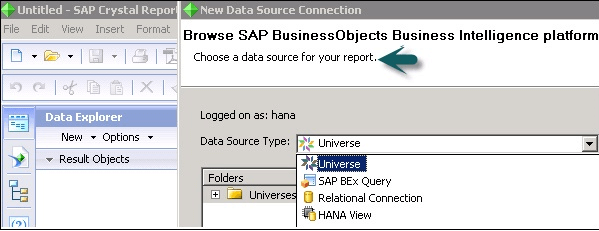
Step 2) Select the data source.
To select a data source, you must connect to the SAP Business Objects platform server.
Step 3) Check the Data Source Type list.
File -> New -> From Data Source -> Choose a data source connection dialog box appears -> Browse Repository -> Data Source Type list -> Select the data source you want to connect -> Next.
Features of Crystal Reports
Following are the features of SAP Crystal Reports:
- Allows you to interact with various data sources.
- Avoids the intervention of middle layers such as Universes.
- Easy interaction with SAP HANA.
- Powerful report design.
- Flexible application development.
- Report management and delivery.
- Administration via a web interface.
- Easy navigation system.
- Tracks information and keeps data organized.
- Live connection to external data.
- Multi-data source reporting.
- OLAP (pre-processed cube representation).
- ROLAP (SQL-layer querying).
Uses of Crystal Report
SAP Crystal Reports is used to extract custom analytical reports from various data sources. Crystal Reports also helps businesses create a database reporting environment to access data, format data, view data, and integrate reports with various applications so that the reports are available to all users in the organization.
Crystal Reports – GUI Navigation
Crystal Reports for enterprise offers an interface that allows you to create, format, and publish effective reports. The menu bar of Crystal Reports provides a wide range of features shown in the following image.
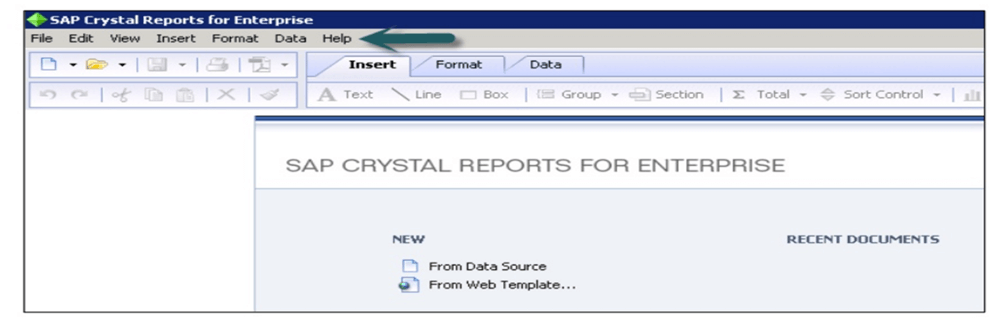
The Insert tab helps you insert an object into your report, such as text, lines, boxes, groups, sections, pictures, and charts.
The Format tab helps you use functions for formatting the selected file, such as changing the size or font, the background color, and alignment of text to center, left, or right.
Crystal Reports supports conditional formatting, such as highlighting values above or below a particular threshold in the report.
When you select a conditional formatting option at the top right corner, you can set the formatting box. In this box, you can give the condition under which the conditional formatting will appear.
What are the Benefits of Crystal Report?
Here are the benefits and advantages of using SAP Crystal Reports:
- Allows you to create highly pixel-perfect reports using SAP Crystal Reports through an easy design interface and efficient workflows.
- Helps you build personalized reports in your preferred language and format.
- You can connect to information sources directly, including native data, OLE DB, ODBC, and JDBC connectivity to relational databases, OLAP, web services, and more.
- Helps you export more data to a single worksheet without extending it to multiple sheets.
- Allows you to open interactive reports through your mobile devices.
- Helps you produce a report from virtually any data source.
- Allows you to analyze and interpret important information.
- Data connection procedures are straightforward.
- Helps you access trusted data.
- Allows you to navigate to the lowest level of data granularity.
- Helps you create a customized reporting view that you need for your business.
What are the Disadvantages of Crystal Reports?
Here are the drawbacks and cons of using SAP Crystal Reports:
- Crystal Reports is not very user-friendly for learning, as error decryption is tedious and hard to figure out.
- Using sub-reports embedded with main reports for different views of the same data sourced from different tables makes the entire process very slow.
- Security is a big concern at times while accessing data.
- A new version of Crystal Reports does not always work with older engines.
- Incorporating reports into webpages sometimes crashes the application.
- A stable internet connection is always needed for the software to function well.
- The company does not offer any free trial plan.
