
6 Best FREE Node.js Hosting (2026)
 Editorial Team
Disclosure: Guru99 is reader-supported. We may earn a commission when you buy through links on this page. Learn more

Node.js hosting can feel simple until poor uptime, slow builds, confusing dashboards, restricted ports, expired credits, and inconsistent runtime support disrupt a deployment. A missed environment variable can break production, while unclear limits waste debugging hours. Important details often sit inside technical documentation. The right host provides predictable releases, compatible runtimes, useful logs, and enough network control for the application. Clear comparisons remove guesswork, reduce rework, and help teams move forward with confidence.
I spent 48+ hours researching 15 hosting providers, checking official plans, runtime documentation, port rules, Git workflows, uptime commitments, and recurring user feedback. After focused evaluation, I shortlisted five Best FREE Node.js Hosting options. This evidence-based review covers interface findings, features, pros and cons, and current access conditions. Continue reading to find the deployment model that fits your application. Read more…

Best Free Node.js Hosting Server Providers: Cheap Options!
| Tool |
 DigitalOcean |
 Kamatera |
 Hosting.com |
| Storage | 2 GB | 1 GB | 80 GB |
| RAM | 512 MB | 20 GB | 500 MB |
| Deployment Location | Oregon, Virginia, Australia, and Japan. | North America, Europe and Asia. | North America, US, Canada, and Mexico |
| Free Tier/Refund | 30 Days | 30 Days | 60 days with a $200 credit |
| Link | Visit DigitalOcean | Visit Kamatera | Visit Hosting.com |
 Hostinger
2) DigitalOcean
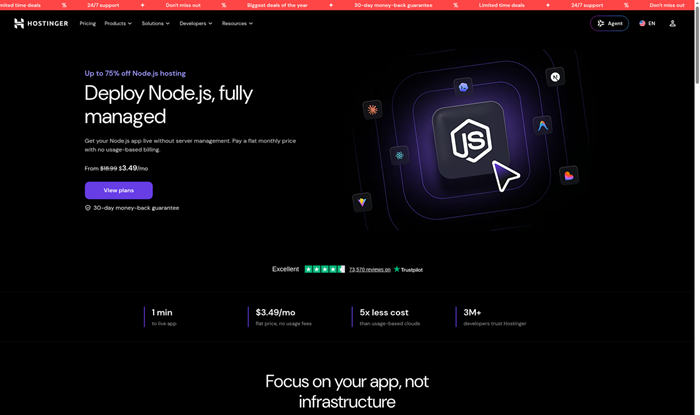
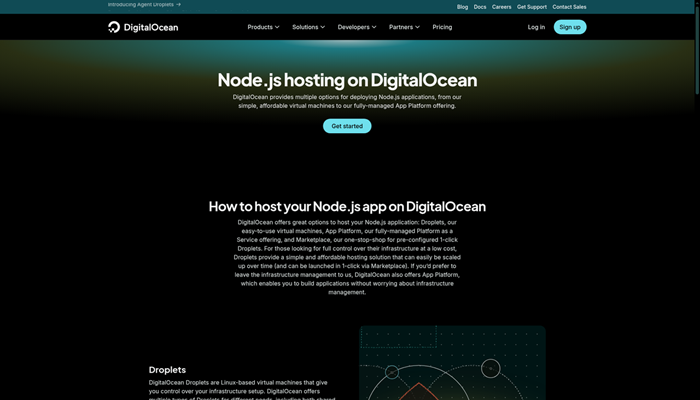
DigitalOcean offers two Node.js paths: managed App Platform and configurable Droplets. App Platform builds from Git repositories or containers, handles routing, and exposes logs. Droplets provide virtual machines for teams needing operating-system access, custom services, and network control. Both approaches connect with DigitalOcean databases and monitoring.
App configuration can pin Node through package.json engines. Applications must listen on the provided PORT value, while platform routing handles traffic. Droplets accept arbitrary internal ports and process managers. I found the documentation detailed, although choosing between PaaS convenience and infrastructure responsibility requires planning.
Features:
- App Platform: Build and run Node applications without maintaining the operating system. The service handles builds, deployment, routing, and scaling for supported components.
- Droplets: Provision Linux virtual machines with root access and flexible networking. Teams control packages, firewalls, process managers, and custom services.
- Git Sources: Deploy from GitHub or GitLab repositories and retain deployment history. Automatic releases can follow selected branches.
- Runtime Pinning: Declare a supported Node release in package.json. Explicit engines settings reduce surprises when the platform updates its default runtime.
- Managed Databases: Connect managed PostgreSQL, MySQL, MongoDB, Valkey, Kafka, and OpenSearch without running your own database servers.
- Scaling Controls: Adjust component sizes, instance counts, or autoscaling rules as traffic changes. Scaling settings can be managed without rebuilding the application.
- Logs: Inspect build, deployment, and runtime logs from the platform. Centralized output helps trace failures without creating a separate logging stack.
- Regional Deployment: Place resources in supported regions near users or connected services. Region choice affects latency, availability design, and data-location planning.
Pros
Cons
👉 How to Use DigitalOcean Credit
- Sign up for a new DigitalOcean account using the link on this page.
- Add an accepted payment method. Eligible new accounts receive a $5 promotional credit.
- Deploy test resources during the 90-day window. Charges beyond $5 or after expiration become payable.
Free static sites; $5 credit for 90 days
3) Kamatera
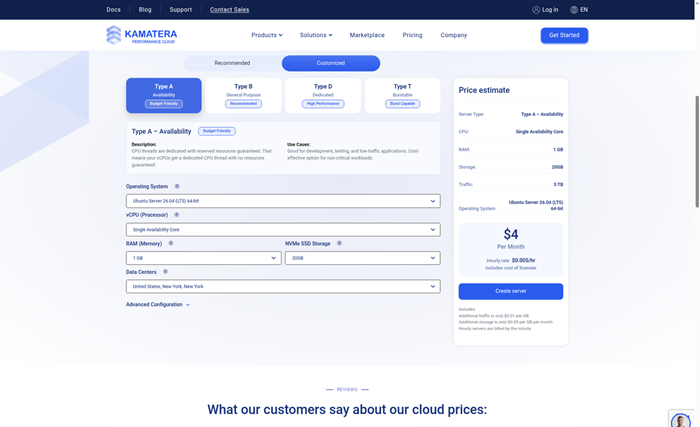
Kamatera supplies configurable cloud servers rather than a simplified platform. Users select processors, memory, storage, operating systems, networking, and locations. Root access supports Node, NVM, Git, databases, proxies, process managers, containers, and firewall policies. Resources can be resized as application demands change.
Teams seeking a VPS gain deployment freedom and predictable isolation. That freedom also places patching, backups, runtime upgrades, monitoring, and recovery on the customer. I appreciated the granular server builder, but beginners may need more guidance than managed PaaS products provide. Managed services are available separately.
Features:
- Server Builder: Select virtual processors, memory, storage, operating system, and region before deployment. The configurator shows how each choice affects cost.
- Root Access: Install Node releases, databases, proxies, containers, and administration tools without PaaS restrictions. Full control also increases maintenance responsibility.
- Firewall: Allow only the network traffic required by the application. Explicit rules reduce unnecessary exposure while preserving custom port control.
- Runtime Choice: Install and switch Node releases with NVM or another version manager. Teams can match production runtimes to local development.
- Elastic Resources: Resize compute, memory, or storage as workloads change. Capacity adjustments avoid rebuilding the entire server.
- Global Network: Choose among data centers across several regions. Regional placement can reduce latency and support data-residency requirements.
- API Access: Automate provisioning and infrastructure changes through documented APIs. Scripts can recreate servers consistently across environments.
- Managed Option: Add administration support when the team cannot maintain every server component. Service scope and responsibilities should be confirmed before purchase.
Pros
Cons
👉 How to Start the Kamatera Free Trial
- Register a new account and provide a valid payment card for verification.
- Activate the 30-day trial, then configure one eligible cloud server.
- Keep consumption within the stated $100 allowance and included transfer limits. Continued resources become billable after the trial.
30-day trial, up to $100
4) Hosting.com
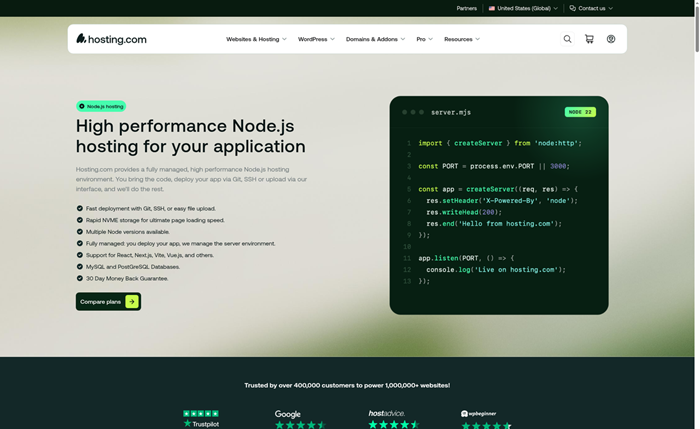
Hosting.com provides managed Node.js hosting for teams preferring control-panel administration. Applications can be deployed through Git, SSH, or file upload. The service includes SSL, database choices, monitoring, and selectable Node versions. Managed infrastructure reduces server work compared with an unmanaged virtual machine.
Configuration focuses on standard web applications rather than infrastructure experiments. Public custom-port behavior is not clearly documented, so buyers should confirm networking requirements before subscribing. I found the Git and SSH options useful for familiar workflows. Developers needing containers, system packages, or specialized daemons may prefer a VPS.
Features:
- Git Deployment: Pull application code from a Git repository and retain a traceable release workflow. This is safer than repeated manual file uploads.
- SSH Access: Run supported command-line tasks and inspect application files remotely. SSH helps with dependency checks, configuration, and troubleshooting.
- Node Selection: Choose from the Node versions available in the hosting panel. Matching the application runtime prevents avoidable compatibility failures.
- Database Options: Connect MySQL or PostgreSQL for persistent application data. Availability and resource limits depend on the selected hosting plan.
- Free SSL: Protect public traffic with an included SSL certificate. The managed certificate removes a separate purchase and basic renewal task.
- Resource Monitoring: Track hosting usage and identify applications nearing plan limits. Early warnings help teams plan upgrades before performance is affected.
- Managed Platform: The provider maintains the server environment while developers retain supported deployment access. This reduces routine operating-system work.
- Support Access: Contact technical support for platform, configuration, and account questions. Teams should confirm response targets for their selected plan.
Pros
Cons
👉 How to Test Hosting.com with the Refund Window
- Buy a Node.js hosting plan from Hosting.com’s Node.js hosting page.
- Deploy a representative application and verify its runtime, database, SSH, and Git requirements.
- Request cancellation within 30 days if unsuitable. Refund eligibility can exclude domains, add-ons, or other non-hosting charges.
30-day money-back guarantee
5) Heroku
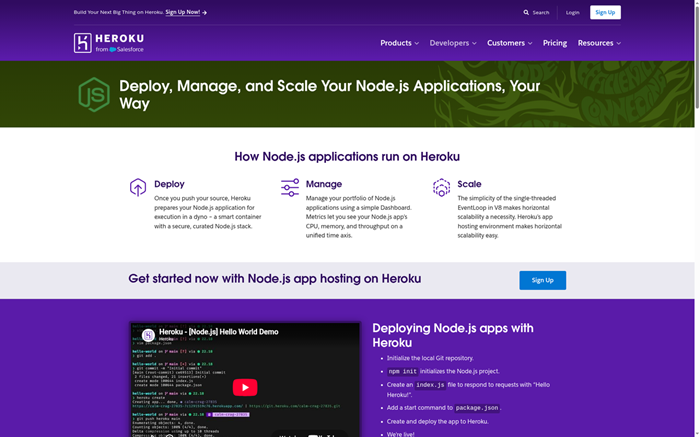
Heroku remains a recognizable platform for deploying Node.js applications from Git. Buildpacks detect dependencies, install the selected runtime, and create release artifacts. Dynos run processes, while pipelines, review apps, add-ons, logs, configuration variables, and managed routing support delivery workflows across development stages.
Deployment stays simple when applications follow Heroku conventions, including binding to the assigned PORT variable. Public traffic is routed through web endpoints rather than arbitrary ports. Node versions are pinned through package.json. I valued the mature workflow, although free dynos ended in 2022. The $5 Eco plan sleeps after 30 minutes without web traffic, so an always-on application needs Basic at $7 monthly or a higher tier.
Features:
- Buildpacks: Detect dependencies and prepare releases through standardized builds. Build logs show installed packages, runtime selection, and failed steps.
- Dynos: Run web, worker, and scheduled processes as separate components. Process types can scale independently according to workload.
- Git Deployment: Release code through Heroku Git or connected GitHub workflows. Each deployment retains a release record for troubleshooting and rollback.
- Pipelines: Promote builds across review, staging, and production environments. The same artifact can move forward without rebuilding.
- Review Apps: Create temporary environments for supported pull requests. Reviewers can test proposed changes before they reach shared staging or production.
- Runtime Pinning: Declare the Node version in package.json engines. Pinning a supported major release avoids unexpected changes to the default runtime.
- Add-ons: Attach databases, monitoring, caching, messaging, and other marketplace services. Each add-on has separate limits, pricing, and support terms.
- Config Variables: Store environment-specific settings and secrets outside the repository. Changes can be applied without committing sensitive values to Git.
Pros
Cons
👉 How to Start with Heroku's Lowest-Cost Plan
- Create a Heroku account and prepare a Node application with a valid start command.
- Connect GitHub or push through Heroku Git, then configure required environment variables.
- Subscribe to Eco for $5 monthly and 1,000 shared dyno hours. Eco web dynos sleep after 30 minutes without traffic.
No free plan. Eco costs $5 monthly
6) Upsun
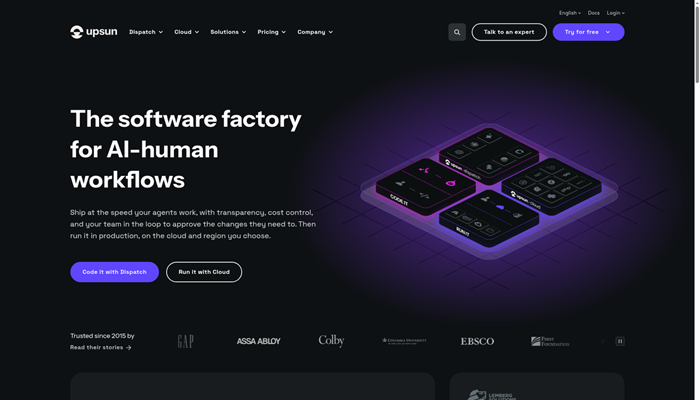
Upsun, formerly Platform.sh, centers deployment around Git branches and reproducible environments. YAML configuration defines the Node runtime, build commands, services, routes, storage, and environment variables. Each branch or pull request can create an isolated preview environment, helping teams test application and infrastructure changes before production.
Applications listen on platform-provided network configuration while managed routing exposes public endpoints. Native Git plus GitHub, GitLab, and Bitbucket integrations support existing workflows. The model works well for teams managing several services, although its configuration files and platform concepts take longer to learn than basic control-panel hosting.
Features:
- Git Environments: Create isolated environments from branches and pull requests. Each environment can include application code, services, routes, and configuration.
- YAML Configuration: Define runtimes, builds, routes, storage, and service relationships as code. Versioned configuration makes infrastructure changes reviewable.
- Runtime Pinning: Select a supported Node runtime in the application configuration file. The declared value keeps environments aligned across branches.
- Managed Services: Attach databases, caches, search, and messaging components through project configuration. Services are reproduced within preview environments.
- Preview Workflows: Test application and infrastructure changes before merging production branches. Preview URLs make stakeholder review easier.
- Repository Links: Connect GitHub, GitLab, or Bitbucket and map branches to environments. Pushes and pull requests can trigger automated builds.
- Observability: Review logs, infrastructure metrics, and profiling data from the platform. Available history and advanced tools depend on the paid configuration.
- Scaling Options: Adjust application resources vertically or horizontally as demand changes. Upsun bills provisioned resources and supports additional uptime options.
Pros
Cons
👉 How to Start the Upsun Free Trial
- Create an Upsun account and start the 15-day free trial without entering a payment card.
- Connect a repository and define the Node runtime, routes, and required services.
- Evaluate the deployment for 15 days. Then continue with usage-based billing or export the application before trial access ends.
15-day free trial. No card required
Comparison Between Top Node.js Hosting Platforms
| Name | Always-On Node Process | Custom Port Option | Runtime Version Control | Git-Based Deployment | Published Uptime SLA | Free Trial or Credit |
|---|---|---|---|---|---|---|
| DigitalOcean | ✅ | ✅ | ✅ | ✅ | ✅ | ✅ |
| Kamatera | ✅ | ✅ | ✅ | ✅ | ✅ | ✅ |
| Hosting.com | ✅ | ❌ | ✅ | ✅ | ✅ | ✅ |
| Heroku | ❌ | ❌ | ✅ | ✅ | ❌ | ❌ |
What Is Node.js Hosting?
Node.js hosting provides an environment for running server-side JavaScript applications. Unlike static hosting, it maintains application processes that answer requests and perform background work. A provider supplies compute, memory, storage, networking, logs, and deployment controls. Managed platforms handle much of the operating system and routing. Virtual private servers give developers deeper control but require administration. The right model depends on application architecture, traffic, databases, worker processes, and team skills. Free access usually means credits, trials, limited capacity, or refund windows rather than permanent production service.
How Does Node.js Hosting Work?
A provider installs or builds the application with its declared dependencies. The platform then starts a command defined in package.json, a process file, or hosting configuration. A Node process listens for requests on an assigned network port. Managed routers connect public web traffic to that process. Environment variables store secrets and deployment settings outside source code. Logs reveal build failures and runtime errors. Some platforms restart failed processes automatically. VPS customers configure reverse proxies, firewalls, certificates, monitoring, and process managers themselves.
What Is the Difference Between VPS and PaaS Node.js Hosting?
A VPS gives root access to a virtual machine. Developers choose packages, ports, databases, security controls, and process managers. This flexibility suits custom services, WebSockets, workers, or specialized dependencies. A platform as a service builds and runs code through provider conventions. It manages operating systems, routing, certificates, and many recovery tasks. PaaS reduces administration but restricts networking and system changes. Teams should choose based on required control, available operations skills, compliance needs, expected maintenance responsibility, recovery objectives, and internal policies.
What Features Should Free Node.js Hosting Include?
A useful evaluation should cover the complete path from code to recovery.
- Runtime control: Confirm supported Node releases and a reliable method for pinning versions.
- Deployment workflow: Check Git connections, build logs, rollbacks, and environment-variable management.
- Network behavior: Verify assigned ports, public routing, WebSockets, workers, and connection limits.
- Operational visibility: Look for logs, metrics, alerts, backups, and documented recovery procedures.
- Access conditions: Separate permanent free plans from credits, trials, and refund guarantees.
These checks reveal whether a free offer can test the intended application realistically.
How Should a Node.js App Handle Custom Ports?
Managed platforms commonly inject a PORT environment variable for the application process. Code should read that value instead of hardcoding port 3000. The provider then maps public HTTP and HTTPS traffic to the internal listener. Arbitrary public ports may remain unavailable. A VPS works differently because administrators configure firewalls, reverse proxies, and exposed services directly. Before choosing a host, identify every protocol and port the application requires. Confirm WebSocket, TCP, UDP, and private-service behavior through current documentation or a controlled deployment.
How Do You Manage Node.js Runtime Versions Safely?
Pin a supported Node.js version rather than accepting changing defaults. Managed platforms may read the package.json engines field or a hosting configuration file. VPS deployments can install NVM and select a release explicitly. Prefer active LTS versions unless application dependencies require another supported release. Test upgrades in staging before production. Review build logs for deprecated packages and engine warnings. Keep lockfiles committed so dependency resolution stays repeatable. Document the selected runtime, package manager, start command, and rollback procedure for every environment.
How Does Git-Based Deployment Work for Node.js Hosting?
A Git-based deployment connects a repository or receives a pushed commit. The provider checks out the selected revision, installs dependencies, runs build commands, and starts the declared process. Connected repositories can trigger deployment after merges. Review environments may build pull requests before production changes. Teams should protect deployment branches and store secrets outside Git. Confirm whether the platform supports rollback to a previous release. Build logs, commit identifiers, and deployment history make failures easier to trace than manual file uploads.
Which Node.js Hosting Supports WebSockets and Background Workers?
Support depends on the deployment model and plan. A VPS normally permits WebSockets, queue consumers, schedulers, and permanent worker processes after correct firewall configuration. Managed platforms may support them through dedicated process types or application components. Entry-level managed hosting can restrict inbound WebSockets, custom services, or multiple persistent processes. Verify connection duration, idle timeouts, scaling behavior, and worker pricing. A successful HTTP demo does not prove a chat server, job queue, or event consumer will operate correctly under production conditions.
What Do Uptime Guarantees and Network SLAs Actually Cover?
An uptime guarantee states a contractual availability target and possible service credits. It does not prove that a specific application achieved the same result. Terms may exclude maintenance, customer configuration, attacks, upstream failures, or unsupported software. Network and compute components can also carry different SLAs. Read the measurement period, qualifying outage definition, claim deadline, and credit cap. Independent monitoring should check application health from several locations. Credits rarely compensate for lost revenue, so architecture, backups, recovery, and incident communication still matter.
Can AI Improve Node.js Hosting Operations?
AI assistants can explain logs, draft infrastructure files, suggest health checks, and identify common configuration mistakes. They can also summarize alerts or prepare deployment runbooks. These benefits depend on accurate context and controlled access. An assistant may recommend unsupported runtimes, unsafe permissions, or invented platform settings. Engineers should verify every AI-generated configuration against current vendor documentation. Keep secrets, customer data, and production credentials outside prompts unless approved controls exist. Automated changes need review, testing, audit records, and a reliable rollback path.
Can AI Replace Manual Server Administration?
AI can reduce repetitive analysis, but it cannot own production accountability. Server administration includes patching, access control, backups, capacity planning, incident response, and recovery testing. These decisions require current system context and business priorities. AI may draft commands or highlight suspicious logs, yet administrators must validate consequences before execution. Managed hosting removes more routine work than an assistant can. Teams should require human approval for security changes, data deletion, firewall rules, customer-facing releases, and restoration tests before applying them to production systems.
How Do We Select the Best FREE Node.js Hosting?
Guru99 spent 48+ hours evaluating 15 hosting providers. We checked access terms, Node runtimes, port rules, Git workflows, uptime commitments, documentation, support, and recurring developer feedback before selecting five options.
- Access and Value: We distinguished permanent free resources from temporary credits, trials, and money-back guarantees. Each offer was checked for duration, eligibility, billing requirements, and meaningful limitations. We also noted renewal conditions and excluded fees.
- Runtime Compatibility: Our team reviewed supported Node releases, version-pinning methods, package installation, build commands, environment variables, and start-process conventions across managed and self-administered hosting. Compatibility warnings and upgrade paths were documented separately.
- Networking: The researchers examined assigned ports, custom-port control, public routing, SSL, WebSockets, firewall configuration, background workers, connection limits, and other architecture-sensitive restrictions. Plans with unclear behavior received more cautious conclusions.
- Deployment Workflow: The team checked repository connections, Git pushes, build output, deployment histories, preview environments, rollback paths, and repeatability across development and production stages. Manual uploads were compared with repeatable repository releases.
- Reliability Terms: Our reviewers compared published uptime guarantees and network SLAs without presenting contractual targets as independently measured results. Exclusions, component differences, and customer responsibilities remained part of the review. Credit rules and claim windows were recorded when available.
- Operational Control: Our experts considered logs, metrics, scaling, backups, databases, root access, process management, regional choices, and the amount of server maintenance placed on customers. Responsibility boundaries influenced each recommendation and ranking.
- User Experience: The experts reviewed setup clarity, dashboard evidence, documentation depth, support routes, and recurring feedback patterns. Isolated complaints were not treated as universal outcomes. Patterns mattered only when several reviewers reported them.
How Do You Troubleshoot Common Node.js Hosting Problems?
Start with deployment logs, runtime settings, environment variables, and network rules. Then reproduce the problem using the smallest representative application. Check the active release identifier before changing multiple settings at once.
- Issue: The application starts locally but fails because the host assigns another network port.
Solution: The developer should read the provided PORT variable and avoid hardcoded listeners before redeploying the application. - Issue: Build logs report an unsupported Node release or incompatible dependency engine requirement.
Solution: The team should pin a supported runtime, refresh the lockfile, and rebuild within a clean environment. - Issue: A deployment succeeds, but required secrets remain missing from the running process.
Solution: The administrator should add environment variables through protected settings and restart every affected application component. - Issue: WebSocket connections close because the selected plan restricts protocols or idle duration.
Solution: The buyer should verify protocol support and timeout limits, then select compatible managed components or VPS hosting. - Issue: Background jobs stop whenever an entry-level instance sleeps after inactive web traffic.
Solution: The operator should choose an always-on worker process and configure queue retries with idempotent job handling. - Issue: Git deployment serves older code after the expected repository commit was merged.
Solution: The team should confirm branch selection, deployment history, build cache behavior, and the running release identifier.
Verdict
I compared deployment control, runtime handling, network rules, and access conditions across the shortlist. Three providers offered the clearest paths for different Node.js workloads.
- DigitalOcean: Its App Platform and Droplets gave me the strongest balance between managed deployment and infrastructure flexibility.
- Kamatera: I valued its granular server builder, root access, regional choices, and meaningful 30-day trial allowance.
- Hosting.com: I found its managed Git, SSH, and Node version options a practical fit for teams wanting less server maintenance.
