
How to Perform Dunning in SAP F150
 Editorial Team
⚡ Smart Summary
Dunning in SAP is the automated process of reminding customers about overdue open items, using transaction F150 to select accounts, assign dunning levels, generate a dunning proposal, and print or email the resulting dunning notices.

Dunning in SAP automates the reminder letters a business sends when customers let invoices run overdue. The dunning program (transaction F150) reads the open items, decides which accounts to remind, assigns a dunning level, and produces the dunning notices. This guide explains how dunning works, the configuration it depends on, and a step-by-step F150 dunning run.
What Is Dunning in SAP?
Dunning is the process of corresponding with customers or vendors about pending bills, which SAP records as open items. In SAP you can schedule the dunning process and maintain different dunning levels for each dunning run, so the tone of the reminder escalates the longer an item stays unpaid. It is mainly part of accounts receivable, but a vendor with a debit balance can be dunned too.
A dunning run moves through the following steps:
- Enter the parameters for the dunning program. The parameters of an old dunning run can be copied and the dates adjusted.
- The dunning run selects the accounts, examines them for overdue items, checks whether they have to be dunned, and assigns dunning levels to them. All dunning data is stored in a dunning proposal.
- The dunning proposal can be edited, deleted, and recreated as often as necessary until the dunning clerk is satisfied with the result.
- If desired, this step can be skipped, and the dunning run can be followed directly by the printout of dunning notices.
- In one click, the dunning notices are printed and the dunning data is updated in the master records and associated documents.
Dunning Configuration and Prerequisites (FBMP)
Before the first F150 run, the dunning basics have to be configured, otherwise the run finds nothing to process. Three settings matter most: the dunning procedure, the dunning levels, and (optionally) the dunning area.
- Dunning procedure (FBMP) — transaction FBMP maintains the dunning procedure, which defines the dunning interval in days, the number of dunning levels (a maximum of nine), the minimum overdue amounts, and the notice forms.
- Dunning area (OB61) — an optional organizational unit that lets you dun items separately, for example by region or division, within one company code.
- Master data assignment — the dunning procedure is entered in the customer or vendor master record. Accounts without a procedure are skipped, so this is set when you create the vendor master data or maintain the customer.
Because dunning acts on overdue receivables, it works alongside customer credit control: credit management limits exposure up front, while dunning chases what is already overdue.
Procedure for Dunning in SAP (F150)
The steps below run a complete dunning run as a background scheduled job. Each screen in the F150 transaction is shown in order.
Step 1) Perform a complete dunning run as a background scheduled job by entering the transaction code F150 in the SAP command field, as shown below.

Step 2) On the next screen, enter the dunning run date and the dunning run identification, which together name this run.

Step 3) On the Parameters tab, enter the run details that tell SAP which items to select:
- The dunning date that prints on the notice
- The date up to which documents are considered for dunning
- The company code for dunning
- The customers and vendors to be dunned
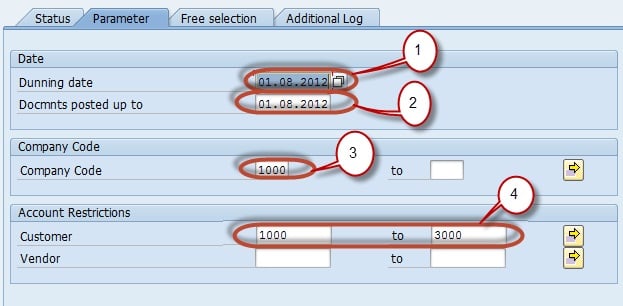
Step 4) Save the dunning parameters so the run can use them.

Step 5) Schedule the dunning run by pressing the Schedule button.

Step 6) On the next screen, select the printer that will print the dunning notices generated by the run.

Step 7) On the next screen, schedule the start time of the dunning run.
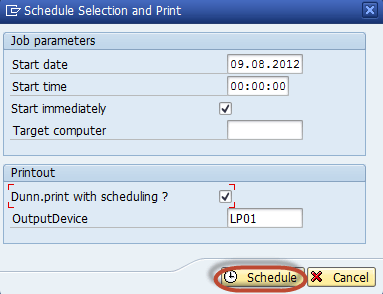
Step 8) Check the status of the dunning run to confirm that it has finished.

Step 9) Check the dunning notice in the spool requests, where the generated output is stored for printing.
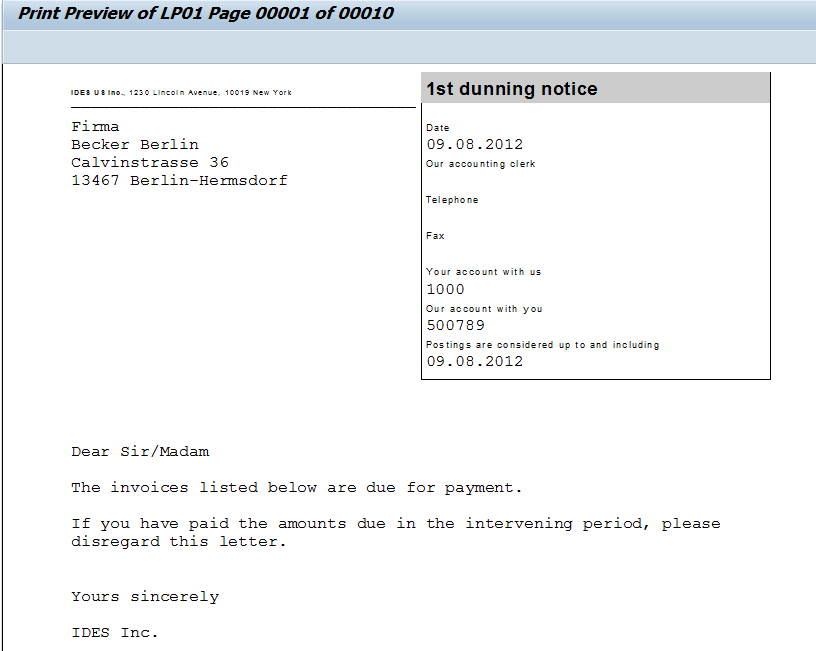
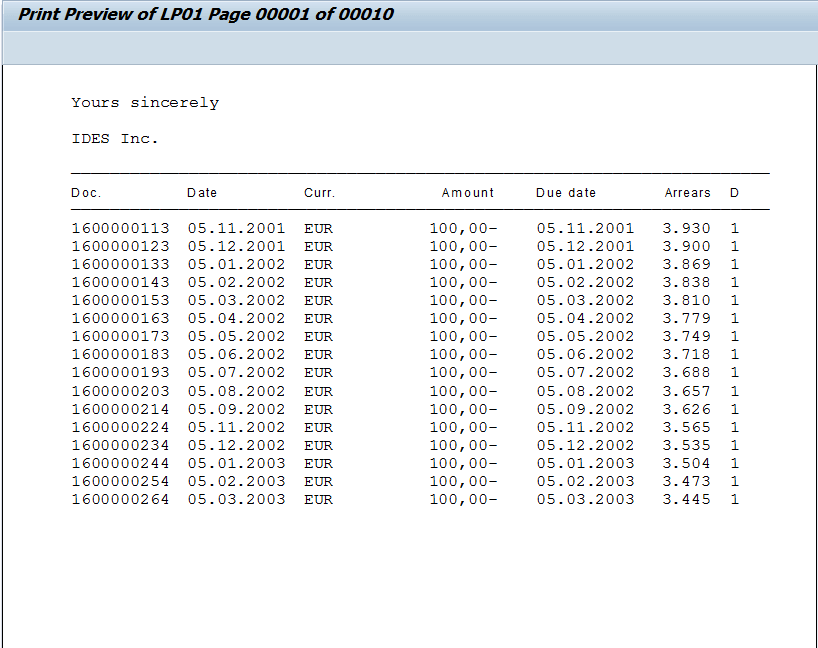
Opening the spool request shows the finished dunning notice, listing the overdue open items and the dunning level applied to the account.

Understanding Dunning Levels and Dunning Notices
Dunning levels are what make the process escalate. Each level corresponds to a stage of overdue debt, and with each level the reminder becomes firmer and can add dunning charges or interest.
| Dunning level | Typical tone | Common content |
|---|---|---|
| Level 1 | Polite reminder | A courteous note that the invoice is overdue |
| Level 2 | Firm reminder | A stronger request, often with dunning charges or interest |
| Level 3 | Urgent notice | A final demand before escalation |
| Level 4+ | Final / legal | Warning of legal action or handover to collections (up to level 9) |
The dunning level reached by each item is written back to the customer or vendor master record and the document, so the next run knows to move an item to the following level once the interval has passed. The dunning data itself is stored in FI tables such as the vendor dunning table LFB5, described in the important FI tables reference.
Dunning in SAP S/4HANA and Common Errors
Transaction F150 still runs dunning in SAP S/4HANA, and the classic configuration in FBMP remains valid. SAP S/4HANA Cloud adds Fiori apps such as Manage Dunning Notices and Schedule Accounts Receivable Jobs, which schedule and monitor the run without the classic dialog, but the underlying selection logic is the same.
A best practice on any release is to start the dunning run after the payment run, so items that were just paid are already cleared and customers are not dunned for invoices they have settled. Common issues that stop a run include:
- List contains no data — no items are overdue for the selection, the dunning procedure is missing from the master record, or the minimum amount was not reached.
- Dunning block — a block set on the master record or a line item deliberately excludes those items, often during a dispute.
- Wrong dates — the dunning date or the document consideration date excludes the items you expected to see.
