
How to Create One Time Vendor FK01 in SAP
 Editorial Team
⚡ Smart Summary
One-time vendor master records in SAP serve suppliers who are invoiced only occasionally. A single collective account carries the accounting settings, and the name, address and bank details are captured on each document instead.

Not every supplier deserves a master record. In SAP, a supplier that is invoiced once or twice a year can be posted through a shared one-time account, and the details that make the payment traceable are captured on the document itself.
What Is a One-Time Vendor in SAP?
A one-time vendor is a collective master record used for suppliers who have no frequent transactions and do not justify a record of their own. Because the same record serves many different suppliers, no vendor-specific data is stored in it. The name, address, telephone number and bank details are entered when the document is posted.
The record still behaves like an ordinary vendor account in every other respect. It belongs to a company code, it carries a reconciliation account, and its open items appear in the usual accounts payable reports.
| Aspect | Regular vendor | One-time vendor |
|---|---|---|
| Master records needed | One per supplier | One collective account for many suppliers |
| Name and address | Stored in the master record | Entered on each document |
| Bank details | Stored in the master record | Entered on each document |
| Best suited to | Recurring suppliers, contracts, scheduled payments | Occasional purchases, expense refunds, single deliveries |
| Reporting by supplier | Straightforward, by vendor number | Requires reading the address data on the documents |
The trade-off is convenience against visibility. Fewer master records mean less maintenance, but spend analysis by supplier becomes harder, because every posting sits under the same account number.
The One-Time Vendor Account Group and Its Indicator
A one-time vendor cannot be created from an ordinary account group. The behaviour comes from a single customizing setting, so the account group has to exist before transaction FK01 is started.
In the vendor account group definition, reached with transaction OBD3, a one-time account indicator is set for the group. The indicator does two things: it suppresses the vendor-specific fields on the master data screens, and it tells the posting transactions to ask for those details on the document instead. The setting is stored on each vendor record in field XCPDK of table LFA1.
SAP delivers ready-made groups for this purpose, and most systems use one of them rather than defining a new one.
- CPD: One-time vendor group with internal number assignment, so the system issues the account number.
- CPDL: One-time vendor group with external number assignment, so the number is typed in.
- 0099: The one-time vendors group used in the walkthrough below, shown with its indicator ticked in the account group list.
Two more prerequisites are worth checking before starting. The number range assigned to the group decides whether the vendor number can be typed in at all, and the reconciliation account that will be entered later has to exist in the chart of accounts of the company code being used.
How to Create a One-Time Vendor in SAP Using FK01
With the account group in place, the record is created in the accounts payable master data transaction.
Step 1) Enter transaction code FK01 in the SAP command field, as shown below.
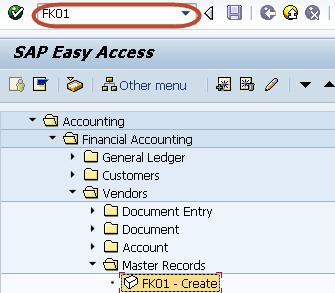
Step 2) On the Create Vendor: Initial Screen, place the cursor in the Account group field and press F4 to open the search help, highlighted below.

Step 3) In the dialog box that opens, select the account group whose one-time account property is ticked. In the list below, the OTA column marks the one-time groups, and group 0099 “One-time vendors” is the one being selected.

Step 4) Back on the initial screen, enter the following, as marked below.
- Enter the vendor ID according to the number range assigned to the account group.
- Enter the company code in which the master record is to be created.

Step 5) On the next screen, Create Vendor: Address, enter the following in the general data, as marked below.
- Enter a name that identifies the collective record, for example “One time Vendor New”.
- Enter a search term so the account can be found quickly during posting.
- Enter the communication language.
The street and postal fields stay empty here on purpose, because they belong to the individual supplier rather than to the collective account.

Step 6) On the company code data screen, Create Vendor: Accounting information Accounting, enter the following, as marked below.
- Enter the reconciliation G/L account number, which links the vendor postings to the general ledger.
- Enter the cash management group used for liquidity forecasting.

Step 7) Press ‘Save’ on the standard toolbar, shown below, to create the new one-time vendor master record.

Step 8) Check the status bar for the confirmation message. The example below reports that vendor 0000088888 was created in company code 1000.

The account is now ready for use, and the supplier details are supplied the first time it is posted to.
How to Post an Invoice to a One-Time Vendor
Nothing special happens until the collective account is used. Entering it as the vendor on a vendor invoice in FB60, or on F-43, makes the system open an extra address screen before the line items can be completed.
The screen asks for the details that were deliberately left out of the master record.
- Name and address: Title, name, street, postal code, city and country of the actual supplier.
- Communication: Telephone and other contact fields, where they are relevant.
- Bank details: Country, bank key and account number, which the payment program then uses.
- Tax numbers: The tax identification fields, where local reporting requires them.
These entries are stored per document in table BSEC, the one-time account data segment, rather than in the vendor master tables. That is what makes the same account usable for many suppliers, and it is also the reason a supplier-level report cannot simply read LFA1. The address has to be taken from the document, and the outgoing payment picks up the bank data the same way.
Two consequences follow. Duplicate payments are harder to spot, because two invoices from the same supplier carry two independent address entries, and any control that relies on vendor master data — a bank detail change check, for instance — does not apply. Many finance teams therefore restrict one-time accounts to low-value postings and review them separately during the period-end reporting cycle.
In SAP S/4HANA the one-time account survives, but it is created as a business partner. A dedicated business partner grouping is mapped to the one-time vendor account group in Customer/Vendor Integration customizing, the record is maintained with transaction BP in the supplier role, and the document-level address screen behaves exactly as it does in SAP ERP. The equivalent object on the customer side works the same way in accounts receivable.
