
How to Post Foreign Currency Invoice in SAP FB70
 Editorial Team
⚡ Smart Summary
Foreign Currency Invoice posting in SAP FI lets finance teams record customer billings in any document currency, convert balances to the company code currency using the live exchange rate, and capture revenue accurately for cross-border operations.
What Is a Foreign Currency Invoice in SAP?
A foreign currency invoice in SAP FI is a customer billing document recorded in a currency that differs from the company code’s local currency. SAP automatically translates the foreign-currency amount into the local currency using the exchange rate stored in table TCURR (maintained through transaction OB08). Exchange rate type M (Standard Translation) is the default rate type used for FB70 invoice postings.
The transaction stores both the document currency value and the converted local-currency value, allowing the General Ledger to remain balanced in the leading ledger while preserving the customer’s contractual currency on the open item.
Why Post Customer Invoices in Foreign Currency
Organizations that trade across borders must invoice customers in the currency stipulated in their contracts. Posting in foreign currency through FB70 ensures revenue recognition aligns with the export sale, supports accurate accounts receivable aging in the customer’s currency, and feeds correct data into foreign currency valuation runs (FAGL_FC_VAL) at period close.
Using a single transaction for invoicing also keeps tax determination, withholding settings, and customer master defaults consistent with the standard domestic posting workflow.
Prerequisites Before Using FB70
Before posting a foreign currency invoice, confirm the following configuration items are in place:
- Customer master record exists with the correct reconciliation account.
- Document type DR (Customer Invoice) is active for the company code.
- Exchange rate type M is maintained in OB08 for the currency pair on the document date.
- Tax code and revenue G/L account are configured for the company code.
- Posting period is open in transaction OB52.
Steps to Post Foreign Currency Invoice in SAP FB70
Follow the sequence below to record a customer invoice in a foreign document currency. Each step mirrors the SAP Easy Access menu path Accounting → Financial Accounting → Accounts Receivable → Document Entry → Invoice (FB70).
Step 1) Enter Transaction Code FB70
Enter Transaction code FB70 in the SAP Command Field and press Enter to open the Customer Invoice entry screen.

Step 2) Enter Customer Invoice Header and Item Data
In the next screen, enter the following data in the header and item areas:
- Enter Customer ID of the customer whom the invoice is to be posted.
- Enter Invoice Date.
- Enter Document Type as Customer Invoice (DR).
- Enter the Currency in which the invoice is to be posted (Document Currency).
- Enter Invoice Amount.
- Enter Tax Code applicable to the invoice.
- Enter the Sales Revenue G/L Account to be credited.
- Enter the Credit Amount.

Step 3) Adjust the Exchange Rate
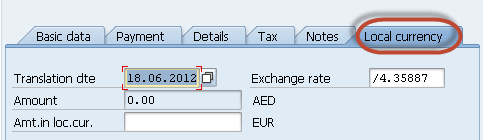
Switch to the Local Currency tab. SAP defaults the exchange rate from table TCURR (maintained via OB08) for exchange rate type M on the document date. Overwrite the value if the contract specifies a fixed rate.
Step 4) Save the Document
After maintaining the Exchange Rate, press Save (Ctrl+S) to post the document. SAP performs the currency translation, validates tax determination, and writes the entry into table BKPF and BSEG.

Step 5) Verify the Document Number
Check the status bar at the bottom of the SAP GUI for the document number generated. Use transaction FB03 to display the posted invoice and confirm both the document currency and local currency lines were created correctly.

Exchange Rate Maintenance with OB08
Transaction OB08 is the central point for maintaining exchange rates in SAP. The most common exchange rate types are:
- M (Standard Translation) — used by default for document postings such as FB70.
- B (Bank Selling Rate) — used for outgoing payments in foreign currency.
- G (Bank Buying Rate) — used for incoming payments in foreign currency.
Ensure rate type M is current; otherwise SAP may issue warning message F5806 (Exchange rate has not been maintained) when you press Enter on the FB70 screen.
Foreign Currency Valuation at Period End
Open items posted through FB70 in a foreign currency are revalued at period close using transaction FAGL_FC_VAL. The valuation program reads the current rate from OB08, calculates unrealized gain or loss, and posts an adjustment to a P&L account configured in transaction OBA1. The original document remains untouched in the document currency, preserving audit history while the local-currency view stays accurate.
Common Errors and Troubleshooting
- F5806: Exchange rate has not been maintained — add the missing pair in OB08.
- F5808: Customer not assigned to company code — extend the customer master in XD01.
- FF707: Tax code not defined — configure the tax code in FTXP.
- F5005: Posting period is not open — adjust period variant through OB52.
Best Practices for Foreign Currency Invoice Posting
- Refresh OB08 daily through an automated job (program RFTBFF00) to keep exchange rates current.
- Document the contractual rate in the invoice header text when overriding the default.
- Run FAGL_FC_VAL in test mode before the final month-end posting to preview gains and losses.
- Reconcile receivables in transaction code FBL5N grouped by currency for clearer visibility.
- Use SAP S/4HANA Universal Journal (table ACDOCA) to drill from the local currency line to the document currency value in real time.
