
How to Create Customer Sales Invoice FB70 in SAP FICO
 Editorial Team
⚡ Smart Summary
Posting Sales Invoice in SAP FI uses transaction code FB70 to record customer billing inside the Financial Accounting module, debit the customer account, credit revenue, and apply tax codes for accurate accounts receivable postings.
What is a Customer Sales Invoice in SAP FI?
A customer sales invoice in SAP FI is the financial document that records a sale to a customer, debits the customer account in the accounts receivable subledger, and credits the corresponding revenue G/L account. Transaction code FB70 is the dedicated SAP FI entry point for posting these invoices directly in Financial Accounting, without routing through the Sales and Distribution (SD) module.
This direct posting path is common for service charges, miscellaneous billings, and adjustments where a full sales order flow is not required. The posting updates the general ledger in real time and keeps the customer balance accurate for dunning, payment, and reporting.
Why Use FB70 for Customer Invoices?
FB70 is preferred when finance users need a quick, document-balanced posting without the overhead of an SD billing document. It is widely used for ad-hoc receivables entries, internal cost recoveries, and one-off customer charges that do not originate from a sales order.
With FB70, the user controls header data such as company code, customer ID, invoice date, amount, and tax code, then balances the entry with one or more revenue line items. The transaction enforces double-entry rules so the customer debit equals the revenue credit plus any tax amount.
Prerequisites Before Posting in FB70
Before opening FB70, confirm that the customer master record is created in the relevant company code, the revenue G/L accounts are open for posting, and the tax codes are configured for the country and jurisdiction of the sale. Posting periods must also be open in transaction OB52, and the document type for customer invoices (typically DR) should be available.
Steps to Create Customer Sales Invoice in FB70
The following steps walk through creating and posting a customer sales invoice using transaction FB70 in SAP FI. Each step maps to the standard FB70 screen layout.
Step 1) Enter transaction FB70 in the SAP Command Field.

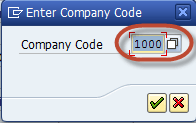
Step 2) In the next screen, enter the Company Code you want to post the invoice to.
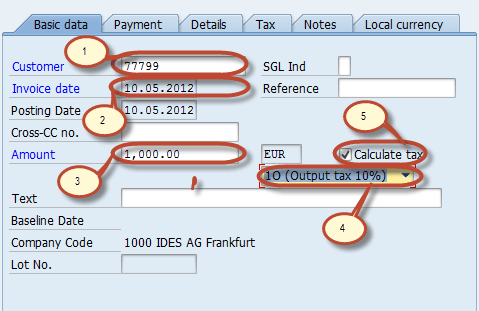
Step 3) In the next screen, enter the following header details:
- Enter the Customer ID of the customer to be invoiced.
- Enter the Invoice Date.
- Enter the Amount for the invoice.
- Select the Tax Code for the applicable tax.
- Select the Tax Indicator “Calculate Tax”.
Step 4) Check the Payment Terms on the Payment tab page to ensure correct due date and discount calculation.

Step 5) In the Item Details section, enter the following:
- Enter the Sales Revenue Account (G/L).
- Select Credit as the posting key.
- Enter the Amount for the invoice line.
- Check the Tax Code matches the header.

Step 6) After completing the entries above, check the status of the document. A green traffic light confirms the debit and credit are balanced and the document is ready to post.

Step 7) Press the Post button in the standard toolbar  and wait for the document number to be generated and displayed on the status bar for confirmation.

Verify the Posted Customer Invoice
After posting, the generated document number can be viewed using transaction FB03 (Display Document) or FBL5N (Customer Line Items) to confirm the open receivable on the customer account. The revenue G/L line can be reviewed in FAGLL03 to verify the credit posting in the general ledger.
If the document was created in error, it can be reversed using transaction FB08 with the appropriate reversal reason. Reversal creates a new document that offsets the original posting and clears the open item on the customer account once both entries are matched.
