
How To Create a Vendor Account Group in SAP FICO
 Editorial Team
⚡ Smart Summary
Vendor account groups in SAP control the number range a vendor number is drawn from and the field status of every vendor master screen, and they are created in customizing through transaction SPRO or OBD3.
Before a single vendor can be created, SAP needs to know what kind of vendor it is. That classification is the account group, and it is set up once in customizing.
What Is a Vendor Account Group in SAP?
A vendor account group is a customizing object that classifies vendor master records used across purchasing and accounting, and it controls how those records are created. Every vendor is assigned to exactly one account group at creation time, and that assignment cannot be changed freely afterwards.
The account group governs three things.
- Number range: The interval the vendor account number is taken from, and whether the number is assigned internally by the system or entered externally by the user.
- Field status: Which fields on the general, company code and purchasing screens are required, optional, displayed only, or suppressed entirely.
- One-time indicator: Whether the group is a collective account for one-time vendors, where the name and address are entered on the document rather than in the master record.
Most projects define separate groups for domestic suppliers, foreign suppliers, employees paid through accounts payable, and one-time vendors, because each population needs a different set of mandatory fields. The steps below create such a group.
How to Create a Vendor Account Group in SAP
The account group is created in customizing, so a customizing request and the corresponding authorisation are needed before starting.
Step 1) Enter transaction code SPRO in the SAP command field, as shown below.

Step 2) In the next screen, select the ‘SAP Reference IMG’ button shown below to open the implementation guide.

Step 3) In the next screen, ‘Display IMG’, select the menu path Financial Accounting → Accounts Receivable and Accounts Payable → Vendor Accounts → Master Data → Preparations for Creating Vendor Master Data → Define Account Groups with Screen Layout (Vendors). The activity can also be reached directly with transaction code OBD3. The expanded path looks as follows.

Step 4) In the next screen, select the ‘New Entries’ button from the application menu bar, highlighted below.

Step 5) In the next screen, enter the following on the new entries screen shown below.
- Enter a unique key as the account group key.
- Enter a short description for the account group.
- Select the one-time account indicator when the group is being created for one-time vendors.
- Select the master data section for which the field status is to be maintained.
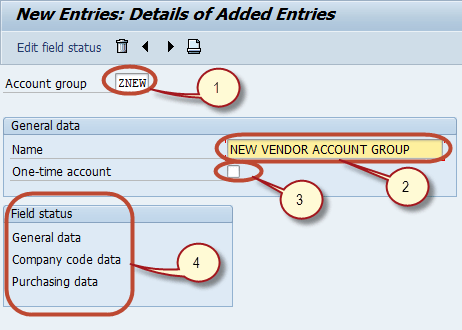
Step 6) Press the ‘Edit Field Status’ button to maintain the field status of the selected master data section, as shown below.

Step 7) In the next screen, select the group of fields for which the field status is to be maintained. The available field groups are listed below.

Step 8) In the next screen, maintain the field status of the fields of the selected group, as shown below.

Similarly, the field status of the other master data sections and their groups can be maintained. After maintaining the field status, press ‘Save’ in the SAP standard menu, shown below, to create the account group.

Step 9) In the next screen, enter the customizing request number to create the vendor account group. The prompt is shown below.

The account group now exists, but it is not usable until a number range is attached to it.
Number Ranges and Field Status for Vendor Account Groups
Two follow-up activities complete the configuration. The number range decides which account numbers the group may use, and the field status decides what a user has to type when creating the vendor.
| T-code | Activity | Why it matters |
|---|---|---|
| OBD3 | Define account groups with screen layout (vendors) | The activity carried out in the steps above. |
| XKN1 | Create number ranges for vendor accounts | Defines the interval and whether numbering is external. |
| OBAS | Assign number ranges to vendor account groups | Links the interval to the group so numbers can be issued. |
A single number range can serve every account group, or each group can carry its own interval. Separate intervals are the common choice, because the account number itself then reveals what kind of vendor it is. When the interval is flagged as external, the user types the vendor number; otherwise the system assigns the next free number.
Field status is maintained per master data section, and the sections mirror the segments of the vendor master record: general data, company code data and purchasing data. Inside a section, fields are grouped, and each field takes one of four settings.
- Suppress: The field is hidden completely.
- Required entry: The record cannot be saved until the field is filled.
- Optional entry: The field is shown and may be left empty.
- Display: The field is visible but cannot be changed.
Field status is not decided by the account group alone. The transaction-level and company-code-level field status settings are combined with it, and the most restrictive setting wins. A conflict, such as a field suppressed in one place and required in another, produces an error, which is also why moving an existing vendor to a different account group is restricted.
Standard Vendor Account Groups and S/4HANA Business Partner Groupings
SAP delivers several account groups in the standard system, and most projects copy one of them rather than starting from an empty entry.
- 0001: The general vendor group used as the model for ordinary suppliers.
- KRED and LIEF: Delivered vendor groups whose numbering behaviour depends on the number range assigned to them.
- CPD and CPDA: One-time account groups, where a single collective master record serves many occasional vendors.
- 0002 to 0006: Role-specific groups such as goods supplier, alternative payee, invoicing party and forwarding agent.
In SAP S/4HANA the vendor is a business partner, and vendor master data is maintained with transaction BP instead of the FK and XK transactions. The account group does not disappear. Each business partner grouping is mapped to a vendor account group in Customer/Vendor Integration customizing, and the number ranges behind the grouping and the account group have to stay aligned, otherwise synchronisation fails during creation or during a conversion from SAP ERP.
Once the group and its number range are in place, the next steps are to create the vendor master record and, later, to block or flag it for deletion when the relationship ends. The equivalent classification on the customer side is used the same way in accounts receivable.
