
What is Data Driven Testing?
 Editorial Team
⚡ Smart Summary
Data Driven Testing is a software testing method that stores test data in tables or spreadsheets so one script can validate many input combinations. It separates test logic from data, reducing script duplication and maintenance effort.
Data Driven Testing
Data Driven Testing is a software testing method in which test data is stored in table or spreadsheet format. Data driven testing allows testers to input a single test script that can execute tests for all test data from a table and expect the test output in the same table. It is also called table-driven testing or parameterized testing.
Data Driven Framework
Data Driven Framework is an automation testing framework in which input values are read from data files and stored into variables in test scripts. It enables testers to build both positive and negative test cases into a single test. Input data in data driven framework can be stored in single or multiple data sources like .xls, .xml, .csv and databases. The diagram below shows how input values flow from the data file into the test script.

Why Data Driven Testing?
Data Driven Testing is important because testers frequently have multiple data sets for a single test and creating individual tests for each data set can be time-consuming. Data driven testing helps keep data separate from test scripts, and the same test scripts can be executed for different combinations of input test data while test results are generated efficiently.
Example:
Suppose we want to test the login system with multiple input fields against 1000 different data sets.
To test this, you can take the following different approaches:
Approach 1) Create 1000 scripts, one for each dataset, and run each test separately one by one.
Approach 2) Manually change the value in the test script and run it several times.
Approach 3) Import the data from the Excel sheet. Fetch test data from Excel rows one by one and execute the script.
Among the given three scenarios, the first two are laborious and time-consuming. Therefore, it is ideal to follow the third approach.
Thus, the third approach is nothing but a Data-Driven framework.


Types of Test Data in Data Driven Testing
The value of data driven testing depends directly on the quality of the datasets you feed into your test scripts. A well-designed data file mixes several categories of test data so that one script can validate normal behavior, error handling, and limits in a single run:
- Positive (valid) data: Correct inputs, such as a valid username and password, used to confirm that the application accepts what it should accept.
- Negative (invalid) data: Wrong or malformed inputs that should be rejected, such as an incorrect password or special characters in a numeric field.
- Boundary data: Values at the edges of allowed ranges, like a 1-character or 255-character username, which frequently expose hidden defects.
- Blank or null data: Empty fields that verify mandatory-field validation and error messages.
- Large-volume data: Bulk or randomly generated records used to check performance and stability under realistic load.
With the right data prepared, the next step is building the framework itself.
How to create a Data Driven Automation Framework
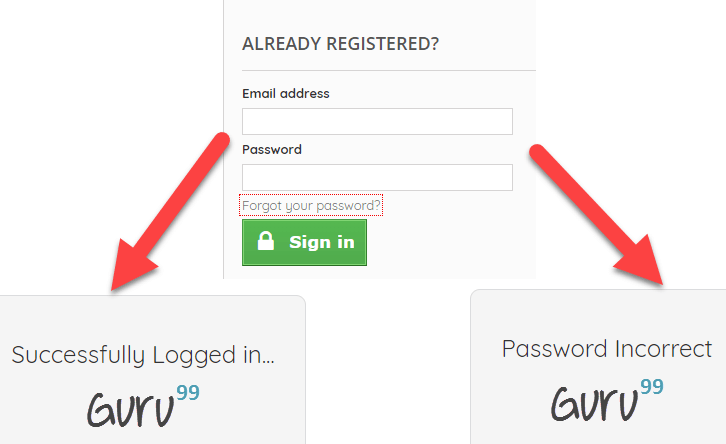
Consider that you want to test the login functionality of an application. The flowchart above shows the complete cycle: identify the test cases, write the common test script, move the data to an external file, and loop the script over each data row.
Step 1) Identify the Test Cases
- Input Correct username and password – Login Success
- Input incorrect username and correct password – Login Failure
- Input correct username and incorrect password – Login Failure
Step 2) Create detailed test Steps for above 3 Test Cases
| Test Case# | Description | Test Steps | Test Data | Expected Results |
|---|---|---|---|---|
| 1 | Check Login for valid credentials |
|
Username: valid password: valid | Login Success |
| 2 | Check Login for invalid credentials |
|
Username: invalid password: valid | Login Fail |
| 3 | Check Login for invalid credentials |
|
Username: valid password: invalid | Login Fail |
Step 3) Create Test Script
If you observe, the test steps remain common across all 3 test cases. You need to create a test script to execute these steps:
// This is Pseudo Code

// Test Step 1: Launch Application
driver.get("URL of the Application");

// Test Step 2: Enter Username
txtbox_username.sendKeys("valid");

// Test Step 3: Enter Password
txtbox_password.sendKeys("invalid");

// Test Step 4: Check Results
If (Next Screen) print success else Fail
Step 4) Create an Excel/CSV with the input test data, as shown in the sample sheet below

Step 5) Modify the script to loop over the input test data. The input commands should also be parameterized
// This is Pseudo Code
// Loop 3 Times
for (i = 0; i & lt; = 3; i++) {
    // Read data from Excel and store into variables
    int input_1 = ReadExcel(i, 0);
    int input_2 = ReadExcel(i, 1);

    // Test Step 1: Launch Application
    driver.get("URL of the Application");

    // Test Step 2: Enter Username
    txtbox_username.sendKeys(input_1);
    // Test Step 3: Enter Password

    txtbox_password.sendKeys(input_2);
    // Test Step 4: Check Results
    If(Next Screen) print success
    else Fail
}
Above are just 3 test cases. The test script can be used to loop over following test cases just by appending test data values to Excel
- Input incorrect username and incorrect password – Login Fail
- Input correct username and password blank – Login Fail
- Input blank username and blank password– Login Fail
And so on
💡 Pro Tip: Store the expected result for each row in the same data file as the inputs. Your script can then compare actual and expected outcomes automatically, turning the data file into a complete, self-verifying test suite.
Once your framework is ready, the right tool simplifies data management, execution, and reporting.
Best Data Driven Testing Tool
1) Testsigma
Testsigma is a cloud-based data-driven testing platform that I’ve found invaluable for maximizing test coverage by decoupling test logic from test data. It’s specifically designed for teams who need to validate applications against diverse datasets, edge cases, and business scenarios without creating redundant test scripts, streamlining the entire data-driven testing workflow.
During my data-driven testing projects, I leveraged Testsigma’s parameterization capabilities to execute identical test scenarios against multiple data combinations from external sources like Excel and CSV files. The platform’s ability to iterate through data rows automatically expanded my test coverage significantly, while granular reporting on data-level results helped me quickly identify which specific input combinations triggered failures across web, mobile, and API layers.

Features:
- External Data Source Integration: This feature enables direct connections to Excel spreadsheets, CSV files, and database tables for centralized test data management. It eliminates hardcoded values and allows you to maintain test data independently from test logic. You can update datasets without modifying test scripts, ensuring flexibility and maintainability. I use this to manage hundreds of data variations efficiently while keeping test scenarios clean and reusable.
- Automated Multi-Row Data Iteration: Testsigma automatically executes test scenarios across multiple data rows in a single test run, dramatically expanding coverage. You can validate numerous input combinations, boundary conditions, and business rule variations without duplicating test cases. This feature handles data sequencing and iteration logic transparently. I found this particularly effective for comprehensive regression testing with minimal script maintenance overhead.
- Dynamic Test Step Parameterization: It allows you to replace static values with dynamic parameters that pull data from external sources during execution. You can configure test steps to adapt to varying inputs, conditions, and expected outcomes based on dataset values. This feature supports complex data transformations and conditional logic. I rely on it to build flexible test scenarios that accommodate diverse business requirements and user workflows.
- Data-Level Execution Reporting: The platform generates detailed reports that break down test results by individual data combinations, showing exactly which inputs passed or failed. You can analyze patterns, identify problematic data ranges, and trace failures to specific dataset rows. This feature provides visual dashboards and exportable analytics for stakeholder communication. I recommend using these insights to prioritize data quality improvements and refine test data strategies.
- Cross-Platform Data-Driven Support: Testsigma extends data-driven capabilities across web, mobile, and API testing within unified workflows. You can apply the same datasets to validate consistency across different application layers and technologies. This feature ensures comprehensive end-to-end validation with parameterized data flows. I’ve used it to verify that backend data processing correctly reflects in frontend interfaces across multiple platforms simultaneously.
Pros
Cons
Pricing:
- Price: Custom pricing with data-driven testing capabilities included as part of the comprehensive subscription plan
- Free Trial: 14-Days Free Trial
14-Days Free Trial
2) Testiny
Testiny is a modern cloud-based test case management platform I’ve used to organize data-driven test cases efficiently while keeping clear separation between test logic and parameterized datasets. It is built for teams that need to manage diverse data combinations across many test runs without losing traceability.
While running data-driven projects with Testiny, I appreciated how its bulk editing and template features made it easy to scale test variations across hundreds of data rows. The platform integrates with Jira, GitHub, and GitLab so failed data combinations link back to issue trackers automatically.

Features:
- Bulk Test Case Editing: Testiny lets you edit, duplicate, and parameterize many test cases at once which speeds up creating data-driven variations. You can apply changes across folders in seconds without touching each case individually. I rely on this when expanding coverage to new data sets without rewriting scripts.
- Custom Fields for Data Inputs: It allows you to define custom fields per project so dataset attributes can be tracked alongside each test run. You can record input values, expected outcomes, and conditions clearly in one place. I use these fields to keep complex parameterized scenarios easy to audit later.
- Real-Time Test Run Tracking: The platform shows live execution status across team members so data-driven test runs stay transparent. You can assign cases, monitor pass/fail percentages, and identify blocked data combinations as they happen. I find this useful for keeping QA leads informed without constant status meetings.
- PDF and Shareable Reporting: Testiny generates clean PDF reports with charts and execution summaries you can share with non-technical stakeholders. You can filter by data set, milestone, or release. I send these out at the end of each sprint to communicate quality posture.
- Native Issue Tracker Integrations: It connects to Jira, GitHub, GitLab, Azure DevOps, Linear, Asana, Confluence, Trello, and monday.com so failed data rows turn into tickets quickly. You can keep test execution and engineering workflows aligned. I have noticed this dramatically reduces hand-off friction between QA and dev teams.
Pros
Cons
Pricing:
- Price: Free plan for up to 3 users; paid plans scale by seats and add premium support
- Free Trial: 21-Days Free Trial
21-Days Free Trial
3) Testpad
Testpad is a lightweight checklist-driven test management tool I have leaned on when data-driven scenarios need quick capture without heavy ceremony. It is built around hierarchical checklists so testers can group data variations under parent cases and execute them rapidly.
During my data-driven sessions with Testpad, I used its keyboard-first interface to spin up dozens of input variations in one sitting. Guest tester support let me bring in domain experts to validate edge-case data combinations without paying for extra seats.

Features:
- Hierarchical Test Checklists: Testpad organizes parameterized tests in nested checklists so you can group related data variations under a single parent case. You can expand and collapse branches to focus on specific datasets. I use this to keep complex data matrices visually tidy.
- Keyboard-Driven Editing: It lets you create, indent, and reorder test items with keyboard shortcuts so building large data-driven plans is fast. You can stay in flow without reaching for the mouse. I find this dramatically reduces the time to capture new dataset rows.
- Guest Tester Access: Testpad supports unlimited guest testers without per-seat charges so you can bring in domain experts for specific data combinations. You can invite stakeholders to verify edge cases without licensing overhead. I rely on this during user acceptance with parameterized scenarios.
- Instant Shareable Reports: The platform generates lightweight reports you can share via link so progress is visible without opening the tool. You can filter by tester, status, or test branch. I send these to product managers at the end of each data-driven test run.
- Issue Tracker Linking: It connects failed tests to Jira or GitHub tickets through simple links so data row failures route to engineering quickly. You can attach context directly from a failed checklist item. I keep tester focus on execution while letting tools handle the routing.
Pros
Cons
Pricing:
- Price: Plans start at $59/month with custom enterprise plans available for larger teams
- Free Trial: 30-Day Free Trial
30-Days Free Trial
Best practices of Data Driven testing
Given below are the best testing practices for Data-Driven testing:
- It is ideal to use realistic information during the data-driven testing process
- Test flow navigation should be coded inside the test script
- Drive virtual APIs with meaningful data
- Use Data to Drive Dynamic Assertions
- Test positive as well as negative outcomes
- Repurpose Data Driven Functional Tests for Security and Performance
Advantages of Data-Driven testing
Data-Driven testing offers many advantages. Some of them are:
- Allows testing the application with multiple sets of data values during Regression testing
- Test data and verification data can be organized in just one file, and it is separate from the test case logic.
- Based on the tool, it is possible to have the test scripts in a single repository. This makes the tests easy to understand, maintain, and manage.
- Actions and Functions can be reused in different tests.
- Some tools generate test data automatically. This is useful when large volumes of random test data are necessary, which helps to save time.
- Data-driven testing can be performed in any phase of the development. Data-driven test cases are generally merged into a single process. However, they can be used in multiple test cases.
- Allows developers and testers to have clear separation for the logic of their test cases/scripts from the test data.
- The same test cases can be executed several times, which helps to reduce the number of test cases and scripts.
- Any changes in the test script do not affect the test data
Disadvantages of Data Driven testing
Some Drawbacks of Data Driven Automation Testing method are:
- Quality of the test is dependent on the automation skills of the implementing team
- Data validation is a time-consuming task when testing a large amount of data.
- Maintenance is a big issue, as a large amount of coding is needed for Data-Driven testing.
- High-level technical skills are required. A tester may have to learn an entirely new scripting language.
- There will be more documentation, mostly related to script management, test infrastructure, and testing results.
- A text editor like Notepad is required to create and maintain data files.
Data Driven Testing vs Keyword Driven Testing
Beginners often confuse data driven testing with keyword driven testing because both separate test design from test scripts. The difference lies in what is externalized: data driven testing externalizes the input values, while keyword driven testing externalizes the actions themselves as reusable keywords. The table below compares the two approaches:
| Parameter | Data Driven Testing | Keyword Driven Testing |
|---|---|---|
| What is externalized | Test data (inputs and expected results) | Test actions (keywords such as Login, Click, Verify) |
| Data source | Excel, CSV, XML, or database tables | Keyword tables plus optional data tables |
| Skills required | Moderate scripting knowledge | Higher initial design effort; less coding to create new tests |
| Best suited for | Repeating one scenario with many input combinations | Building many scenarios from reusable action blocks |
| Maintenance | Update data files without touching scripts | Update the keyword library when application behavior changes |
Many teams combine both approaches into a hybrid framework, where keywords define reusable actions and external data files supply the values for each test run.
