
UiPath Tutorial for Beginners: What is UiPath RPA? Features
 Editorial Team
⚡ Smart Summary
UiPath is a robotic process automation platform that records human actions and replays them as software robots. This article explains the three product components, the installation steps, the Studio interface, a recorded sample script, and a comparison against rival automation platforms.

What is UiPath?
UiPath is a robotic process automation platform for end-to-end high-scale automation. UiPath software offers solutions for enterprises to automate repetitive office tasks for rapid business transformation. It converts repetitive tasks into an automated process using multiple tools. It was founded in Bucharest in 2005 by Romanian entrepreneurs Daniel Dines and Marius Tîrcă, originally under the name DeskOver.
More and more companies are adopting digital ways of working day by day. With digitisation, the biggest advantage is the speed of execution. But the challenge is that it requires diverse tools, and therefore a workforce with a diverse skill set to handle those tools. A workforce with such a varied skill set is scarce. To resolve this issue, the IT industry has been looking for a reliable, fast, intelligent, and robust solution. This demand is fulfilled by robotic process automation platforms such as UiPath.
The key idea is that a robot works through the user interface exactly as a person would. Nothing inside the target application has to be modified, which is why the approach suits legacy systems that offer no API.
Products of UiPath
UiPath is available as three different products that work together:
UiPath Studio
It allows you to plan any automation process visually with the help of different diagrams. Each diagram represents a certain type of work to perform.
UiPath Robot
Once you are done designing the processes in Studio, you need to execute them. Robots pick up those steps and run them without human direction in any environment. A robot can also work when a human triggers the process.
UiPath Orchestrator
This tool is a web-based application. It helps you to deploy, schedule, monitor, and manage robots and processes. It is a centralised platform from which all robots are managed.
UiPath Architecture and How It Works
The three products above map onto three layers, and understanding that split explains where each piece of work happens.
| Layer | Component | Responsibility |
|---|---|---|
| Design | UiPath Studio | Build and test the workflow, publish it as a package |
| Execution | UiPath Robot | Run the published package against the target applications |
| Control | UiPath Orchestrator | Store packages, assign jobs, hold queues and credentials, collect logs |
Robots themselves come in two operating styles, and choosing the wrong one is a common early mistake.
- Attended robot: Runs on the same machine as a person and is started by that person, usually to remove clicks from a task they are already doing. It cannot run while the desktop is locked.
- Unattended robot: Runs on its own virtual machine, triggered by a schedule or a queue item from Orchestrator, with no person present. This suits overnight batch work.
Features of UiPath
Now we will learn about the important features of UiPath:
1. Hosting Options: It can be hosted in cloud environments or on virtual terminals.
2. Application Compatibility: Offers a wide range of applications to work with, which includes web and desktop applications.
3. Centralised repository: This feature lets users handle all the robots simultaneously.
4. Security: Offers auto login features to run the bots, with credentials held in Orchestrator rather than in the workflow.
5. Advanced screen scraping solution: A scraping solution that works with almost any application, including .NET, Java, Flash, PDF, legacy, and SAP, with high accuracy.
6. Reliable tool for modelling business processes: UiPath Studio supports automation at scale with the help of modelled business processes.
7. Scalability and robustness:
- Effective debugging and exception handling mechanisms.
- Artificial intelligence that handles day-to-day applications such as Outlook, Excel, and PDF, including document understanding for semi-structured files.
How to install UiPath?
Now we will learn how to install UiPath. The screenshots below were captured from an earlier release, and the current sign-up runs through UiPath Automation Cloud, so the wording of some screens differs while the sequence of steps remains the same.
Step 1) Enter this URL in your browser: https://www.uipath.com/community. Click on the get community edition button.

Step 2) Enter all the marked details.

Step 3) Click Request Community Edition.

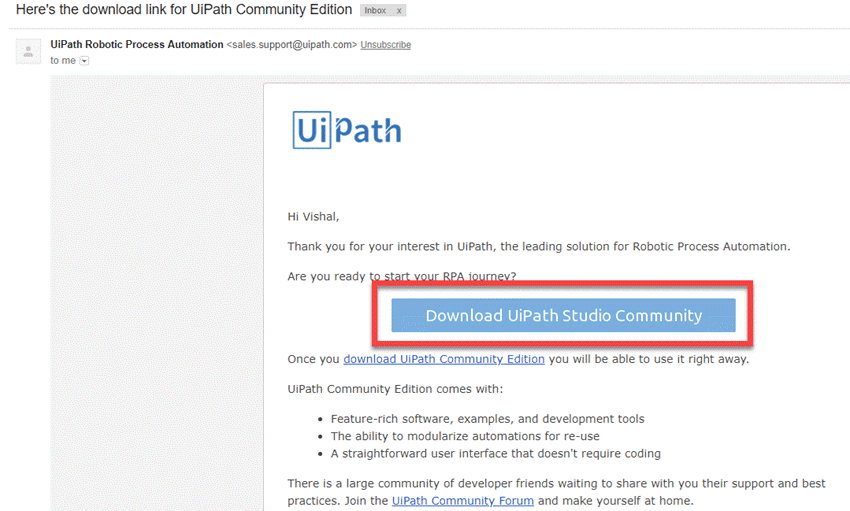
Step 4) You will receive the mail shown below. Click on download community edition and your download will begin.
Step 5) Once the download is completed, click on the setup file.

Step 6) Once the software is installed, click on start free trial.

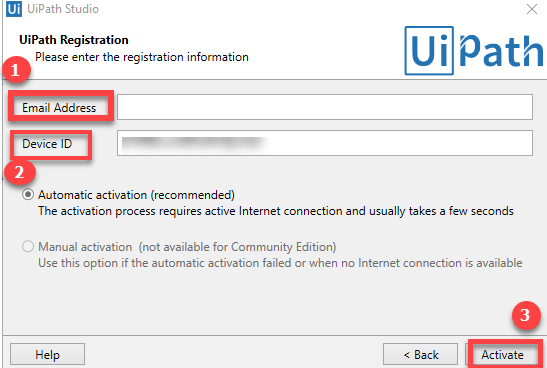
Step 7) In the next screen,
- Enter your email address.
- The device id will be detected automatically.
- Then click on the Activate button.
You will have UiPath on your system now.
💡 Tip: The Community Edition is free for individuals, small teams, and learning, but it is not licensed for large-scale production use. Check the current licensing terms before building anything a business will depend on.
Understanding UiPath Interface
UiPath has a GUI which consists of multiple panels. It offers easy access to specific functionality.
Following are the main components of UiPath Studio:
- The Ribbon
- The Universal Search Bar
- The Activities Panel
- The Library Panel
- The Project Panel
The Ribbon:
It consists of the following four tabs:
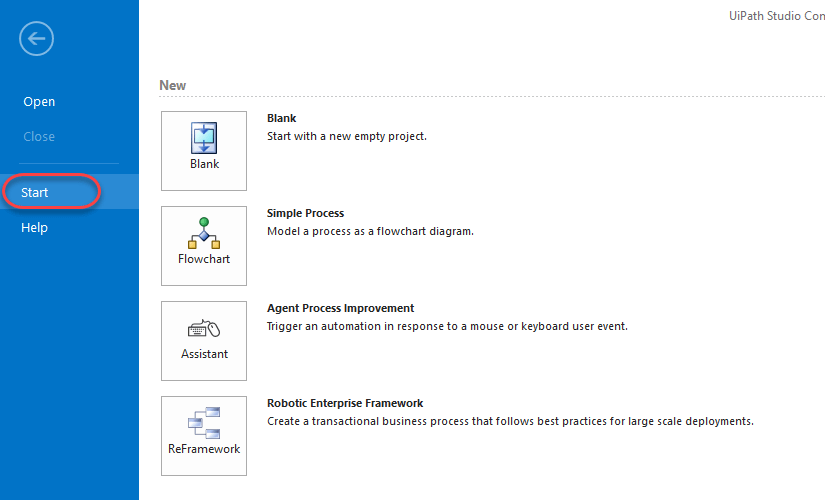
1. Start – It helps you create a new project or open a previously created task. By default, all projects are created in C:\Users\Username\Documents\UiPath.
2. Design – It offers all the options to create or launch sequences and flowcharts, access wizards, and manage variables.

3. Execute – It helps in running or stopping any project. Before starting the debug process, it can slow down steps and open logs.

4. Setup – Used to publish a project or create a shortcut for it, schedule tasks, and install extensions.

The Universal Search Bar:
The Universal Search bar allows the user to search for anything contained in the libraries, activities, project, and Designer panels.

The Activities Panel: The Activities panel allows quick access to all available activities that can be dragged into the current project.

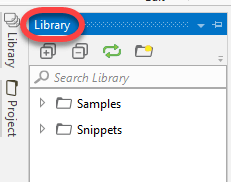
The Library Panel: The Library panel allows you to reuse automation. A search box is also provided to find items faster.
The Project Panel: The Project panel allows you to view the contents of the current project and open the file location in Windows Explorer.

Sample Script using UiPath
Following are the steps to create a sample RPA UiPath script. The recorder is the fastest route to a first working robot, because it writes the activity sequence for you.
Step 1) Click on the “Blank” icon, boxed in the image below:

Step 2) In the next screen,
- Enter the name of the project.
- Click the Create button.

Step 3) In the next screen,
- Click on Recording.
- Select “Basic”.

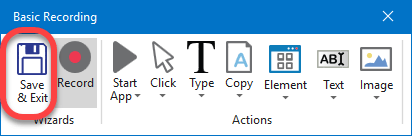
Step 4) This opens a small window with an icon to record, as shown below. Click on the Record button.

Step 5) Once this icon is clicked, you will see the cursor turn into a hand icon, and the screen highlights each element as you move over it, as shown below.

Step 6) Perform the manual tasks that you want to automate. UiPath will automatically create the sequence of your mouse and keyboard actions.
Once recording is done, click Save and Exit.
Step 7) You will see the sequence of recorded steps as shown below.

Step 8) Then click on the run icon. UiPath will replay the recorded actions.

This is a basic way to create small automation robots. UiPath has many advanced features for building more complex robots, including selectors, data tables, and exception handling.
⚠️ Warning: A recorded workflow depends on selectors that describe where each element sits. If the target application changes its layout or window title, the selector breaks. Open each recorded activity and replace unstable attributes with wildcards before relying on the robot.
UiPath Vs. Other Automation Tools
Many automation tools already exist in the market, such as Selenium and similar browser-driven frameworks. These tools generally perform well on web automation, but they struggle when you try to automate desktop applications or remote sessions.
Areas where RPA tools like UiPath go beyond that existing technology are:
- Desktop automation
- Remote applications and virtual desktops
- Data handling techniques
- Scraping techniques
- The methodology of writing the logic, which is visual rather than code first
The distinction that matters is purpose. Selenium is a testing framework that drives a browser, whereas an RPA platform is a business process tool that drives whatever the user can see.
UiPath vs Automation Anywhere vs Blue Prism
Three platforms dominate enterprise RPA shortlists. The table below sets them side by side on the factors that usually decide a selection.
| Parameter | UiPath | Automation Anywhere | Blue Prism |
|---|---|---|---|
| Design approach | Visual drag and drop, low code | Web based designer, low code | Object and process studio, more structured |
| Attended automation | Strong, a core use case | Strong | Limited, unattended by design |
| Learning curve | Gentlest for beginners | Moderate | Steepest, developer oriented |
| Free edition | Community Edition | Community Edition | Trial only |
| Recorder | Yes, multiple recorder types | Yes | No recorder, objects are modelled |
| Typical strength | Speed of building a first robot | Cloud native deployment | Governance and auditability |
Advantages and Disadvantages of UiPath
Weighing both sides prevents the common outcome of a pilot that works and a rollout that stalls.
Advantages
- A first automation can be built without writing code, so business analysts can contribute directly.
- Works against any interface the user can see, including legacy systems with no API.
- Orchestrator gives central scheduling, credential storage, and audit logs.
- A large activity library and an active community reduce the time spent solving common problems.
Disadvantages
- Selectors are brittle. An interface change in the target application can break a working robot.
- Licensing costs rise quickly once unattended robots move into production.
- Automating a badly designed process simply makes a poor process run faster, so process review must come first.
- Robots need maintenance, which means an ongoing support commitment rather than a one-off project.
To go further, compare this with the Automation Anywhere tutorial and the Blue Prism tutorial, read the wider RPA introduction, and prepare for interviews with the UiPath interview questions. For the testing side of automation, see automation testing.
