
What is Selenium? Introduction Tutorial
 Krishna Rungta
⚡ Smart Summary
Selenium is a free, open-source automated testing framework designed to validate web applications across browsers and platforms using multiple programming languages. It enables robust, efficient, and scalable test automation for modern QA practices.

What is Selenium?
Selenium is a free (open-source) automated testing framework used to validate web applications across different browsers and platforms. You can use multiple programming languages like Java, C#, Python, etc to create Selenium Test Scripts. Testing done using the Selenium testing tool is usually referred to as Selenium Testing.
Expert Insights
“Avoid using fixed sleep delays in your tests. Instead, use explicit waits (like WebDriverWait) to wait for elements to load. This makes your scripts more reliable and faster, as they respond dynamically to actual page conditions—a key best practice for students everywhere, starting with Selenium.”
👉 Enroll for Free Live Selenium Testing Project
Selenium Tool Suite
Selenium Software is not just a single tool but a suite of software, each piece catering to different Selenium QA testing needs of an organization. Here is the list of tools
- Selenium Integrated Development Environment (IDE)
- Selenium Remote Control (RC)
- WebDriver
- Selenium Grid

At the moment, Selenium RC and WebDriver are merged into a single framework to form Selenium 2. Selenium 1, by the way, refers to Selenium RC.
Video Tutorial Selenium
Click here if the video is not accessible
Who developed Selenium?
Since Selenium is a collection of different tools, it also had different developers. Below are the key persons who made notable contributions to the Selenium Project

Primarily, Selenium was created by Jason Huggins in 2004. An engineer at ThoughtWorks, he was working on a web application that required frequent testing. Having realized that their application’s repetitive Manual Testing was becoming increasingly inefficient, he created a JavaScript program that would automatically control the browser’s actions. He named this program the “JavaScriptTestRunner.”
Seeing potential in this idea to help automate other web applications, he made JavaScriptRunner open-source, which was later renamed Selenium Core. For those interested in exploring other options for web application testing, take a look at these Selenium alternatives.
The Same Origin Policy Issue
Same Origin policy prohibits JavaScript code from accessing elements from a domain that is different from where it was launched. For example, the HTML code in www.google.com uses a JavaScript program “randomScript.js”. The same origin policy will only allow randomScript.js to access pages within google.com, such as google.com/mail, google.com/login, or google.com/signup. However, it cannot access pages from different sites such as yahoo.com/search or guru99.com because they belong to different domains.

This is the reason why, prior to Selenium RC, testers needed to install local copies of both Selenium Core (a JavaScript program) and the web server containing the web application being tested, so they would belong to the same domain
Birth of Selenium Remote Control (Selenium RC)
.png)
Unfortunately, testers using Selenium Core had to install the whole application under test and the web server on their own local computers because of the restrictions imposed by the same-origin policy. So another ThoughtWorks’ engineer, Paul Hammant, decided to create a server that would act as an HTTP proxy to “trick” the browser into believing that Selenium Core and the web application being tested come from the same domain. This system became known as the Selenium Remote Control or Selenium 1.
Birth of Selenium Grid
.jpg)
Selenium Grid was developed by Patrick Lightbody to address the need to minimize test execution times as much as possible. He initially called the system “Hosted QA.” It was capable of capturing browser screenshots during significant stages, and also of sending out Selenium commands to different machines simultaneously.
Birth of Selenium IDE
.jpg)
Shinya Kasatani of Japan created Selenium IDE, a Firefox and Chrome extension that can automate the browser through a record-and-playback feature. He came up with this idea to further increase the speed of creating test cases. He donated Selenium IDE to the Selenium Project in 2006.
Birth of WebDriver
.jpg)
Simon Stewart created WebDriver circa 2006 when browsers and web applications were becoming more powerful and more restrictive with JavaScript programs like Selenium Core. It was the first cross-platform testing framework that could control the browser at the OS level.
Birth of Selenium 2
In 2008, the whole Selenium Team decided to merge WebDriver and Selenium RC to form a more powerful tool called Selenium 2, with WebDriver being the core. Currently, Selenium RC is still being developed, but only in maintenance mode. Most of the Selenium Project’s efforts are now focused on Selenium 2.
So, Why the Name Selenium?
The Name Selenium came from a joke that Jason cracked once to his team. During Selenium’s development, another automated testing framework was popularly made by the company called Mercury Interactive (yes, the company that originally made QTP before it was acquired by HP). Since Selenium is a well-known antidote for Mercury poisoning, Jason suggested that name and his teammates took it. So that is how we got to call this framework up to the present.

What is Selenium IDE?
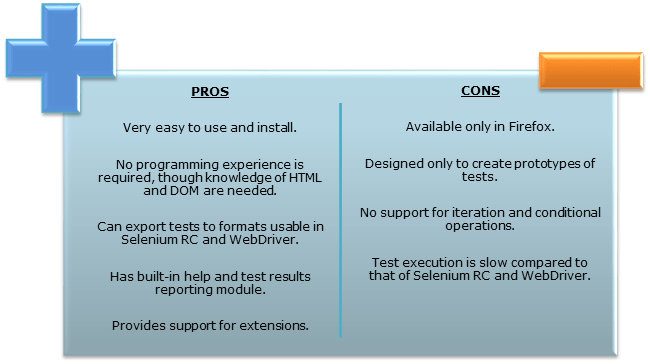
Selenium Integrated Development Environment (IDE) is the simplest framework in the Selenium suite and is the easiest one to learn. It is a Chrome and Firefox plugin that you can install as easily as you can with other plugins. However, because of its simplicity, Selenium IDE should only be used as a prototyping tool. If you want to create more advanced test cases, you will need to use either Selenium RC or WebDriver.
What is Selenium Remote Control (Selenium RC)?
Selenium RC was the flagship testing framework of the whole Selenium project for a long time. This is the first automated web testing tool that allows users to use a programming language they prefer. As of version 2.25.0, RC can support the following programming languages:

What is WebDriver?
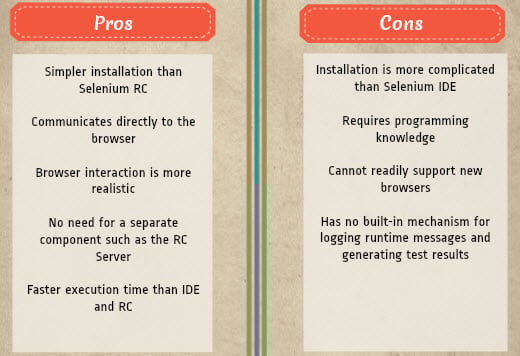
The WebDriver proves to be better than Selenium IDE and Selenium RC in many aspects. It implements a more modern and stable approach in automating the browser’s actions. WebDriver, unlike Selenium RC, does not rely on JavaScript for Selenium Automation Testing. It controls the browser by directly communicating with it.
The supported languages are the same as those in Selenium RC.
- Java
- C#
- PHP
- Python
- Perl
- Ruby
What is Selenium Grid?
Selenium Grid is a tool used together with Selenium RC to run parallel tests across different machines and different browsers all at the same time. Parallel execution means running multiple tests at once.
Features:
- Enables simultaneous running of tests in multiple browsers and environments.
- Saves time enormously.
- Utilizes the hub-and-nodes concept. The hub acts as a central source of Selenium commands to each node connected to it.
Selenium Browser and Environment Support
Because of their architectural differences, Selenium IDE, Selenium RC, and WebDriver support different sets of browsers and operating environments.
| Selenium IDE | WebDriver | |
|---|---|---|
| Browser Support | Mozilla Firefox and Chrome | Google Chrome 12+ Firefox Internet Explorer 7+ and Edge Safari, HtmlUnit and PhantomUnit |
| Operating System | Windows, Mac OS X, Linux | All operating systems where the browsers above can run. |
Note: Opera Driver no longer works
How to Choose the Right Selenium Tool for Your Needs
| Tool | Why Choose? |
|---|---|
| Selenium IDE |
|
| Selenium RC |
|
| WebDriver |
|
| Selenium Grid |
|
Real-World Case Studies
🔍 Case Study 1: Cross-Browser Compatibility for SaaS Dashboard
Scenario
A software-as-a-service company was preparing to release an analytics dashboard that needed to function consistently across modern browsers (Chrome, Firefox, Edge, Safari).
Challenge
Manual testing on each browser was time-consuming, error-prone, and couldn’t keep pace with rapid development iterations.
Solution with Selenium
A QA engineer created a Selenium Grid setup to execute the same test suite simultaneously across multiple browsers and OS combinations. Tests were authored in Python using Selenium WebDriver for actions like login, chart filtering, and data export.
Outcome
- Reduced regression duration by 80%.
- Discovered browser-specific rendering bugs early (e.g., misaligned graphs in IE).
- Maintained a consistent dashboard UX across the browser matrix without extra manual cycles.
⚙️ Case Study 2: CI/CD Integration for Web App via Selenium + TestNG
Scenario
A mid-sized web development firm relies on a CI/CD pipeline using Jenkins. They needed to ensure core user journeys worked after every code change.
Challenge
New build deployments occasionally broke user flows—login, form submission—escaping detection until end-of-day manual testing.
Solution with Selenium
A tester implemented a Java-based Selenium WebDriver suite integrated with TestNG. Tests covered authentication, profile updates, and search functionalities. These ran on every Jenkins build, leveraging parallel execution and browser parameterization.
Outcome
- Achieved fail-fast feedback: broken flows were flagged immediately.
- Reduced post-deploy bugs by over 60%.
- Enabled developers to address issues before they reached QA.
🚀 Case Study 3: Accelerating Feature Release for Travel Aggregator
Scenario
A travel aggregator platform needed to release a revamped flight booking feature. Manual regression tests across 10+ pages took days and blocked release.
Challenge
Pressure to reduce time-to-market couldn’t outpace manual test cycles, risking delays or lower quality.
Solution with Selenium & Page Object Model
A QA automation lead introduced a Page Object Model (POM) structure in C#. Selenium WebDriver scripts encapsulated page elements and actions (search flights, apply filters, and payment cases). Automated test runs were triggered nightly on GitLab CI.
Outcome
- Testing time dropped from 3 days to just 4 hours.
- Script reuse across multiple features cut scripting effort by 50%.
- Confidence increased: the release shipped on schedule with minimal bug reports.
Common Selenium Challenges (and Fixes)
Even though Selenium is powerful, testers often face challenges that can affect reliability and speed. Here are some common ones and how to fix them:
- Flaky Tests:
Tests may fail randomly due to timing or network issues.
Fix: Use explicit waits and stable locators; avoidThread.sleep(). - Dynamic Web Elements:
Changing element IDs or XPaths cause element-not-found errors.
Fix: Use relative XPaths, CSS selectors, or dynamic attribute handling. - Synchronization Issues:
Elements load slower than script execution.
Fix: Implement WebDriverWait with expected conditions. - Cross-Browser Inconsistencies:
Tests behave differently on Chrome, Firefox, or Edge.
Fix: Run tests on Selenium Grid or cloud platforms for cross-browser validation. - Handling Pop-ups and Alerts:
Unexpected pop-ups can interrupt test flow.
Fix: Use Selenium’s Alert interface or try–catch blocks to handle them gracefully. - Test Maintenance Overhead:
Frequent UI changes make tests fragile.
Fix: Adopt Page Object Model (POM) and version control for easy updates. - Integration Challenges:
CI/CD pipelines may fail due to driver issues.
Fix: Use Selenium Manager (Selenium 4+) or WebDriver Manager to auto-manage drivers.
In short: Most Selenium problems stem from poor synchronization or brittle locators—both solvable through smarter waits, modular design, and continuous maintenance.
