
Supervised Machine Learning: Algorithms, Types & Examples
 Editorial Team
⚡ Smart Summary
Supervised Machine Learning trains an algorithm on labeled examples so it can predict outcomes for data it has never seen before, using regression for numeric targets and classification for category targets such as spam or fraud.
What is Supervised Machine Learning?
Supervised Machine Learning is an algorithm that learns from labeled training data to help you predict outcomes for unforeseen data. In supervised learning, you train the machine using data that is well “labeled.” It means some data is already tagged with correct answers. It can be compared to learning in the presence of a supervisor or a teacher.
Successfully building, scaling, and deploying accurate supervised machine learning models takes time and technical expertise from a team of highly skilled data scientists. Data scientists must also rebuild models periodically so the insights they produce stay true as the underlying data changes.
How Supervised Learning Works
Supervised machine learning uses training data sets to achieve desired results. These data sets contain inputs and the correct output that helps the model to learn faster. For example, you want to train a machine to help you predict how long it will take you to drive home from your workplace.
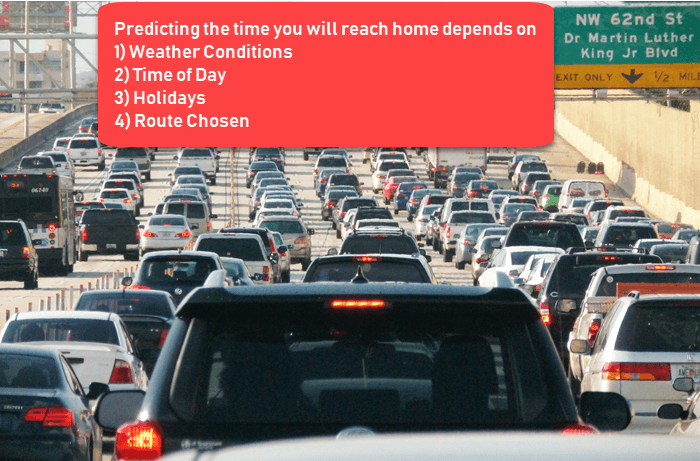
Here, you start by creating a set of labeled data. This data includes:
- Weather conditions
- Time of the day
- Holidays
- Route chosen
All these details are your inputs in this supervised learning example. The output is the amount of time it took to drive back home on that specific day, as the image below shows.
You instinctively know that if it is raining outside, then it will take you longer to drive home. But the machine needs data and statistics.
The first thing you need to create is a training set. It will contain the total commute time and corresponding factors like weather, time, etc. Based on this training set, your machine might see there is a direct relationship between the amount of rain and the time you will take to get home.
So, it ascertains that the more it rains, the longer you will be driving to get back to your home. It might also see the connection between the time you leave work and the time you will be on the road. The closer you are to 6 p.m. the longer it takes for you to get home.
Your machine may find some of the relationships with your labeled data. That learning phase is shown below.
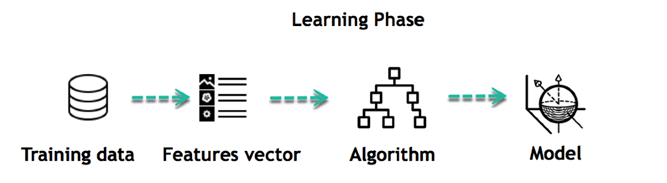
This is the start of your Data Model. It begins to record how rain impacts the way people drive, and that more people travel during a particular time of day.
Types of Supervised Machine Learning Algorithms
Following are the types of Supervised Machine Learning algorithms:
Regression
Regression technique predicts a single continuous output value using training data.
Example: You can use regression to predict the house price from training data. The input variables will be locality, size of a house, etc.
Strengths: Outputs are easy to interpret, and the algorithm can be regularized to avoid overfitting.
Weaknesses: A linear model is not flexible, so it does not capture complex relationships without added features.
Here are a few types of Regression Algorithms:
- Linear regression
- Polynomial regression
- Ridge and Lasso regression
- Logistic regression (for classification)
- Decision tree and random forest regression
- Support vector regression
Logistic Regression:
Logistic regression is used to estimate discrete values based on a given set of independent variables. It helps you predict the probability of occurrence of an event by fitting data to a logit function. Therefore, it is also known as logit regression. As it predicts a probability, its output value lies between 0 and 1, and it may underperform when there are multiple or non-linear decision boundaries.
Classification
Classification means to group the output inside a class. If the algorithm tries to label input into two distinct classes, it is called binary classification. Selecting between more than two classes is referred to as multiclass classification.
Example: Determining whether or not someone will be a defaulter of the loan.
Strengths: Classification trees perform very well in practice.
Weaknesses: Unconstrained, individual trees are prone to overfitting.
Here are a few types of Classification Algorithms:
- Naive Bayes classifiers
- Decision trees
- Support Vector Machine
- K-Nearest Neighbours
- Random forest and gradient boosting
Naive Bayes Classifiers
The Naive Bayes model is easy to build and very useful for large datasets. This method is composed of directed acyclic graphs with one parent and several children. It assumes independence among child nodes separated from their parent.
Decision Trees
Decision trees classify an instance by sorting it based on the feature value. In this method, each node is the feature of an instance that should be classified, and every branch represents a value which the node can assume. It is a widely used technique for classification.
The same structure works for regression: a regression tree helps you estimate real values (cost of purchasing a car, number of calls, total monthly sales, etc.).
Support Vector Machine
Support Vector Machine (SVM) is a type of learning algorithm introduced in the 1990s. This method is based on results from statistical learning theory developed by Vladimir Vapnik and his colleagues.
SVMs are also closely connected to kernel functions, which are a central concept for most of the learning tasks. The kernel framework and SVM are used in a variety of fields. It includes multimedia information retrieval, bioinformatics, and pattern recognition. Each estimator above is documented with its tuning parameters in the scikit-learn reference.
Supervised vs. Unsupervised Machine Learning Techniques
Placing the method beside unsupervised learning makes its boundaries clear.
| Based On | Supervised machine learning technique | Unsupervised machine learning technique |
|---|---|---|
| Input Data | Algorithms are trained using labeled data. | Algorithms are used against data which is not labeled |
| Computational Complexity | Supervised learning is a simpler method. | Unsupervised learning is computationally complex |
| Accuracy | Highly accurate and trustworthy method. | Less accurate and trustworthy method. |
| Typical algorithms | Logistic regression, decision trees, SVM, Naive Bayes | K-means, hierarchical clustering, PCA |
| How results are judged | Scored against known answers (accuracy, RMSE) | Judged by internal measures and human review |
Challenges in Supervised Machine Learning
Here, are challenges faced in supervised machine learning:
- Irrelevant input features in the training data can produce inaccurate results
- Data preparation and pre-processing is always a challenge.
- Accuracy suffers when impossible, unlikely, and incomplete values have been entered as training data
- If the concerned expert is not available, then the other approach is “brute-force.” It means you have to guess which features (input variables) to train the machine on, and that guess could be inaccurate.
Advantages of Supervised Learning
Set against those challenges, here are the advantages of supervised machine learning:
- Supervised learning in Machine Learning allows you to collect data or produce a data output from previous experience
- Helps you to optimize performance criteria using experience
- Supervised machine learning helps you to solve various types of real-world computation problems.
Disadvantages of Supervised Learning
Below are the disadvantages of supervised machine learning:
- The decision boundary might be overtrained if your training set does not have examples that you want to have in a class
- You need to select lots of good examples from each class while you are training the classifier.
- Classifying big data can be a real challenge.
- Training for supervised learning needs a lot of computation time.
Best Practices for Supervised Learning
The following sequence keeps a project on track:
- Before doing anything else, decide what kind of data is to be used as a training set
- Decide the structure of the learned function and the learning algorithm.
- Gather corresponding outputs either from human experts or from measurements
- Hold back a test set the model never sees, and report the score on it
