
What is Fuzzy Logic? Architecture Diagram & Application
 Editorial Team
⚡ Smart Summary
Fuzzy Logic is a many-valued reasoning method in which truth takes any real value between 0 and 1, allowing machines to handle vague, partial and uncertain information much the way human judgment does.

What Is Fuzzy Logic?
Fuzzy Logic is a many-valued logic in which the truth value of a variable may be any real number between 0 and 1. It handles the concept of partial truth. In real life, we often meet a situation where we cannot decide whether a statement is completely true or completely false. At that point, fuzzy logic offers very valuable flexibility for reasoning.
That value is called the degree of membership: 0 means no membership at all, 1 means full membership, and 0.7 means partial membership. A fuzzy algorithm weighs all available data on that scale and then takes the best possible decision for the given input. The method imitates human decision making, which considers every possibility between the digital values T and F.
History of Fuzzy Logic Systems
Many-valued logic is older than the name: Jan Łukasiewicz described a three-valued logic in the 1920s. The decisive step came in 1965, when Lotfi Zadeh, a professor at UC Berkeley in California, published the paper “Fuzzy Sets” in Information and Control. He observed that conventional computer logic could not manipulate data representing subjective or unclear human ideas.
The idea reached hardware in 1974, when Ebrahim Mamdani built the first working fuzzy controller for a steam engine; Japanese makers commercialised it through the 1980s. Fuzzy algorithms now span control theory to artificial intelligence, letting a computer draw distinctions among data that is neither strictly true nor strictly false — “a little dark”, “fairly bright”, and so on.
Characteristics of Fuzzy Logic
Here are some important characteristics of fuzzy logic:
- Flexible and easy to implement machine learning technique
- Helps you to mimic the logic of human thought
- Truth is not restricted to two values; any degree between 0 and 1 may represent a solution
- Highly suitable method for uncertain or approximate reasoning
- Fuzzy logic views inference as a process of propagating elastic constraints
- Fuzzy logic allows you to build nonlinear functions of arbitrary complexity
- Fuzzy logic should be built with the complete guidance of experts
When not to use fuzzy logic
Fuzzy logic is never a cure for everything. It is equally important to understand where you should not use it.
Here are certain situations in which you are better off avoiding fuzzy logic:
- If you cannot conveniently map an input space to an output space
- Fuzzy logic should not be used when plain common sense already solves the problem
- Many conventional controllers do a fine job without any fuzzy logic at all
Fuzzy Logic Architecture
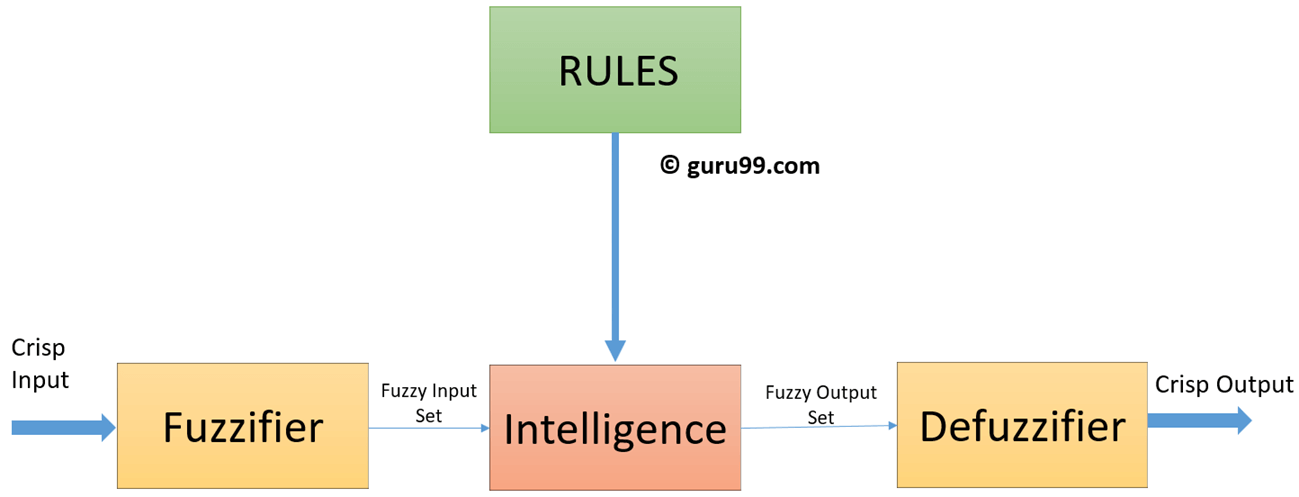
Fuzzy Logic architecture has four main parts, and the diagram below shows how a crisp input travels through all of them:
Rule Base
It contains all the rules and the IF-THEN conditions offered by the experts to control the decision-making system. Recent work in fuzzy theory provides various methods for the design and tuning of fuzzy controllers, and these methods significantly reduce the number of rules a fuzzy set needs.
Fuzzification
Fuzzification converts inputs: it turns crisp numbers into fuzzy sets. Crisp inputs are measured by sensors — room temperature, pressure and so on — and passed into the control system for further processing. The conversion is done by a membership function, a curve that maps every possible input value to a membership degree between 0 and 1.
Inference Engine
It determines the degree of match between the fuzzy input and each rule. Based on that percentage match, it decides which rules need to be applied to the given input field. The applied rules are then combined to develop the control actions.
Defuzzification
Finally, defuzzification converts the fuzzy sets back into a single crisp value. Several techniques exist — centroid, bisector and the maximum-based methods are the usual choices — so select the one best suited to your expert system.
Fuzzy Logic vs. Probability
Fuzziness and probability are routinely confused, yet they answer different questions.
| Fuzzy Logic | Probability |
|---|---|
| Fuzzy: Tom’s degree of membership within the set of old people is 0.90. | Probability: There is a 90% chance that Tom is old. |
| Fuzzy logic takes truth degrees as a mathematical basis on the model of the vagueness phenomenon. | Probability is a mathematical model of ignorance. |
Crisp vs. Fuzzy
| Crisp | Fuzzy |
|---|---|
| It has strict boundary T or F | Fuzzy boundary with a degree of membership |
| Some crisp time set can be fuzzy | It cannot be crisp |
| True/False {0,1} | Membership values on [0,1] |
| In crisp logic the law of Excluded Middle and Non-Contradiction may or may not hold | In fuzzy logic the law of Excluded Middle and Non-Contradiction hold |
Classical Set vs. Fuzzy Set Theory
| Classical Set | Fuzzy Set Theory |
|---|---|
| Classes of objects with sharp boundaries. | Classes of objects do not have sharp boundaries. |
| A classical set is defined by crisp boundaries, i.e., there is clarity about the location of the set boundaries. | A fuzzy set always has ambiguous boundaries, i.e., there may be uncertainty about the location of the set boundaries. |
| Widely used in digital system design | Used mainly in fuzzy controllers and approximate-reasoning systems. |
Fuzzy Logic Examples
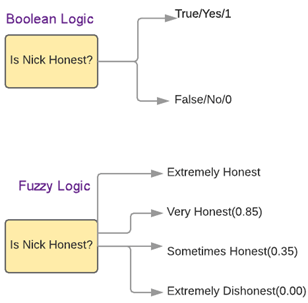
The diagram below makes the membership scale concrete. In a fuzzy system the values are denoted by a number from 0 to 1, where 1.0 means absolute truth and 0.0 means absolute falseness.
Application Areas of Fuzzy Logic
The table below shows applications of fuzzy logic by well-known companies in their products.
| Product | Company | Fuzzy Logic |
|---|---|---|
| Anti-lock brakes | Nissan | Use fuzzy logic to control brakes in hazardous cases, depending on car speed, acceleration, wheel speed, and wheel acceleration |
| Auto transmission | NOK/Nissan | Fuzzy logic is used to control the fuel injection and ignition based on throttle setting, cooling water temperature, RPM, etc. |
| Auto engine | Honda, Nissan | Used to select gear based on engine load, driving style, and road conditions. |
| Copy machine | Canon | Used for adjusting drum voltage based on picture density, humidity, and temperature. |
| Cruise control | Nissan, Isuzu, Mitsubishi | Used to adjust throttle setting to set car speed and acceleration |
| Dishwasher | Matsushita | Used for adjusting the cleaning cycle, rinse and wash strategies, depending upon the number of dishes and the amount of food served on the dishes. |
| Elevator control | Fujitec, Mitsubishi Electric, Toshiba | Used to reduce waiting time based on passenger traffic |
| Golf diagnostic system | Maruman Golf | Selects golf club based on golfer’s swing and physique. |
| Fitness management | Omron | Fuzzy rules applied to check the fitness of their employees. |
| Kiln control | Nippon Steel | Mixes cement |
| Microwave oven | Mitsubishi Chemical | Sets power and cooking strategy |
| Palmtop computer | Hitachi, Sharp, Sanyo, Toshiba | Recognizes handwritten Kanji characters |
| Plasma etching | Mitsubishi Electric | Sets etch time and strategy |
Note: many of these products date from the fuzzy-appliance boom of the late 1980s and 1990s; Matsushita has traded as Panasonic since 2008.
Advantages of Fuzzy Logic System
Engineers keep reaching for fuzzy controllers because they buy tolerance to messy inputs cheaply.
- The structure of fuzzy logic systems is simple and understandable
- Fuzzy logic is widely used for commercial and practical purposes
- Fuzzy logic in AI helps you control machines and consumer products
- It may not offer exact reasoning, but it offers reasoning that is acceptable in practice
- Fuzzy logic in Data Mining helps you deal with the uncertainty in engineering
- Mostly robust, as no precise inputs are required
- It can be programmed to keep working in situations where a feedback sensor stops responding
- It can easily be modified to improve or alter system performance
- Inexpensive sensors can be used, which helps you keep the overall system cost and complexity low
- It provides a highly effective solution to complex issues
Disadvantages of Fuzzy Logic Systems
- Fuzzy logic is not always accurate; results are derived from assumptions, so they may not be widely accepted
- Fuzzy systems on their own do not learn, unlike a neural network with its pattern-recognition ability
- Validation and verification of a fuzzy knowledge-based system needs extensive testing with hardware
- Setting exact fuzzy rules and membership functions is a difficult task
- Fuzzy logic is frequently confused with probability theory, and the two vocabularies get mixed up
