
Top 13 Applications of Artificial Intelligence (AI) in 2026
 Editorial Team
⚡ Smart Summary
Artificial Intelligence now runs inside everyday products, from e-commerce recommendations and spam filters to hospital scans and farm sensors. Thirteen sectors are covered below with concrete examples of what the technology actually does in each one.
Artificial Intelligence has moved out of the research lab and into products people use without thinking about it. Here are some real-life use cases in different sectors, with the specific task the technology performs in each.
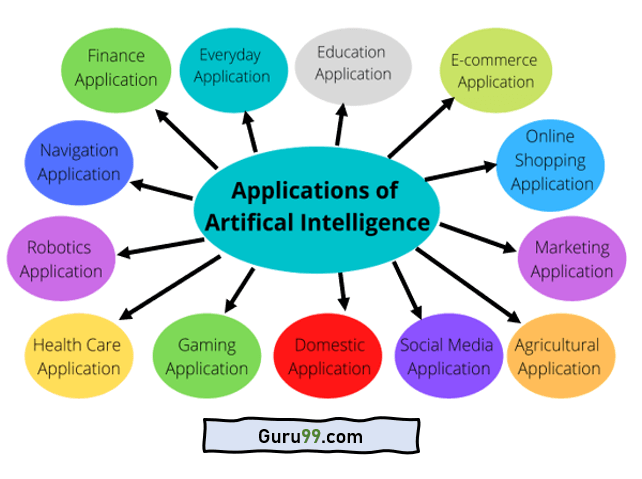
The chart below groups those sectors.
1) E-commerce Applications
Artificial Intelligence (AI) allows retailers to upgrade their customer experience on and off their web pages. It can be directed to make more informed decisions using customer and business data. It helps you to predict business trends and offers owners strategies and tips for developing their businesses.
The following are AI applications in the e-commerce sector:
Personal Shopping: Artificial intelligence technology uses recommendation engines to improve customer interaction.
For example, AI will use customers’ data to display the products and items they are most likely to want. It helps you to improve customer-seller relationships and builds trust towards the brand and its services.
Virtual Assistants: Natural language processing makes a conversation with software feel as close to human as possible. It provides real-time engagement between customers and AI assistants.
For example, the assistant would suggest tips to customers to buy the right product in a live chat.
Note:
- Real-time engagement means the customer and the assistant exchange messages live, with no waiting.
- NLP, or natural language processing, is the ability of a machine to understand human language.
Fraud Detection: Fraud detection is another important area of application for AI. It helps you to reduce the possibility of credit card fraud. It works by taking account of the latest activities, trends and behaviour when tracking customers’ transactions.
For example, sales security increases in peak periods of fraud and vice-versa. Customers prefer to invest their money in products and services with high-rated customer reviews. AI can easily detect this behaviour, allowing users to receive authentic service.
2) Education Applications
The same pattern repeats in classrooms, where the goal is to take routine work off teachers rather than to replace them.
AI is also used widely in the education sector to handle administration work. This allows teachers to concentrate more on students.
The following are essential AI applications in the education sector:
Automation of Administrative Tasks: AI has helped teachers and tutors to increase productivity.
For example, automated messages help staff grade homework, save time in communicating with guardians, and manage multiple courses simultaneously.
Smart Content Creation: Adaptive intelligence can digitize content like conferences, video lectures, and textbook guides.
For example, making audiobooks for students to listen to and preparing a flexible lesson plan.
The use of intelligent voice assistants: It allows students to access supplementary learning material and receive support from them. It also reduces the printing expenses of temporary handbooks. It provides quick solutions to frequently asked questions, unlike delayed responses from teachers.
Personalized Learning: AI technology offers hyper-personalization techniques to track students’ behaviour for self-improvement. It also includes habits and plans students need to adopt for better grades.
3) Everyday Use Applications
There are many applications of AI in our daily lives. It helps us to read emails, get driving directions, and find the best movie or music recommendations. It can also unlock electronic devices in the simplest of ways. Face ID is a biometric feature that uses AI to unlock the smartphone.
The following are AI applications in everyday use.
Automation On Vehicles: Automobile companies are using AI to teach computers to think and act like humans. It contributes to detecting and driving through obstacles.
For example, self-driving cars or autonomous vehicles work on the same concept.
AI In Spam Filters: AI in mail systems works by detecting and sending suspicious emails into trash or spam folders. It helps you save time by filtering out irrelevant emails and removes virus-infected messages that might delete your data. Probabilistic classifiers such as Naive Bayes were the original engine behind this filtering.
For example, Gmail has achieved a filtration capacity of about 99.9 percent.
AI In Face Recognition: Facial recognition is a commonly used AI application in businesses. Modern gadgets like phones, laptops and PCs use facial recognition technology to detect and identify users.
AI Recommendation System: These systems work on feedback drawn from user data. This application is widely used in every industry.
For example, the LinkedIn platform suggests relevant people to add to your network. Platforms like YouTube and Facebook use AI recommendation systems to deliver personalized information.
4) Navigation Applications
Artificial Intelligence is also helpful in navigating directions. AI-based GPS signals are used to ensure the safety of military units. These satellite-generated signals help you to track position, timing equipment, and navigation.
Here are the important AI applications in the navigation sector:
Road Mapping: GPS technology can give users accurate, timely, and thorough information to improve safety. A typical example of road mapping is Uber and other logistics firms that use AI for operational efficiency and optimizing routes. Google Maps also uses AI to calculate traffic and construction to find the quickest route to your location.
For example, Google Maps offers directions based on the shortest path from Berlin to Potsdam. The areas are highlighted in colour to represent the intensity of traffic. The dark colour indicates maximum traffic, whereas the light shade is for minimum traffic.
AI In Airline Flights: AI technology has widely contributed to plane operations. Autopilot and flight-management systems handle most of the cruise phase of a modern commercial flight, leaving pilots to manage take-off, landing and anything unexpected. Uncrewed aircraft that fly entirely under automated control are already in service.
5) Robotics Applications
AI applications are used in the robotics industry. AI-powered robots plan their journey based on obstructions in their path. AI helps robotics technology to increase machine intelligence in different scenarios.
For example, it allows the robot to understand logistical and physical data patterns to respond accordingly.
The following are AI applications in the robotics sector.
- AI-Based Household Robots: Amazon’s Astro bot is an example of an AI-powered domestic robot. It keeps watch on the home while moving around the house, and it can send an alert with an image of an unknown person inside.
- AI-Based Manufacturing Robots: AI-based manufacturing robots have the potential to be the most transformative. For example, robots can assemble a BMW car engine from small components.
6) Healthcare Applications
Artificial intelligence has many uses in the healthcare industry. For example, AI technology can detect chronic illnesses early by analyzing lab and other medical data. It combines historical analysis with medical knowledge to support the search for new medications, an idea that goes back to early expert systems in medicine.
Here are the AI applications in the health sector:
AI-Supported Medical Image Analyses: Artificial intelligence helps clinics examine body scans. This allows radiologists and cardiologists to find details needed to treat critical patients. AI also helps avoid potential errors in reading electronic health records (EHRs), supporting more exact diagnoses.
AI Can Predict Acute Kidney Injury: Acute Kidney Injury (AKI) develops quickly and may cause patients to deteriorate at any time, so those patients must be tracked closely. AI models help predict AKI up to 48 hours in advance, which buys clinicians time to intervene.
7) Gaming Applications
Artificial intelligence applications have gained decent popularity in the gaming industry. AI can generate human-like non-player characters (NPCs) to interact with players. It can also help to predict human behaviour, which can be used for better game design and testing. The goal of AI in gaming is to improve the player’s experience. Many modern game agents are trained with reinforcement learning.
Moreover, gaming today is not limited to consoles and desktop PCs. Instead, players expect rich game experiences on everything from smartphones to VR headsets. AI lets developers create console-like experiences on a variety of device types.
The following is an AI application in the gaming sector:
Alien: Isolation: Alien: Isolation, launched in 2014, is a well-known AI-driven game. It employs two artificial intelligence systems to interact with the player. The ‘Director AI’ tracks your whereabouts while the ‘Alien AI’ continuously hunts you.
8) Domestic Applications
Innovative home technology, an AI-based system, is widely used in domestic applications. These applications include household appliances, home safety, and security lighting.
AI can connect IoT devices to enhance processing and learning skills. These skills can predict human behaviour in return. AI-powered smart home gadgets interact to collect data that helps them learn human habits. This gathered information can forecast users’ habits and establish situational awareness.
The following are AI applications in the domestic sector.
Alexa, Google Assistant, And Siri: AI controls smart devices through voice control. It includes Alexa, Siri, and Google Assistant. Voice commands can be used to control advanced home security systems. Moreover, researchers have refined voice recognition technology to add value to voice control devices.
Home Automation Systems: Home automation means the automatic control of devices in your home. It allows owners to set alarm systems, control Bluetooth speakers and security cameras, and detect harmful gases.
9) Finance Applications
The benefits for the financial industry include personal money management, business finance, and consumer finance. AI’s evolved technology can help to improve a wide range of financial services. These services include venture capital, customer service, and the making of trading algorithms.
The following are AI applications in the finance sector.
Personal Finance: AI is widely used for personal finance services, such as chatbot advice or customized insights for wealth management. AI is needed for any financial institution that wants to keep pace with its competitors.
For example, Capital One’s Eno is an early AI assistant in personal finance.
Consumer Finance: Consumer finance means the money given to an individual for household or personal use. This finance division needs strong security in the transaction process.
Therefore, AI is the most helpful application from a security point of view. It deals with preventing fraud and controlling cyber-attacks. JPMorgan is one known bank that is utilizing AI in consumer finance processes.
Patterns and Anomalies:
AI is the best tool for verifying similarity and deviation in data. It uses machine learning and cognitive approaches to study patterns in data. It also serves to search for the connections between that data.
AI can examine and identify abnormalities in patterns that humans would otherwise ignore. The goal is to establish whether a set of data points fits the given pattern. If the data does not fit, it is an anomaly.
10) Social Media Applications
AI can use data from social media audiences to generate revenues. The following are AI applications in the social media sector.
- Instagram: Instagram utilizes big data and artificial intelligence to achieve its goals. This social media platform uses it for targeting advertisements, combatting cyberbullying, and removing abusive comments.
- X (formerly Twitter): The platform uses AI for product improvement, post recommendations, and restricting abusive comments. It uses an artificial neural network to learn about users’ preferences over time as it rapidly processes a large amount of data.
- Facebook: Facebook uses AI-based DeepText technology for language processing. That allows Facebook to better interpret discussions, and the same deep learning approach can translate posts from multiple languages automatically.
11) Agriculture Applications
From social feeds to open fields, the same models handle very different inputs.
AI is an emerging technology in the agriculture field. It helps to improve accuracy and harvest quality, an approach known as precision agriculture.
The use of AI can bring sustainability to the agriculture sector.
For example, it can yield healthier crops, control pest attacks, and measure soil conductivity and pH.
The following are AI applications in the agriculture sector.
- AI In Weather Forecast: Farmers can analyze weather forecasts in detail using artificial intelligence. That would help them create the best planting schedule and choose the type of crop to be grown.
- AI Eliminating Soil Deficiencies: An AI-based app such as Plantix uses an algorithm to trace what plants and soils are lacking. It also examines deficiencies in the soil and helps eliminate plant pests. AI further provides recommendations and tips for healthy plant growth.
12) Marketing Applications
Artificial intelligence (AI) applications are also critical in marketing. Marketers use the newest data-driven strategies to produce sales. For example, AI can track sales data for a certain period to suggest strategies for the near future. The use of AI in marketing applications allows owners to collect and analyze huge amounts of data in a short time.
The following are AI applications in the marketing sector.
- Personalized Advertising: Marketers can use AI to produce highly focused and customized ads, drawing on behavioural analysis, pattern recognition and similar techniques. It helps target audiences at the right time to ensure more significant results.
- Content Marketing: AI can assist with content marketing in a way consistent with the brand’s style and voice. It can manage routine tasks such as campaigns, reports, and performance tracking.
13) Online Shopping Applications
The current e-commerce market is competitive and saturated, so businesses need to be faster and smarter to succeed. Consider the construction of a website. For example, an AI website builder can design the website for you within minutes, unlike time-consuming manual web design.
The following are AI applications for online shopping.
Inventory Management: AI’s predictive analytics are making a massive impact on inventory management. For example, it can keep inventory up to date, shelves stocked, and track everything, which is difficult to do manually.
It can also carry out predictive analysis on current and future market demand. That brings the right stock into place before it is needed for a successful business.
Is Artificial Intelligence Limiting Human Roles?
AI replaces most repetitive tasks and other duties with robots. Human involvement decreases, which will present a significant challenge to employment standards. Many firms aim to replace the least skilled roles with AI robots that can do similar jobs more efficiently. However, not every firm can afford an AI machine because of its creation, maintenance, and repair expenses.
They also require compatible software and hardware updates to meet advanced targets. That might consume a lot of productive time. AI is more efficient than humans at repetitive industrial and domestic work.
However, it still lacks some meaningful qualities that demand human intervention. So, it is the AI-human partnership that can bring a brighter future. To explore this further, consider checking out some of the best AI chatbots, which are excellent examples of this partnership in action.
Why Is AI Used?
Across all thirteen sectors, three motives keep recurring, and the diagram below sets them side by side.
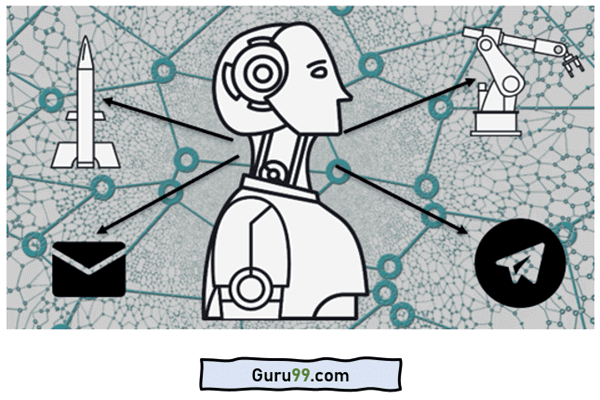
Following are some essential reasons for using AI:
- Automation: AI can automate repetitive tasks that were earlier performed manually, so the work finishes in less time.
- Accuracy: AI can be trained to be more accurate than humans at narrow tasks. It can extract and interpret data to support better decisions in medical work. For example, it can pinpoint locations in the body where cancerous cells are developing.
- Enhancement: AI makes products and services more effective by creating a better experience for end users. That includes optimizing conversation bots or communicating better product recommendations.
