Retail POS Testing validates that Point of Sale terminals, store servers, and enterprise systems process every transaction accurately, securely, and quickly across omnichannel, contactless, mobile POS, and QR payment journeys while staying compliant with EMV and PCI DSS standards.
🛒 Three-Tier Architecture: Validate POS terminals, store servers, and enterprise servers together because hardware, network, and analytics layers fail in different ways.
💳 Payment Coverage: Exercise EMV chip, contactless, mobile wallets, and QR flows so card data stays encrypted from swipe to settlement.
🧪 Scenario Depth: Cover cashier activity, sales, returns, promotions, negative paths, and report generation to mirror real store traffic.
✅ PCI DSS Compliance: Combine penetration testing, vulnerability scans, and access reviews to satisfy retail audit and breach prevention duties.
🛠️ Peripheral Reliability: Verify RFID readers, barcode scanners, printers, and cash drawers under load to prevent checkout queues and lost revenue.
🤖 AI Assistance: Apply AI fraud detection models and AI test automation to flag anomalies and accelerate regression cycles across releases.
POS Testing is defined as the testing of a Point of Sale application. A POS or Point of Sale software is a vital solution for retail businesses to carry out retail transactions effortlessly from anywhere. You have likely seen a Point of Sale terminal while checking out at your favorite mall or grocery store, and today the same workflows run on mobile POS tablets, self-checkout kiosks, and contactless QR readers.
The Retail POS system is more complex than it appears and is tightly integrated with other software systems like warehouse, inventory, purchase order, supply chain, marketing, and merchandise planning. Strong POS domain knowledge is therefore essential for testers who need to validate end-to-end omnichannel journeys.
Test Architecture for POS Application
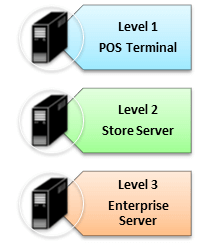
A Retail POS test architecture includes three components for testing: the POS terminal, the store server, and the enterprise server. Validation is therefore classified into three levels so that hardware, in-store transactions, and head-office analytics each receive the right depth of coverage.
Level 1- (POS Terminal )
Level 2- (Store Server)
Level 3- (Enterprise Server)
Device and hardware testing (RFID, Scanner, Printer, Barcode reader)
With the architecture in mind, the testing of a POS system can be broken down into two levels that map to where the software runs and who consumes the results.
Once the scope is clear, the next step is to translate it into executable scenarios. To ensure the quality of the POS system, proper POS software testing is mandatory. The POS testing scope spans the following areas, including modern contactless and mobile wallet flows.
Test Scenario
Test Cases
Cashier activity
Test that the entry of items purchased by a customer is correct
Test discounts are applied correctly
Verify store value cards can be used
Check petty cash management works as expected
Check totals and closings match
Check cash drawer loans are handled properly
Test the POS system is compatible with peripherals like RFID Reader, Bar Code Scanner etc.
Payment Gateway Processing
Test the validity of the CVV number of a credit card
Test swiping of cards from both sides, EMV chip insertion, and contactless taps
Verify mobile wallet and QR code payments complete end-to-end
Verify that the captured card details are properly encrypted and decrypted
Sales
Check for a regular sale process
Check sales can be processed with debit/credit cards
Check for loyalty membership purchase
Check that the correct prices are displayed for merchandise purchased
Test for “0” or null transaction
Tie UPC or barcodes to vendors
Test for billing details or shipping details in payment manager
Test for reference transaction
Test the print format of the receipt generated
Verify that the correct code is generated for approved, hold or declined transactions
Return & Exchange scenarios
Make sure the in-house inventory is well integrated with other outlets or the supply chain
Check for exchange or return of an item with cash
Check whether the system responds on exchange or return of an item with a credit card
Check the system processes the sale with a receipt or without a receipt
Verify the system allows entering a bar-code manually in case the scanner does not work
Verify the system displays both the current amount and the discount amount on an exchange of item if applicable
Performance
Check the speed or time taken to receive a response or send a request
Check that transaction based rules are applicable (discounts/tax/rebates etc.)
Verify that the correct code is generated for approved, hold or declined transactions
Negative Scenarios
Test the system with expired card details
Test with an invalid PIN for credit card
Check the inventory by entering a wrong code for the item
Check how the system responds while entering a wrong invoice number
Test for a negative transaction
Test the response of the system while entering an invalid date for promotional offers on online items
Managing Promotions and Discounts
Test the system for various discounts like a veteran discount, seasonal discount, undergage or overgage discount etc.
Test the system for various promotional offers on certain line items
Test the alert system that notifies the end or beginning of seasonal offers
Test whether the receipt prints the exact discount or offers that are leveraged
Test the system for allocating wrong offers or discount on an online item
Test the order management process
Verify product data obtained after scanning a barcode is accurate
Tracking customer’s data
Test for system response with incorrect customer data input
Test the system for allowing authorized access to customer’s confidential data
Test the database for recording customer’s buying history (what they buy, how frequently they buy, etc.)
Security & Regulatory Compliance
Verify the POS system against regulatory compliances such as PCI DSS and EMV
Test the alert system that notifies security defenders
Make sure you can void a payment before posting
Test user profiles and access levels on the POS Software
Test database consistency
Verify specific information about each tender such as cash, coupon identifier, check number and so on
Report testing
Testing of a trend analysis report
Test information related to credit card transactions is reflected in reports
Test for the individual as well as consolidated reports of customer buying history
Test for online report generation
Security Testing for Retail POS Systems
Because payment data is involved, security work deserves its own dedicated pass. Recent studies have flagged Point of Sale Systems as having very high security vulnerabilities. The following measures will help with the security of POS deployments running EMV, contactless, and mobile POS payments.
Security testing in compliance with the PCI DSS standard is very crucial and must be addressed as part of enterprise testing
Actively manage all software on the network so that only authorized software can execute and be installed
Conduct regular Penetration Testing to identify attack vectors and vulnerabilities
Include tests for the presence of unprotected system information and artifacts that would be useful to hackers
Use vulnerability testing tools
Create a testbed that imitates a production environment for specific penetration tests and attacks against elements that are not tested in production
Challenges in POS Testing
Even with a strong test plan, several recurring obstacles slow down POS quality engineering teams, especially as retailers extend into omnichannel and mobile POS.
Multiple configurations across store formats and hardware vendors
Complex interfaces with inventory, ERP, CRM, and payment processors
Peripheral issues with scanners, RFID, printers, and cash drawers
Frequent upgrades to firmware, operating systems, and payment kernels
PCI DSS compliance and EMV certification cycles
Test lab maintenance to mirror live store environments
Best Practices for Retail POS Testing
To overcome those challenges, mature retail engineering teams adopt the following best practices that combine domain expertise with modern automation.
Build a hardware-in-the-loop lab that mirrors store peripherals, network latency, and offline failover
Automate regression suites across the three architecture levels so each release validates terminal, store server, and enterprise flows
Apply AI-driven test automation to prioritize high-risk scenarios and self-heal locator changes
Run continuous PCI DSS and EMV compliance checks rather than waiting for an annual audit
Include omnichannel journeys such as buy-online-pick-up-in-store, mobile POS line busting, and QR-based contactless checkout
Monitor production telemetry and feed real failure signatures back into the regression suite
FAQs
Retail POS Testing validates that Point of Sale software, hardware peripherals, and back-end servers process every checkout accurately and securely. It covers functionality, payment processing, performance, security, and integrations with inventory, CRM, and supply chain systems across in-store, mobile POS, and contactless channels.
The three levels are the POS terminal, the store server, and the enterprise server. Terminal testing focuses on devices and peripherals, the store server layer covers in-store interfaces and disaster recovery, and the enterprise server level handles security, analytics, compliance, and head-office reporting.
A complete suite covers cashier activity, payment gateway processing, sales, returns and exchanges, performance, negative paths, promotions and discounts, customer data tracking, security and regulatory compliance, and report generation. Modern suites also add omnichannel, mobile POS, and contactless QR payment journeys.
PCI DSS requires retailers to protect cardholder data through encryption, access control, vulnerability management, and ongoing monitoring. POS test plans must include penetration testing, vulnerability scans, role-based access verification, and EMV certification checks so that the system passes audits and prevents breaches.
Peripheral testing covers barcode scanners, RFID readers, receipt printers, customer-facing displays, cash drawers, weighing scales, EMV chip and contactless card readers, signature pads, and mobile POS sleds. Each device must work reliably under load and degrade gracefully when offline.
AI models learn baseline patterns for cashiers, customers, payment methods, and store locations, then flag anomalies such as unusual refund volumes, repeated voids, suspicious card-not-present sequences, or off-hours transactions. Testing teams validate these models with curated fraud datasets and adversarial scenarios so detection stays accurate as fraud tactics evolve.
Yes. AI test automation tools generate test cases from user stories, self-heal locators when the POS UI changes, prioritize high-risk paths using historical defect data, and create synthetic transaction data for performance runs. The result is faster regression coverage across terminals, store servers, and enterprise reports without growing the maintenance backlog.
Summarize this post with:
Stay Updated on AIGet Weekly AI Skills, Trends, Actionable Advice.
Sign up for the newsletter
You have successfully subscribed. Please check your inbox.

 Editorial Team