
How to Open an APK File?
 Editorial Team
⚡ Smart Summary
Opening an APK File means installing or extracting an Android Package Kit, the ZIP-based container that holds everything an Android app needs to run. This tutorial explains how to open APK files on Android, Windows, Mac, and iPhone, plus the best opener tools.

What is an APK File?
APK stands for Android Package Kit, which comprises all the data needed by a single Android application to run successfully on an Android operating system. Android Package Kits are usually in the ZIP file format.
This article is a comprehensive guide on installing APK files and opening them across various operating systems.
How to Install an APK File on Android
Opening an APK on Android is a two-step process: first enable installation from unknown sources, then install the file. The methods differ slightly by Android version, so follow the section that matches your device.
Part 1) Enabling Install from Unknown Sources
You need to allow opening APK files from external sources. Different methods for different versions of Android are given below.
For Android 8.0 Oreo and Later
Follow these steps to allow the installation of an APK file on Android 8.0 Oreo and later.
Step 1) Find “Apps and notifications” in Settings. On your Android device (Android 8.0 and later), go to Settings and tap “Apps and notifications.”

Step 2) Tap “Special app access.” After opening Apps and notifications, scroll down and tap the “Special app access” option.

Step 3) Tap “Install unknown apps.” Scroll down to find the “Install unknown apps” option and tap it.

Step 4) Select the browser of your choice. You will be directed to a page where you can choose the browser you will use to download the APK file.
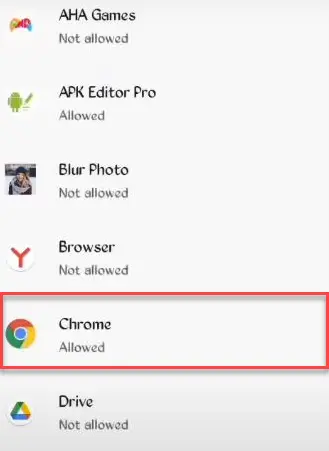
Note: The process may differ depending on your device. For instance, on a Xiaomi Redmi Note device, you find “Install Unknown Apps” by searching “Special App Access.”
Step 5) Enable the toggle button. Tap the toggle to allow app installs from your preferred browser.

For Android 10 and Later Versions
In Android 10 and later, use the search bar in Settings to enable “Install Unknown Apps.” Here is how.
Step 1) Search for “Install Unknown Apps.” Open the Settings app on your Android phone (Android 10 and later) and search for “Install Unknown Apps” in the settings search bar.

Step 2) Tap “Install Unknown Apps” under Special app access. After searching, you are directed to a page titled “Special App Access.” Scroll down and tap “Install Unknown Apps.”
Step 3) Select the browser of your choice or the origin of the unknown app. You will be directed to a page where you can choose where the file will originate — phone memory, a browser, or an online drive. In this case, we added it from Google Drive.
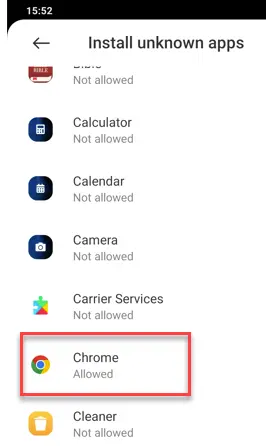
Step 4) Enable the toggle button. After selecting the file’s origin, enable the toggle button.
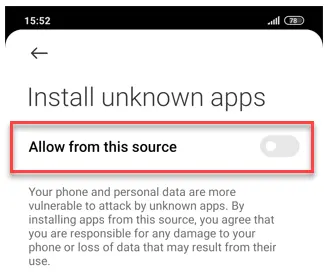
For Versions Earlier Than Android 8.0
The process is straightforward on these versions.
Step 1) Find “Security” under Settings. On your Android device (an earlier version of the operating system), tap Security settings.
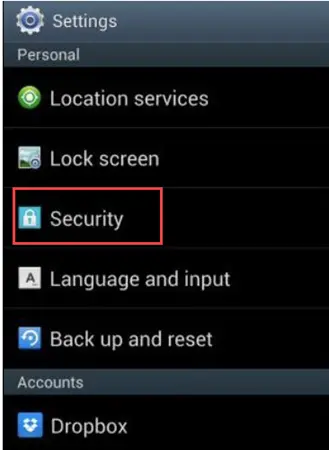
Step 2) Verify installing from an unknown source. Under Device Administration, tap the box to allow installing apps from an unknown source.

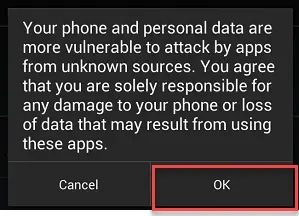
Step 3) Click “OK” to verify. You will see a warning that you are about to install a potentially harmful APK file. Click “OK.”
Part 2) Installing the APK
Once you enable access, the next step is to install the APK. There are two methods, given below.
Method 1: Installing From Your Browser
In this example, we use the Redmi Note 8, an Android 10 device. Here are the steps for installing APK files from your browser.
Step 1) Find the APK file through your browser. Open your browser, find an APK file of your choice, and tap to download it. You should see the download notification in the top bar of your Android device.
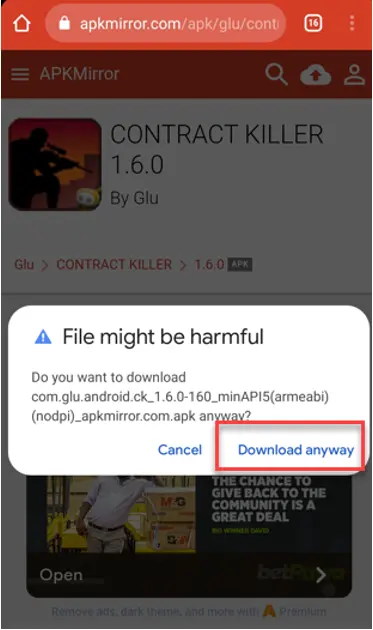
Step 2) Tap to open the APK file and begin installing. Once downloaded, open Completed Downloads and tap the APK file to install. The app should begin installing.

Method 2: Installing From Your Computer
You do not necessarily need a smartphone to download an APK file. You can also download apps and transfer them from your desktop PC.
Step 1) Find an APK file of your choice. Search for an Android APK file online and download it to a location on your computer.

Step 2) Connect your phone to the computer. After downloading, plug your Android device into the computer via USB. A pop-up will prompt you to choose the USB purpose — select File Transfer.

Step 3) Find your phone on the computer. Open Devices and Drives in “My Computer” to locate your phone.

Step 4) Copy the APK file to your device. Create a folder on your device (or pick an existing one) and copy the downloaded APK file into it. Once copied, disconnect the USB.
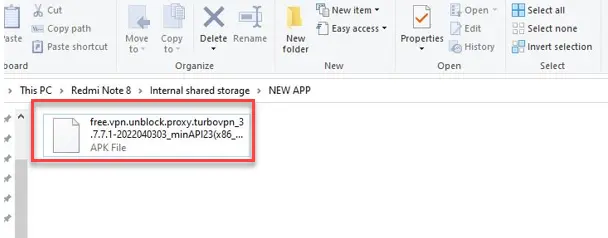
Step 5) Tap to install the APK file. Once the APK file is on your device, tap to install it.

You are now done with installation. Open the app from your Android device and confirm it works. If it does not, find another APK source and repeat the process.
Important Contents of an APK File
For an app to run successfully on an Android device, it must contain certain commands and code specific to Android devices. These commands are grouped into folders and files that every Android app and APK contains. Below is the list of files that are part of every Android app.
- META-INF/ — contains the manifest file and a resource list in the archive.
- lib/ — contains compiled code specific to a processor’s software layer, with subfolders such as armeabi, armeabi-v7a, x86, and MIPS.
- res/ — contains resources that were not compiled into resources.arsc.
- assets/ — contains raw resource files retrievable by AssetManager.
- AndroidManifest.xml — describes the name, version, access rights, and referenced library files for the APK.
- classes.dex — contains classes compiled in dex format for the Dalvik virtual machine.
- resources.arsc — contains pre-compiled resources such as binary XML.
How to Fix the “Can’t Open File” Problem on Android
If a .xapk file shows a “Can’t Open File” notification on Android, the steps below resolve it.
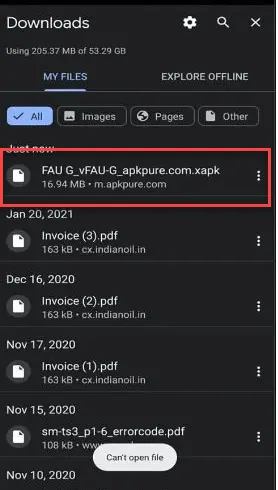
Step 1) Download and install ZArchiver from the Google Play Store.

Step 2) Give ZArchiver access permissions. Open the app and grant permissions by tapping Allow.

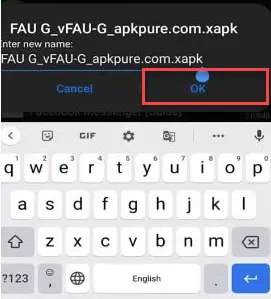
Step 3) Rename the file to .zip. Locate the file with the error, long-press it, remove the .xapk extension, and add .zip at the end. Tap OK to save.
Step 4) Extract to convert APK files. Locate the renamed .zip file and tap “Extract here” to start extracting the APK files.

Step 5) Click to install. The archive is now extracted and the .xapk is converted into an APK file. Find the file that starts with “com.” and ends with “.apk”, then tap to open and install it.

How to Open an APK on iPhone
APK files are not designed for iPhones, so they cannot be opened directly on an iOS device. You have two alternatives:
- Find the corresponding app on the Apple App Store.
- Get the app from the developer using an IPA file.
IPA is the iOS equivalent of an APK. IPA files are written for Apple iOS devices such as iPhone, iPad, and iPod Touch and are found only in the Apple App Store.
How to Open an APK File on Windows/PC
You cannot open an APK file directly on Windows because it is not in EXE format. However, you can use an emulator to open APK files on your computer.
Emulator tools that support opening APK files on PC:
- BlueStacks
- LDPlayer
- Android Studio
- Nox Player
You can also check our list of Best Android Emulators.
Opening APK Files Without Emulator Tools
APK files can be opened on a PC with an emulator like BlueStacks, but downloading and setting up such tools can be daunting and may slow down your PC. There are other ways to open APK files without emulator tools:
- With Android x86.
- With the Chrome extension Android emulator (APK Online).
How to Open APK Files on Mac
Like iOS, macOS is not built to open APK files. However, the ARC Welder tool can help. ARC Welder is a Chrome extension used to test Android apps in Chrome. As long as you have the extension installed in Chrome, you can open an APK file on macOS.
Emulator tools that support opening APK files on macOS:
APK File Opener Tools
APK files cannot be opened on their own in any operating system other than Android. Windows and Mac computers cannot decode these files, so you need additional tools to open and run them. The software below lets users open, edit, and view Android Package files.
1) BlueStacks
Best for enabling Android apps to run on PC and macOS. BlueStacks is one of the most popular emulators for Windows and macOS because it is simple to install and use. The platform has over 300 million users.

Features:
- Move files between BlueStacks and Windows through a shared folder.
- Sync apps between the Windows app and your phone through Cloud Connect.
- Easy to install and use.
- Does not use much RAM.
2) LDPlayer
Best for using virtualization technology to access the Android operating system on a computer. LDPlayer is one of the fastest Android emulators available, letting users experience Android on a PC without worrying about hardware limitations.

Features:
- Drag-and-drop installation.
- Key-mapping and mouse support for playing games from the keyboard.
- Simple and clean interface.
- Smooth gaming experience.
- Multiple profiles and key-mapping tools.
3) WinRAR
Best for multimedia files, thanks to its ability to select the best compression method for each file. WinRAR is an easy-to-use tool for opening APK files. The extractor compresses large files quickly and is popular with over 500 million users.

Features:
- Additional functions that help organize archives.
- Among the fastest tools available.
- Supports nearly all compression formats.
- Saves disk space, transmission costs, and working time.
- Splits archives into volumes saved on different disks.
4) WinZip
Best for bank-level encryption and reducing the size of email attachments. WinZip is easy to use, and its speed and efficiency in unpacking Android Package Kit files make it popular. WinZip can access files on your PC and remotely on networks and clouds such as Google Drive, OneDrive, and Dropbox.

Features:
- Supports almost all file formats.
- Effective compression, ideal for reducing email attachment sizes.
- Strong encryption for protecting files.
5) Google Android SDK
Best for its toolset for building Android applications. Android Studio is an efficient tool for writing apps and is popular among Android developers. It includes a graphical interface that emulates a handheld environment, enabling developers to test and debug code.

Features:
- Visual layout editor for dragging and dropping UI elements.
- Code templates that let coders work faster.
- An APK analyzer that compares two APK apps and their size changes across versions.
- Google Cloud Platform and GitHub integration for importing code and publishing projects.
Link: https://developer.android.com/studio
6) 7-Zip
Best for file protection, thanks to its self-extracting ability and strong encryption. 7-Zip is free, open-source software used to compress and archive data. It groups files into a single archive and reduces file size for quick transfers.

Features:
- Supports many major file formats.
- The 7z archive format has a higher compression ratio than .zip.
- Strong encryption for file protection.
- Windows Shell integration.
- Self-extracting capabilities.
- Powerful file manager and a command-line version.
- Available in 87 languages.
Link: https://www.7-zip.org/
Troubleshooting Opening APK Files
There are many reasons an APK file may not open. Below are common problems and their solutions.
Use an app for bundle installation: Some APK files come in bundles and need an installer such as Split APKs Installer. Files with the extensions APKM, XAPK, and APKS are not regular APKs and require a dedicated installer.
Perform a clean install, do not update: Updating to a newer version does not always work. Try uninstalling the original app and performing a clean install instead of overwriting it.
Make room: Lack of space can prevent an app from opening. Ensure there is enough storage space by doing the following:
- Use an SD card for media such as music, videos, and photos.
- Use Google Photos for cloud backups.
- Use Google Drive or another third-party cloud service.
- Clear data from apps.
- Uninstall unused apps.
Make sure the file is not corrupted: Some third-party APKs come corrupted or unsafe and will not run. Always download from known, trusted sites such as APK Mirror that check apps before publishing them.
Enable installation from unknown sources: You must allow third-party installations to open unofficial APK files.
