
CISSP Certification Guide: Exam, Cost & Training
 Editorial Team
⚡ Smart Summary
CISSP, the Certified Information Systems Security Professional credential from ISC2, is the recognized quality standard for senior information security roles, covering eight knowledge domains, five years of verified experience, and a globally accredited exam.
What is CISSP?
CISSP, short for Certified Information Systems Security Professional, is regarded as a quality standard in the field of information security.
The certification is offered by ISC2, an international non-profit organization whose community of members, associates and candidates passed half a million in 2023. Introduced in 1994, CISSP remains one of the most requested security credentials in job listings. The exam is delivered worldwide through Pearson VUE test centres in English, Chinese, German, Japanese and Spanish. The certification is accredited to ISO/IEC Standard 17024 and is approved under U.S. Department of Defense manual DoDM 8140.03.
Today, many IT security professionals prefer CISSP certification training. It gives an information security professional an objective measure of competence and a globally recognized standard of achievement. Note that the organization dropped the older (ISC)² styling in favour of ISC2 in 2023, so both spellings still appear across older study material.
Important Domains of CISSP Certification
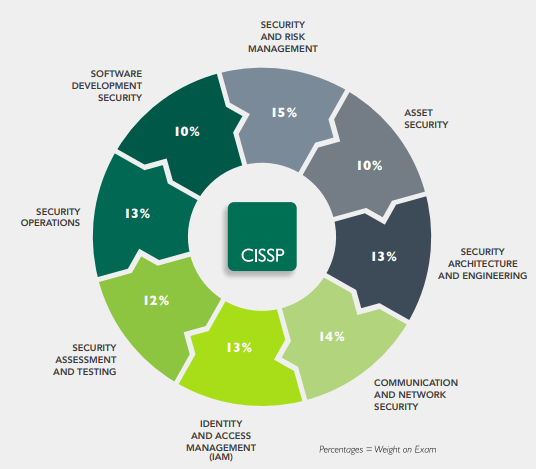
A domain is a broad topic that you need to master to ace the CISSP certification exam. The eight domains below, together with the weight each carries on the exam, come from the current exam outline that took effect on 15 April 2024.
| Domain | Exam weight |
| Domain 1. Security and Risk Management | 16% |
| Domain 2. Asset Security | 10% |
| Domain 3. Security Architecture and Engineering | 13% |
| Domain 4. Communication and Network Security | 13% |
| Domain 5. Identity and Access Management (IAM) | 13% |
| Domain 6. Security Assessment and Testing | 12% |
| Domain 7. Security Operations | 12% |
| Domain 8. Software Development Security | 10% |
The diagram below groups the same eight domains as they appear in the ISC2 Common Body of Knowledge.
Skills Developed After CISSP Certification
By the end of the CISSP certification course you should be able to:
- Define the architecture, design, and management of security across your organization.
- Apply the knowledge and skills expected of a qualified CISSP professional.
- Work confidently across the eight domains of the CISSP Common Body of Knowledge (CBK).
- Design access control systems and apply secure software development methods.
- Optimize day-to-day security operations, from monitoring to incident response.
Who Should Do a CISSP Certification?
CISSP certification training is aimed at experienced practitioners and managers, including:
- Chief Information Security Officer
- Director of Security
- Network Architect
- Security Consultant
- Security Manager
- Security Auditor
- Security Analyst
- IT Director/Manager
- Cloud security manager
- Security Systems Engineer
How to Become CISSP Certified?
Here are the steps you need to follow to become a CISSP certified professional.
Step 1) Understand the Exam Format
CISSP is a CAT (computerized adaptive test) of 100 to 150 questions, delivered in that format worldwide. You get three hours, and you need to score 700 out of 1000 to pass. Every exam includes 25 unscored pretest items, and answers cannot be reviewed or changed once submitted.
Step 2) Match the Eligibility Criteria: Key Prerequisites
- You need at least five years of cumulative, paid, full-time work experience in at least two of the eight domains of the CISSP Common Body of Knowledge.
- A four-year college degree, a regional equivalent, or an approved credential from the ISC2 waiver list satisfies one year of that requirement. Only one waiver is allowed, and the waiver list was last revised on 1 April 2026.
- If you do not yet have the experience, you can become an Associate of ISC2 by passing the exam.
- An Associate of ISC2 then has six years to earn the five years of required experience.
- Once certified, you recertify every three years by earning continuing professional education (CPE) credits and paying the annual maintenance fee.
Step 3) Take the Training
Next, enroll in a CISSP training program to get a comprehensive understanding of the course modules. It improves your odds of passing and takes some of the pressure out of preparation. A certified instructor will guide you through the exam expectations, and official self-study material is available if you prefer to work alone.
Step 4) Create Your Pearson VUE Account
ISC2 exams are delivered exclusively through Pearson Professional Centers and authorized test centres, so you need a Pearson VUE account to book a seat. The Pearson VUE site lists testing locations, policies, and accommodation arrangements.
Step 5) Register and Plan Your Exam
Proceed with the registration, which requires you to complete the examination agreement.
You must attest to the truth of your statements about your professional experience and legally commit to the ISC2 Code of Ethics. You also pay the exam fee at this point, which is US$749 in every region.
Step 6) Take the Exam
Sit the CISSP exam to have your knowledge and judgement assessed. Results are issued immediately, and candidates who do not pass receive domain-level feedback showing where they fell short.
Step 7) Subscribe to the ISC2 Code of Ethics
Once you have passed the exam, you must subscribe to the ISC2 Code of Ethics to receive your CISSP certification.
Step 8) Get Yourself Endorsed
Lastly, you need to have your application endorsed within nine months of your exam date. An endorsement form verifying your professional experience must be completed and signed by an active ISC2 certified professional. If you do not know one, ISC2 can act as your endorser.
Why Become CISSP Certified?
Here are the main reasons to enroll for the CISSP certification course:
- CISSP is an international credential, not specific to any country, which gives you global recognition.
- The training gives you the technical knowledge and skills to build a holistic security program.
- It helps you stand out from other candidates for information security roles.
- You gain access to career resources, peer networking, and the exchange of ideas with other members.
- It validates the skills and competence you have gained through years of work in cyber security.
- The certification confirms that you are capable of developing information security policies, standards, and procedures.
- Membership brings perks such as a subscription to InfoSecurity Professional magazine, discounted ISC2 textbooks, webinars, and a digital badge.
Course Objectives of CISSP Certification
Here are the objectives of the certification course:
- Become familiar with the ISC2 Common Body of Knowledge (CBK) and its terms, principles, and categories.
- Understand the CISSP exam process and build a study plan for passing it.
- Widen your knowledge of software security concepts and practices.
- Become more marketable in a competitive workforce and show your commitment to the discipline.
- Increase credibility and goodwill for your organization when working with vendors and contractors.
- Speak a universal security language built on industry-accepted terms and practices.
Guide to Ace CISSP Certification
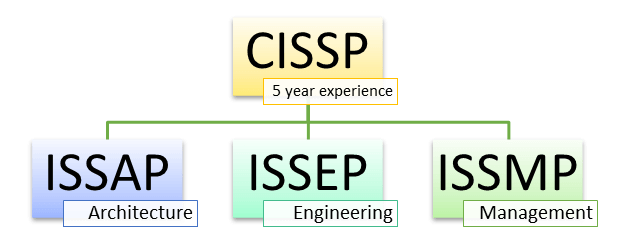
The checklist above summarizes the preparation habits that work; the tips below expand on them.
- Decide how many days you need to prepare, then form a local study group and work through difficult topics together.
- Focus on the domains you know least well, and weight your time toward the heavier domains in the table above.
- Practise a minimum of 50 questions per domain.
- Push your practice scores to a consistent 80%.
- Expect two to three months of study to cover the CISSP course material.
- Use multiple study resources: reference books, learning materials, online eLearning, and free practice tests.
- Prepare for the endorsement process before you sit the exam, not after.
- Read each question carefully and answer the ones you know first.
- Watch the clock. The adaptive exam gives you three hours for 100 to 150 items, so aim for roughly a minute and a half per question.
- Remember that the exam tests principles, so some questions will feel removed from day-to-day practice.
Salary of CISSP Certified Professionals
Salary studies consistently show a premium for CISSP holders over non-certified peers in comparable roles. Recent 2026 surveys put the median United States salary for CISSP holders around US$150,000, with most roles falling between US$120,000 and US$170,000 depending on seniority and location.

As the chart shows, pay scales differ by region and by country, so treat any single figure as a benchmark rather than a promise. If you are still mapping out a route into the field, compare CISSP with the other options in this guide to cyber security certifications and the CompTIA certification guide.
