
8 Best FREE Online Cyber Security Courses (2026)
 Editorial Team
Cybercrime affects individuals, small businesses, and large organizations worldwide. As digital threats become more frequent and complex, employers need professionals who can protect networks, systems, accounts, and sensitive information. This demand has created opportunities in security analysis, incident response, risk management, and network defense.
However, many people and small businesses still lack the knowledge needed to recognize threats and reduce security risks. Online cybersecurity courses provide a structured way to develop these skills.
This article compares 8 beginner and intermediate cybersecurity courses from Coursera and Udemy. It covers course content, duration, certificates, access conditions, advantages, and limitations to help you choose suitable training for your experience and career goals. Read more…

Affiliate Disclosure: Guru99 is reader-supported. We may earn a commission when you buy through links on our site. Learn More
Best Online Cyber Security Courses with Certificates: Top Picks!
| Course Name | Provider | Duration | Ratings | Link |
|---|---|---|---|---|
| Cybersecurity for Everyone | University of Maryland on Coursera | 2 weeks at 10 hours per week | ⭐ 4.7 | Enroll Now >> |
| Introduction to Cyber Security Specialization | New York University on Coursera | 2 months at 10 hours per week | ⭐ 4.7 | Enroll Now >> |
| Cybersecurity: Developing a Program for Your Business Specialization | Kennesaw State University on Coursera | 4 weeks at 10 hours per week | ⭐ 4.5 | Enroll Now >> |
| The Complete Cyber Security Course: Hackers Exposed! | Nathan House on Udemy | 12 hours 5 minutes | ⭐ 4.6 | Enroll Now >> |
| Cyber Security: From Beginner to Expert | Logix Academy on Udemy | 15 hours 34 minutes | ⭐ 4.6 | Enroll Now >> |
1) Cybersecurity for Everyone (Coursera)
Specs: Duration: 2 weeks at 10 hours per week | Certificate on Completion: Yes | Level: Beginner | Modules: 6 | Rating: 4.7
Cybersecurity for Everyone is our Top Recommendation for learners who need security context without a technical background. University of Maryland instructor Charles Harry explains cyber policy, internet governance, threat actors, hacking stages, and organizational consequences.
The course works well for managers, students, and nontechnical teams that need a shared vocabulary. Its policy focus is the main limitation. Learners seeking command-line labs, vulnerability scanning, or defensive tool practice should choose a more technical option.

What will You Learn?
- Security Foundations: Distinguish cyber activity, security concepts, cybersecurity policy, governance, privacy, and organizational risk.
- Internet Architecture: Explain how data moves across networks and how internet governance influences cybersecurity decisions.
- Threat Actors: Compare criminals, hacktivists, hobbyists, and advanced persistent threats by motivation and capability.
- Hacking Process: Trace reconnaissance, weaponization, delivery, exploitation, installation, command, control, and resulting effects.
- Strategic Response: Evaluate direct and indirect consequences before selecting policies that reduce cybersecurity risk.
Pricing:
Free to Enroll
How to Enroll in Cybersecurity for Everyone
- Step 1) Open the Coursera course page.
- Step 2) Review the preview, purchase, subscription, trial, and financial-aid options shown for your account.
- Step 3) Create an account, select the appropriate access option, and begin the first module.
2) Introduction to Cyber Security Specialization (Coursera)
Specs: Duration: 2 months at 10 hours per week | Certificate on Completion: Yes | Level: Beginner | Courses: 4 | Rating: 4.7
Introduction to Cyber Security Specialization builds a broader foundation across identification, authentication, risk, and system protection. New York University structures the program as four connected courses for learners entering information security.
Its sequence suits beginners who prefer academic explanations and graded assignments. The material introduces technical ideas but does not replace a home lab or job-focused certification course. Students should add practical exercises if they want stronger command-line and incident-response experience.

What will You Learn?
- Purpose of Cybersecurity: This feature aims to explain how cybersecurity protects systems, data, and networks in order to prevent breaches and attacks.
- Basics of Identification and Authentication: You will learn the most effective ways to verify user identities and control access, helpful to strengthen system security.
- Security Using Obscurity: This highlights the pros and cons of relying on obscurity as a security approach, typically used for specific threat scenarios.
- Lifelong Learning in Cybersecurity: Develop a structured learning plan for building relevant skills and exploring different cybersecurity career paths.
- Threat Detection: Examine firewalls, intrusion prevention, TCP/IP attacks, and real-time mitigation methods for enterprise networks.
Pricing:
Free to Enroll
How to Enroll in Introduction to Cyber Security Specialization
- Step 1) Open the specialization page on Coursera.
- Step 2) Compare the preview, subscription, trial, and financial-aid options available.
- Step 3) Register and begin the first course in the series.
3) Cybersecurity: Developing a Program for Your Business Specialization (Coursera)
Specs: Duration: 4 weeks at 10 hours per week | Certificate on Completion: Yes | Level: Beginner | Courses: 4 | Rating: 4.5
Cybersecurity: Developing a Program for Your Business focuses on security as an organizational responsibility. Kennesaw State University covers mobile risk, connected devices, human behavior, policy, governance, and risk management.
This specialization fits managers and professionals moving toward security leadership. The capstone connects policy and business decisions, but the program provides less depth in penetration testing and security operations. Technical learners may need a separate lab course for additional tool-based practice.

What will You Learn?
- Mobile Security: Assess how mobile devices, remote work, and bring-your-own-device policies change organizational risk.
- Internet of Things: Identify privacy and security problems created by connected consumer and industrial devices.
- Human Factors: Examine employee behavior, awareness programs, social risks, and reasons security training can fail.
- Governance: Connect policies, responsibilities, strategic planning, and regulatory considerations to information security management.
- Business Capstone: Apply governance, policy, ethics, and risk-management concepts to a structured organizational security program.
Pricing:
Free to Enroll
How to Enroll in Cybersecurity: Developing a Program for Your Business
- Step 1) Open the Coursera specialization page.
- Step 2) Review the current preview, subscription, and financial-aid choices.
- Step 3) Enroll and begin Cybersecurity and Mobility.
4) The Complete Cyber Security Course: Hackers Exposed! (Udemy)
Specs: Duration: 12 hours 5 minutes | Certificate on Completion: Yes | Level: Beginner to intermediate | Lectures: 124 | Rating: 4.6
The Complete Cyber Security Course: Hackers Exposed! introduces threat modeling, malware, phishing, encryption, operating-system security, and privacy. Nathan House presents this as the first volume in a four-part series.
It suits technically curious learners who want more detail than a policy course provides. Cross-platform coverage includes Windows, macOS, and Linux. However, the course was last updated in March 2024, so learners should confirm tool versions and supplement older examples with current documentation.

What will You Learn?
- Threat Modeling: Identify valuable assets, likely adversaries, attack paths, and controls before selecting security tools.
- Threat Landscape: Understand malware, phishing, exploit kits, dark markets, tracking systems, and zero-day vulnerabilities.
- Encryption: Compare encryption concepts and apply appropriate protection to data, communications, and stored information.
- System Security: Improve patching, isolation, privacy, and security settings across Windows, macOS, and Linux.
- Virtual Isolation: Use sandboxes and virtual machines to separate risky activity from important files and systems.
Pricing:
Paid course with a 30-day money-back guarantee
How to Enroll in The Complete Cyber Security Course: Hackers Exposed!
- Step 1) Open the Udemy course page.
- Step 2) Review the current single-course or subscription access option.
- Step 3) Complete checkout, open My Learning, and start the introductory section.
5) Cyber Security: From Beginner to Expert (Udemy)
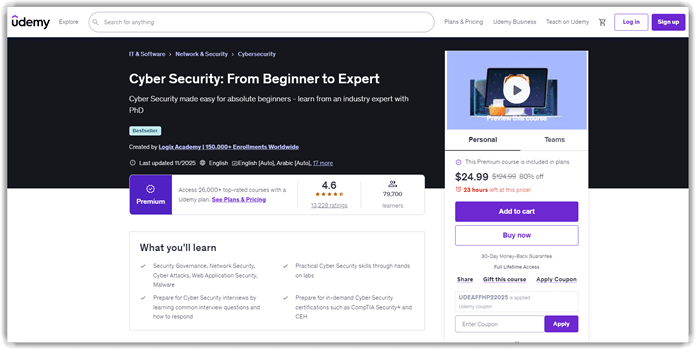
Specs: Duration: 15 hours 34 minutes | Certificate on Completion: Yes | Level: Beginner | Lectures: 102 | Rating: 4.6
Cyber Security: From Beginner to Expert combines governance, networking, attacks, malware, and web application security. The course uses quizzes, activities, and labs to reinforce its explanations.
This option fits beginners who want practical exercises plus interview and certification-preparation context. No prior technical background is required whatsoever. Its broad scope moves quickly, so learners preparing for Security+ or CEH should use the official exam objectives and dedicated practice materials alongside it.
What will You Learn?
- Security Governance: Distinguish policies, standards, procedures, guidelines, privacy obligations, and intellectual-property responsibilities.
- Network Security: Study protocols, port scanning, firewalls, wireless weaknesses, VPNs, encryption, and secure communication.
- Hands-On Labs: Practice hashing, network scanning, email investigation, and other guided security activities safely.
- Attack Analysis: Recognize malware, web application risks, social engineering, and common attacker methods.
- Career Preparation: Review interview questions and connect course topics with Security+ and CEH exam domains.
Pricing:
Paid course with a 30-day money-back guarantee
How to Enroll in Cyber Security: From Beginner to Expert
- Step 1) Open the Udemy course page.
- Step 2) Check the purchase or Personal Plan option available in your region.
- Step 3) Enroll and download the companion study guide before starting the foundations section.
6) The Complete Cyber Security Course: End Point Protection (Udemy)
Specs: Duration: 16 hours 40 minutes | Certificate on Completion: Yes | Level: Intermediate | Lectures: 177 | Rating: 4.7
The Complete Cyber Security Course: End Point Protection examines device hardening, antivirus, endpoint detection, disk encryption, malware removal, secure deletion, email, and messenger security. It is volume four of Nathan House’s series.
This course suits learners responsible for laptops, desktops, or mobile devices. It can stand alone, but the instructor recommends completing earlier volumes for context. A basic understanding of operating systems, networks, software installation, and internet use will make the practical sections easier.

What will You Learn?
- Device Hardening: Reduce attack surfaces by configuring operating systems, applications, services, and accounts more securely.
- Endpoint Protection: Compare antivirus, next-generation protection, application control, machine learning, and execution-prevention approaches.
- Disk Encryption: Select and apply encryption methods that protect stored information if a device is lost.
- Threat Detection: Use deception, monitoring, and endpoint-response concepts to identify suspicious activity and investigate compromises.
- Malware Removal: Locate persistent threats, remove malicious software, and recover systems without destroying useful evidence.
Pricing:
Paid course with a 30-day money-back guarantee
How to Enroll in The Complete Cyber Security Course: End Point Protection
- Step 1) Open the Udemy course page.
- Step 2) Review the available purchase and subscription choices.
- Step 3) Enroll and begin with the endpoint-protection goals and prerequisites.
7) The Complete Cyber Security Course: Network Security (Udemy)
Specs: Duration: 12 hours 25 minutes | Certificate on Completion: Yes | Level: Beginner to intermediate | Lectures: 106 | Rating: 4.5
The Complete Cyber Security Course: Network Security concentrates on wireless threats, firewalls, vulnerability scanning, Wireshark, secure networking, authentication, and password management. It is the second volume in Nathan House’s series.
Choose it when network defense is your main goal and you already understand basic systems and internet concepts. Practical tools make the material more technical than the policy-focused Coursera picks. However, legal and ethical testing requires systems you own or explicit permission to assess.

What will You Learn?
- Network Discovery: Identify hosts, services, weaknesses, and exposed systems through authorized scanning and enumeration.
- Wi-Fi Security: Understand wireless authentication, encryption, common attacks, and practical methods for improving protection.
- Traffic Analysis: Use Wireshark concepts to inspect packets, protocols, sessions, and suspicious network behavior.
- Firewalls: Apply filtering, segmentation, and defensive configuration principles to reduce unauthorized network access.
- Credential Protection: Improve authentication with password managers, stronger account practices, and multi-factor protection.
Pricing:
Paid course with a 30-day money-back guarantee
How to Enroll in The Complete Cyber Security Course: Network Security
- Step 1) Open the Udemy course page.
- Step 2) Review the current purchase or subscription option.
- Step 3) Enroll, prepare an authorized practice environment, and begin the networking modules.
8) The Complete Cyber Security Course: Anonymous Browsing (Udemy)
Specs: Duration: 13 hours 32 minutes | Certificate on Completion: Yes | Level: Intermediate | Lectures: 120 | Rating: 4.5
The Complete Cyber Security Course: Anonymous Browsing covers operational security, identity separation, Tor, VPNs, proxy servers, secure shell connections, live operating systems, and cellular-network privacy. It is volume three of the series.
The course suits learners studying privacy, censorship resistance, or anonymity risks. It explains both defensive uses and de-anonymization methods. Some referenced tools and services may change over time, so verify current official documentation and use privacy techniques lawfully.

What will You Learn?
- Operational Security: Separate identities, minimize exposed information, and avoid common mistakes that weaken anonymity.
- Anonymous Browsing: Compare Tor, proxy servers, VPNs, secure shell tunnels, and live operating systems.
- Identity Strategy: Use compartmentalization, aliases, and security domains to reduce cross-contamination between activities.
- Adversary Analysis: Evaluate tracking, correlation, fingerprinting, and other techniques that can reveal user identity.
- Mobile Privacy: Understand cellular-network weaknesses and choose safer practices for mobile communication and browsing.
Pricing:
Paid course with a 30-day money-back guarantee
How to Enroll in The Complete Cyber Security Course: Anonymous Browsing
- Step 1) Open the Udemy course page.
- Step 2) Review the purchase or subscription option available.
- Step 3) Enroll and start with the operational-security and threat-modeling lessons.
What is Cyber Security?
Cybersecurity is the practice of protecting devices, accounts, applications, networks, and information from unauthorized access, damage, disruption, or theft. It combines technology, policies, processes, and user behavior. Common areas include network security, application security, identity management, incident response, risk management, digital forensics, and privacy.
Beginners can use our ethical hacking tutorials to study authorized testing concepts. Ethical hacking must only be performed on systems you own or have explicit permission to assess.
Why Should You Learn Cyber Security?
Security knowledge helps you recognize phishing, manage passwords, reduce device risks, and understand how attacks affect organizations. A structured course can also introduce the vocabulary needed for technical support, governance, security operations, and risk roles.
People comparing free online cyber security courses or free cybersecurity training for beginners should distinguish a preview from a complete course. A Coursera cybersecurity certification normally requires paid access after a preview or trial. Udemy completion certificates are also limited to approved paid courses.
What Careers Are Available in Cybersecurity?
- Security Engineer: Designs, deploys, and maintains protective controls across systems and networks.
- Incident Response Analyst: Investigates alerts, contains incidents, preserves evidence, and supports recovery.
- Security Analyst: Monitors systems, evaluates risks, and helps improve an organization’s security posture.
- Cryptography Specialist: Designs or evaluates methods that protect sensitive data and communications.
- Network Security Engineer: Secures network architecture, firewalls, remote access, monitoring, and segmentation.
- Security Trainer: Teaches employees or students how to recognize and reduce security risks.
- Security Auditor: Reviews controls, evidence, policies, and compliance against defined requirements.
Can You Enter Cybersecurity Without a Degree or Coding Experience?
Yes. Some entry-level roles value demonstrable skills, labs, projects, certifications, and related IT experience alongside or instead of a degree. Requirements vary by employer, and a course certificate alone does not guarantee employment. Build evidence through authorized labs, documented projects, and clear explanations of your decisions.
Coding is not required for every starting role, but basic scripting becomes useful in automation, log analysis, security testing, and incident response. Python, PowerShell, Bash, JavaScript, and SQL support different security tasks. Start with networking and operating-system fundamentals, then add the language most relevant to your target role.
What Types of Cybersecurity Courses Are Available?
- Foundation Courses: Introduce threats, risk, networks, identity, privacy, and defensive concepts for beginners.
- Technical Courses: Add labs involving systems, networks, scanning, analysis, hardening, or incident response.
- Management Courses: Focus on governance, policy, business risk, awareness, compliance, and program development.
- Certification Preparation: Align lessons and practice questions with a named industry’s exam objectives.
- Specialized Courses: Concentrate on cloud security, endpoint protection, forensics, application security, or privacy.
How Does Cybersecurity Protect a Business?
Cybersecurity uses several layers rather than one product. Identity controls limit account access, endpoint tools monitor devices, network controls restrict traffic, backups support recovery, and policies define responsible behavior. Monitoring and incident-response plans help teams detect, contain, and learn from security events.
Organizations comparing cybersecurity software tools should match each product to a documented risk. Tools cannot compensate for missing updates, weak access controls, poor backups, or inadequate staff training.
How We Researched and Compared the Best Online Cyber Security Courses

At Guru99, we compared these eight courses using current Coursera and Udemy pages. We reviewed their curricula, intended levels, durations, course structures, certificate requirements, access conditions, and practical exercises. This article is based on provider research rather than first-hand course completion, and ratings or enrollment conditions may change.
- Curriculum Coverage: We compared the security concepts, tools, projects, and business topics covered by each course.
- Learner Level: We checked the published prerequisites and intended experience level for every recommendation.
- Practical Work: We considered labs, quizzes, assignments, capstone projects, and other applied learning activities.
- Certificate Terms: We distinguished free previews from paid access and verified which provider issues each certificate.
- Course Structure: We checked durations, module or lecture counts, learning formats, and scheduling flexibility.
- Limitations: We identified a specific restriction or curriculum gap for each course.
