
How to Audit Payroll in SAP: RPUAUD00
 Editorial Team
⚡ Smart Summary
Payroll Audit in SAP uses the standard program RPUAUD00 to track changes made to HR master data. Running it through transaction SE38 reveals who changed an infotype, when, and what the old and new values were.
What is Payroll Audit in SAP (RPUAUD00)?
Payroll Audit in SAP is the process of reviewing and tracking changes made to HR master data to ensure payroll accuracy and compliance. You can use the standard SAP program RPUAUD00 to determine the changes made in master data, such as who modified an employee’s infotype and when.
This audit report is especially important because a single incorrect change to an infotype can affect an employee’s pay. RPUAUD00 gives HR and payroll teams a reliable trail of these changes, so any difference can be traced back to its source.
Steps to Audit Payroll in SAP
Step 1) While in SAP, go to Transaction SE38.
Step 2) Enter the Program Name – RPUAUD00.
Step 3) Click Execute.

Step 4) In the next screen of SAP, select the type of document you want to display:

- Long-term document (recommended): Long-term documents are used for revision purposes. Changes made to the infotype are stored in the database or can be archived. Long texts are stored until they are deleted. The archiving object is called PA_LDOC.
- Short-term document: Short-term documents are stored in the database. They are evaluated differently from long-term documents – short-term documents are evaluated according to date and time.



Step 5) Next, select the Transaction Class as Master Data.

HR transactions are divided into different transaction classes, such as:
- A – HR Master Data (Administration): Data stored in tables PAxxxx (where xxxx = SAP Infotype Number).
- B – Applicant Data: Data stored in tables PBxxxx (where xxxx = SAP Infotype Number).
Step 6) Enter the Selection Criteria.

Hint: Enter the SAP user ID in the “Changed By” field to determine changes made by a particular user to an employee.
Step 7) Select the Output Options and click Execute.

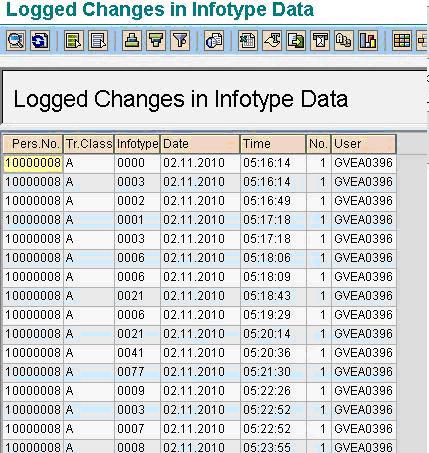
Step 8) The next screen shows the changes made to the employee.
Benefits of Auditing Payroll with RPUAUD00
Running RPUAUD00 regularly gives HR and payroll teams several practical advantages:
- Payroll regression checks: This process is very useful for payroll regression. If there are any pernrs (personnel numbers) with a mismatch and you are not sure whether the difference is genuine or due to a master data change, you can execute this report and audit the changes.
- Accountability: The report shows exactly which user changed a field, so responsibility for every change is clear.
- Compliance and revision: Long-term documents can be archived (object PA_LDOC), providing an audit trail for internal and external compliance reviews.
- Faster troubleshooting: When a paycheck looks wrong, the audit trail quickly reveals whether a recent infotype change is the cause.
