
What is Expert System in AI (Artificial Intelligence)? with Example
 Editorial Team

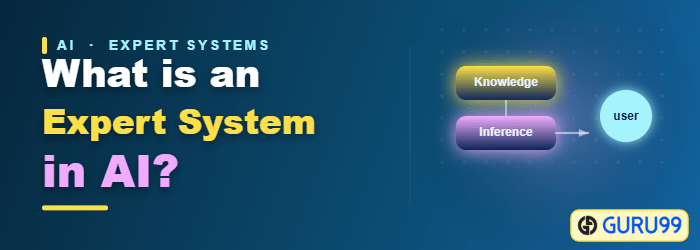
What is Expert System?
Expert System is an interactive and reliable computer-based decision-making system which uses both facts and heuristics to solve complex decision-making problems. The purpose of an Expert System is to solve the most complex issues in a specific domain.
Expert Systems in Artificial Intelligence
The Expert System in AI can resolve many issues which generally would require a human expert. It is based on knowledge acquired from an expert. Artificial Intelligence and Expert Systems are capable of expressing and reasoning about some domain of knowledge. Expert Systems were the predecessor of the current day artificial intelligence, deep learning and machine learning systems.
Examples of Expert Systems
Following are the Expert System Examples:
- MYCIN: It was based on backward chaining and could identify various bacteria that could cause acute infections. It could also recommend drugs based on the patient’s weight. It is one of the best Expert System Examples.
- DENDRAL: Expert System used for chemical analysis to predict molecular structure.
- PXDES: An Example of Expert System used to predict the degree and type of lung cancer.
- CaDet: One of the best Expert System Examples that can identify cancer at early stages.
Characteristics of Expert System
Those examples share a common set of qualities, summarised in the diagram below.

Why Expert Systems are required?
Following are the important Characteristics of Expert System in AI:
- The Highest Level of Expertise: The Expert System in AI offers the highest level of expertise. It provides efficiency, accuracy and imaginative problem-solving.
- Right on Time Reaction: An Expert System responds within a reasonable time, ideally faster than a human expert would reach the same conclusion.
- Good Reliability: The Expert System in AI needs to be reliable, and it must not make mistakes.
- Flexible: An Expert System must remain flexible, so its knowledge base can be extended or corrected as the domain changes.
- Effective Mechanism: The system needs an efficient mechanism for organising and updating the knowledge it already holds.
- Capable of handling challenging decisions & problems: An Expert System is capable of handling challenging decision problems and delivering solutions.

Components of Expert System
Those characteristics are delivered by three parts that pass information to one another, as the block diagram shows.

The Expert System in AI consists of the following given components:
User Interface
The user interface is the most crucial part of the Expert System Software. This component takes the user’s query in a readable form and passes it to the inference engine. After that, it displays the results to the user. In other words, it is an interface that helps the user communicate with the Expert System.
Inference Engine
The inference engine is the brain of the Expert System. It contains rules to solve a specific problem and refers to the knowledge held in the Knowledge Base. It selects the facts and rules to apply when trying to answer the user’s query, breaks the problem down, and formulates the conclusion.
Knowledge Base
The knowledge base is a repository of facts. It stores all the knowledge about the problem domain. It is like a large container of knowledge which is obtained from different experts of a specific field.
Thus we can say that the success of the Expert System Software mainly depends on the highly accurate and precise knowledge.
Other Key terms used in Expert Systems
Facts and Rules
A fact is a small portion of important information. Facts on their own are of very limited use. The rules are essential to select and apply facts to a user problem.
Knowledge Acquisition
The term knowledge acquisition means how to get required domain knowledge by the Expert System. The entire process starts by extracting knowledge from a human expert, converting the acquired knowledge into rules and injecting the developed rules into the knowledge base, as traced in the figure below.
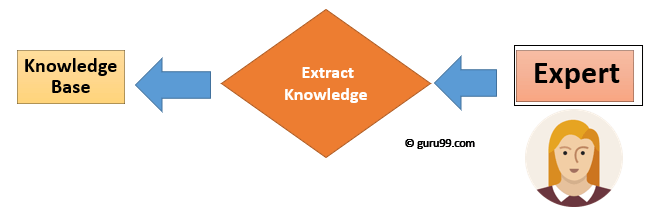
Knowledge Extraction Process
Participant in Expert Systems Development
| Participant | Role |
| Domain Expert | A person or group whose expertise and knowledge is taken to develop an Expert System. |
| Knowledge Engineer | A technical person who integrates that knowledge into computer systems. |
| End User | A person or group of people who use the Expert System to get advice which would otherwise not be available from the expert. |
The process of Building An Expert System
- Determining the characteristics of the problem
- Knowledge engineer and domain expert work in coherence to define the problem
- The knowledge engineer translates the knowledge into a computer-understandable language and designs an inference engine, a reasoning structure, which can use that knowledge when needed.
- The knowledge engineer also determines how to integrate the use of uncertain knowledge in the reasoning process and what type of explanation would be useful.
Conventional System vs. Expert System
The design becomes clearer when an Expert System is placed beside an ordinary program.
| Conventional System | Expert System |
| Knowledge and processing are combined in one unit. | Knowledge database and the processing mechanism are two separate components. |
| The program does not make errors (unless there is an error in programming). | The Expert System may make a mistake. |
| The system is operational only when fully developed. | The Expert System is optimized on an ongoing basis and can be launched with a small number of rules. |
| Step by step execution according to fixed algorithms is required. | Execution is done logically & heuristically. |
| It needs full information. | It can be functional with sufficient or insufficient information. |
Human expert vs. Expert System
| Human Expert | Artificial Expertise |
| Perishable | Permanent |
| Difficult to Transfer | Transferable |
| Difficult to Document | Easy to Document |
| Unpredictable | Consistent |
| Expensive | Cost effective System |
Advantages of Expert System
Below are the main advantages/benefits of Expert Systems in Artificial Intelligence (AI):
- It improves the decision quality
- Cuts the expense of consulting experts for problem-solving
- It provides fast and efficient solutions to problems in a narrow area of specialization.
- It can gather scarce expertise and use it efficiently.
- Offers a consistent answer for the repetitive problem
- A proper explanation of decision making
- Ability to solve complex and challenging issues
- Artificial Intelligence Expert Systems can steadily work without getting emotional, tensed or fatigued.
Limitations of Expert System
Below are the disadvantages/limitations of Expert System in AI:
- Unable to make a creative response in an extraordinary situation
- Errors in the knowledge base can lead to wrong decision
- The maintenance cost of an Expert System is too expensive
- Each problem is different therefore the solution from a human expert can also be different and more creative
Applications of Expert Systems
Some popular Application of Expert System:
- Information management
- Hospitals and medical facilities
- Help desks management
- Employee performance evaluation
- Loan analysis
- Virus detection
- Useful for repair and maintenance projects
- Warehouse optimization
- Planning and scheduling
- The configuration of manufactured objects
- Financial decision making
- Knowledge publishing
- Process monitoring and control
- Stock market trading
- Airline scheduling & cargo schedules
⚡ Smart Summary
Expert System is an interactive, rule-driven decision-making program that combines stored facts with heuristics to solve narrow, complex problems at a level of judgement normally expected from a trained human specialist in that domain.
