
How to Download & Install Postman for Windows?
 Editorial Team
⚡ Smart Summary
Postman installs on Windows, macOS and Linux as a free desktop application, and the six steps below cover downloading the installer, running it, creating an optional account and reaching the startup screen.
Postman is a free API testing platform that sends HTTP requests, inspects responses and stores them in reusable collections, all without writing client code. Installing it takes only a few minutes on any desktop operating system, which is why it is one of the first tools added to a software testing toolkit.
The sections below list the current system requirements, walk through the Windows installer screen by screen, cover the Mac and Linux routes, and compare the desktop application with the browser version.
Postman System Requirements
Check the operating system before downloading, because an unsupported build simply refuses to install. Postman publishes the following minimum versions for the desktop application.
| Platform | Supported versions | Architecture |
| Windows | Windows 10 and later | Intel 64-bit or ARM 64-bit |
| macOS | macOS 11 (Big Sur) and later | Intel or Apple silicon |
| Linux | Ubuntu 18.04+, Fedora 32+, Debian 10+ | Intel 64-bit or ARM 64-bit |
| Browser (web app) | Chrome 80+, Firefox 76+, Edge 79+, Safari 13.1.1+ | Any |
Two further points matter on a work machine. The installer writes to the user profile rather than Program Files, so administrator rights are usually unnecessary, and corporate proxies or antivirus rules that block the update service are the most common reason a fresh install refuses to launch.
With the prerequisites confirmed, the Windows download can begin.
How to Download and Install POSTMAN
Postman is free to download and ships with a free plan, so the installer can be fetched directly from the vendor. Here are the steps to install:
Step 1) Download Postman
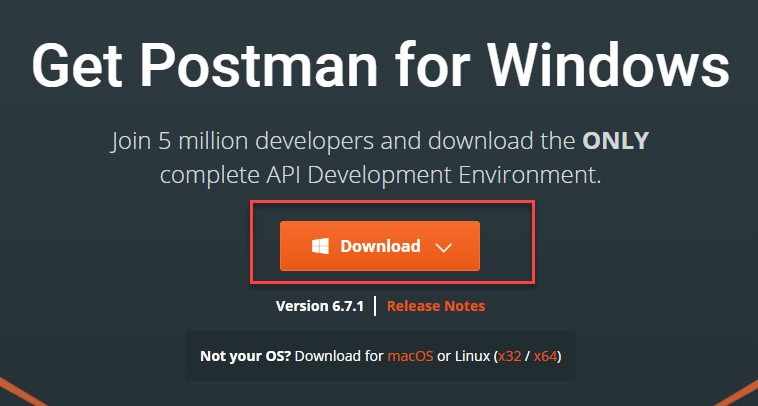
Go to https://www.postman.com/downloads/ and choose your desired platform among Mac, Windows or Linux. Click Download.
The download page detects the operating system automatically and highlights the matching installer, as shown below.
Step 2) Click on Run
Your download is in progress message should now display on the Apps page. Once the Postman download is completed, click on Run.
Note: current browsers save the installer to the Downloads folder instead of offering an in-page Run button. Double-click the downloaded .exe file to start the same installation. The download indicator appears as follows.

Step 3) Postman Installation Start
Wait for some time to Complete the Installation of Postman.
A progress splash screen appears while files are unpacked, and it normally clears within a minute.

Step 4) Signup for Postman Account
In the next window, Signup for a Postman Account
The sign-in window that opens after installation looks like this.

NOTE: There are two ways to sign up for a Postman account. One is to create an own Postman account, and the other is to use a Google account. Though Postman allows users to use the tool without logging in, signing up ensures that your collection is saved and can be accessed for later use.
Note: skipping the sign-in now opens the lightweight API Client, which sends requests but does not sync workspaces. Signing in later restores the full workspace view without reinstalling.
Step 5) Click on Save My Preferences
Select the workspace tools you need and click Save My Preferences
The preferences screen lists the panels that will be visible in the workspace.

Step 6) Congratulation!
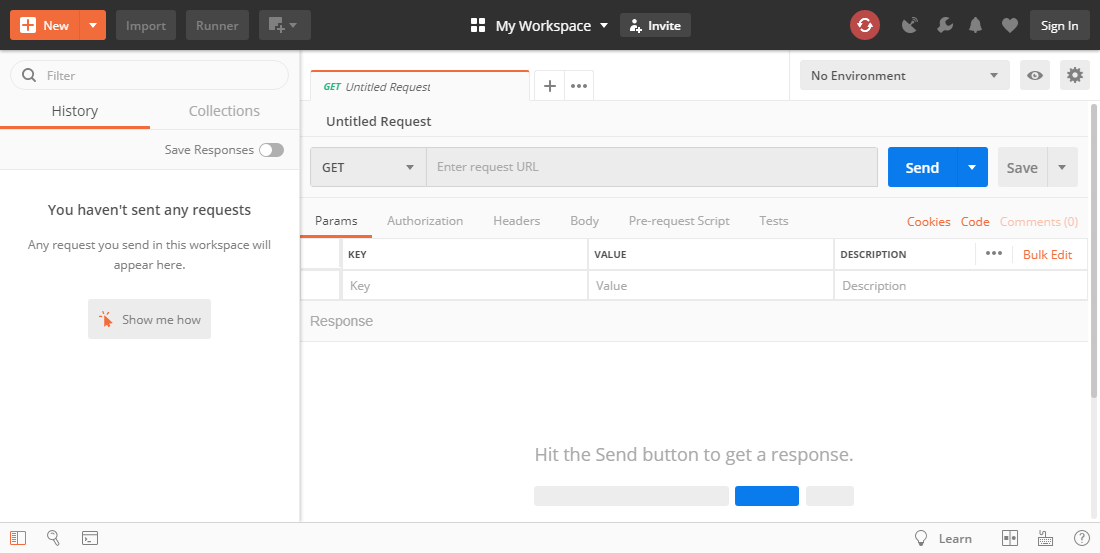
You will see the Startup Screen
The startup screen below confirms a working installation and is the launch point for the first request against a REST or web service endpoint.
To confirm the build number afterwards, open Settings > About inside the application. The same panel is where the automatic updater reports a newer version.
How to Install Postman on Mac and Linux
The download page serves every platform, so the first step is identical everywhere. Only the unpacking differs, and both alternative platforms also offer a package manager route that keeps Postman updated alongside the rest of the system.
Installing on macOS
- Download the latest Postman version for Intel or Apple silicon.
- If the browser saves a ZIP file, open the Downloads folder and unzip it.
- Open the extracted Postman file to install it.
- When prompted, move the file to the Applications folder so that future updates install correctly.
Homebrew users can skip those steps entirely and run brew install --cask postman, which places the same application bundle in /Applications.
Installing on Linux
- Install from the Snap store, or run
snap install postmanfrom a terminal once snapd is available. - Alternatively, download the archive and unpack it with
tar zxf linux_64. - Create a launcher icon by installing the bundled Postman.desktop file into a directory such as ~/.local/share/applications/.
Postman recommends the Snap package because it bundles every library the application needs. Three Linux rules prevent the most frequent failures: never start Postman with sudo, because the files it creates then carry the wrong ownership; make sure the account has read and write permission on ~/.config, where Postman stores its data; and install openssl beforehand. On Ubuntu 18 the libgconf-2-4 package is also required.
Once the application launches, the sign-in and preferences screens shown earlier behave the same on all three platforms.
Postman Desktop App vs Postman Web App
Installation can be avoided altogether by running Postman in a browser, which is useful on a locked-down machine. The trade-off is a shorter feature list, so the table below sets out what each option supports.
| Capability | Desktop app | Web app |
| Installation required | Yes | No |
| Account required | Optional | Yes |
| Calls to localhost and private networks | Direct | Needs the Postman Desktop Agent |
| Find and replace across a workspace | Yes | No |
| Proxy configuration and request capture | Yes | No |
| Performance testing and collection-run export | Yes | No |
| Built-in terminal with Native Git | Yes | No |
The Desktop Agent is the deciding factor for most teams. Browsers enforce cross-origin restrictions, so a request typed into the web app cannot reach an API running on a developer machine until the agent relays it. Anyone testing internal services, or comparing results against SoapUI or a JMeter load plan, is better served by the desktop build.
Two companion tools extend the same account: the Postman CLI runs collections inside a build pipeline, and the Visual Studio Code extension sends requests from the editor. Both keep API checks running beside a UI suite driven by Selenium, rather than replacing it.
