
12 BEST R Programming Books (2026 Update)
 Editorial Team
We are reader supported and may earn a commission when you buy through links on our site
R is used for data analysis, statistics, charts, reporting, and machine learning. The best book depends on whether you need a beginner course, stronger statistics, better programming skills, package development, or a complete data science workflow. R for Data Science is our top recommendation because it gives beginners a practical path from raw data to clear results.
This guide compares 12 R books for different skill levels and jobs.
Each review explains what the book covers, the background it expects, and which edition it describes. Read more…
Best R Programming Books
| Book Title | Author Name | Latest Edition | Publisher | Ratings | Link |
|---|---|---|---|---|---|
| R for Data Science | Hadley Wickham, Garrett Grolemund | 1st edition | O′Reilly |  |
Learn More |
| The Book of R | Tilman M. Davies | 1st edition | No Starch Press |  |
Learn More |
| R For Dummies | Andrie de Vries & Joris Meys | 2nd edition | For Dummies | |
Learn More |
| Discovering Statistics Using R | Andy Field | 1st edition | SAGE Publications Ltd | |
Learn More |
| The Art of R Programming | Norman Matloff | 1st edition | No Starch Press | |
Learn More |
Ratings: These ratings come from Amazon book listings, not Guru99. They may vary by book edition or seller. Ratings, publisher names, and edition details were checked in October 2026.
1) R for Data Science: Import, Tidy, Transform, Visualize, and Model Data
Author Name: Hadley Wickham, Garrett Grolemund
Publisher: O′Reilly
Latest Edition: 1st edition
No of Pages: 518 pages
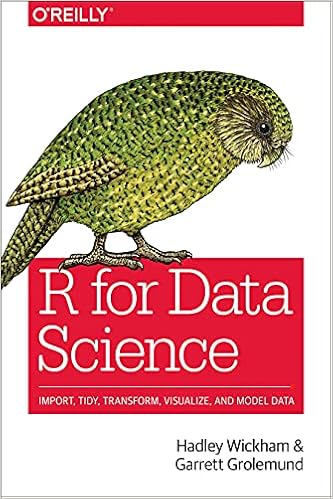
R for Data Science by Hadley Wickham and Garrett Grolemund explains a complete tidyverse workflow, from importing data to communicating results. Published in 2017, it covers visualization with ggplot2, transformation with dplyr, tidying, strings, factors, dates, functions, iteration with purrr, modeling, and R Markdown reports. Exercises let readers practice each step with real datasets.
This is the strongest starting point for readers who want to analyze data rather than study R as a general programming language. It moves quickly through code and expects you to work alongside the examples. Choose The Book of R instead if you need more statistics teaching and slower coverage of programming basics.
What You’ll Learn:
- Import flat files and spreadsheets into R with readr
- Clean and reshape tables with tidyverse data tools
- Build clear charts with ggplot2 layers and scales
- Write reusable functions and repeat work with iteration
- Explore patterns before choosing a suitable statistical model
- Combine code, results, and writing with R Markdown reports
Best For: Beginners and early-career analysts who want a practical tidyverse path through importing, cleaning, visualizing, and reporting data. It suits readers who learn by running code and completing exercises, but it is less suitable for those seeking a deep statistics course.
2) The Book of R: A First Course in Programming and Statistics
Author Name: Tilman M. Davies
Publisher: No Starch Press
Latest Edition: 1st edition
No of Pages: 832 pages

The Book of R teaches programming and statistics together. Tilman M. Davies starts with vectors, data frames, files, functions, conditions, and loops. Published in 2016, the book then moves through probability, hypothesis tests, regression, model checks, and graphics, with exercises connecting each idea to working R code.
Its broad scope helps readers understand why a statistical method works and which command to run. The size may feel demanding if your goal is a quick data-cleaning workflow. R for Data Science is a faster route into tidyverse work, while this book gives statistics more room.
What You’ll Learn:
- Create vectors, matrices, lists, data frames, and functions
- Use conditions, loops, files, packages, and error handling
- Summarize data and calculate useful common descriptive statistics
- Run hypothesis tests and interpret their main results
- Build and check simple and multiple regression models
- Create useful plots with base and modern graphics
Best For: Students and independent learners who want one book covering both R programming and introductory statistics. It works best for readers who prefer detailed explanations, regular exercises, and a steady course from basic data structures through regression and graphics for practical analysis work.
3) R For Dummies
Author Name: Andrie de Vries
Publisher: For Dummies
Latest Edition: 2nd edition
No of Pages: 432 pages

R For Dummies introduces the language in short, approachable lessons. It explains the workspace, vectors, lists, data frames, formulas, functions, graphics, and common statistical tasks. The examples are designed for readers who want help getting past unfamiliar syntax without starting with a formal computer science text.
The friendly pace is useful for a first look. The second edition, published in 2015, focuses on base R, so readers who want the tidyverse workflow should follow it with R for Data Science. Choose it for a gentle overview, then move to a current data science or package-specific book for deeper work.
What You’ll Learn:
- Install R and understand its basic working environment
- Create vectors, lists, factors, matrices, and data frames
- Write functions and control code with simple conditions
- Import, clean, summarize, and inspect common data files
- Build charts and adjust labels, colors, and layouts
- Apply basic tests and models to sample datasets
Best For: Complete beginners who want patient explanations of R syntax, data structures, charts, and basic statistics. It is a useful first overview for nervous learners, and a solid base before moving to package-focused books.
4) Discovering Statistics Using R
Author Name: Andy Field
Publisher: SAGE Publications Ltd
Latest Edition: 1st edition
No of Pages: 992 pages

Discovering Statistics Using R teaches statistical reasoning through R examples, explanations, exercises, and a more conversational style than many textbooks. It covers data exploration, tests, regression, analysis of variance, mixed models, and other methods used in social and behavioral research.
The book spends more time on statistics than on general R programming. That makes it useful for students following a research methods course, but less direct for readers who mainly want data engineering or software skills. The humor and long explanations help some learners, while others may prefer a shorter reference.
What You’ll Learn:
- Understand statistical ideas before running tests in R
- Explore distributions, assumptions, outliers, and missing values carefully
- Compare groups with t-tests and analysis of variance
- Build regression models and interpret their practical meaning
- Work with categorical outcomes and repeated measurements data
- Report statistical findings clearly without hiding important limits
Best For: University students, researchers, and analysts who need detailed statistics teaching alongside R examples. It suits readers working in social or behavioral research, but it is not the shortest route for learning everyday R programming and does require patience with longer explanations.
5) The Art of R Programming: A Tour of Statistical Software Design
Author Name: Norman Matloff
Publisher: No Starch Press
Latest Edition: 1st edition
No of Pages: 404 pages

The Art of R Programming focuses on R as a programming language. Norman Matloff explains data types, vectors, matrices, lists, data frames, functions, environments, object systems, simulations, graphics, debugging, and performance.
Published in 2011, the book concentrates on base R as a language, and its programming lessons help readers understand how R evaluates code and stores data. Choose it when you want stronger language skills, not when you only need a guided tidyverse analysis.
What You’ll Learn:
- Understand vectors, matrices, lists, factors, and data frames
- Write functions using scoping, environments, and closures correctly
- Apply functional and object-oriented programming methods in R
- Run simulations and reshape data for easier analysis
- Debug slow or incorrect code with systematic checks
- Connect R programs with C, C++, and Python
Best For: Programmers, analysts, and technical students who want to understand how R works beneath common data-analysis commands. It fits readers comfortable with code who want to write faster, cleaner R programs.
6) Practical Data Science with R
Author Name: Nina Zumel
Publisher: Manning
Latest Edition: 2nd edition
No of Pages: 568 pages

Practical Data Science with R follows the work of a data project from defining a goal through preparing data, building models, checking results, and presenting findings. Nina Zumel and John Mount use examples from marketing, business intelligence, risk, and decision support.
This is not a first programming course. The publisher recommends basic statistics and some experience with R or another high-level language. It earns its place by covering the decisions around a model, including data quality, evaluation, interpretation, deployment, and communication with people who will use the result.
What You’ll Learn:
- Turn business questions into measurable data science goals
- Load, explore, clean, and reshape real project data
- Choose useful baselines before fitting complex predictive models
- Evaluate classification and regression results with suitable measures
- Present findings clearly to technical and business readers
- Plan deployment, monitoring, and maintenance for finished models
Best For: Analysts and data scientists who know basic R or another programming language and want a complete project workflow. It is especially useful for business problems where model evaluation, communication, deployment, and maintenance matter from early problem framing through final delivery.
7) Advanced R (Chapman & Hall/CRC The R Series)
Author Name: Hadley Wickham
Publisher: Chapman and Hall/CRC
Latest Edition: 2nd edition
No of Pages: 588 pages

Advanced R explains the language features that shape how R code behaves. Hadley Wickham covers data structures, subsetting, functions, environments, conditions, object systems, functional programming, metaprogramming, debugging, and performance. The second edition, published in 2019, is also freely available online.
This is a focused language book, not a guide to statistics or data visualization. Readers need enough R experience to recognize the problems being discussed. It is most useful when ordinary scripts have grown into functions, tools, or packages and you need to reason about evaluation, memory, and program design.
What You’ll Learn:
- Inspect data structures and apply precise subsetting rules
- Understand functions, environments, promises, and lazy evaluation clearly
- Use conditions, handlers, and custom error messages correctly
- Compare R object systems and choose suitable designs
- Write functional code with maps and function factories
- Measure performance before changing slow or wasteful code
Best For: Experienced R users who already write functions and need a deeper grasp of evaluation, environments, object systems, metaprogramming, and performance. It best serves people building larger scripts, developer tools, or packages. Beginners should first learn everyday data structures and function writing.
8) R for Everyone: Advanced Analytics and Graphics
Author Name: Jared P. Lander
Publisher: Addison-Wesley Professional
Latest Edition: 2nd edition
No of Pages: 560 pages
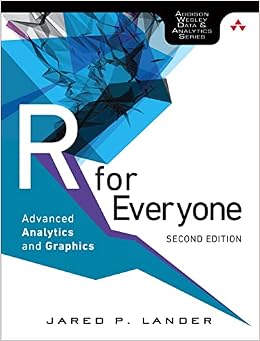
R for Everyone starts with installation and basic syntax, then moves into data import, manipulation, graphics, functions, probability, statistical tests, regression, time series, machine learning, reporting, and package creation. Jared P. Lander writes for readers who use data at work but may not have formal programming training.
The broad coverage makes it a useful desk reference, though some chapters move quickly. The second edition was published in 2017. It offers more statistical range than R For Dummies, while The Book of R gives longer explanations of programming and statistical foundations.
What You’ll Learn:
- Set up R, RStudio, packages, and project files
- Import, combine, reshape, and summarize several data formats
- Create graphics and interactive reports for clear communication
- Run common tests and build several regression models
- Explore practical clustering, classification, and time-series analysis methods
- Create reproducible reports, dashboards, and reusable R packages
Best For: Analysts, researchers, and Excel users who want one broad reference covering R basics, data work, graphics, statistics, modeling, and reporting. It suits readers who prefer wide coverage and want a single book for regular reference, from first syntax through modeling and reporting.
9) R Packages
Author Name: Hadley Wickham
Publisher: O′Reilly
Latest Edition: 1st edition
No of Pages: 202 pages

R Packages explains how to turn useful functions into code that other people can install, document, test, and maintain. Published in 2015, the first edition by Hadley Wickham covers package structure, DESCRIPTION and NAMESPACE files, dependencies, documentation with roxygen2, testing with testthat, data, compiled code, Git and GitHub, and preparing a package for CRAN.
It assumes readers can already write R functions, and it builds the workflow around the devtools package. Choose Advanced R for language internals; choose this book when the immediate goal is sharing dependable code through a package.
What You’ll Learn:
- Create a working package from existing R functions
- Organize code, data, documentation, tests, and metadata clearly
- Manage imports, suggestions, versions, and package dependencies carefully
- Write help pages with roxygen2 and useful examples
- Test functions and run complete package quality checks
- Track changes with Git and GitHub and prepare a CRAN release
Best For: R users who can already write functions and want to package, document, test, and share reusable code. It fits work, research, teaching, and open source projects. Complete beginners should learn core R programming with a smaller introductory book before starting.
10) Learning R
Author Name: Richard Cotton
Publisher: O′Reilly
Latest Edition: 1st edition
No of Pages: 396 pages

Learning R gives beginners a structured tour of the language through chapter goals, examples, quizzes, and exercises. Richard Cotton covers vectors, lists, data frames, functions, strings, dates, data cleaning, graphics, models, debugging, object systems, testing, and package creation.
The book offers more programming depth than a quick introductory guide. Published in 2013, it is strongest on base R concepts and practice. New tidyverse users may prefer R for Data Science as their main course.
What You’ll Learn:
- Use vectors, matrices, arrays, lists, and data frames
- Write functions and control program flow with confidence
- Clean strings, reshape tables, and handle missing values
- Create plots with base, lattice, and ggplot2 systems
- Fit basic models and inspect their main results
- Debug, test, document, and package reusable R code
Best For: Beginners who prefer a structured textbook with goals, quizzes, exercises, programming topics, graphics, and introductory modeling. It suits readers who want to understand base R thoroughly before moving to the tidyverse.
11) Machine Learning with R: Expert techniques for predictive modeling, 3rd Edition
Author Name: Brett Lantz
Publisher: Packt Publishing Limited
Latest Edition: 3rd edition
No of Pages: 458 pages

Machine Learning with R introduces predictive modeling through worked examples. Brett Lantz covers data preparation, nearest neighbors, Bayesian methods, decision trees, rules, regression, neural networks, support vector machines, clustering, model evaluation, bias, and links to larger data tools.
Published in 2019, the third edition is written for R 3.6. The explanations provide a clear map of common algorithms and the problems they solve, and readers should know basic R syntax before starting.
What You’ll Learn:
- Prepare data before fitting machine learning models in R
- Classify outcomes with neighbors, trees, rules, and Bayes
- Predict numeric values using several common regression techniques
- Build neural networks and support vector machine models
- Find groups and patterns through practical clustering methods
- Evaluate models while checking bias and common mistakes
Best For: Students and analysts who know basic R and want a practical introduction to classification, regression, clustering, neural networks, and model evaluation through guided examples and small practice projects.
12) R in Action: Data Analysis and Graphics with R
Author Name: Robert I. Kabacoff
Publisher: Manning Publications
Latest Edition: 2nd edition
No of Pages: 608 pages

R in Action combines language basics, data management, statistics, and graphics in one course. Published in 2015, the second edition covers base graphics and ggplot2, regression, hypothesis tests, principal components, factor analysis, time series, cluster analysis, classification, advanced programming, dynamic reports, and package creation.
Robert I. Kabacoff uses scientific and business examples, making the book useful for readers who want applied statistics rather than language theory. It requires basic math and statistics but no prior R experience. The wide scope works well as a reference, although it is larger than a focused beginner guide.
What You’ll Learn:
- Install R and organize analysis work in a project workflow
- Clean, manage, and inspect incomplete or messy data
- Create charts using base graphics and ggplot2
- Run tests and fit interpretable regression models carefully
- Explore time series, components, factors, and classification methods
- Build reports and debug reusable analysis code carefully
Best For: Researchers, analysts, and students who want one applied guide to R, data management, graphics, statistics, regression, and forecasting. It suits readers with basic math knowledge who prefer examples drawn from real analysis problems rather than language internals or package engineering.
How to Choose an R Programming Book
Start with the work you want to complete. A new analyst usually needs data import, cleaning, charts, and clear reports. A statistics student needs more explanation of tests and models. An experienced R user may need language internals, package development, or machine learning instead of another general introduction.
- For tidyverse data work: Start with R for Data Science.
- For programming and statistics: Choose The Book of R.
- For a gentle introduction: Consider R For Dummies.
- For deeper programming: Read The Art of R Programming, then Advanced R.
- For package development: Use R Packages after learning functions.
- For applied modeling: Choose Practical Data Science with R or Machine Learning with R.
Check the publication date as well as the title. Base R concepts age slowly, while package workflows evolve faster, so a book’s date tells you which tools it teaches.
Which R Book Should a Beginner Start With?
R for Data Science is the clearest starting point for readers who want to work with real datasets. It teaches a connected workflow and gives quick visual results. The Book of R is a better fit when a course or job requires both programming foundations and formal statistics.
R For Dummies offers a slower introduction to syntax and common tasks. Learning R provides more exercises and programming coverage of base R. Pick one main book, type the examples, and keep a small dataset beside you for practice.
When Should You Choose a Specialist R Book?
Move to a specialist title when general tutorials stop answering your questions. Advanced R explains why functions, environments, objects, and evaluation behave as they do. R Packages shows how to turn tested functions into installable software. Machine Learning with R focuses on predictive methods, while Practical Data Science with R covers the wider project around a model.
A specialist book works best when you have a real task. Build a small package, clean an untidy dataset, compare two models, or reproduce a report. That work exposes gaps faster than reading chapters without applying them.
Verdict
Our research points to three books for different R learning needs. The top recommendation focuses on practical data work, while the other picks cover statistics teaching and deeper language understanding.
- R for Data Science: Choose it for a hands-on path through importing, cleaning, visualizing, and reporting data. Skip it if you need detailed statistics instruction or an in-depth look at how R works internally.
- The Book of R: Choose it when you want to learn R programming and statistics together from the ground up. Skip it if you only want a fast, workflow-focused introduction to data analysis.
- Advanced R: Choose it when you already use R and want to understand functions, environments, and object systems in depth. Skip it if you are still learning the basics of the language.
