
VBA Arithmetic Operators: Addition, Subtraction, Multiplication
 Editorial Team
⚡ Smart Summary
VBA Arithmetic Operators perform mathematical operations such as addition, subtraction, multiplication, division, exponentiation, and modulus inside Excel macros. This resource explains each operator with examples and demonstrates how to build a working Add button using a short VBA code routine in the Excel VBA editor.
VBA Arithmetic Operators
VBA Arithmetic Operators are used to perform arithmetic operations such as adding, subtracting, dividing, or multiplying numbers. The following table shows the VBA mathematical operators:
| Operator | Description | Example | Output |
|---|---|---|---|
| + | Addition: This operator is used to add up numbers. | 2 + 2 | 4 |
| – | Subtraction: This operator is used to subtract numbers. | 5 – 3 | 2 |
| * | Multiplication: This operator is used to multiply numbers. | 3 * 2 | 6 |
| / | Division: This operator is used to divide numbers. | 9 / 3 | 3 |
| ^ | Exponentiation: This operator is used to raise a number to the power of another number. | 2^3 | 8 |
| mod | Modulus operator: Divides a number and returns the remainder. | 10 mod 3 | 1 |
VBA Arithmetic Operators Example
Add a button to the Excel sheet as we showed earlier, and then follow these points:
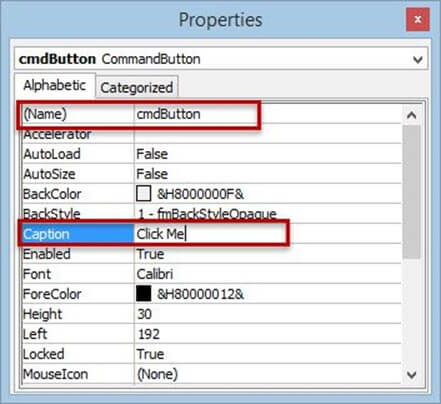
- Change the name property to btnAdd.
- Change the caption property to Add Operator.
- Right-click on the button.
- Select View Code.
- You will get the following code window.
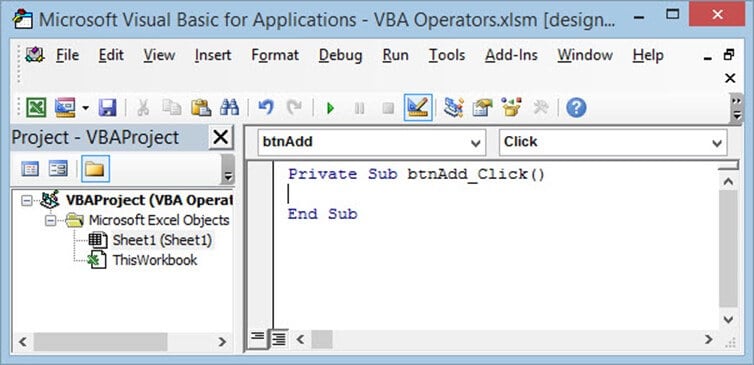
Enter the following code in between Private Sub btnAdd_Click() and End Sub:
Dim x As Integer, z As Integer
x = 2
z = 3
MsgBox x + z, vbOKOnly, "Addition Operator"
- Click on the Save button.
- Close the code editor window.
Let us now execute our code.
On the ribbon bar, look for the Design Mode button.

If the button is in the active state (green background color), then it is in Design Mode. You cannot execute code in this state. If it is not in the active state (white background color), then it allows you to run the code.
Click on the Design Mode button.
The button should now appear as follows:

Click on Add Operator.
You will get the following result:

Arithmetic Operators Tutorial exercise
The best way to learn is by practicing. Follow the above steps to create buttons for subtraction, division, multiplication, and exponentiation.
Write the code for the buttons and test them to see if the code executes.
