
SAP HANA Direct Extractor Connection (DXC) Tutorial
 Editorial Team
⚡ Smart Summary
SAP HANA DXC, the Direct Extractor Connection, is a batch driven replication technique. It reuses the existing Business Suite extractors over HTTPS, delivering semantically rich data to SAP HANA without any additional server.
What is SAP HANA DXC?
SAP HANA DXC is batch driven data replication technique i.e. it can execute after a time interval.
SAP HANA DXC uses existing ETL (Extract, Transform, and Load) method of SAP Business Suite Application via a HTTPS connection.
In SAP Business suite application content Data Source Extractors have been available for data modeling and data acquisition for SAP Business Warehouse.
SAP DXC use these Data Source Extractor to deliver data directly to SAP HANA.
Advantage of SAP DXC
- SAP DXC requires no additional server or application in the system landscape.
- It reduces the complexity of data Modelling in SAP HANA, as it sends the data to SAP HANA after applying all business extractor logic in the source system.
- It speeds up SAP HANA Implementation time lines.
- It extract semantic rich data from SAP Business site and provide to SAP HANA.
Limitation of SAP DXC
- Data Source must have pre-define ETL method, if not then we need to define them.
- SAP DXC requires a Business Suite System on Net Weaver 7.0 or higher (e.g. ECC) equal or below SP level: Release 700 SAPKW70021 (SP stack 19, from Nov 2008).
- A procedure with a key field defined must exist in Data Source.
How DXC Works: Architecture and Data Flow
The advantage list above makes more sense once the flow is clear. DXC is unusual among provisioning methods because the transformation happens in the source system, not in HANA and not in a middleware layer.
Four components take part:
- The Business Suite source. An ECC or similar system holding the DataSource extractors originally written for BW. These already contain the business logic that turns raw tables into meaningful records.
- The extractor. When a load runs, the extractor reads the source tables, applies its logic, and produces a semantically complete record set rather than a raw table copy.
- The HTTPS connection. An RFC destination of type HTTP, created in SM59, carries the extracted data to the HANA XS engine. There is no separate replication server in the path.
- The IMDSO in HANA. The In Memory DataStore Object receives the data, applies record mode handling, and activates it into the target table.
This is what distinguishes DXC from table level replication. SLT copies a table as it stands, leaving the modeller to reconstruct the business meaning inside HANA. DXC delivers records that already carry that meaning, which is why it reduces modelling effort so noticeably. The trade off is latency, since extraction runs on a schedule rather than in real time.
Configure SAP DXC DATA Replication
Step 1) Enabling XS Engine and ICM Service
Enabling XS Engine. Go to SAP HANA Studio -> Select System -> Configuration -> xsengine.ini.
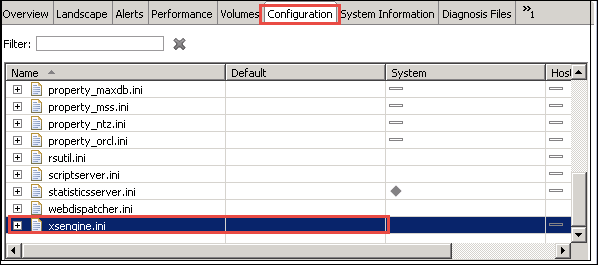
Set instance value to 1 in the Default field.
Enabling ICM Web Dispatcher Service. It enables ICM Web Dispatcher service in HANA system. Web dispatcher uses ICM method for data read and loading in HANA system. Go to SAP HANA Studio -> Select System -> Configuration -> webdispatcher.ini

Set instance value to 1 in the Default column.
Step 2) Setup SAP HANA Direct Extractor Connection
Set DXC Connection in SAP HANA – To create a DXC connection we need to import delivery unit in SAP HANA as below –
- Import Delivery Unit. You need to download the DXC delivery unit from SAP into SAP HANA database. You can import the unit in the location “/usr/sap/HDB/SYS/global/hdb/content”. Import the delivery unit using Import Dialog in SAP HANA Content Node.
- Configure XS Application server to utilize the DXC. Modify the application container value to libxsdxc (if any value existed, then append it).
- Verify the DXC is working. We can check DXC Connection by using below path in a browser – http://<hostname>:80<instance Number>/sap/hana/dxc/dxc.xscfunc. Enter a user name and password to connect.
- User and Schema need to be defined in HANA Studio.
- HTTP connection in SAP BW for HANA needs to be defined through SM59.
So create a http connection in SAP BW Using T-code SM59. Input Parameters will be
- RFC Connection equal Name of RFC Connection
- Target Host equal HANA Host Name
- Service Number equal 80 <Instance Number>
On the Log on Security tab, maintain the DXC user created in HANA Studio, which uses the basic authentication method.
Data Sources in BW need to be configured to replicate the structure to the HANA defined schema. We need to set up the following parameters in BW using program SAP_RSADMIN_MAINTAIN (T-code SE38 or SA38). The parameter list contains values which are passed to the call screen.

PSA_TO_HDB: This parameter accepts three object values as shown below –
- GLOBAL – This is used to replicate all data sources to HANA
- SYSTEM – It specifies clients to use DXC
- DATASOURCE – It specifies data sources, and only the specified ones can be used.
PSA_TO_HDB_DATASOURCETABLE: In this we need to give the table name, which holds the list of data sources used for DXC. In the VALUE field, enter the name of the table you created.
PSA_TO_HDB_DESTINATION: In this we need to move the incoming data. Enter the value created in SM59, here XC_HANA_CONNECTION_HANAS.
PSA_TO_HDB_SCHEMA: It specifies which schema the replicated data needs to be assigned to.
Data Source Replication
Install data source in ECC using RSA5. we have taken data source 0FI_AA_20 (FI-AA: Transactions and Depreciation). First we need to Replicate the Meta data Using Specified application Component (data source version Need to 7.0 version. If we have 3.5 version data source, we need to migrate that first. Active the data Source in SAP BW).
Once data source loaded and activated in SAP BW, it will create the following table in the Defined schema.
- /BIC/A<data source>00 – IMDSO Active Table
- /BIC/A<data source>40 – IMDSO Activation Queue
- /BIC/A<data source>70 – Record Mode Handling Table
- /BIC/A<data source>80 – Request and Packet ID information Table
- /BIC/A<data source>A0 – Request Timestamp Table
- RSODSO_IMOLOG – IMDSO related table. Stores information about all data sources related to DXC.
Now data is successfully loaded into Table /BIC/A0FI_AA_2000 once it is activated. And we can preview data from table /BIC/A0FI_AA_2000 in SAP HANA Studio.
DXC vs SLT vs Data Services
DXC is one of three main routes into SAP HANA and is the most narrowly scoped of them. The comparison shows where each earns its place.
| Parameter | DXC | SLT | SAP Data Services |
|---|---|---|---|
| Latency | Batch, on a schedule | Real time or scheduled | Batch, on a schedule |
| Source systems | SAP Business Suite only | SAP and non-SAP databases | Almost any source |
| Extra landscape | None | An SLT server | A Data Services landscape |
| Business semantics | Preserved by the extractor | None, table level copy | As designed in the job |
| Modelling effort in HANA | Low | High | Medium |
| Best for | Reusing proven BW extractor logic | Operational reporting on live data | Consolidating heterogeneous sources |
In short, choose DXC when the extractors already exist and their logic is trusted, SLT when latency matters, and Data Services when sources are varied and transformation is complex. The full landscape of options is set out in the data provisioning tutorial.
Troubleshooting a DXC Connection
Configuration spans two systems and several layers, so failures are common on a first setup. These checks resolve most of them, in the order worth trying.
- The test URL returns nothing. The XS engine is not running. Confirm the instance value in xsengine.ini is set and the service has been restarted, then retest the dxc.xscfunc address.
- Authentication fails at the test URL. The DXC user does not exist in HANA or lacks privileges on the target schema. It also needs basic authentication enabled, since the destination uses it.
- SM59 connection test fails. Check the service number is 80 followed by the two digit instance number, and that the target host resolves from the BW system rather than only from your workstation.
- Data loads but lands in the wrong schema. PSA_TO_HDB_SCHEMA names the target. If it is unset, the load falls back to a default that rarely matches expectation.
- The data source is ignored. With PSA_TO_HDB set to DATASOURCE, only entries listed in the table named by PSA_TO_HDB_DATASOURCETABLE are replicated. A missing row silently excludes it.
- Activation fails on the IMDSO. Almost always a missing key field. DXC requires a DataSource with a defined key, which is the third limitation listed earlier.
- The extractor is version 3.5. It must be migrated to 7.0 before DXC can consume it.
Table RSODSO_IMOLOG is the first place to look when diagnosing a load, because it records every data source registered for DXC along with its status.
