
SAP Sales Document Tutorial: VA01, VA02, VA03
 Editorial Team
⚡ Smart Summary
Sales order creation in SAP records a contract to supply goods or services to a customer. This resource explains what a sales order is, its four data levels, and how to manage it.
What Is a Sales Order in SAP?
A sales order is a contract between a customer and a sales organization to supply goods or a service within an agreed time period. It is one of the most important documents in SAP Sales and Distribution, because it drives the later steps of delivery and billing. Once the customer confirms what they want, the sales order captures the agreement in a single place.
The data on the sales order screen is derived from master data, mainly the customer master and the material master, for a particular sales area. This means the order fills in many details automatically, which reduces manual entry and keeps information consistent. The sales area that accepts the customer’s request is responsible for completing the contract. A sales order can be created new, or by copying an earlier document such as a quotation. The transaction codes are VA01 to create, VA02 to change, and VA03 to display a sales order.
Sales Order vs Quotation in SAP
A quotation and a sales order are consecutive stages in the sales cycle. A quotation offers terms, while a sales order confirms them and starts fulfillment, so it helps to see how the two differ.
| Basis of comparison | Quotation | Sales order |
|---|---|---|
| Purpose | Offers terms to the customer | Confirms the agreement to supply |
| Commitment | An offer, not yet an order | A firm contract |
| Triggers delivery | No | Yes |
| Triggers billing | No | Yes, after delivery |
| Typical T-code | VA21 | VA01 |
In short, a quotation proposes, and a sales order commits. A quotation is often copied into a sales order once the customer accepts, which carries the data forward and links the documents in the sales document flow. Because the two are linked, the sales order can also inherit the pricing and validity agreed in the quotation, which keeps the promise made to the customer consistent through to delivery.
Sales Order Data Levels: Organization, Header, Item, and Schedule Line
To create a sales order, SAP needs data at four levels. Each level adds detail, moving from the sales area down to the delivery schedule for a single item.
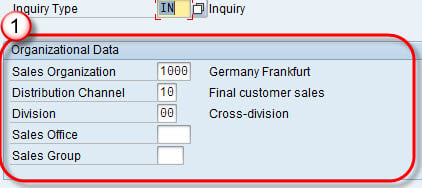
1. Organization data: The organization data is the first screen of the sales document and contains fields such as Sales Organization, Distribution Channel, Division, Sales Office, and Sales Group.
2. Header data: The sales order header contains many tabs (Sales, Shipping, Billing, and so on). The header mostly holds information from the customer master. Click the header  button to display the sales header screen.

The sales header screen is displayed as below:

3. Item data: This contains the line items. A line item holds all the information related to the customer, material, and quantity.

4. Schedule line data: Each line item has schedule lines, which describe the quantity and date. Select the item lines and click the schedule line  button.

Click the schedule line  button again:
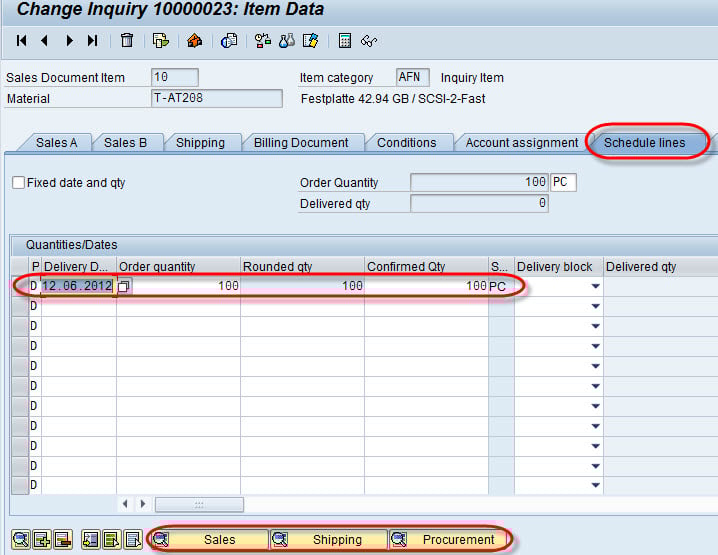
There are three views for a schedule line:
- Sales: Delivery date, time, and quantity.
- Shipping: Shipping, delivery, and route details.
- Procurement: Plant, item, and quantity details.
VA01, VA02, and VA03: Managing Sales Orders
SAP manages a sales order through its life with three transaction codes, each opening the order in a different mode.
- VA01 – Create Sales Order: Raises a new sales order, either new or with reference to a quotation.
- VA02 – Change Sales Order: Updates an existing order, for example to change the quantity or dates.
- VA03 – Display Sales Order: Opens the order in read-only mode to review it.
Because all three transactions act on the same order number, a change in VA02 is immediately visible in VA03. As good practice, display the order first with VA03 to confirm the current details before you change it with VA02, which keeps order data reliable through delivery and billing. The same order number also appears in reports and in later documents such as deliveries and invoices, so keeping it accurate from VA01 onward supports the whole order-to-cash chain.
