
9 BEST Paychex Competitors (2026)
 Editorial Team
Disclosure: Guru99 is reader-supported. We may earn a commission when you buy through links on this page. Learn more

Businesses look for another payroll and HR platform when inaccurate filings, unreliable support, wasted administrative time, confusing interfaces, hidden fees, or inconsistent integrations start disrupting payday. These problems can trigger corrections, employee questions, and unexpected costs. Important details such as tax coverage, implementation help, contract terms, and system ownership are often missed. A better match can simplify payroll reviews, improve reporting, and give employees clearer self-service access. The right shortlist replaces uncertainty with a practical route forward.
I spent 57+ hours researching 17+ competitors, checking official product pages, current pricing, security information, and recurring review patterns. My review covered each product’s dashboards, features, pros, cons, and service trade-offs. After rigorous analysis, I shortlisted nine Best Paychex Competitors options for different workforce needs. Continue reading to find the closest fit for your payroll and HR priorities. Read more…

Remote is my top Paychex alternative for businesses that pay people in more than one country. It runs global payroll, employer-of-record hiring, and contractor payments from one dashboard, with local tax filings and labor-law compliance handled for you in 180+ countries.
Best Paychex Competitors & Alternatives: Top Picks!
✔️ Direct Deposit Speed: Varies by Country
✔️ PEO Service: Yes
✔️ HR Functions: Global Payroll, EOR, Compliance, Onboarding etc.
✔️ Integrations: QuickBooks, HiBob, Xero, Personio etc.

✔️ Direct Deposit Speed: 2 to 4 Days
✔️ PEO Service: No
✔️ HR Functions: Onboarding, Benefits, Compliance, Tax Filing etc.
✔️ Integrations: Guideline, Deputy, When I Work etc.

✔️ Direct Deposit Speed: 2 Days
✔️ PEO Service: No
✔️ HR Functions: Payroll, Tax Filing, Time Tracking, Employee Portal etc.
✔️ Integrations: QuickBooks, Xero, QuickBooks Time etc.


“Businesses can benefit from payroll services that optimize and simplify business operations such as payroll, HR, and time tracking. You should select a provider that provides good service even at a premium as switching providers is not easy. Take your business size into consideration. “
1) Remote
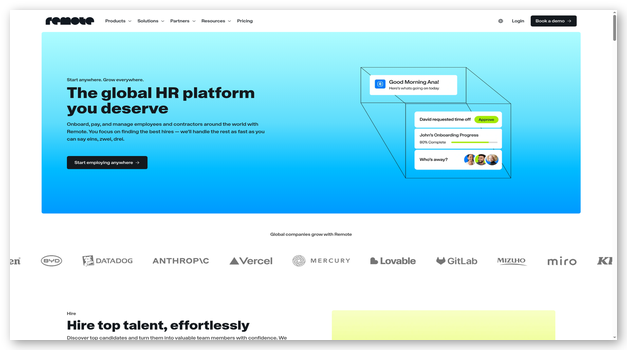
Remote is a global employment platform for companies paying employees and contractors across multiple countries. It combines payroll, employer-of-record services, contractor management, benefits, expenses, and country-specific compliance within one account. The interface centralizes employment records, contracts, time off, and payment details.
Its strongest fit is a distributed company that wants to hire without opening local entities. Remote publishes starting prices for major services, although total costs vary by country and employment model. Domestic US teams may find its international scope broader and costlier than necessary.
Features:
- Global Payroll: Consolidates payroll operations across more than 100 countries, with local calculations, payment coordination, reporting, and compliance support for multinational teams.
- Employer of Record: Employs workers through local entities where available, handling contracts, payroll, taxes, benefits, and statutory requirements without a customer-owned entity.
- Contractor Management: Supports contracts, invoices, approvals, and payments for international contractors while giving administrators a consistent record of engagements and scheduled disbursements.
- Employee Self-Service: Lets workers review payslips, submit expenses, request leave, update details, and access documents without routing every change through human resources.
- Compliance Controls: Provides localized employment guidance, document workflows, and country-specific processes intended to reduce regulatory gaps during hiring, payment, and offboarding.
- Security Program: Maintains ISO 27001 certification, SOC 2 compliance, and CSA STAR Level 1 registration, supported by access controls and published security practices.
- Workflow Automation: Uses configurable approvals, notifications, reporting, and artificial intelligence assistance to reduce repetitive global workforce administration across payroll and human resources.
Pros
Cons
Pricing:
| Plan | Pricing |
|---|---|
| Global Payroll | From $29 per employee/month |
| Contractor Management | From $29 per contractor/month |
| Employer of Record | From $599 per employee/month with annual billing |
| Free access | Product demo available, no standard free trial published |
Demo available
2) OnPay
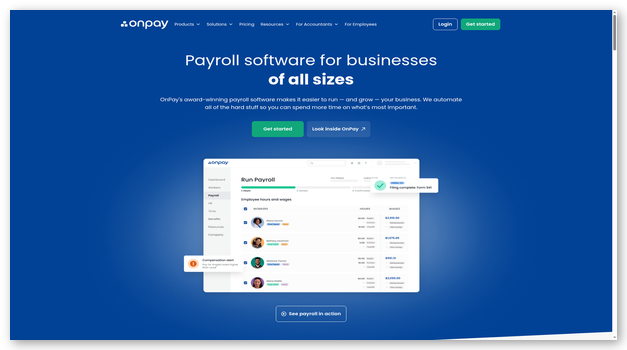
OnPay focuses on US payroll for small and midsize employers that want one published base price. It handles unlimited pay runs, direct deposits, payroll taxes, multi-state calculations, new-hire reporting, employee onboarding, and self-service. Administrators can assign six permission levels and connect common accounting or time tools.
The platform suits teams seeking predictable domestic payroll without an enterprise HCM rollout. Optional HR and benefits services extend the account, but OnPay is not a professional employer organization. Businesses needing global payroll or deep talent management should consider broader alternatives instead.
Features:
- Unlimited Payroll: Processes regular, bonus, and off-cycle payroll runs without per-run charges, supporting employees and contractors within the same working account.
- Tax Administration: Calculates, files, and pays applicable federal, state, and local payroll taxes while preparing standard year-end employee and contractor forms.
- Multi-State Payroll: Supports workers across states and handles relevant withholding requirements, which helps growing employers avoid maintaining separate payroll systems.
- HR Tools: Includes onboarding, document storage, personnel files, paid-time-off tracking, and customizable workflows, with additional HR services available as paid modules.
- Permission Levels: Offers six administrator permission levels so owners, accountants, managers, and payroll staff can receive access suited to their responsibilities.
- Integrations: Connects with QuickBooks, Xero, QuickBooks Time, Deputy, When I Work, and selected benefits or retirement services to reduce duplicate entry.
- Customer Support: Provides phone, chat, and email assistance during extended weekday hours, plus free account migration and setup guidance for new customers.
Pros
Cons
Pricing:
| Plan | Pricing |
|---|---|
| Payroll Essentials | $49 base fee plus $6 per worker/month |
| HR add-on | $15 base fee plus $2 per worker/month |
| Free access | 30-day free trial, setup and migration included |
30-day free trial
3) Patriot Software
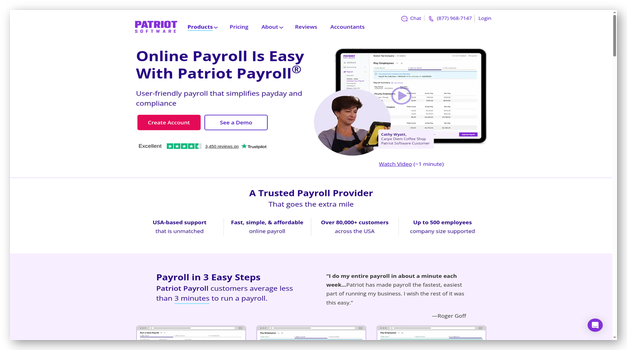
Patriot Software offers payroll and accounting products designed for US small businesses. Its Basic Payroll plan calculates payroll while the employer handles tax deposits and filings. Full Service Payroll adds federal, state, and local tax filing, deposits, and year-end forms. Both plans include unlimited payroll runs and employee access.
The product is attractive to cost-conscious teams with straightforward domestic requirements. Optional time, attendance, and HR modules add practical functions without changing systems. Companies seeking international employment, extensive benefits administration, or enterprise workforce planning will outgrow its narrower focus.
Features:
- Payroll Processing: Calculates wages, deductions, and net pay for employees and contractors, with unlimited runs and support for common pay frequencies.
- Tax Filing Choice: Lets buyers choose employer-managed tax filing or Full Service filing and deposits, matching responsibility and price to internal capability.
- Direct Deposit: Supports direct deposit and printable checks, with eligible customers receiving two-day funding after account verification and approval requirements.
- Employee Portal: Gives workers access to pay information, tax forms, and selected personal details, reducing repeated requests to payroll administrators.
- Automatic Payroll: Runs qualifying salaried payrolls automatically after configuration, helping businesses with consistent wages reduce repetitive processing steps each cycle.
- Reports: Produces payroll registers, tax reports, contribution details, and accounting records that owners can review, export, or share with advisors.
- Optional Modules: Adds time and attendance or basic human resources functions for separate fees, keeping the core payroll subscription comparatively focused.
Pros
Cons
Pricing:
| Plan | Pricing |
|---|---|
| Basic Payroll | $17 base fee plus $4 per worker/month |
| Full Service Payroll | $37 base fee plus $5 per worker/month |
| HR or time add-on | $6 base fee plus $2 per employee/month for each |
| Free access | 30-day free trial |
30-day free trial
4) Rippling
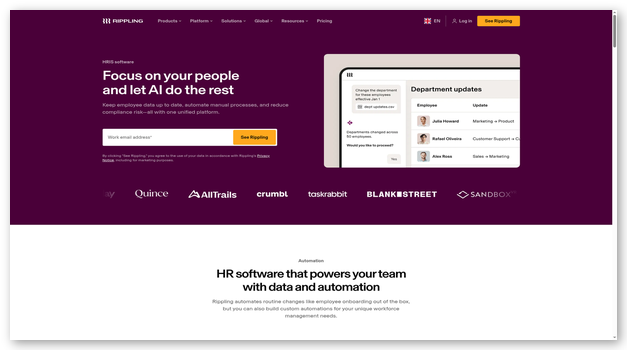
Rippling connects payroll, human resources, information technology, and company spending through a shared employee record. A change to a worker profile can update payroll, benefits, permissions, devices, and connected applications. Its workflow builder helps administrators automate approvals and lifecycle tasks across departments.
This breadth suits growing companies that want to replace several systems, especially when onboarding and offboarding touch IT. Pricing is modular, beginning with a platform fee and per-employee charges. Buyers should request a complete quote because additional modules, implementation, and country services can raise the total considerably.
Features:
- Unified Employee Data: Maintains one employee record across payroll, benefits, devices, applications, expenses, and human resources, reducing inconsistent updates between departments.
- Payroll Automation: Calculates payroll, taxes, deductions, and filings while flagging changes and variances for administrator review before approval and disbursement.
- Workflow Builder: Triggers approvals, notifications, assignments, and access changes from workforce events, supporting complex processes without manual coordination between teams.
- IT Management: Provisions applications, manages devices, and removes access during offboarding, connecting security tasks directly to the employee lifecycle.
- Global Capabilities: Offers international payroll and employment services in supported countries, although available functions and automation depth differ by location.
- Integration Library: Connects with hundreds of business applications across accounting, identity, collaboration, recruiting, benefits, and productivity categories through configurable integrations.
- AI Assistance: Supports natural-language reporting and workflow creation in eligible products, with access depending on the purchased platform and module combination.
Pros
Cons
Pricing:
| Plan | Pricing |
|---|---|
| Platform access | Starts at $8 per employee/month plus a monthly base fee |
| Payroll and modules | Custom quote based on selected products and workforce |
| Free access | Product demo available, no standard free trial published |
Demo available
5) Justworks
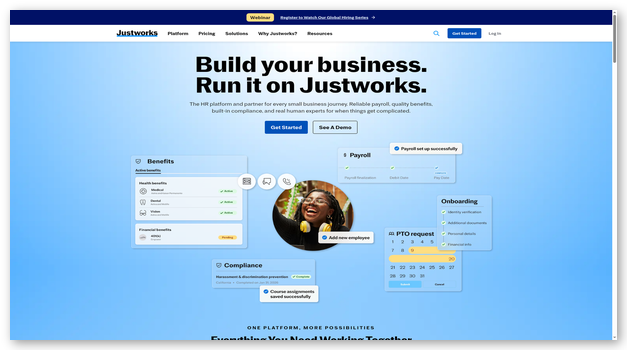
Justworks combines payroll software with professional employer organization services for US businesses. Its standalone Payroll plan covers direct deposit, tax filing, reports, contractor payments, and basic timecards. PEO plans add access to benefits, compliance support, workers compensation, and human resources guidance through a co-employment model.
The platform fits small businesses wanting more service than self-managed payroll provides. Published per-employee PEO prices make comparison easier, although benefits costs and eligibility still vary. Teams that need only basic payroll may pay less elsewhere, while international hiring requires separate employer-of-record services.
Features:
- Full-Service Payroll: Handles employee and contractor payments, tax calculations, filings, year-end forms, direct deposits, and reports across all fifty US states.
- PEO Services: Combines payroll, benefits access, compliance assistance, and workers compensation through co-employment plans designed for small and midsize employers.
- Benefits Administration: Supports medical, dental, vision, retirement, and other employee benefits on eligible plans, with availability and pricing varying by group.
- Compliance Support: Provides guidance, required notices, and human resources resources intended to help small employers manage changing workplace obligations.
- Employee Self-Service: Lets employees view pay information, tax documents, benefits, time off, and personal details from a centralized account and mobile access.
- Accounting Integrations: Connects payroll data with QuickBooks, Xero, NetSuite, Sage Intacct, and selected recruiting, performance, and compliance applications.
- Human Support: Offers continuous support through phone, chat, and email, with review feedback generally praising access while noting occasional complex-case delays.
Pros
Cons
Pricing:
| Plan | Pricing |
|---|---|
| Payroll | $50 base fee plus $8 per employee/month |
| PEO Basic | $79 per employee/month |
| PEO Plus | $124 per employee/month |
| Free access | Three months free on the Payroll plan |
3 months free
6) Paycor
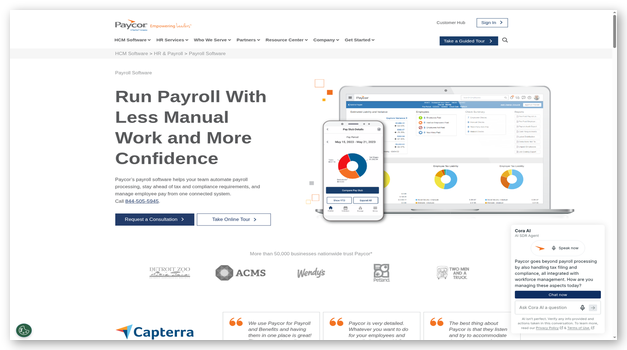
Paycor provides payroll, human resources, time, scheduling, recruiting, talent development, and workforce analytics for US employers. Its platform is aimed at organizations that want employee records and payroll connected with broader people operations. Unlimited payroll runs and configurable reports support recurring administration.
The suite fits growing companies that need more talent and analytics depth than small-business payroll tools. Pricing is available only through a tailored quote, so buyers must compare implementation, modules, service levels, and contract terms carefully. Smaller teams may find the platform broader than their immediate requirements.
Features:
- Payroll: Supports unlimited payroll runs, direct deposit, tax filing, general-ledger mapping, employee self-service, and configurable earnings and deduction rules.
- Workforce Management: Connects time, attendance, scheduling, and payroll data, helping managers reduce re-entry and review labor information before processing.
- Recruiting: Provides applicant tracking, candidate communication, offer management, and onboarding tools that connect new-hire information to employee records.
- Talent Management: Adds performance, learning, compensation, and development functions for employers seeking a broader employee lifecycle within one provider.
- Analytics: Offers dashboards and workforce reporting across payroll and human resources, with filters designed for managers, administrators, and organizational leaders.
- Developer Access: Provides public application programming interfaces and a sandbox through its developer portal for approved integration and data-exchange projects.
- Payroll Alerts: Uses auditing rules and error detection to surface payroll changes or exceptions that administrators should investigate before final submission.
Pros
Cons
Pricing:
| Plan | Pricing |
|---|---|
| Payroll and HR plans | Custom quote based on company size and selected modules |
| Free access | Product demo available, no standard trial duration published |
Demo available
7) Bambee
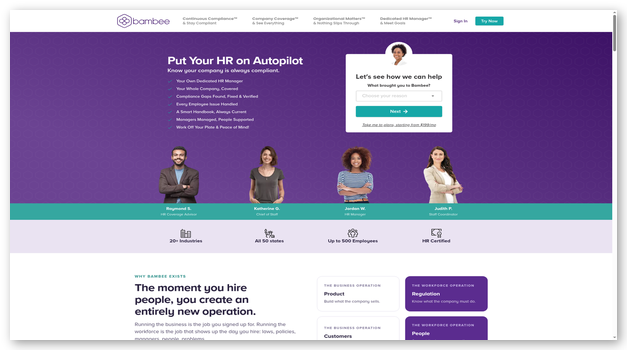
Bambee gives small businesses access to a dedicated human resources manager, policy development, employee documentation, compliance guidance, and workplace support. Its service begins with an HR audit and builds an action plan around policies, records, and recurring responsibilities. The relationship is advisory and service-led.
Bambee is useful when a company needs human guidance but cannot hire an internal HR professional. It is not a direct payroll replacement, so buyers may still need separate payroll software. Plans start at $199 per month, and service depth increases substantially across tiers.
Features:
- Dedicated HR Manager: Assigns a human resources professional who advises the business, reviews priorities, and helps managers address recurring employee and compliance questions.
- HR Audit: Reviews current policies, records, and practices to identify gaps, then develops an action plan for the employer to follow.
- Policy Development: Creates and updates company policies and employee handbooks aligned with the business profile, supported jurisdictions, and selected service tier.
- Employee Records: Organizes policy acknowledgments, signed documents, and related employee records so managers can demonstrate consistent communication and documentation.
- Manager Guidance: Provides advice for performance, discipline, termination, and workplace questions, helping owners prepare documentation before taking sensitive employment actions.
- Training Resources: Offers manager and employee training materials that support policy awareness, conduct expectations, and recurring workplace compliance responsibilities.
- Service Plans: Scales from observational guidance to supervision and management tiers, with increasing involvement, meeting cadence, and human resources coverage.
Pros
Cons
Pricing:
| Plan | Pricing |
|---|---|
| Observation | From $199/month |
| Supervision | From $799/month |
| Management | From $1,499/month |
| Paid trial | $1 for 30 days on selected HR service offers |
$1 for 30 days
8) Gusto
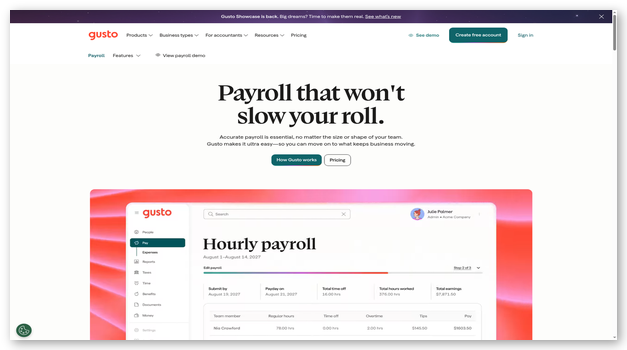
Gusto is a US payroll and human resources platform built around guided setup and employee self-service. It processes payroll, taxes, year-end forms, benefits, onboarding, time tracking, and contractor payments. Published plan prices let small businesses estimate recurring costs before contacting sales.
The product suits employers that value an approachable administrator and employee experience. Higher plans add multistate payroll, time tools, and more human resources support. Gusto does not offer a standard free trial, but customers generally do not pay until they are ready to run payroll.
Features:
- Full-Service Payroll: Calculates employee pay, deductions, and taxes while filing standard payroll forms and supporting unlimited runs on eligible US payroll plans.
- Employee Onboarding: Collects new-hire details, tax forms, direct-deposit information, signatures, and selected benefits choices through a guided employee workflow.
- Benefits Administration: Supports medical, dental, vision, retirement, workers compensation, and other benefits, with availability and broker arrangements varying by state.
- Time Tools: Adds time tracking, paid-time-off management, and payroll synchronization on eligible plans, reducing manual transfer from approved hours.
- Employee Wallet: Gives workers mobile access to pay details, tax documents, financial tools, and selected benefits information outside the administrator interface.
- Security Controls: Publishes encryption, multifactor authentication, single sign-on, penetration testing, daily backups, and access controls for payroll and personal information.
- Integrations: Connects with accounting, time, point-of-sale, expense, and business applications, although certain connections and developer access have eligibility requirements.
Pros
Cons
Pricing:
| Plan | Pricing |
|---|---|
| Simple | $49 base fee plus $6 per person/month |
| Plus | $80 base fee plus $12 per person/month |
| Premium | $180 base fee plus $22 per person/month |
| Free access | No standard free trial, payment begins when payroll starts |
Pay when payroll starts
9) ADP Payroll
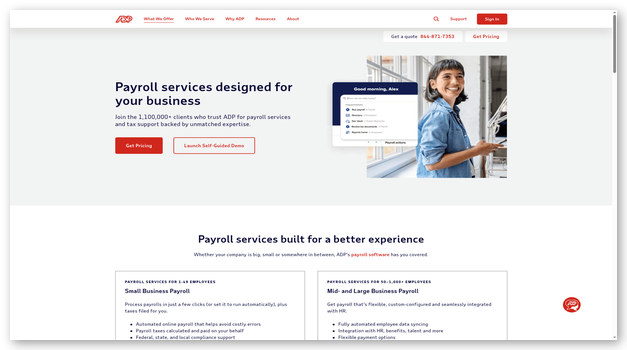
ADP Payroll, represented here by RUN Powered by ADP, serves small US businesses with payroll, tax filing, employee access, onboarding, and optional human resources services. Higher packages add background checks, training, handbooks, marketing tools, and dedicated guidance. ADP also maintains a large integration marketplace.
Its long operating history and service range suit employers expecting to expand beyond basic payroll. Pricing is quote-based, so costs and included services require written confirmation. The interface and package choices can feel complex, but businesses gain broad integrations, scalable upgrades, and established compliance processes.
Features:
- Payroll Processing: Handles employee and contractor payroll, direct deposits, checks, deductions, garnishments, tax calculations, filings, and standard year-end forms for US employers.
- Payroll Alerts: Uses ADP Assist and system checks to flag potential errors, unusual changes, or missing information before administrators complete payroll.
- Employee Access: Lets employees retrieve pay statements, tax forms, and selected personal information through web and mobile self-service accounts.
- Package Options: Offers Essential, Enhanced, Complete Payroll and HR Plus, and HR Pro packages with progressively broader payroll and human resources services.
- HR Services: Adds onboarding, background checks, policy resources, training, handbooks, and advisor access depending on the selected RUN package.
- Integration Marketplace: Connects ADP data with accounting, benefits, time, recruiting, productivity, and enterprise systems through Marketplace applications and API Central.
- Multi-Jurisdiction Support: Supports payroll requirements across states and local jurisdictions, with package scope and service configuration confirmed during the sales process.
Pros
Cons
Pricing:
| Plan | Pricing |
|---|---|
| RUN packages | Custom quote for Essential, Enhanced, Complete, or HR Pro |
| Free access | Current promotion offers three months free payroll, subject to terms |
3 months free
Comparison Between Top Best Paychex Alternatives
| Tool | US Tax Filing | Global Payroll | PEO/EOR Option | Published Pricing | Accounting Integrations | AI Payroll Checks |
|---|---|---|---|---|---|---|
| Remote | ✅ | ✅ | ✅ | ✅ | ✅ | ✅ |
| OnPay | ✅ | ❌ | ❌ | ✅ | ✅ | ✅ |
| Patriot Software | ✅ | ❌ | ❌ | ✅ | ✅ | ✅ |
| Rippling | ✅ | ✅ | ✅ | ❌ | ✅ | ✅ |
| Justworks | ✅ | ❌ | ✅ | ✅ | ✅ | ❌ |
What Is a Paychex Competitor?
A Paychex competitor provides payroll, tax filing, employee records, or related workforce services. Some products closely replace Paychex Flex for US payroll. Others focus on global employment, PEO services, or human resources advice. Buyers should separate direct replacements from adjacent services before comparing prices. A payroll subscription may calculate wages and file taxes. A PEO shares certain employer responsibilities, while an EOR legally employs workers abroad. The right category depends on workforce location, company size, internal expertise, and desired service level.
Why Do Businesses Look for Paychex Alternatives?
Businesses usually compare Paychex alternatives when pricing, support access, integrations, or administrative workflows no longer fit. Small employers may want published monthly rates and simpler payroll screens. Growing teams may need connected recruiting, time, benefits, or information technology controls. International companies often require employer-of-record or global payroll coverage. Public discussions also emphasize migration help, tax correction handling, and contract terms. A switch makes sense only when the new provider improves the specific problem without creating a larger implementation burden or removing necessary compliance support.
Which Features Matter Most in Payroll and HR Software?
The strongest payroll and HR software should calculate wages accurately, file required taxes, and support reliable employee payments. It should also provide permission controls, audit records, employee self-service, and useful reports. Buyers should verify multi-state support, year-end forms, contractor handling, benefits connections, and accounting integrations. Growing teams may need time tracking, recruiting, onboarding, or performance tools. International employers should confirm country coverage and legal employment models. Each feature should be evaluated on the exact plan being purchased, since availability often changes by tier.
How Did We Choose BEST Paychex Competitors?

At Guru99, we are dedicated to providing credible and objective information, ensuring each resource is both accurate and reliable. Through 57+ hours of research on 17+ Paychex Competitors, we curated a top list of free and paid alternatives that meet diverse business needs. This comprehensive, unbiased guide examines each option’s features, pros, cons, and pricing to help you make a well-informed choice. Finding the right Paychex competitor is crucial for tailored HR and payroll solutions, balancing core services with cost efficiency.
- Comprehensive Features: We looked for competitors offering a full suite of HR and payroll solutions to meet varied business needs.
- Cost-Effectiveness: It is important to keep in mind the affordability of these solutions, especially for smaller businesses.
- User-Friendly Interface: A simple and accessible interface is one of the easiest ways to ensure effective use by all employees.
- Customer Support: A top pick offers responsive support, essential to resolve issues and improve the user experience.
- Customizability: According to business requirements, the best options allow flexibility in service packages.
How Much Do Paychex Competitors Cost?
Pricing for Paychex competitors ranges from low-cost payroll subscriptions to service-heavy employment platforms. Patriot begins with a base fee plus a per-worker charge, while OnPay and Gusto publish similar two-part pricing. PEO providers often charge per employee each month. Employer-of-record services cost far more because the provider becomes the legal employer. Rippling, Paycor, and ADP require fuller quotes for selected modules. Buyers should request implementation, tax filing, benefits, support, cancellation, and year-end charges in writing before comparing annual totals accurately.
What Is the Difference Between Payroll Software, a PEO, and an EOR?
Payroll software calculates pay, deductions, taxes, and filings while the customer remains the employer. A professional employer organization uses co-employment to provide payroll, benefits, compliance, and human resources services for domestic workers. An employer of record legally employs workers in another country or jurisdiction for the client. These models have different costs, responsibilities, and contracts. A company should confirm who signs employment agreements, holds tax responsibility, provides benefits, and controls workplace decisions before selecting any workforce service arrangement carefully today.
Can Paychex Alternatives Handle Multistate and Global Payroll?
Many alternatives support multistate payroll, but global coverage varies sharply. OnPay, Patriot, Gusto, Paycor, Justworks, and ADP primarily address US payroll needs. Remote and Rippling offer broader international payroll or employment services in supported countries. Country lists alone do not prove equal capability. Buyers should verify local tax filings, payment currencies, benefits, statutory reports, entity requirements, contractor handling, and support ownership. A product may process international payments without providing the legal employment framework needed for fully compliant local hiring arrangements.
How Do Payroll Integrations Affect Daily Work?
Good payroll integrations move approved hours, deductions, benefits, and accounting entries between systems without repeated typing. The practical value depends on data direction, synchronization timing, field coverage, and error handling. A marketplace listing does not guarantee every workflow is automatic. Buyers should test one real pay period using their time, accounting, benefits, and expense tools. They should also confirm whether the connection costs extra, requires middleware, supports historical corrections, and preserves an audit trail when payroll records change later unexpectedly.
How Is Artificial Intelligence Used in Modern Payroll Platforms?
Modern platforms apply artificial intelligence to payroll variance checks, report creation, workflow suggestions, employee questions, and document summaries. These features can help administrators spot unusual changes or find information faster. They should not replace payroll approval, tax review, or professional judgment. Buyers should ask which data trains or informs the feature, whether customer information leaves the account boundary, and how errors are corrected. Human review remains necessary whenever an automated answer affects wages, taxes, benefits, or sensitive employment decisions directly.
When Is the Best Time to Switch Payroll Providers?
The start of a calendar year is often the simplest time to switch payroll providers because prior-year records remain with one system. Midyear moves are still possible, but they require accurate year-to-date wages, deductions, taxes, and filing history. Buyers should plan parallel checks, employee communications, bank verification, integrations, benefits deductions, and tax account access. Avoid switching immediately before a payroll deadline. The outgoing contract, data export process, record retention, and final tax responsibilities should be clearly documented before final cancellation.
What Payroll Migration Problems Should Buyers Expect?
Common migration problems include incomplete year-to-date balances, incorrect tax jurisdictions, missing deduction codes, delayed bank verification, and mismatched employee identifiers. Historical reports may export differently from the new system. Benefits and time integrations can also duplicate or omit entries during cutover. Buyers should create a field-level migration checklist, reconcile totals against filed returns, and run parallel payroll calculations when practical. A named implementation owner should record decisions, deadlines, and unresolved exceptions before the first live payroll is finally approved safely.
How Do You Troubleshoot Common Payroll Platform Problems?
Payroll problems should be isolated before another run is approved. The following structured checks address common failures without exposing sensitive employee information or creating unnecessary duplicate corrections.
Issue: An employee receives the wrong net pay after earnings or deductions changed unexpectedly.
Solution: The administrator should compare the payroll register, effective dates, deduction rules, and prior run before submitting a correction.
Issue: A tax filing shows the wrong jurisdiction after an employee moved locations.
Solution: The payroll team should verify work and home addresses, withholding forms, effective dates, and provider tax registrations.
Issue: Approved time does not appear in payroll after an integration completed successfully.
Solution: The administrator should inspect synchronization logs, pay-period dates, employee identifiers, earning mappings, and approval status before importing again.
Issue: A new hire cannot access online self-service or finish required onboarding forms.
Solution: The system owner should confirm the email address, invitation status, permissions, browser support, and incomplete identity-verification steps.
Issue: Direct deposits remain pending near the stated scheduled payroll payment date unexpectedly.
Solution: The employer should check funding deadlines, bank verification, account balance, holiday schedules, and provider status notifications immediately.
Issue: A report total differs from the accounting entry after payroll posts successfully.
Solution: The finance team should reconcile gross wages, taxes, benefits, liabilities, departments, and rounding rules against the final register.
What Should a Payroll Security Review Include?
A payroll security review should examine multifactor authentication, role-based access, encryption, audit logs, incident response, backups, and independent assurance reports. Administrators should limit bank, tax, and employee data to necessary roles. Former workers and vendors need prompt access removal. Buyers should ask how support verifies callers, how exports are protected, and how suspected account changes are communicated. Security also depends on internal practice, so companies need approval separation, password controls, phishing training, and regular documented internal permission reviews every quarter.
Verdict
After reviewing nine alternatives, I found three options that covered the clearest buyer needs across global employment, straightforward US payroll, and budget-conscious small businesses.
- Remote: I valued its global payroll, employer-of-record coverage, and published service starting prices for distributed teams.
- OnPay: Its single payroll price, unlimited runs, tax filing, and free migration made domestic costs easier to understand.
- Patriot Software: I found its low entry pricing and optional full-service tax filing practical for smaller US employers.
FAQs

Zoho WorkDrive is an online file storage and content collaboration platform for modern teams, small businesses, and large enterprises. It offers a Smart Search for instant file retrieval and unlimited version history to restore documents.
