
12 BEST Data Structures and Algorithms Books (2026 Update)
 Editorial Team
We are reader supported and may earn a commission when you buy through links on our site
An algorithm is a set of steps a computer follows to solve a problem. It takes information as input, works through those steps, and produces a result. A data structure organizes information so a program can store, find, and update it efficiently. Grokking Algorithms is our top recommendation because its drawings and Python examples make the main ideas easier to follow.
Learning algorithms and data structures helps you write clearer code, prepare for coding interviews, and understand how software handles data.
This guide compares 12 books for beginners, students, and working developers. It includes visual introductions, practice books, university textbooks, and guides for Python and Java. Choose one main book for learning, then use a problem book or reference for practice. Read more…
Best Algorithm and Data Structure Books
| Book Title | Author Name | Latest Edition | Publisher | Ratings | Link |
|---|---|---|---|---|---|
| Grokking Algorithms | Aditya Bhargava | 2nd edition | Manning |  |
Learn More |
| Data Structures and Algorithms Made Easy | Narasimha Karumanchi | 5th edition | Careermonk Publications |  |
Learn More |
| Introduction to Algorithms | Thomas H. Cormen, Charles E. Leiserson, Ronald L. Rivest & Clifford Stein | 4th edition | The MIT Press |  |
Learn More |
| Algorithms Unlocked (The MIT Press) | Thomas H. Cormen | 1st edition | The MIT Press | |
Learn More |
| Algorithms | Robert Sedgewick & Kevin Wayne | 4th edition | Addison Wesley | |
Learn More |
Ratings: These ratings come from Amazon book listings, not Guru99. They may vary by book edition or seller. Ratings, publisher names, and edition details were checked in October 2026.
1) Grokking Algorithms
Author Name: Aditya Bhargava
Publisher: Manning
Latest Edition: 1st edition
No of Pages: 256 pages

Grokking Algorithms is our top recommendation for beginners because it explains each idea with drawings, short examples, and Python 3 code. The second edition covers searching, sorting, hash tables, trees, graphs, greedy methods, artificial intelligence, and NP-complete problems without assuming advanced mathematics.
The visual approach makes performance trade-offs easier to remember, especially when Big O notation is new. It is less complete than Introduction to Algorithms and less focused on interview drills than Data Structures and Algorithms Made Easy, so experienced readers may finish it quickly.
What You’ll Learn:
- Compare common algorithms using practical Big O notation
- Choose arrays, linked lists, hash tables, and trees
- Apply binary search, sorting, and recursive problem solving
- Trace graph searches and shortest path algorithms visually
- Understand greedy choices and difficult NP-complete problem classes
- Read and adapt fully annotated Python 3 examples
Best For: Beginners, self-taught programmers, and interview candidates wanting a visual introduction to algorithms before moving to a detailed textbook or reference.
2) Data Structures and Algorithms Made Easy
Author Name: Narasimha Karumanchi
Publisher: Careermonk Publications
Latest Edition: 5th edition
No of Pages: 453 pages

Data Structures and Algorithms Made Easy is built around solved problems rather than long theory chapters. Narasimha Karumanchi presents several approaches to many questions, then compares their time and space costs. The supplied edition uses C and C++ examples and covers the topics commonly seen in technical interviews.
Its large problem set makes it useful for revision after you know the basics. Explanations can feel compressed when a topic is completely new, and the layout works better as a practice guide than a first course. Start with Grokking Algorithms if you need slower teaching and more visual support.
What You’ll Learn:
- Analyze running time and memory use for solutions
- Practice arrays, linked lists, stacks, queues, and hashing
- Solve common tree, graph, sorting, and searching problems
- Compare brute force and improved problem-solving approaches carefully
- Recognize common patterns used in technical coding interviews
- Implement selected solutions using C and C++ code
Best For: Students and interview candidates with basic programming knowledge who want solved problems, alternative solutions, and regular practice with common algorithms.
3) Introduction to Algorithms
Author Name: Thomas H. Cormen
Publisher: PHI Learning Pvt. Ltd.
Latest Edition: 3rd edition
No of Pages: 1312 pages

Introduction to Algorithms, often called CLRS, is the broadest academic reference on this list. The fourth edition explains algorithms in English and readable pseudocode, with self-contained chapters covering data structures, sorting, graphs, dynamic programming, greedy algorithms, matchings, online algorithms, and machine learning.
The book balances proofs, design methods, and extensive exercises, which makes it useful for university courses and long-term reference. At 1,312 pages, it is demanding and not the fastest route to interview practice. Grokking Algorithms is more approachable, while CLRS gives much greater depth and mathematical detail.
What You’ll Learn:
- Prove algorithm correctness and analyze asymptotic running time
- Study sorting, hashing, trees, heaps, and graph methods
- Apply greedy methods, dynamic programming, and network flows
- Work through readable pseudocode without choosing one language
- Explore online algorithms, matching, and machine learning topics
- Use exercises to test formal algorithm design skills
Best For: Computer science students, instructors, and programmers needing a detailed algorithms reference with proofs, pseudocode, exercises, and broad coverage of theory.
4) Algorithms Unlocked (The MIT Press)
Author Name: Thomas H. Cormen
Publisher: The MIT Press
No of Pages: 236 pages

Algorithms Unlocked explains how computers search, sort, protect information, compress data, and work with graphs. Thomas Cormen uses limited mathematics and everyday examples, including a plain introduction to cryptography. The book is much shorter and less formal than Introduction to Algorithms.
It gives non-specialists a useful map of the subject and explains how to judge whether an algorithm is efficient. The trade-off is depth: readers get fewer implementation details and exercises than in a textbook. Choose it for understanding and review, not as the only source for coding practice.
What You’ll Learn:
- Describe algorithms and compare their basic efficiency clearly
- Understand searching, sorting, and common graph problems clearly
- See how cryptography protects information during online use
- Learn why compression reduces storage and transfer needs
- Recognize hard problems without known fast computer solutions
- Connect everyday software tasks with underlying algorithm ideas
Best For: New computer science students, managers, and non-specialists wanting a readable algorithms overview with limited mathematics before taking a formal course.
5) Algorithms
Author Name: Robert Sedgewick
Publisher: Addison Wesley
Latest Edition: 4th edition
No of Pages: 976 pages

Algorithms by Robert Sedgewick and Kevin Wayne teaches core data structures and algorithms through Java implementations. The fourth edition covers sorting, searching, graphs, strings, compression, and supporting programming models. Its companion website adds code, test data, visual demonstrations, assignments, and course material.
The combination of book and online resources works well for readers who want to study and implement each method. Java is central to the examples, so Python or C++ learners must translate the code. It is more practical than CLRS but still large enough to support a full university course.
What You’ll Learn:
- Implement fifty core algorithms with complete Java examples
- Use stacks, queues, trees, hash tables, and graphs
- Compare sorting and searching methods through measured behavior
- Process strings with tries, searches, and regular expressions
- Study compression, shortest paths, and spanning tree algorithms
- Practice with visualizations, exercises, tests, and coding assignments
Best For: Java programmers and students wanting a complete algorithms course with working code, visual examples, exercises, test data, and implementation practice.
6) Data Structures and Algorithms in Java
Author Name: Robert Lafore
Publisher: Sams Publishing
Latest Edition: 2nd edition
No of Pages: 800 pages
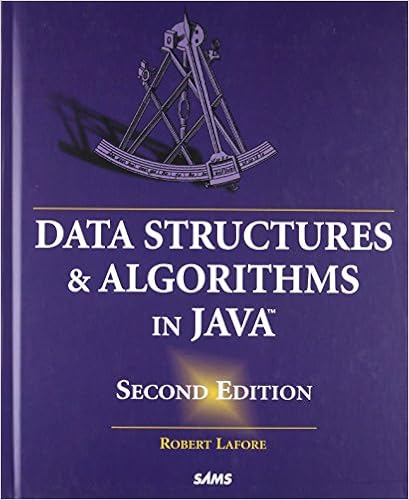
Data Structures and Algorithms in Java by Robert Lafore uses small programs and graphical workshop applets to show how structures change during an operation. It covers arrays, linked lists, stacks, queues, recursion, sorting, trees, hash tables, heaps, and weighted graphs.
The current second-edition listing keeps the visual teaching approach and includes revised examples, questions, and projects. Some workshop material comes from an older Java teaching style, so setup may need extra care. Sedgewick and Wayne provides broader theory, while Lafore spends more time building intuition step by step.
What You’ll Learn:
- Build arrays, linked lists, stacks, and queue structures
- Trace sorting methods through small graphical workshop programs
- Use recursion, binary trees, red-black trees, and heaps
- Implement hash tables with suitable collision handling methods
- Traverse graphs and calculate weighted shortest paths correctly
- Select structures based on speed, memory, and operations
Best For: Java learners moving beyond basic syntax who prefer complete programs and practical demonstrations over dense proofs or highly mathematical explanations.
7) Problem-Solving with Algorithms and Data Structures Using Python
Author Name: Bradley N Miller
Publisher: Franklin Beedle & Assoc
Latest Edition: 2nd edition
No of Pages: 438 pages
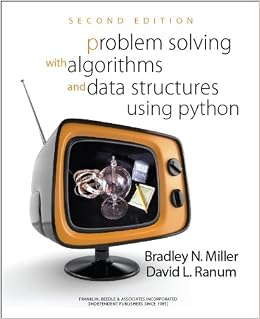
Problem-Solving with Algorithms and Data Structures Using Python connects a Python review with a first course in computer science. Brad Miller and David Ranum explain abstract data types, Big O analysis, recursion, sorting, searching, stacks, queues, trees, graphs, and classic problem-solving patterns.
An official interactive version lets readers run examples and complete exercises online, which adds useful practice to the printed text. The class-based implementations can feel detailed if you only want interview shortcuts. It is a stronger course choice than a puzzle collection when Python is your main language.
What You’ll Learn:
- Review Python classes, functions, collections, and control flow
- Measure algorithm growth with practical Big O analysis
- Implement stacks, queues, linked lists, trees, and graphs
- Apply recursion to searching and sorting problems safely
- Use abstract data types to organize program behavior
- Practice algorithms through interactive examples and coding exercises
Best For: Python students wanting algorithms, data structures, object-oriented programming, and interactive exercises taught together within an introductory computer science classroom setting.
8) Algorithms Illuminated: Part 1: The Basics
Author Name: Tim Roughgarden
Publisher: Soundlikeyourself Publishing, LLC
Latest Edition: Illustrated edition
No of Pages: 228 pages

Algorithms Illuminated: Part 1 teaches the analysis tools behind divide-and-conquer algorithms. Tim Roughgarden covers Big O notation, merge sort, integer and matrix multiplication, the master method, QuickSort, randomized selection, and graph contraction for minimum cuts.
The writing follows the author’s online courses, and official videos can support readers who prefer lessons alongside a book. This volume is intentionally narrow. Graph searches, data structures, greedy methods, dynamic programming, and NP-hard problems appear in later parts, so one volume does not form a complete algorithms course.
What You’ll Learn:
- Use Big O notation to compare algorithm growth
- Break large problems into smaller recursive subproblems effectively
- Analyze merge sort with the master method correctly
- Understand QuickSort and randomized pivot selection behavior clearly
- Find order statistics with randomized selection algorithms efficiently
- Study minimum cuts through randomized graph contraction methods
Best For: Students wanting focused lessons on analysis, sorting, divide-and-conquer methods, and randomized algorithms, supported by Tim Roughgarden’s videos and courses.
9) Algorithms
Author Name: Sanjoy Dasgupta
Publisher: McGraw-Hill Education
Latest Edition: 1st edition
No of Pages: 336 pages

Algorithms by Sanjoy Dasgupta, Christos Papadimitriou, and Umesh Vazirani is a concise university text that builds each topic around its main mathematical idea. It covers divide and conquer, graph algorithms, greedy methods, dynamic programming, linear programming, NP-completeness, and selected advanced topics.
At roughly one quarter of CLRS’s length, it moves quickly and leaves more work to the reader. The explanations can feel elegant once the mathematics clicks, but there are fewer implementation details than in Sedgewick and Wayne. It suits theory-focused courses better than language-specific coding practice.
What You’ll Learn:
- Analyze divide-and-conquer methods through recurrence relations using examples
- Solve graph problems using searches and shortest paths
- Apply greedy choices and prove when they work
- Build dynamic programs from overlapping smaller problems correctly
- Understand linear programming and reductions between hard problems
- Connect algorithm design with core mathematical ideas directly
Best For: Students comfortable with proofs who want a compact algorithms textbook covering design ideas without the size or detail of CLRS.
10) The Algorithm Design Manual
Author Name: Steven S Skiena
Publisher: Springer
Latest Edition: 2nd edition
No of Pages: 230 pages

The Algorithm Design Manual by Steven Skiena focuses on recognizing problems and choosing workable methods. The third edition adds material on hashing, randomized algorithms, divide and conquer, approximation, and quantum computing, while keeping its practical “war stories” and catalog of 75 common algorithmic problems.
The catalog makes this a useful desk reference when you know the problem but not the standard name or approach. Examples lean toward C and practical design rather than formal proof. CLRS is stronger for comprehensive theory, while this book is easier to consult during projects and interview preparation.
What You’ll Learn:
- Recognize common problems before choosing an algorithm family
- Analyze data structures, sorting, searching, and graph methods
- Apply dynamic programming, heuristics, and randomized algorithms practically
- Use the problem catalog to find suitable approaches
- Learn from real project stories and design mistakes
- Practice interview problems from major software companies directly
Best For: Programmers, computer science students, and interview candidates wanting practical design advice, real examples, and a searchable catalog of algorithm problems.
11) Algorithm Design: Pearson New International Edition
Author Name: Jon Kleinberg
Publisher: Pearson
Latest Edition: 1st edition
No of Pages: 832 pages

Algorithm Design by Jon Kleinberg and Eva Tardos starts with representative problems, then develops the techniques needed to solve them. Topics include graph algorithms, divide and conquer, greedy methods, dynamic programming, network flow, NP-completeness, approximation, randomized algorithms, and local search.
Concrete problems keep the theory tied to applications, and the exercises suit a university design course. The book expects comfort with proofs and does not provide ready-to-run code for every method. Choose it when learning how to design solutions matters more than collecting implementations.
What You’ll Learn:
- Turn representative computing problems into precise algorithm models
- Analyze growth rates and common algorithm running times
- Design greedy, recursive, and dynamic programming solutions carefully
- Model matching and routing problems with network flows
- Understand NP-completeness, approximation, and tractability limits more clearly
- Use randomization and local search for difficult problems
Best For: University students and advanced learners wanting a problem-driven course in algorithm design, mathematical analysis, proofs, exercises, and structured academic study.
12) Algorithms in a Nutshell: A Practical Guide
Author Name: George Heineman
Publisher: O′Reilly
Latest Edition: 2nd edition
No of Pages: 390 pages

Algorithms in a Nutshell helps programmers match a known problem with a suitable algorithm and understand the expected performance. The second edition covers analysis, sorting, searching, graphs, path finding, network flow, computational geometry, spatial trees, approximation, parallel methods, and probabilistic algorithms.
Each algorithm follows a repeatable format with context, inputs, solution details, analysis, and variations. That layout works well as a reference when implementing or comparing options. The 2015 edition is aimed at intermediate readers, and some language examples may require adaptation for current projects.
What You’ll Learn:
- Match software problems with established algorithm families quickly
- Compare best, average, and worst case performance clearly
- Implement sorting, searching, graph, and pathfinding methods correctly
- Work with network flows and computational geometry problems
- Choose spatial trees for range and neighbor queries
- Evaluate approximation, parallel, and probabilistic algorithm options carefully
Best For: Intermediate programmers needing a practical reference for choosing, analyzing, and implementing algorithms in software projects using common languages and tools.
How We Reviewed These Algorithm Books
We checked publisher pages, official companion sites, and the supplied article in October 2026. The review focused on audience level, topic coverage, teaching style, code language, exercises, current edition, and the difference between a course book and an interview practice guide. We did not treat publisher praise or retailer ratings as hands-on test results.
Each book needed a clear reason to remain. Some teach intuition, others provide proofs, coding practice, or a reference catalog. Older books stayed only when their core teaching remains useful and their limitations could be stated plainly. Edition details shown inside preserved Lasso cards may differ from current publisher listings, so confirm the linked format before buying.
How to Choose an Algorithm Book
Start with your immediate goal. A beginner needs clear explanations and small examples. A university course usually requires proofs, pseudocode, and exercises. Interview preparation needs repeated problems and several ways to solve them. Working programmers often need a reference that helps identify a familiar problem and choose an efficient method.
- For a visual introduction: Start with Grokking Algorithms.
- For interview practice: Use Data Structures and Algorithms Made Easy.
- For academic depth: Choose Introduction to Algorithms.
- For Java implementation: Use Algorithms or Data Structures and Algorithms in Java.
- For Python study: Choose Problem-Solving with Algorithms and Data Structures Using Python.
- For practical reference: Keep The Algorithm Design Manual nearby.
How to Practice While Reading
Do not stop after following an example. Close the book and write the algorithm again from memory. Test it with an empty input, one item, repeated values, sorted data, and a larger random case. Then explain its running time and memory use in plain words.
Use one language long enough to separate algorithm mistakes from syntax mistakes. Draw trees and graphs by hand, trace each operation, and keep failed attempts. A short study session that includes implementation and testing teaches more than reading several chapters without writing code.
