
SAP C223: How to Create a Production Version in SAP PP
 Editorial Team
⚡ Smart Summary
Production versions in SAP PP pair one alternative bill of material with one routing, so planning and order creation know exactly which components and which operations to use for a given lot size and validity period.
What is a Production Version in SAP PP?
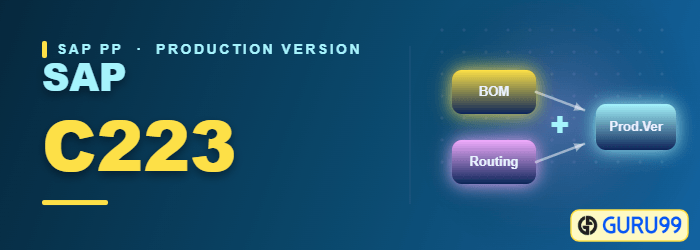
The production version is the link between a product BOM (bill of material) and the process routing. It determines which alternative BOM is used together with which routing to produce a material or plan a material.
There may be different production versions based on the lot sizes and validity dates. For example, there may be different versions if you want to produce 1 to 100 liters of paint rather than 100 to 1,000 liters, because a different composition of the BOM may be required in each case.
A production version comprises the following data:
- The assignment of routings to the production version.
- The assignment of the alternative BOM to the production version.
Production versions are used in material requirements planning (MRP), production order creation and product costing, to select the most suitable routing and the corresponding bill of material.
Why is a Production Version Required?
A material with only one BOM and one routing still runs without a version in older releases. The moment a plant has a choice, however, something has to record which combination is legitimate, and that is the job of the production version.
- Several ways to make the same material. Two production lines, or a manual and an automatic line, each need their own BOM and routing pairing.
- Quantity-dependent recipes. A small batch and a bulk batch often use different components, so each gets its own version with its own lot-size range.
- Time-dependent changes. A reformulated product can be introduced on a fixed date by giving the new version a later validity start.
- Unambiguous planning. Without a version, MRP has to guess which alternative BOM and which routing group to explode.
- Mandatory in SAP S/4HANA. What was optional in SAP ERP is required master data in S/4HANA for discrete, process and repetitive manufacturing, so existing materials must be given versions during migration.
Key Fields in the Production Version
The C223 detail screen is short but every field changes how the version is selected. The table below explains what each entry controls before you fill the screen in.
| Field | What it controls |
|---|---|
| Plant and Material | The material and location the version belongs to. A version is always plant specific |
| Production version and text | The identifier, usually 0001, 0002 and so on, plus a description a planner can recognize |
| Valid from / Valid to | The period during which planning may select this version |
| Lot size from / to | The order quantity range the version covers. An order outside the range will not use it |
| Alternative BOM and BOM usage | Which BOM alternative to explode. Usage 1 is the production BOM |
| Task list type | N for a routing, 2 for a master recipe in process manufacturing |
| Task list group and group counter | The routing group generated by CA01, and the counter that picks one alternative inside it |
Steps to Create Production Version in SAP
Before starting, confirm that the material master exists in the plant, that the BOM has been created in CS01 and that the routing has been created in CA01. In order to create a production version, perform the following steps.
Step 1) From the SAP Easy Access screen, open transaction C223.
- Enter the Plant code.
- Enter the parent material for which the production version needs to be created.
- Enter the Material code.
- Input the production version code and text.
- Input the validity dates of the production version.
- Input the lot size range where it would be valid.
- Input the Alternative BOM and BOM usage as “1” for a production BOM.
- Enter the Routing Group and Group Counter.
- Enter the type of task list, which is N for a routing.
The detail screen collects all of these entries in a single pop-up window.

After filling in all the fields, click  or press Enter to go to the next screen.
Step 2) In this screen:
- Select the line of the newly created production version.
- Press “consistency check” to check whether the BOM and routing are valid.
A new version starts with the status “not yet checked”, shown as a yellow triangle, until the check is run.

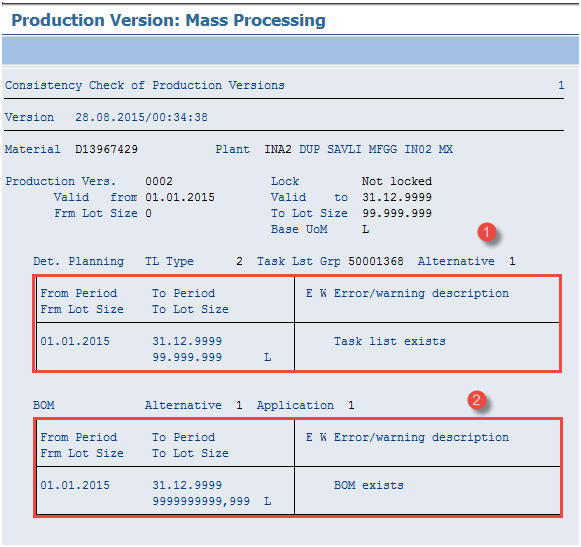
Step 3) In this screen, you can see the messages regarding the validity of the BOM and routing for the material.
- Check whether the task list routing exists in the validity period (01.01.2015 to 31.12.9999) and lot sizes (0 to 99999999) of the production version.
- Check whether the BOM exists in the validity period (01.01.2015 to 31.12.9999) and lot sizes (0 to 9999999999999) of the production version.
Each line reports one check, so a red entry names exactly which object failed.
Click  or press F3 on the keyboard to return to the previous screen.
Step 4) In this screen, you can see that the test status is indicated by a green color.
- You can see the consistency check status in green.

Click  to save the new version. The system will show the message “Production version saved” in the lower left corner.
Production Version in the Material Master
C223 is not the only route to the same data. The identical production versions can be reached from the material master, which is often faster when you are already working on one material.
- Run transaction MM02 for the material and plant.
- Open the MRP 4 view, or the Work Scheduling view.
- Click the ProdVersions button to open the same detail screen used above.
The choice is one of scale rather than function. C223 is built for mass processing, so it lists every version for a material or plant at once and allows a collective consistency check, while MM02 handles a single material at a time. In SAP S/4HANA, the Manage Production Version app covers the same task, and the Process Production Version app proposes new versions automatically when a matching BOM and routing appear.
Troubleshooting Production Version Errors
- There might be a case where the BOM and routing are not valid within the production version validity time frame. Ensure that the validity period of the production version falls within the validity period of both the BOM and the routing.
- If the lot-size range of the version is wider than the range on the routing header, the consistency check reports an error. Narrow the version or widen the routing lot size.
- An order quantity outside the version lot-size range simply will not select the version, which usually looks like a missing version rather than an error message.
- If the routing group or group counter is wrong, the check still passes on the BOM line but fails on the task list line, so read both messages rather than only the first.
- The consistency check is informational and does not block order creation, so a version can be used while still yellow. Running it anyway is what surfaces lot-size and validity mismatches early.
