
How to Configure Client and Repository in Informatica
 Editorial Team
⚡ Smart Summary
Configuring Informatica PowerCenter after installation means creating the Repository Service, generating repository contents, creating the Integration Service, adding the domain to each client tool, and creating users with domain and repository privileges.
After installing the Informatica server and client, the Informatica server needs to be configured.
The Informatica architecture is a Service Oriented Architecture (SOA). Therefore, before using Informatica tools, the server and client components need to be installed and configured.
Prerequisites to configure clients, the Integration Service and the Repository Service:
- Informatica server and client should be installed.
- Informatica service should be up and running.
- Oracle or another compatible database must be installed, and the database service must be up.
- Database users must be created for the Repository Service.
- Domain administrator console credentials must be available (these are configured during server installation).
The following components need to be set up before you can start working in Informatica PowerCenter.
- Informatica domain
- Creating the Repository Service
- Creating the Integration Service
- Creating users
What is an Informatica Domain?
An Informatica Domain is the basic administrative unit for various services and hosts.
Using the domain console you can perform various administrative tasks like adding a node, creating a Repository Service, creating an Integration Service, creating a Reporting Service, managing and creating users, monitoring services, and so on.
During installation of the Informatica server, the system prompts for setting up the domain credentials and database connection. That database is the domain configuration repository, which is separate from the PowerCenter repository created below.
You need to use the same credentials when you access the domain console.
How to Open the Administrator Home Page
Step 1) From the program menu, open the Informatica Administrator home page.

This will open up the domain home page in the web browser.
Troubleshooting – if the home page does not open up, check whether the Informatica server process and the database service are up and running. If not, start them.
Step 2) Enter the domain credentials (these credentials are generated during server installation).
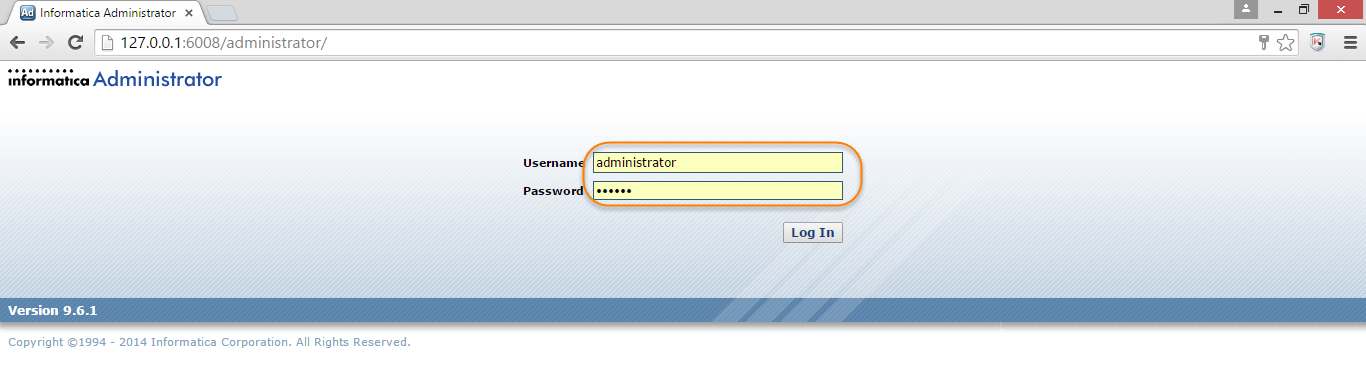
Step 3) On successful login, the Informatica Administrator home page appears, as shown below.

How to Create the Repository Service
It is the first service that needs to be created in the domain console. The prerequisite is to have a database user created in the database along with basic privileges (connect, resource), as this service maintains repository data in the database. You can create versioned objects in the repository using the enable version control option.
You can select Oracle, DB2, Sybase or SQL Server databases to create a repository.
Step 1) Start the service creation wizard.
- Right-click on the domain name
- Select the new option
- Select PowerCenter Repository Service.

Step 2) In the next screen:
- Enter a name for the repository
- Select the license
- Select the node
- Click on the Next button

Step 3) In the next screen:
- Enter the database properties.
- Select the option – enable version control, if the version control feature is required for Informatica development.
- Select the finish button.

Note – the connection string name is the name of the database instance service name.
Step 4) The Repository Service will be created, and will be listed under the domain tree.

Troubleshooting – if there is an error during service creation, check whether the correct database credentials are provided, and whether the connection string is correct. After any changes are made to repository properties, recycle the Repository Service to make the changes effective.
How to Create Repository Contents
After the Repository Service is created, repository contents need to be created (this is a one-time activity for a repository). Without repository contents, you cannot start the Repository Service. Repository content is basically the set of database tables that contains the details of objects created in Informatica.
Step 1) Select the Repository Service under the domain tree.

Step 2) After selecting the Repository Service:
- Select the Actions menu on the right side of the page
- Select the repository contents option
- Select the create option
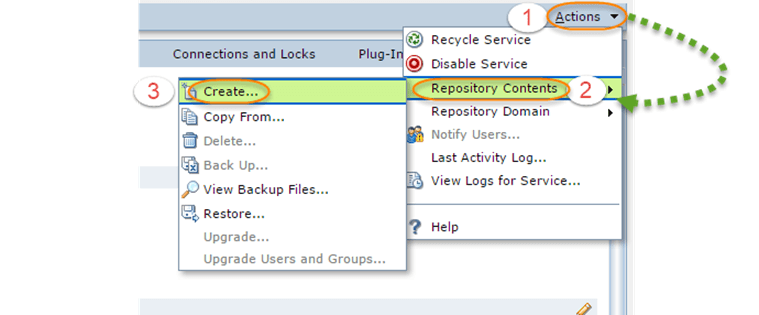
Step 3) In the next screen:
- Select the options of local/global repository (we are keeping it unchecked to create a local repository)
- Select version control (if required; we are keeping it unchecked to skip the version control feature)
- Click OK.

Step 4) Once repository content is created, change the Repository Service from exclusive to normal mode.
Note – if the Repository Service is in exclusive mode, users would not be able to connect to the repository. Exclusive mode allows a single user at a time, which is what makes creating or deleting contents safe; normal mode is the multi-user state developers connect to.
Select the edit property option of the repository.

Step 5) In the properties dialog:
- Select the mode from exclusive to normal
- Select the OK button.

Once done, the Repository Service will be running in normal mode.
How to Create the Integration Service
The Integration Service is responsible for the execution of workflows. Whenever any workflow is executed from Workflow Manager, a scheduler or the command prompt, the Integration Service receives a request. This service locks the respective workflow, fetches the details about the workflow, mapping and session from the Informatica repository, and executes the workflow. This service is also responsible for creating workflow logs, reading parameter files, creating process threads to execute workflows, executing any other task created in Workflow Manager, and so on.
The two services divide the work as follows.
| Service | What it is responsible for |
|---|---|
| Repository Service | Stores and serves the metadata – mappings, sessions, workflows and folders – held in the repository database. |
| Integration Service | Reads that metadata and actually runs the workflows and sessions, writing session and workflow logs. |
To create the Integration Service:
Step 1) Start the service creation wizard.
- Right-click on the Domain Navigator tree
- Select the new option
- Select PowerCenter Integration Service

Step 2) In this step we will:
- Enter the Integration Service name
- Select the license
- Select a node and click next.

Step 3) On the next page:
- Select the Repository Service
- Enter the Informatica Administrator user name and password.
- Select Finish.

Step 4) To enable the Integration Service:
- Click on the Integration Service in the domain tree and select the Actions option.
- Select the Enable Service option

When both the Integration Service and the Repository Service are created and enabled, they should be in running status, as the domain tree confirms below.

How to Configure the Client and Domain
Before you start using the Informatica Integration Service and Repository Service of the Informatica server, you have to configure the Informatica domain at the client. To add the domain at the client, the following steps are required.
Step 1) Open the Informatica PowerCenter Designer client. The same Repository menu exists in Repository Manager and Workflow Manager, so this dialog can be reached from any client tool.
- Select the Repository menu
- Select Configure Domains

Step 2) Select the add new domain option.

Step 3) In the add domain window:
- Enter the domain name
- Enter the gateway host
- Enter the gateway port (the port number is assigned during the Informatica server installation process)
- Select OK

Step 4) The repository will be listed on the right side of the window. Select the checkbox and select OK.

The repository will then be listed in the Repository Manager navigation tree.

How to Create a User
To create mappings in Informatica Designer and to perform various tasks such as executing workflows, managing repository folders and monitoring workflows, a valid Informatica user is required, and the user must have privileges. A user can be an administrator user or a developer user based on the roles assigned to it. You can create any number of users based on requirement.
To create an Informatica user:
Step 1) In the Informatica Administrator home page, select the Security tab.

Step 2) In this step we will:
- Select the Users tab
- Select the Actions menu
- Select the create user option

Step 3) On the create user page:
- Enter the desired login name
- Enter the desired password
- Confirm the password
- Select OK

Step 4) The user must have privileges on the domain and the repository. To assign the privileges:
- Click on the user name
- Select the Privileges tab
- Select the domain.

Step 5) In the edit roles window:
- Select the check box of the domain
- Select the check box for the Repository Service
- Select OK.
This will assign repository and domain privileges to the user, as the edit roles window below shows.

Now you will be able to connect to the repository using the client tools.
This completes the exercise of Repository Service creation, Integration Service creation, domain configuration, user creation and adding a repository in the client.
