
10 Best HRIS Systems (2026) Guide & Comparision
 Editorial Team
Disclosure: Guru99 is reader-supported. We may earn a commission when you buy through links on this page. Learn more

HR software can become another problem when records stay incomplete, payroll connections fail, support responds slowly, interfaces confuse managers, fees appear late, or reports disagree. Those gaps lead to correction work, delayed onboarding, weak audit trails, and frustrated employees. Buyers often overlook service scope, implementation ownership, and data controls. A well-matched system can centralize records, shorten routine approvals, and improve workforce reporting. Clear comparisons make the decision manageable and give teams a confident path forward.
I spent 65+ research hours evaluating 20+ competitors through official product pages, pricing schedules, security materials, interface screenshots, and recurring user feedback. My firsthand interface review covered features, pros and cons, usability, and service boundaries in a backed-by-evidence assessment. After rigorous analysis, I shortlisted 10 Best HRIS Systems options. Continue reading to identify the platform that fits your workforce, budget, and internal HR capacity. Read more…
Best HRIS Systems & Software List
| Name | HR Functions | Mobile Access | GDPR and HIPAA Compliance | Reports and analytics | Link |
|---|---|---|---|---|---|
| Justworks | Payroll Processing, Benefits Administration, Compliance Management, etc. | Yes, iOS and Android | Yes | Payroll Analytics, Benefits Reports, Compliance Tracking, etc. | Learn More |
| TriNet | PEO Services, Payroll & Tax Administration, Benefits Management, etc. | Yes, iOS and Android | Yes | HR Analytics, Compliance Reports, Workforce Insights, etc. | Learn More |
| Patriot | Payroll Processing, HR Software, Time & Attendance, etc. | Yes, iOS and Android | Yes | Payroll Reports, Tax Filing Reports, Employee Records, etc. | Learn More |
| Remote | Employee Onboarding & Documentation, Payroll Management, etc. | Yes, iOS and Android | Yes | Employee Performance Reports, Payroll Information, etc. | Learn More |
| When I Work | Employee Scheduling, Time Tracking, Team Communication, etc. | Yes, iOS and Android | Yes | Labor Cost Reports, Scheduling Analytics, Time & Attendance Reports, etc. | Learn More |
“You should always have HRIS software that can help you manage payroll, improve efficiency, perform time tracking, and more. We advise you to select a service that provides proper data-driven recommendations, identifies performance bottlenecks, and assists in decision-making. Always prefer a service with a cost-effective pricing plan for your business scale.“
1) Justworks
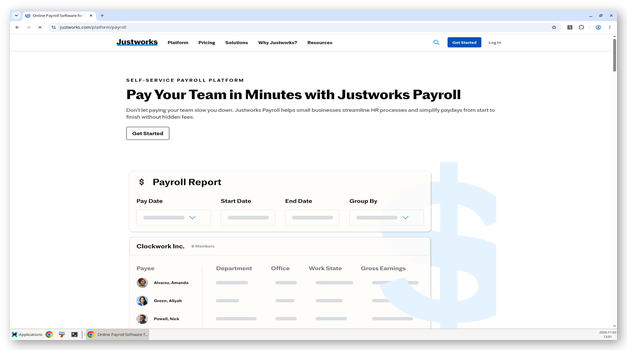
Justworks combines payroll software, HR tools, compliance support, and optional PEO services for US employers. Its platform handles onboarding, payments, tax filings, time-off policies, documents, reporting, and employee self-service. PEO customers also gain access to benefit administration, workers compensation, and HR consulting through a co-employment arrangement.
I found the dashboard approachable for smaller teams that want service alongside software. Published plan prices aid budgeting, though insurance premiums and add-ons change the final cost. Companies seeking deep performance management or a standalone global HRIS may need additional products.
Features:
- Payroll Administration: Processes employee and contractor payments, payroll taxes, direct deposits, and standard filings while keeping payment histories inside the same workforce account.
- PEO Services: Adds co-employment, compliance support, workers compensation access, and HR consulting for US companies needing more guidance than payroll software alone.
- Benefits Administration: PEO Plus manages medical, dental, vision, HSA, FSA, and selected wellness benefits, subject to carrier availability and employer eligibility consistently.
- Employee Self-Service: Lets workers review pay information, manage personal details, access documents, and submit time-off requests through web and mobile interfaces directly.
- Time and Attendance: Provides basic timecards and PTO management, with advanced time tracking available as a separately priced add-on across current plans centrally.
- Reporting Tools: Offers payroll, benefits, census, time-off, and custom reports, helping administrators reconcile workforce costs and prepare routine audits for routine administration.
- Support Access: Includes support for employers and employees, while PEO tiers add HR consulting and compliance guidance for more complicated workplace questions.
Pros
Cons
Pricing:
| Plan | Pricing |
|---|---|
| Payroll | $50 base fee plus $8 per employee/month |
| PEO Basic | $79 per employee/month |
| PEO Plus | $124 per employee/month |
| Free access | Current Payroll promotion includes three free months |
Three months free on Payroll
2) TriNet
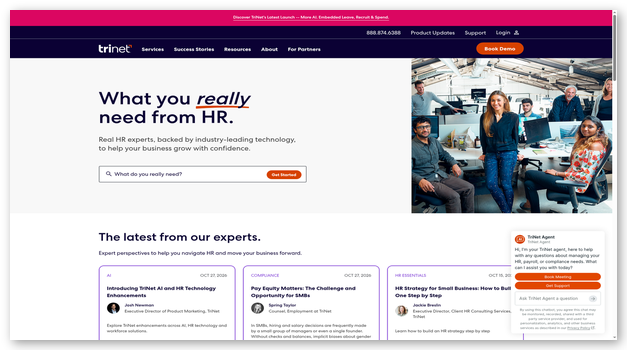
TriNet provides PEO services and an HR Plus option for small and midsize US businesses. Its offering combines payroll, benefits administration, compliance guidance, risk support, employee self-service, and HR technology. Industry-focused service teams support organizations in areas such as technology, financial services, professional services, nonprofits, and life sciences.
The service fits employers wanting human guidance with their workforce platform. I valued the broad benefits and advisory coverage, but pricing requires a tailored quote. Buyers should compare co-employment terms, implementation responsibilities, benefit choices, and service response commitments before signing.
Features:
- PEO Administration: Combines payroll, tax administration, benefits, compliance, and risk services under a co-employment model for eligible US small and midsize employers.
- HR Plus Services: Offers an alternative managed HR package for employers seeking technology and support without adopting the complete PEO service relationship efficiently.
- Benefits Access: Provides access to health, retirement, life, disability, and voluntary benefits, with plan availability and premiums determined during enrollment for managers.
- Payroll and Taxes: Coordinates payroll calculations, payments, tax administration, year-end forms, and employee access through the connected HR technology platform during common workflows.
- Industry Guidance: Aligns service teams and HR advice with common needs in technology, finance, professional services, nonprofits, and life-sciences organizations across departments.
- Compliance Support: Provides HR guidance, policy resources, risk services, and regulatory updates while employers retain responsibility for workplace decisions and accurate data.
- Global Add-On: Extends selected payroll and workforce services across more than 150 countries and 120 currencies through TriNet global capabilities during reviews.
Pros
Cons
Pricing:
| Plan | Pricing |
|---|---|
| TriNet PEO | Custom per-employee pricing |
| TriNet HR Plus | Custom pricing |
| Free access | Product demonstration available, with no standard trial published |
Demo available
3) Patriot
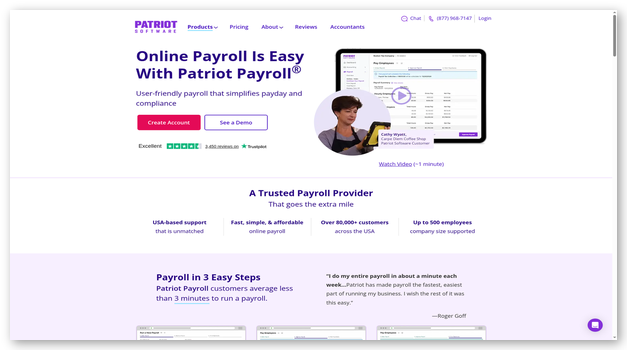
Patriot offers payroll, accounting, time, and basic HR software for US small businesses. Its HR module stores employee information and documents, supports customizable reports, and can pair with payroll and time products. Payroll plans provide unlimited runs, employee access, direct deposit, and either customer-managed or full-service tax filing.
I found its modular pricing easier than many enterprise suites. The platform is best for straightforward domestic administration, not complex talent management or global employment. Growing teams should price each add-on because payroll, HR, time, and expert support are billed separately.
Features:
- Employee Records: Stores contact, employment, emergency, pay, and document information in a central account with customizable fields and administrative access controls securely.
- HR Reporting: Creates employee-focused reports from stored workforce data, giving small businesses a practical alternative to maintaining several separate spreadsheets during administration.
- Payroll Options: Offers Basic Payroll for employer-filed taxes and Full Service Payroll for automated deposits and filings across supported US jurisdictions consistently.
- Employee Portal: Lets workers review pay information, tax documents, and selected personal details without requesting every record from an administrator during implementation.
- Time Add-On: Adds employee time entry, approvals, and payroll transfer as a separate subscription for teams needing connected attendance records across departments.
- HR Experts: Provides optional HR training and access to professional guidance for policies, compliance questions, and common employee-management situations for routine administration.
- Support and Setup: Includes US-based product support and guided setup resources, helping smaller employers configure payroll and workforce records without dedicated implementation consultants.
Pros
Cons
Pricing:
| Plan | Pricing |
|---|---|
| HR Software | $6 base fee plus $2 per active employee/month |
| HR Software + Experts | $51 base fee plus $2 per active employee/month |
| Full Service Payroll | $37 base fee plus $5 per worker/month |
| Free access | 30-day free trial |
30-day free trial
4) Remote
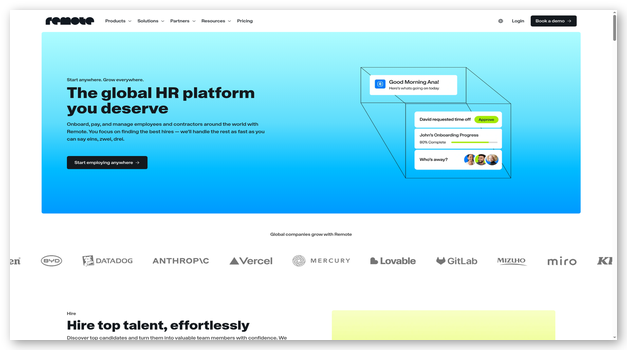
Remote HRIS centralizes employee profiles, contracts, onboarding, leave, time, expenses, permissions, workflows, and compliance information for distributed teams. It can sit beside Remote payroll, contractor, employer-of-record, and PEO services. Companies may add direct employees from any country without limiting the number of records in the account.
I found the product most relevant for teams managing several countries from one system. Its HRIS price is published separately from employment services, improving scope comparisons. Buyers should confirm which integrations, analytics, and local payroll functions their selected countries support.
Features:
- Employee Profiles: Maintains workforce records, job information, documents, contracts, compensation details, and reporting lines for direct employees across supported locations across teams.
- Onboarding Workflows: Guides new hires through required details, documents, signatures, and assigned tasks while administrators track completion from a central view efficiently.
- Leave and Time: Manages time-off requests, policies, approvals, calendars, and time records for distributed teams working under different local arrangements throughout employee management.
- Expenses: Lets employees submit expense details and documentation, with configurable approvals helping managers review reimbursement requests within the workforce platform directly.
- Compliance Watchtower: Surfaces country-related employment updates and compliance information, supporting teams that oversee people across several legal jurisdictions across common employee lifecycle tasks.
- Roles and Permissions: Controls access to employee and company data through assigned administrative roles, helping limit sensitive information to appropriate users for employees.
- Connected Employment: Links HRIS records with Remote payroll, contractor management, PEO, and employer-of-record services when companies purchase those products throughout employee management.
Pros
Cons
Pricing:
| Plan | Pricing |
|---|---|
| HRIS | $12 per employee/month |
| Global Payroll | From $29 per employee/month |
| Employer of Record | From $599 per employee/month on annual contracts |
| Free access | Self-guided tour available, with no standard trial published |
Self-guided tour available
5) When I Work
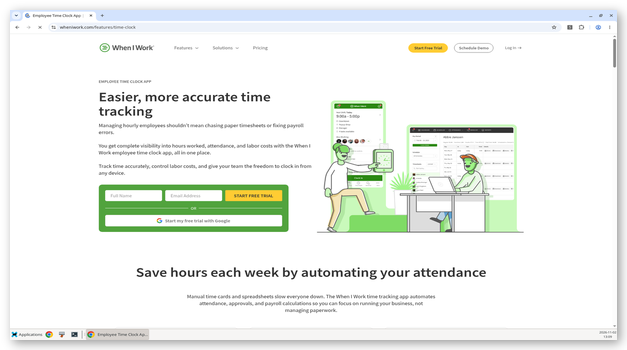
When I Work is workforce management software focused on employee scheduling, time tracking, attendance, and team messaging. Managers can build multi-week schedules, publish open shifts, manage swaps, track availability, and connect attendance data with payroll services. Mobile apps keep shift-based employees informed across locations and departments.
I found it practical for retail, hospitality, healthcare, and other hourly teams. It is not a complete HRIS because payroll, benefits, performance, and employee-record depth depend on integrations. Buyers should treat it as a specialized workforce layer rather than a central HR system.
Features:
- Schedule Builder: Creates reusable schedules across weeks, positions, locations, and time zones while showing availability and potential staffing conflicts before publication securely.
- Open Shifts: Allows managers to publish unassigned work and employees to request eligible shifts, reducing manual calls when coverage changes during administration.
- Time and Attendance: Adds clock-in controls, attendance records, GPS or geofencing options, and timesheet approvals that can feed connected payroll products for managers.
- Team Messaging: Keeps schedule announcements, shift questions, and workplace conversations inside mobile and web applications rather than scattered personal messages during implementation.
- Forecasting: Uses staffing and labor information to help managers compare scheduled coverage with operational demand and anticipated labor budgets across departments.
- Payroll Integrations: Connects approved time data with selected payroll and HR platforms, reducing duplicate entry while keeping the external system of record.
- Advanced Controls: Higher tiers add scheduling rules, custom reporting, permissions, API access, webhooks, and SAML single sign-on for complex organizations during reviews.
Pros
Cons
Pricing:
| Plan | Pricing |
|---|---|
| Essentials | $2.50 per user/month |
| Pro | $5 per user/month |
| Premium | $8 per user/month |
| Free access | 14-day free trial with no payment card required |
14-day free trial
6) BambooHR
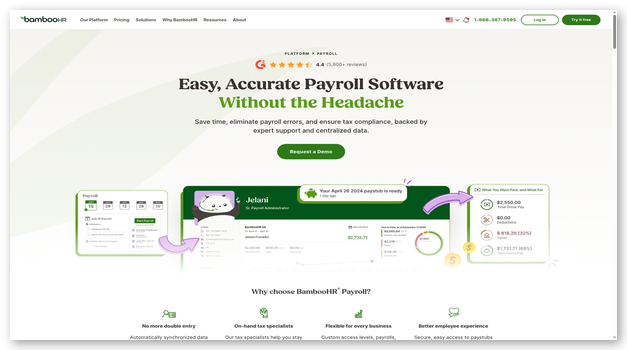
BambooHR is a cloud HR platform covering employee records, onboarding, applicant tracking, time off, benefits tracking, reporting, and employee experience. Higher plans add performance tools, recognition, compensation planning, benchmarks, deeper analytics, and broader compliance training. Payroll, benefits administration, time tracking, and global employment are optional additions.
I found its interface well suited to HR teams replacing spreadsheets with structured workflows. Current public prices improve planning, though organizations with 25 employees or fewer face monthly minimums. Buyers should calculate add-ons and confirm implementation scope before comparing totals.
Features:
- Employee Database: Centralizes personal, employment, compensation, document, and reporting information with configurable access for administrators, managers, and employees within routine administrative workflows.
- Hiring and Onboarding: Supports job postings, candidate records, offer templates, onboarding packets, tasks, and new-hire information collection through connected workflows for routine administration.
- Time-Off Management: Tracks policies, balances, requests, approvals, and calendars while allowing organizations to create multiple rules for different employee groups for managers.
- Reporting and Analytics: Provides custom reports, dashboards, workforce benchmarks, and advanced visualizations according to the purchased Core, Pro, or Elite plan during implementation.
- Employee Experience: Includes eNPS, wellbeing tools, total rewards, community, recognition, and rewards functions, with feature depth increasing on higher tiers across departments.
- AI Assistant: Answers approved HR data questions and expands to policy, document, benchmark, and analysis requests on higher-priced subscription levels for employees.
- Integration Marketplace: Connects with more than 150 partners covering payroll, benefits, recruiting, identity, performance, finance, and other workforce categories throughout employee management.
Pros
Cons
Pricing:
| Plan | Pricing |
|---|---|
| Core | $10.25 per employee/month, or $250 monthly for 25 or fewer |
| Pro | $17.50 per employee/month, or $425 monthly for 25 or fewer |
| Elite | $25 per employee/month, or $650 monthly for 25 or fewer |
| Free access | Free trial available with no payment card, duration not published |
Free trial available
7) OnPay
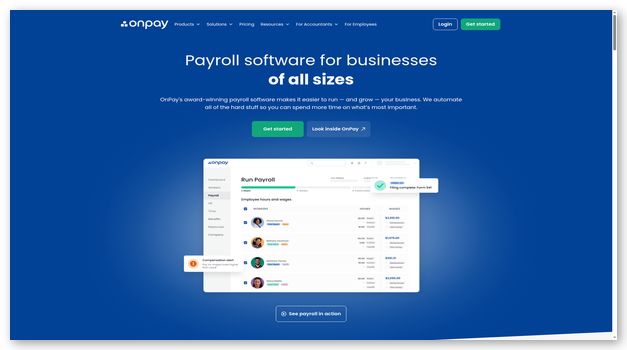
OnPay combines US payroll with employee onboarding, self-service, document storage, PTO tools, organizational charts, and benefits connections. Its base payroll plan includes unlimited pay runs, multi-state processing, automated tax filings, year-end forms, and support. Optional HR and time modules extend workforce administration without replacing the payroll account.
I found its pricing calculator helpful for estimating a small team. The product suits employers prioritizing payroll accuracy and practical HR basics rather than deep talent management. Companies needing international employment, advanced performance, or enterprise workforce planning should consider broader HRIS platforms.
Features:
- Full-Service Payroll: Processes employees and contractors, unlimited payroll runs, multiple schedules, direct deposits, checks, pay cards, and standard tax deductions across teams.
- Tax Administration: Files and pays federal, state, and local payroll taxes, including supported year-end forms and multi-state requirements without separate state charges.
- Employee Onboarding: Collects new-hire details, supports electronic forms and signatures, and gives employees secure access to personal payroll and document information consistently.
- HR Records: Organizes employee profiles, documents, PTO information, directory details, and reporting relationships, with extended workflows available through the HR add-on directly.
- Benefits Connections: Supports health, retirement, workers compensation, and selected insurance services while synchronizing relevant deductions with payroll processing across common employee lifecycle tasks.
- Accounting Integrations: Connects with QuickBooks, Xero, and other supported accounting or time systems to reduce duplicate payroll journal and attendance entries accurately.
- Expert Support: Includes phone, chat, and email assistance plus account setup and data migration without separate implementation or integration charges during reviews.
Pros
Cons
Pricing:
| Plan | Pricing |
|---|---|
| Payroll Essentials | $49 base fee plus $6 per worker/month |
| HR add-on | $15 base fee plus $2 per worker/month |
| HR + Time bundle | $21 base fee plus $4 per worker/month |
| Free access | First month free for eligible new accounts |
First month free
8) Rippling HRIS
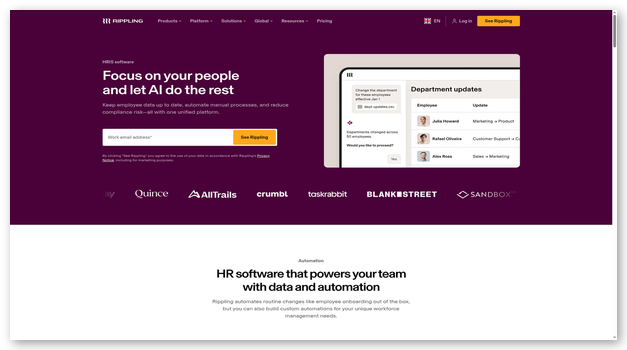
Rippling HRIS uses a shared employee record across HR, payroll, benefits, IT access, devices, expenses, and connected applications. Administrators can automate onboarding, approvals, permission changes, offboarding, reporting, and compliance tasks through configurable workflows. Companies select modules around the underlying workforce platform rather than buying one fixed bundle.
I found its cross-department automation compelling for growing technology-heavy organizations. The same modular structure makes total cost harder to predict because payroll, time, benefits, IT, and finance products require a scoped quote. Implementation also needs careful ownership and data mapping.
Features:
- Unified Employee Record: Feeds approved employee changes across HR, payroll, benefits, devices, applications, and spend modules, reducing repeated updates between department systems securely.
- Workflow Automation: Triggers approvals, notifications, assignments, access changes, and other actions from employee events using configurable conditions and role-based logic during administration.
- Payroll Services: Supports payroll calculations, taxes, deductions, filings, and reporting in eligible markets as a separately selected product within the platform consistently.
- Identity and Devices: Provisions applications, manages access, and coordinates supported device tasks during onboarding, role changes, and employee offboarding within routine administrative workflows.
- Benefits Administration: Connects enrollment, plan information, deductions, and qualifying events with the employee record, depending on brokerage and selected service arrangements centrally.
- Reporting and AI: Provides custom reporting, analytics, and eligible natural-language assistance across permitted workforce data and purchased modules across common workforce management processes today.
- Integration Library: Connects with hundreds of business applications across accounting, recruiting, collaboration, security, benefits, and productivity categories within routine employee administration workflows.
Pros
Cons
Pricing:
| Plan | Pricing |
|---|---|
| Rippling Platform | Modular pricing, with an official total requiring a quote |
| HR, Payroll, IT, and Spend | Products priced according to selected modules |
| Free access | Product demonstration available, with no standard trial published |
Demo available
9) Bambee
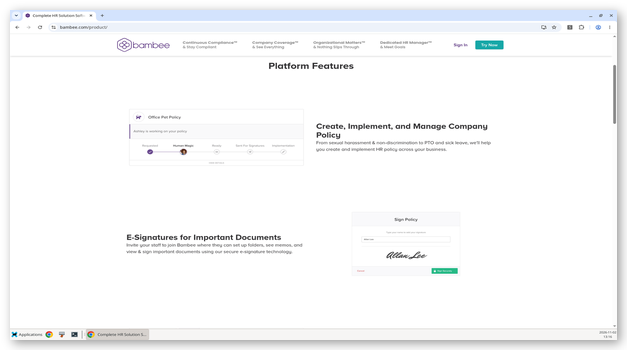
Bambee pairs small businesses with managed HR services and a supporting platform. Depending on the plan, its team can review policies, conduct HR audits, coordinate employee communications, maintain required practices, and help managers address workplace matters. The service emphasizes observation, supervision, and management rather than a conventional self-service HRIS suite.
I found it relevant for owners without an internal HR specialist. Buyers should not treat it as a replacement for a deep employee database, payroll, or benefits platform. Scope, responsibilities, response times, and included management work need confirmation before purchase.
Features:
- Dedicated HR Guidance: Connects customers with HR professionals who help interpret workplace situations, shape policies, and plan appropriate administrative responses across daily operations.
- HR Audits: Reviews documented practices and workforce processes to identify gaps that management should address through policies, training, or operational changes efficiently.
- Policy Support: Helps create, distribute, and reaffirm workplace policies so businesses can maintain consistent expectations and evidence of employee acknowledgement for managers.
- Employee Relations: Supports managers handling workplace questions, performance concerns, and employee communications while final employment decisions remain with the customer during implementation.
- HR Autopilot: Coordinates recurring HR activities, reminders, and follow-up work according to the selected observation, supervision, or management service level across departments.
- Document Organization: Provides a place for HR documents and policy records, helping small employers replace scattered email attachments and local files accurately.
- Service Tiers: Separates visibility, direct workforce supervision, and delegated management responsibilities, allowing businesses to match service depth with internal capacity during reviews.
Pros
Cons
Pricing:
| Plan | Pricing |
|---|---|
| Observation | Custom pricing based on company size and scope |
| Supervision | Custom pricing based on company size and scope |
| Management | Custom pricing based on delegated responsibilities |
| Free access | Consultation available, with no standard free trial published |
Consultation available
10) Gusto
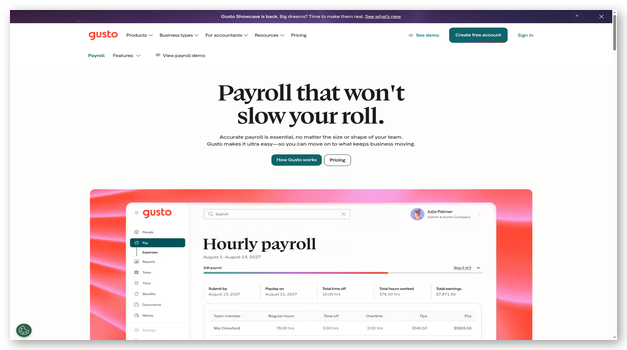
Gusto combines US payroll, tax filing, onboarding, employee self-service, basic HR, and benefits connections for small and midsize businesses. Higher tiers add multi-state payroll, time tracking, scheduling, project costing, HR guidance, and premium support. Add-ons cover selected compliance, payment speed, benefits, and workforce needs.
I found the published plan structure easy to compare for domestic employers. Simple is limited to basic single-state payroll, while Plus and Premium carry broader workforce functions at higher per-person costs. Organizations needing deep talent management, global employment, or complex enterprise controls may outgrow the platform.
Features:
- Payroll Processing: Runs unlimited payrolls, calculates deductions, files supported federal, state, and local taxes, and prepares standard employee and contractor forms securely.
- Employee Onboarding: Collects new-hire details, forms, payment information, and acknowledgements while giving workers secure access to their payroll and benefits account efficiently.
- Benefits Administration: Supports medical, dental, vision, retirement, workers compensation, and selected tax-advantaged accounts, with availability and charges varying by product for managers.
- Time and Scheduling: Plus and Premium include time tracking and scheduling, while Simple customers can purchase Time and Attendance Plus separately during implementation.
- Multi-State Payroll: Higher tiers support employers operating across multiple states, while the entry Simple plan is positioned for single-state payroll across departments.
- HR Guidance: Premium includes HR guidance and compliance tools, while eligible customers can add priority support or fractional HR services for employees.
- Integrations: Connects with accounting, time, expense, point-of-sale, and productivity products, helping businesses reuse approved payroll and employee information throughout employee management.
Pros
Cons
Pricing:
| Plan | Pricing |
|---|---|
| Simple | $49 base fee plus $6 per person/month |
| Plus | $80 base fee plus $12 per person/month |
| Premium | $180 base fee plus $22 per person/month |
| Free access | Account access is free until the first payroll run |
Free until first payroll run
Feature Comparison Table Top HRIS Systems
| Tool | Core HR & Payroll | Easy Self-Service | Published Entry Pricing | Live Support | Security & Scaling | Integrations & AI |
|---|---|---|---|---|---|---|
| Justworks | ✅ | ✅ | ✅ | ✅ | ✅ | ✅ |
| TriNet | ✅ | ✅ | ❌ | ✅ | ✅ | ✅ |
| Patriot | ✅ | ✅ | ✅ | ✅ | ✅ | ❌ |
| Remote | ✅ | ✅ | ✅ | ✅ | ✅ | ✅ |
| When I Work | ❌ | ✅ | ✅ | ✅ | ✅ | ✅ |
What is an HRIS System and What Does It Do?
An HRIS system stores employee information and supports recurring HR processes. It usually covers records, documents, onboarding, leave, approvals, reporting, and self-service. Some platforms also include payroll, benefits, recruiting, performance, or scheduling. Others connect those functions through integrations. The important distinction is the central employee record. Approved changes should flow into connected processes without repeated entry. Smaller businesses may need only core administration. Larger organizations often require detailed permissions, audit trails, analytics, country support, and configurable workflows across departments securely.
How Do HRIS, HRMS, and HCM Platforms Differ?
HRIS, HRMS, and HCM often overlap in vendor marketing. HRIS usually describes core employee records and administrative processes. HRMS commonly adds payroll, time, recruiting, performance, and benefits. HCM often includes broader talent strategy, workforce planning, compensation, learning, and analytics. These labels are not standardized, so buyers should compare functions rather than names. Ask which modules are included, which require add-ons, and which depend on partners. A clear requirements list prevents teams from paying for broad terminology without receiving necessary capabilities.
Which Features Should You Look for in HRIS Software?
The strongest HRIS features support accurate records and repeatable administration. Prioritize functions that solve current bottlenecks before comparing optional modules.
- Employee records: Check effective-dated history, custom fields, documents, organizational structures, and secure access controls.
- Workflow automation: Confirm approvals, reminders, onboarding tasks, and role changes follow configurable business rules.
- Reporting: Require exportable reports, audit logs, dashboards, and filters that answer routine workforce questions.
- Integrations: Test payroll, accounting, benefits, identity, recruiting, and scheduling connections with realistic sample data.
- Employee self-service: Employees should update permitted details, access documents, and request leave without administrator intervention.
Prioritize features solving documented workflow, security, and compliance needs.
How Much Does an HRIS System Cost?
HRIS pricing can use monthly base fees, per-employee charges, flat company tiers, custom quotes, or bundled PEO rates. Published software plans in this guide range from low per-user scheduling fees to higher HR platform subscriptions. PEO and employer-of-record services cost more because they include operational services and risk support. Add implementation, payroll, time, benefits, support, integrations, and data migration to the comparison. Request a three-year cost estimate using expected headcount, required modules, contract increases, and termination terms before choosing carefully.
What Benefits Can HRIS Software Provide Small Businesses?
A suitable small-business HRIS replaces scattered spreadsheets, shared folders, and repeated data entry. Employees can access approved documents and update permitted information themselves. Managers receive consistent onboarding tasks, leave approvals, and workforce reports. Payroll and benefits connections can reduce reconciliation work when configured correctly. The system also creates clearer audit trails for sensitive changes. Benefits depend on disciplined setup, accurate source data, and assigned ownership. Software cannot correct weak policies automatically, but it can make agreed processes easier to follow and review.
How Is Artificial Intelligence Changing HRIS Platforms?
AI-powered HRIS features increasingly summarize workforce data, categorize survey comments, answer policy questions, draft workflows, and support natural-language reporting. These tools can shorten routine research and analysis. They should not make final employment decisions without qualified review. Buyers should ask which data trains the model, what information leaves the platform, how permissions apply, and whether outputs are logged. Human resources teams also need testing for bias, accuracy, and inappropriate disclosure before using artificial intelligence in hiring, performance, compensation, or disciplinary processes.
How Should an HRIS Connect With Payroll and Business Tools?
An HRIS integration should define which system owns each field and how changes move. Employee names, jobs, pay rates, cost centers, leave, and termination dates need clear direction. Test new hires, retroactive changes, duplicate records, failed transfers, and offboarding before launch. Prefer documented APIs, audit logs, retry controls, and integration monitoring. Payroll, accounting, identity, recruiting, benefits, and scheduling connections deserve separate acceptance tests. A connection advertised in a marketplace may still require paid middleware, manual mapping, or limited regional support.
What HRIS Security and Compliance Controls Matter?
Review HRIS security through evidence, not general promises. Ask for access controls, multifactor authentication, encryption, audit logs, retention settings, backups, incident procedures, and independent assurance reports. Confirm where data resides and which subprocessors receive it. Permissions should separate payroll, medical, performance, and manager information. Compliance badges do not make an employer automatically compliant. Buyers must configure roles, retention, consent, and workflows correctly. Legal and security teams should review contracts, breach terms, deletion procedures, and cross-border transfers before sensitive records move.
How Do You Plan a Safe HRIS Implementation and Migration?
A safe HRIS implementation starts with data ownership and realistic testing. Migration should be treated as an operational change, not a file upload.
- Define ownership: Assign accountable leaders for employee data, payroll, integrations, testing, training, and final approvals.
- Clean records: Remove duplicates, correct identifiers, standardize fields, and document unresolved exceptions before migration.
- Map processes: Record current onboarding, leave, payroll, access, and offboarding steps before configuring replacements.
- Test scenarios: Run hires, changes, approvals, terminations, imports, reports, and payroll reconciliations in a controlled environment.
- Launch gradually: Use a pilot group, preserve exports, monitor errors, and keep rollback procedures available.
How Do We Select the Best HRIS Systems?
Guru99 invested 65+ research hours evaluating 20+ competitors through current product pages, pricing, security material, screenshots, and user feedback to build a practical, evidence-led shortlist for reliable buying decisions today.
- Product scope: We separated core HRIS platforms from PEOs, payroll-first tools, scheduling products, global employment services, and managed HR providers. This classification shows whether each option can become the employee system of record or must connect to another platform.
- Record management: Our team checked employee profiles, documents, organizational structures, history, permissions, self-service, reporting, and audit capabilities. Tools received stronger consideration when administrators could maintain accurate records without relying on several disconnected spreadsheets.
- Workflow fit: The researchers examined onboarding, leave, approvals, payroll links, offboarding, and manager tasks. We favored configurable workflows with visible ownership, status tracking, error handling, and practical controls for different employee groups.
- Pricing and value: The team compared public prices, base fees, per-person charges, minimums, trials, add-ons, implementation, and custom-quote requirements. We avoided treating promotional offers as permanent prices and distinguished software subscriptions from managed services.
- Security and compliance: Our testers reviewed published security controls, permissions, audit features, data handling, and compliance resources. We did not treat certifications or PEO support as a substitute for proper employer configuration and legal review.
- User experience: Our experts assessed authorized product screenshots for navigation, information density, reporting access, and common employee actions. Screenshot review supported observations about layout only and did not substitute for unverified performance claims.
- Support and scale: The experts considered implementation help, support channels, integration breadth, geographic coverage, automation, and upgrade paths. Strong candidates could serve their intended buyer without forcing unnecessary modules or unclear service responsibilities.
How Can You Troubleshoot Common HRIS Problems?
HRIS problems often come from data ownership, permissions, integrations, or configuration. Diagnose the failing process before changing employee records or rerunning payroll.
- Issue: New employee records appear twice after recruiting and payroll integrations both create profiles.
Solution: The administrator should select one creation source, disable duplicate provisioning, merge approved records, and retest the complete hiring workflow. - Issue: Payroll totals differ because effective dates or compensation changes failed during synchronization.
Solution: The payroll owner should compare change logs, correct effective dates, rerun validation reports, and approve payment only after reconciliation. - Issue: Managers can view sensitive fields that should remain limited to payroll administrators.
Solution: The security administrator should review role inheritance, remove excessive permissions, test representative accounts, and document the approved access model. - Issue: Employees cannot complete onboarding because required forms remain assigned to unavailable approvers.
Solution: The HR administrator should reassign ownership, add backup approvers, update workflow conditions, and verify completion with a test employee. - Issue: Time-off balances disagree after policy changes or imported historical adjustments for employees.
Solution: The system owner should confirm policy dates, recalculate affected balances, review exceptions, and provide employees with corrected statements. - Issue: Reports show inconsistent headcount because terminated workers remain active in connected systems.
Solution: The integration owner should trace offboarding events, correct status mappings, rerun synchronization, and verify access removal across every connected application.
When Should a Business Replace Its Current HRIS?
Consider replacing an HRIS system when inaccurate records, broken integrations, weak permissions, poor reporting, or high administrative effort persist after reasonable configuration work. A missing feature alone may be solved through an integration or process change. Replacement becomes stronger when the platform cannot meet security, geographic, payroll, audit, or scale requirements. Document specific failures, affected users, workaround costs, and contract limitations first. Then compare remediation against migration cost, implementation risk, training, historical data needs, and the operational disruption of switching systems.
Verdict
I compared each platform’s scope, pricing, administration, and buyer fit. Three options stood out for combining useful services with clearly defined workforce needs.
- Justworks: I valued its combination of published PEO pricing, payroll administration, employee benefits, and practical compliance support for growing US teams.
- TriNet: Its industry-focused PEO model impressed me through broad benefits access, advisory support, and workforce services for small and midsize employers.
- Patriot: For budget-conscious small businesses, I found its modular HR and payroll pricing straightforward, with affordable entry plans and optional expert support.
