
10 Best FREE Web Scraping Tools (2026)
 Editorial Team
Disclosure: Guru99 is reader-supported. We may earn a commission when you buy through links on this page. Learn more
Web scraping tools can save hours, yet the wrong choice often returns incomplete records, triggers IP blocks, wastes credits, hides important limits, and leaves beginners inside confusing dashboards. Unstable selectors or inconsistent rendering can also break reports without warning. Readers often compare headline allowances while missing request costs, JavaScript support, data retention, and compliance controls. A clearer review makes those trade-offs visible, helps match each workflow to the right service, and turns an uncertain shortlist into a manageable next step.
I spent 55+ hours researching 18+ tools, checking official product pages, access limits, workflows, and recurring review patterns. My in-depth research shortlisted 10 Best Free Web Scraping Tools options with features, pros and cons, and backed-by current plan details. The guide separates permanent free plans from trial credits and paid tests, so you can continue with clearer expectations. Read more…

Oxylabs is a market-leading web intelligence collection platform. It is driven by the highest business, ethics, and compliance standards, enabling companies worldwide to unlock data-driven insights. It offers an auto-retry mechanism that helps handle and circumvent IP blocks.
Best FREE Web Scraping Software & Tools
| Name | Best For | Key Features | Ease of Use | Free Trial | Link |
|---|---|---|---|---|---|
👍 Oxylabs |
Large-scale data extraction | High success rate, Geo-targeting, Structured Data | Moderate | Unlimited | Learn More |
 👍 Decodo |
Advanced Data Scraping Solutions | IP rotation, High success rate, Proxy management | Easy | 7-Days Free Trial | Learn More |
 👍 NodeMaven |
Premium residential and mobile proxy scraping | IP Quality Filter, 7-day sticky sessions, 190+ countries | Easy | 750MB for $3.50 | Learn More |
 Webshare |
Affordable proxy network for scraping | 80M+ IPs, Geo-targeting, IP rotation | Easy | 10 Free Proxies | Learn More |
 Apify |
Developers and automation enthusiasts | Advanced data extraction, API calls | Moderate | Lifetime Free Basic Plan | Learn More |
1) Oxylabs
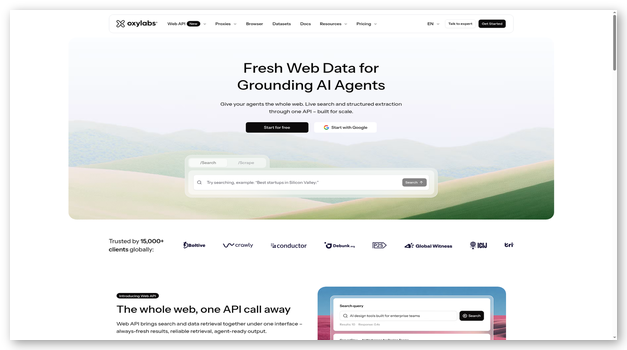
Oxylabs provides a managed Web Scraper API for teams collecting public data from difficult websites. It handles proxy routing, browser rendering, retries, and structured delivery behind one API. Retail monitoring teams can request localized product pages without maintaining separate browser fleets.
Its dashboard centers on usage, requests, and parser controls. Batch queries and scheduling support recurring jobs, while OxyCopilot helps generate requests. The service fits production workloads better than casual one-off projects, especially when predictable delivery matters more than owning the scraping infrastructure at scale.
Features:
- Managed requests: The API routes requests through suitable infrastructure and retries blocked attempts. Teams receive usable responses without maintaining large proxy lists or browser workers.
- Headless browser: Browser rendering loads JavaScript-heavy pages before extraction. This supports dynamic product listings, interactive travel pages, and other content missing from raw HTML.
- Custom parser: Custom parsing rules convert supported pages into structured fields. Analysts spend less time cleaning markup before loading results into databases or reports.
- Batch queries: Batch submission groups many target URLs into one workflow. It reduces orchestration work when teams monitor prices, inventory, search results, or listings.
- Scheduler: Scheduled jobs run recurring collections at defined intervals. This helps teams refresh datasets without relying on a separate cron service for every project.
- Geo targeting: Location parameters request pages from selected markets. Researchers can compare regional pricing, availability, or search results through the same API integration.
- Usage controls: The dashboard shows result consumption and request activity. Teams can track volume before limits become a surprise during a production collection run.
Pros
Cons
👉 How to Get Oxylabs for Free?
- Open the Oxylabs Web Scraper API pricing page.
- Create an account and select the free trial without adding a card.
- The trial includes up to 2,000 results for supported scraping workflows.
Free trial with up to 2,000 results
2) Decodo
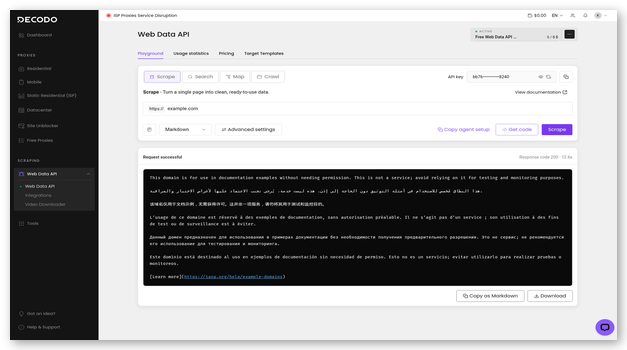
Decodo combines proxy infrastructure with a Web Scraping API built for developers, analysts, and AI workflows. Its scrape, search, map, and crawl endpoints cover single pages through multi-page discovery. Prepared templates return structured data for common targets without requiring a custom parser.
The dashboard exposes API keys, request settings, usage, and output choices. JavaScript rendering and managed proxy selection handle tougher pages, while Markdown output supports language-model pipelines. A permanent free plan makes Decodo practical for prototypes before teams commit to higher request volumes reliably.
Features:
- Four endpoints: Scrape, search, map, and crawl endpoints cover focused extraction and site discovery. Developers can keep several data tasks behind one API key.
- Prepared templates: More than 100 maintained templates target common websites and data types. They reduce selector work and speed up early proof-of-concept projects.
- JavaScript rendering: Optional rendering loads dynamic content before delivery. Teams can collect data from client-rendered pages without operating their own headless browser cluster.
- Flexible output: Responses can include HTML, Markdown, JSON, CSV, PNG, or XHR data where supported. Each workflow can choose an analysis-ready format.
- Proxy handling: Built-in proxy selection and anti-bot controls reduce manual rotation work. Requests can reach geo-sensitive pages while the API manages infrastructure decisions.
- AI connections: MCP and other integration paths bring current web data into supported AI tools. This suits research agents and retrieval workflows needing live sources.
- Request controls: Rate limits and usage totals appear with each plan. Teams can size a project around crawl volume instead of guessing from bandwidth alone.
Pros
Cons
👉 How to Get Decodo for Free?
- Visit Decodo's Web Scraping API pricing page.
- Create the free account and copy the generated API credentials.
- The free plan covers 5,000 crawls or 10,000 scraped pages monthly.
Free plan with up to 10,000 pages
3) NodeMaven
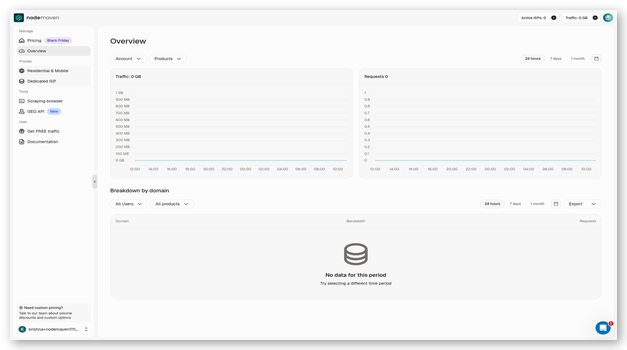
NodeMaven is a proxy platform for scraping teams that already own extraction code or browser automation. Residential, mobile, and ISP options support HTTP and SOCKS5 connections across broad geographic coverage. Its IP Quality Filter screens addresses before assignment to reduce avoidable failures.
The dashboard focuses on traffic, credentials, targeting, and rotation settings rather than parsed datasets. Sticky sessions suit account or location continuity, while per-request rotation fits broad crawls. NodeMaven works best when proxy quality and session control matter more than a ready-made scraping API.
Features:
- Quality filter: The IP Quality Filter screens available addresses before assignment. Cleaner pools can reduce wasted retries and CAPTCHA interruptions during long collection runs.
- Proxy types: Residential, mobile, and ISP proxies sit under one account. Teams can match reputation, stability, and cost to each scraping target.
- Rotation controls: Connections can rotate between requests or remain sticky for extended sessions. This supports both large crawls and workflows requiring a consistent identity.
- Geo targeting: Country, city, and ISP controls narrow the exit location. Researchers can collect localized prices, ads, search results, or availability data.
- Protocol support: HTTP and SOCKS5 support works with common scripts and automation tools. Existing crawlers can connect without changing their extraction logic.
- Traffic rollover: Unused traffic can move into the next billing period under current plans. This helps projects with uneven monthly collection schedules preserve purchased capacity.
- Usage dashboard: Traffic and connection details appear in the account dashboard. Teams can watch consumption and adjust rotation before a crawl exhausts its allowance.
Pros
Cons
👉 How to Get NodeMaven for Free?
- Open NodeMaven's pricing page and create an account.
- Select the trial for residential and mobile proxy access.
- The paid trial costs $3.50 and includes 750 MB of bandwidth.
750 MB trial for $3.50
4) Webshare
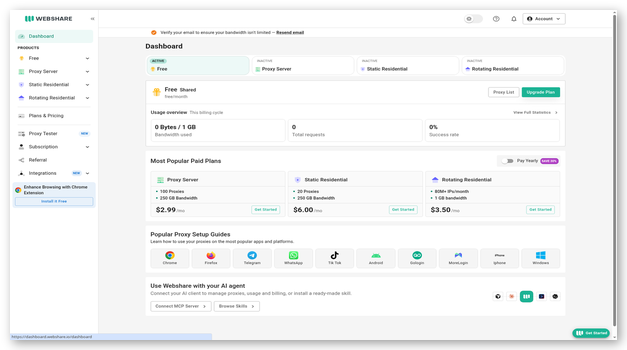
Webshare supplies datacenter, residential, and ISP proxy connections for scripts, crawlers, and browser automation. Its permanent free plan gives small projects ten datacenter proxies and a monthly bandwidth allowance. Users can authenticate through credentials or approved IP addresses.
The dashboard presents proxy lists, connection details, usage, and API access in one place. Rotation controls help distribute requests, while location filters support regional collection. Webshare suits learners and lightweight jobs that need dependable proxy access, although it does not replace a parser or complete scraping workflow.
Features:
- Free proxies: The permanent free plan includes ten datacenter proxies and 1 GB monthly traffic. Small experiments can continue without an expiring trial window.
- Proxy choices: Paid options cover datacenter, residential, and ISP connections. Teams can select a pool based on target difficulty, stability, and budget.
- Rotation: Rotating endpoints change addresses automatically for supported plans. This reduces manual proxy-list maintenance across larger or frequently repeated request sets.
- Geo controls: Location filters help route requests through relevant countries or regions. Market researchers can compare localized content using the same connection workflow.
- API access: The API exposes proxy details and account operations for automation. Developers can provision or retrieve connections without copying lists from the dashboard.
- Authentication: Username credentials and IP authorization support different deployment patterns. Teams can secure access for servers, laptops, or distributed scraping workers.
- Usage tracking: Dashboard metrics show bandwidth and proxy activity. Users can spot approaching limits before a crawler stops during an important collection run.
Pros
Cons
👉 How to Get Webshare for Free?
- Open Webshare and register a free account without a card.
- Visit the proxy list to retrieve the assigned connection details.
- The free plan includes ten datacenter proxies and 1 GB monthly.
10 free proxies and 1 GB monthly
5) Apify
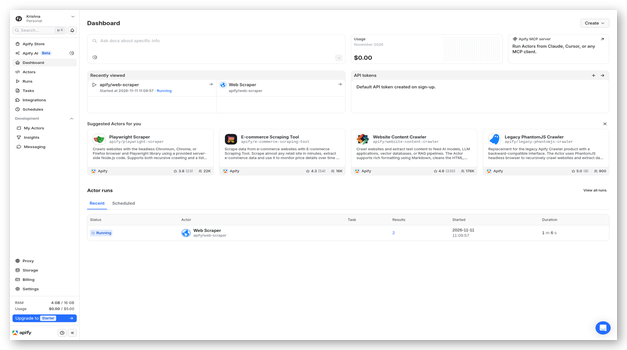
Apify is a cloud platform for running reusable scrapers called Actors. Its public Store covers common websites, while developers can build custom Actors with Crawlee or other supported tools. Schedules, datasets, queues, and webhooks turn individual runs into repeatable data workflows.
The console shows inputs, run logs, storage, costs, and outputs for each Actor. Teams can export records or connect them through the API. Apify offers broad flexibility, though marketplace quality and usage costs vary. It suits users who want both prepared scrapers and a programmable automation platform.
Features:
- Actor Store: The Store provides ready-made scrapers for many common websites and tasks. Users can start with an existing Actor instead of coding every collector.
- Custom Actors: Developers can package their own scraping logic as reusable Actors. Versioned inputs and builds make the same workflow easier to run repeatedly.
- Scheduling: Built-in schedules launch Actors at selected times or intervals. Recurring price, listing, or content monitoring can run without an external scheduler.
- Data storage: Datasets, key-value stores, and request queues organize outputs and crawl state. Each run keeps its records accessible for export or downstream processing.
- Integrations: APIs, webhooks, and connectors send results into other systems. Teams can trigger follow-up jobs after a run succeeds or fails.
- Proxy options: Datacenter and residential proxy services are available within the platform. Actors can rotate connections without a separately managed proxy provider.
- Run monitoring: Logs, status, compute use, and costs appear for each run. Developers can diagnose failures and estimate the resources a recurring job consumes.
Pros
Cons
👉 How to Get Apify for Free?
- Visit Apify's pricing page and select the Free plan.
- Create an account without entering payment-card information.
- The plan renews with $5 monthly credit and five concurrent runs.
$5 monthly free credit
6) Novada
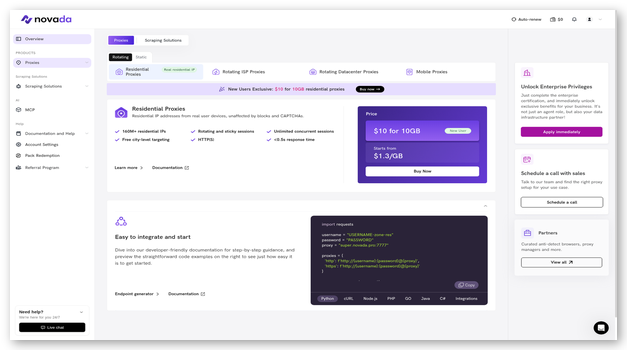
Novada groups a Scraper API, Web Unblocker, and Browser API under one credit balance. The Scraper API returns structured records for supported targets, while the Browser API handles interactive JavaScript pages through familiar automation protocols. Managed anti-bot controls reduce infrastructure work.
Its dashboard tracks product consumption, domains, credits, and concurrent requests. Unified billing lets teams switch methods without separate subscriptions. Novada is useful for mixed extraction needs, but trial access requires campaign sharing and support approval. Purchased credits also expire after the stated validity period.
Features:
- Scraper API: The Scraper API returns cleaned data for supported search, commerce, and social targets. Teams can skip much of the HTML parsing stage.
- Web Unblocker: Web Unblocker returns raw pages while handling common access barriers. It suits teams that want to keep their own parsing logic.
- Browser API: Cloud browsers support Puppeteer and Playwright style connections. Developers can render pages, click elements, scroll, and capture complex interactive content.
- Unified credits: One balance covers the scraping, unblocking, and browser products. Teams can change methods without purchasing a separate allowance for each service.
- Success billing: Novada charges credits when requests return data under its published rules. Failed platform requests do not consume the same balance.
- Structured output: Supported templates provide JSON or CSV records rather than raw markup. Analysts can load the results into reports with less cleanup.
- Concurrency controls: Plan tiers define parallel-request capacity for each product. Teams can choose an allowance that matches crawler volume and expected response times.
Pros
Cons
👉 How to Get Novada for Free?
- Create a Novada account and open its free-trial campaign page.
- Share the campaign with three groups, then send screenshots to support.
- After approval, Novada adds $15 credit for proxies and scraping tools.
$15 trial credit
7) Bright Data
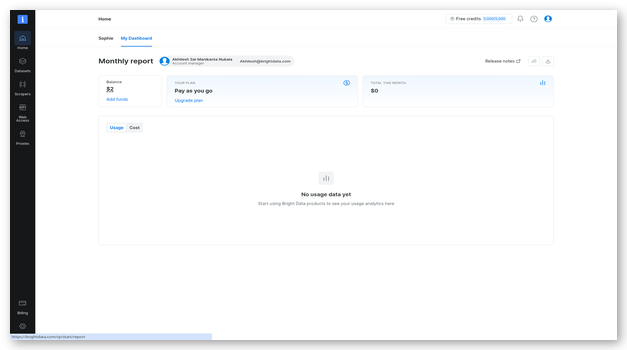
Bright Data offers prebuilt Web Scraper APIs, a Scraping Browser, Scraper Studio, proxies, and datasets. Teams can choose structured records or control a remote browser with Playwright and Puppeteer. Built-in access handling manages rotation, browser fingerprints, and access challenges.
The control panel separates products, credentials, usage, collectors, and delivery settings. Prebuilt APIs reduce maintenance on supported targets, while browser access handles custom interactions. Bright Data fits demanding projects with broad coverage and support needs. Its large product catalog and enterprise options can feel excessive for simple personal scraping.
Features:
- Scraper APIs: Prebuilt APIs return structured records for supported websites and categories. Teams avoid maintaining selectors and browser logic for every target change.
- Scraping Browser: A hosted browser connects through Playwright or Puppeteer. Developers can execute JavaScript and automate interactions while Bright Data handles access infrastructure.
- Scraper Studio: Studio tools help build and deploy custom collectors. Visual and AI-assisted options reduce setup time for targets without a prepared API.
- Proxy network: Integrated proxy services cover multiple connection types and locations. Workflows can route traffic without moving credentials between several separate vendors.
- Delivery options: Collected data can move through APIs, webhooks, or supported cloud destinations. Teams can feed existing warehouses and analysis pipelines after each run.
- Spend controls: Pay-as-you-go options and monthly limits help manage consumption. Dashboard usage views show how a collector is affecting the project budget.
- Free records: The Web Scraper API free tier includes 5,000 records each month. No payment card is required to start that published tier.
Pros
Cons
👉 How to Get Bright Data for Free?
- Open Bright Data's Web Scraper API pricing page.
- Select Start free and register without entering a payment card.
- The free tier includes 5,000 Web Scraper API records each month.
5,000 free records monthly
8) PrivateProxy
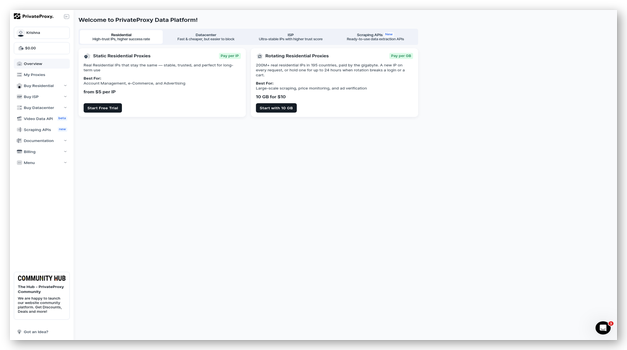
PrivateProxy provides static and rotating proxy packages for scripts and browser automation. Static residential and datacenter trials let users test one address before committing, while paid rotating plans cover request-based or bandwidth-based traffic. Connections support common authentication patterns.
The account area focuses on packages, locations, credentials, usage, and subscription status. Dedicated static options suit jobs needing a consistent address, while rotating services fit broader crawls. PrivateProxy is an infrastructure component rather than a complete scraper, so teams must supply extraction logic, retries, storage, and data validation.
Features:
- Static proxies: Static datacenter and ISP options keep one address for the subscription period. They suit sessions that require continuity or allow-listed access.
- Rotating access: Rotating packages change addresses across requests or sessions. This can distribute crawler traffic without maintaining a separate local proxy list.
- Trial choices: Selected static packages include a two-day free trial with card verification. Rotating test-drive packages instead charge an introductory first-cycle price.
- Authentication: Username credentials and IP-based authorization support common server deployments. Teams can choose the method that best fits their crawler environment.
- Location selection: Available packages provide regional choices during ordering. Users can match a proxy location to the market or website being studied.
- Subscription controls: The dashboard shows active packages and renewal status. Trial users can cancel before renewal to avoid the listed monthly charge.
- Protocol support: HTTP, HTTPS, and SOCKS connections cover many scraping libraries and browsers. Existing tools can connect without a vendor-specific extraction SDK.
Pros
Cons
👉 How to Get PrivateProxy for Free?
- Open PrivateProxy's help page and choose an eligible static trial.
- Select location details and add a card for verification.
- The free trial lasts two days and renews unless cancelled promptly.
2-day free trial
9) ScraperAPI
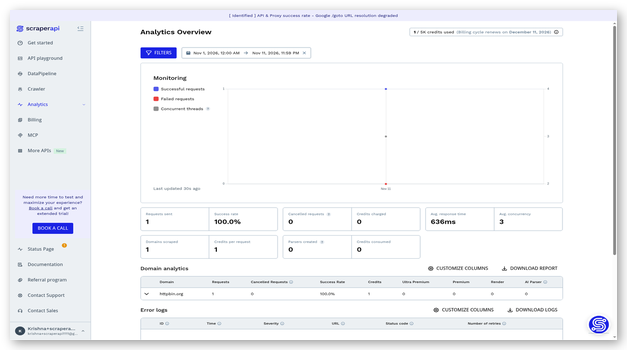
ScraperAPI gives developers one endpoint for fetching pages through managed proxy pools. It handles address rotation, automatic retries, CAPTCHAs, geotargeting, and optional JavaScript rendering. Structured endpoints cover selected commerce and search targets, while the async API supports larger request batches.
The dashboard displays API credentials, credit use, concurrency, and request analytics. DataPipeline adds scheduling and delivery without a separate crawler service. ScraperAPI suits teams that already know what pages to request but want to avoid proxy operations. Credit costs vary by target and enabled features.
Features:
- Single endpoint: A standard API request sends the target URL and authentication key. ScraperAPI manages proxy selection and returns the resulting page response.
- Automatic retries: Failed or blocked attempts can be retried through different connections. This reduces custom retry logic inside the caller's scraping application.
- JavaScript rendering: Optional rendering loads client-side content before returning a response. Dynamic product pages and application interfaces become accessible through the same API.
- Structured data: Dedicated endpoints return parsed records for supported targets. Teams can avoid maintaining selectors for common product, search, and listing pages.
- DataPipeline: DataPipeline schedules collections and delivers completed files to supported destinations. Analysts can operate recurring jobs without building a full orchestration layer.
- Cost estimator: Dashboard tools estimate credit consumption for a URL and parameter set. This helps teams compare rendering, premium proxy, and bypass costs.
- Free allowance: The published free plan includes 1,000 API credits and five concurrent connections. Users can test standard requests before choosing a paid plan.
Pros
Cons
👉 How to Get ScraperAPI for Free?
- Visit ScraperAPI's pricing page and create a free account.
- Copy the API key and test a standard request.
- The free plan includes 1,000 credits and five concurrent connections monthly.
1,000 free credits monthly
10) ScrapingBee
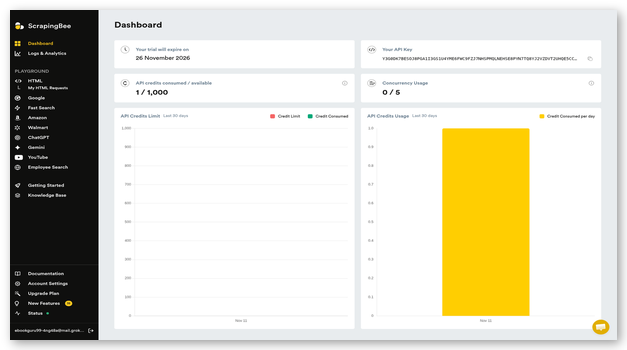
ScrapingBee is an API for collecting pages that require browsers, proxies, or location controls. JavaScript rendering loads interactive content, while classic, premium, and stealth connections address different target difficulty levels. Screenshot and search APIs extend the same account beyond HTML retrieval.
The dashboard provides an API key, request builder, credit estimate, and usage history. Developers can add custom headers or JavaScript scenarios for clicks and scrolling. AI extraction accepts plain-language field instructions. ScrapingBee is approachable for API users, although enabled options can change the credit cost sharply.
Features:
- HTML API: The HTML API returns rendered or unrendered page content through one endpoint. Developers control proxy level, location, headers, and browser behavior.
- JS scenarios: Custom JavaScript scenarios can click, scroll, wait, or interact before capture. This supports pages where content appears only after user actions.
- Proxy levels: Classic, premium, and stealth routes address different blocking levels. Teams can start with lower-cost access and escalate only when needed.
- AI extraction: Plain-language queries and extraction rules identify requested fields. This reduces selector work when teams need a quick structured result from changing pages.
- Screenshot API: Screenshot requests capture full pages or selected elements. Monitoring teams can store visual evidence alongside extracted values and change records.
- Request builder: The dashboard builder generates code and displays estimated credit cost. Developers can verify parameters before adding them to an application.
- Free credits: Every new account receives 1,000 API credits without a payment card. The allowance supports evaluation but does not renew as a timed trial.
Pros
Cons
👉 How to Get ScrapingBee for Free?
- Open ScrapingBee and register a new account without a card.
- Use the dashboard request builder to generate a test call.
- Each new account receives 1,000 free API credits for evaluation.
1,000 free signup credits
Feature Comparison Table of Top Web Scraping Tools
How Did We Choose Best Free Web Scraping Tools?

At Guru99, we are committed to providing accurate, relevant, and objective information to help users make informed decisions. Our editorial process focuses on delivering informative and reliable resources, ensuring the content is both credible and trustworthy. After reviewing over 18 of the best web scraping tools, including free and paid options, we have compiled a comprehensive selection based on their features, pros, cons, and pricing. This guide ensures a detailed understanding of each tool, assisting you in choosing the best one for your needs. We focus on the following factors while reviewing a tool based on functionality, ease of use, and versatility.
- Ease of Use: We selected tools based on their user-friendly interface, allowing beginners and experts to scrape data smoothly.
- Efficiency: The experts in our team prioritized tools optimized for efficiency, ensuring fast and accurate data extraction without compromise.
- Security: We made sure to shortlist tools with strong security features to protect sensitive data and maintain privacy.
- Adaptability: We chose tools based on their ability to handle diverse websites and extract data in various formats with ease.
- Community Support: Our team considered tools with active communities and reliable customer support to solve problems effectively.
- Flexibility: We selected tools that allow for customization, ensuring they meet the specific needs of different users and projects.
What is a web scraping tool, and how does it work?
A web scraping tool requests a web page, reads its content, and extracts selected fields into a structured format. Some tools parse HTML directly. Others run a browser so JavaScript can load first. Managed APIs also rotate proxies, retry blocked requests, and return results through one endpoint. The workflow usually starts with a URL and extraction rule. It ends with records in JSON, CSV, or a database. Beginners should first decide whether they need pages, structured fields, screenshots, or repeated monitoring. That choice determines the right tool type.
Which free access model suits your web scraping project?
Free access can mean a permanent monthly allowance, one-time signup credits, a timed trial, or a paid evaluation. Those models are not interchangeable. A renewable plan suits small recurring jobs. One-time credits work better for testing an integration. Timed trials help evaluate support and difficult targets quickly. Paid trials often provide higher-quality proxy traffic than a free tier. Check whether a card is required, what consumes credits, and whether unused capacity expires. The best option matches your request frequency, target difficulty, and tolerance for rebuilding later.
What features should you look for in web scraping tools?
Useful features depend on the job, so begin with the target and required output. These checks cover the main buying decisions:
- Rendering: JavaScript support matters when the required data appears after the initial HTML response.
- Access control: Proxy rotation, sessions, and location targeting determine whether requests reach regional or protected pages.
- Output: JSON, CSV, Markdown, screenshots, and raw HTML serve different analysis and evidence needs.
- Operations: Scheduling, retries, logs, alerts, and spend limits keep recurring jobs observable and controlled.
- Support: Clear documentation and responsive help reduce downtime when targets or request rules change.
How do scraping APIs compare with proxies and browser tools?
Scraping APIs manage requests, retries, and often rendering behind one endpoint. They suit teams that want results without operating network infrastructure. Proxy services only route traffic, so users still need crawlers, parsers, storage, and error handling. Browser tools run JavaScript and simulate actions such as clicking or scrolling. They handle interactive pages but consume more computing resources. Many production systems combine these approaches. A proxy can support a custom crawler, while a managed browser handles difficult pages. Choose the least complex method that reliably returns the required data.
How can AI improve web scraping workflows?
AI can translate plain-language field requests into extraction rules, normalize messy values, and produce cleaner JSON or Markdown. It can also help repair selectors when page layouts change. These capabilities reduce setup time, especially for prototypes and research. They do not remove the need for validation. Models may mislabel fields, miss hidden pagination, or merge unrelated values. Teams should compare samples against the source page and monitor changes over time. AI works best as an assistant around controlled requests, clear schemas, and repeatable quality checks.
How do web scraping tools connect with data workflows?
Web scraping tools usually connect through REST APIs, SDKs, webhooks, cloud storage, or automation platforms. A scheduled job may collect pages, save records to a dataset, and send a completion webhook. Another service can then validate, transform, or load the data into a warehouse. AI workflows increasingly use MCP or Markdown output to supply current pages to research agents. The integration should also carry run status, timestamps, and errors. Without that context, downstream systems cannot distinguish fresh records from incomplete or failed collections.
Is web scraping legal and safe?
Web scraping can be lawful, but legality depends on the data, access method, jurisdiction, and intended use. A responsible project should document these checks:
- Public access: Collect only information that is lawfully accessible and relevant to a defined business or research purpose.
- Site rules: Review terms of service, robots guidance, contractual limits, and applicable local laws before collecting data.
- Personal data: Minimize collection, secure retained records, and follow privacy obligations for identifiable information.
- Request load: Use reasonable rates and caching so automated traffic does not disrupt the target website.
- Legal review: Seek qualified advice when the project involves sensitive data, accounts, authentication, or unclear restrictions.
How can you protect web scraping data quality?
Data quality starts with a clear schema and representative test pages. Validate field types, required values, pagination, duplicates, and timestamps before scaling. Save a small raw response sample beside parsed records so failures remain traceable. Monitor record counts and missing-field rates across runs. Layout changes often create plausible but incorrect output, which is harder to spot than a failed request. Version extraction rules and compare samples after every change. For important datasets, add independent checks against trusted source pages before publishing conclusions.
How do web scraping costs change as projects scale?
Costs rise through request volume, rendered pages, premium proxies, concurrency, storage, and support. One URL may consume several credits when JavaScript, location targeting, or advanced bypassing is enabled. Failed attempts may be free with some APIs but billable with others. Calculate cost from a representative sample, not a simple request count. Include engineering time for parser maintenance and monitoring. A managed API may cost more per result yet reduce operations work. Set spend limits, review usage by target, and separate experiments from production credentials.
What Problems Cause Web Scrapers to Fail, and How Can They Be Fixed?
Scrapers usually fail because page behavior, access rules, or extraction assumptions changed. Each fix should address the observed cause rather than retrying blindly.
- Issue: A page returns empty HTML because content loads through JavaScript after the first response.
Solution: The operator should enable browser rendering and wait for a stable selector before extracting the requested fields. - Issue: Repeated requests trigger CAPTCHAs, rate limits, or temporary blocks during larger collection runs.
Solution: The team should lower request speed, rotate suitable proxies, reuse sessions carefully, and follow the site's access rules. - Issue: A redesigned page moves fields and silently produces blank or mismatched values.
Solution: The maintainer should version selectors, retain raw samples, and alert when required-field completion drops below an agreed threshold. - Issue: Pagination stops early, leaving later products, comments, or listings outside the final dataset.
Solution: The developer should test next-page logic, record page counts, and compare collected totals with visible source indicators. - Issue: Credit consumption rises unexpectedly when rendering, premium routes, or difficult targets are enabled.
Solution: The owner should estimate representative requests first, set spending limits, and separate expensive targets into monitored workflows. - Issue: Duplicate URLs or retries create repeated records that distort counts and downstream analysis.
Solution: The pipeline should assign stable record keys, normalize URLs, and deduplicate before records enter reports or storage.
What trends will shape web scraping tools next?
Web scraping platforms are moving toward AI-guided extraction, agent connections, and more flexible browser infrastructure. Plain-language schemas can shorten setup, while MCP integrations let research agents request current pages through controlled tools. Vendors are also combining scraping, search, crawling, and browser actions behind shared accounts. Compliance and data lineage will receive more attention as automated collection feeds business decisions. The useful trend is greater observability: teams need clear request costs, source timestamps, extraction versions, and failure reasons. Better automation should make those controls easier, not hide them.
Verdict
I reviewed the shortlist against access limits, workflow depth, and scaling demands. Three options offered the clearest fit for distinct scraping needs.
- Oxylabs: I favored its managed Web Scraper API for difficult targets, structured delivery, and production controls without maintaining separate browser and proxy infrastructure.
- Decodo: My review placed it first for approachable free API access, prepared templates, JavaScript rendering, and outputs suited to data or AI workflows.
- NodeMaven: I selected it for teams that already own scraping code and need detailed location targeting, rotation controls, and screened proxy addresses.
