
Types of Network Topology: Bus, Ring, Star, Mesh, Tree Diagram
 Editorial Team
⚡ Smart Summary
Network topology defines how devices are arranged and interconnected within a network, determining data flow, performance, and fault tolerance. Understanding seven major types—P2P, Bus, Ring, Star, Mesh, Tree, and Hybrid—is essential for designing efficient, scalable, and reliable network infrastructures.
What is Network Topology?
Network topology refers to the arrangement and interconnection of network elements such as computers, links, and nodes. It defines the geometric layout and data flow pattern across the network, directly impacting performance, scalability, and fault tolerance.
There are two main categories:
- Physical Topology: The actual layout of wires, cables, and devices in a computer network.
- Logical Topology: How data flows within the network, regardless of physical design.


Types of Network Topologies
The seven main types of network topology are:
- Point to Point (P2P) Topology
- Bus Topology
- Ring Topology
- Star Topology
- Tree Topology
- Mesh Topology
- Hybrid Topology

Let us now examine each topology type in detail, starting with the simplest configuration and progressing toward more complex arrangements.
Point to Point (P2P) Topology
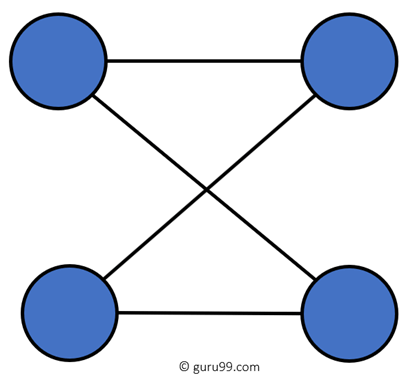
Point-to-Point topology establishes a direct link between two computers or network nodes. The entire bandwidth is available exclusively for the two connected devices.
Advantages of P2P Topology
- Highest bandwidth since the link is not shared with other devices.
- Simple to set up with minimal technical expertise.
- Easy to troubleshoot with only two devices and one connection.
Disadvantages of P2P Topology
- Only practical for connecting two devices, unsuitable for larger networks.
- Not scalable for enterprise environments.
Bus Topology
In Bus topology, all devices connect to a single central cable known as the bus or backbone. Data sent by any device travels in both directions until it reaches its destination.

Advantages of Bus Topology
- Cost-effective for small networks, requiring less cable than other topologies.
- Easy to implement and extend by adding devices to the backbone.
- Does not require specialized hardware such as hubs or switches.
Disadvantages of Bus Topology
- Backbone cable failure disrupts the entire network.
- Performance degrades as more devices are added due to data collisions.
- Troubleshooting is difficult since all devices share one line.
- Limited cable length restricts network size.
Ring Topology
In Ring topology, every device has exactly two neighbors. Data travels in one direction around the ring, passing through each node until it reaches its destination. A token-passing mechanism regulates transmission.

Advantages of Ring Topology
- Data flows in one direction, reducing packet collisions.
- Equal access ensures no single node monopolizes the network.
- Token-passing protocol provides orderly data transfer.
Disadvantages of Ring Topology
- Failure of a single node can disrupt the entire network.
- Adding or removing devices requires shutting down the network temporarily.
- Slower than star topology because data passes through each intermediate node.
- A single break halts all communication unless a dual-ring is used.
Star Topology
In Star topology, all devices connect to a central hub or switch. Each node has a dedicated connection to the hub, and all data passes through it to reach other devices.

Advantages of Star Topology
- Easy to troubleshoot with dedicated connections per device.
- Failure of one node does not affect the rest of the network.
- Simple to add or remove devices without disruption.
Disadvantages of Star Topology
- If the central hub fails, the entire network goes down.
- Requires more cable than bus or ring topology.
- Performance depends on the capacity of the central hub.
- Limited by port count on the central device.
Mesh Topology
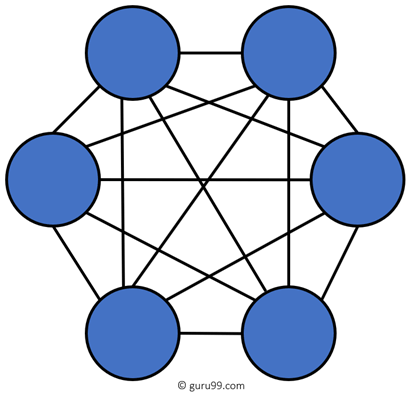
In Mesh topology, each computer connects to every other computer, creating multiple data pathways. If one link fails, data reroutes through an alternative path.
Types of Mesh Topology
- Partial Mesh: Some devices connect to all others, while certain devices connect only to those they exchange the most data with.

- Full Mesh: Every device is connected directly to every other device. This provides maximum redundancy but at a higher cost.
Advantages of Mesh Topology
- Maximum redundancy: if one path fails, data reroutes through another.
- Highly reliable for mission-critical applications like banking and healthcare.
- Faults are easy to diagnose since each connection can be tested individually.
- Robust security with independent connections.
Disadvantages of Mesh Topology
- Requires many cables and I/O ports, making it expensive.
- Installation and configuration are complex.
- Full mesh is impractical for large networks due to exponential connection growth.
Tree Topology
Tree topology organizes devices in a hierarchical structure combining star and bus topologies, suitable for large, segmented networks.

Advantages of Tree Topology
- Easy to manage and segment large networks hierarchically.
- Error detection is straightforward at each level.
- Branches can be managed independently.
Disadvantages of Tree Topology
- Heavily cabled and more expensive than bus topology.
- Root node or backbone failure affects the entire segment.
- Difficult to maintain as the network grows in complexity.
Hybrid Topology
Hybrid topology combines two or more topology types into a single network, allowing designers to leverage the strengths of each type.

Advantages of Hybrid Topology
- Flexible and scalable without redesigning entire infrastructure.
- Faults in one segment can be isolated without affecting others.
Disadvantages of Hybrid Topology
- Complex design requiring experienced network engineers.
- More expensive due to diverse hardware requirements.
The Role of AI in Modern Network Topology
Artificial intelligence is transforming how organizations design and manage network topologies. AI-powered tools analyze traffic patterns in real time, predict failures, and automatically reroute data to maintain optimal performance.
In large-scale data centers, AI-driven software-defined networking (SDN) dynamically adjusts logical topology without physical rewiring. Machine learning algorithms examine historical traffic data and failure rates to recommend optimal topology changes, making AI-assisted management essential as networks grow more complex with IoT devices and cloud infrastructure.
How to Select a Network Topology
Choosing the right network topology depends on several factors:
- Budget: Bus costs the least; mesh requires the highest investment.
- Cable Length: Longer distances may favor bus or tree to minimize cable runs.
- Network Size: Star and tree topologies scale more easily than bus or ring.
- Reliability: Mission-critical systems need mesh or hybrid for fault tolerance.
Summary
| Topology | Description | Diagram |
|---|---|---|
| P2P | Direct dedicated link between exactly two devices, providing full bandwidth to the connection. |
|
| Bus | All devices connect to a single backbone cable. Data travels in both directions along the bus. |
|
| Ring | Each device connects to exactly two neighbors, forming a closed loop for data circulation. |
|
| Star | All devices connect to a central hub or switch. The hub manages all data traffic. |
|
| Mesh | Every device connects to every other device, providing maximum redundancy and fault tolerance. |
|
| Tree | Hierarchical structure with a root node and branching levels, combining star and bus features. |
|
| Hybrid | Combines two or more topology types into one network for flexibility and optimized performance. |
|
