
What is Private Cloud? Examples
 Editorial Team
⚡ Smart Summary
Private Cloud delivers a single-tenant computing environment that gives one organization dedicated infrastructure, granular control, and stronger isolation than shared public platforms, while still using virtualization, automation, and software-defined networking to streamline operations.
What is Private Cloud?
A Private Cloud is a cloud computing model that delivers a secure, dedicated environment to a single organization. It can run inside a corporate data center, in a third-party co-location facility, or with a managed Private Cloud provider. Unlike a Public Cloud, the underlying infrastructure is never shared with other tenants, which gives the business exclusive use of compute, storage, and networking.
Private Cloud emphasizes strong data security and privacy. It blocks third parties from reaching operational data and sensitive workloads. Compared with a Public Cloud, the model usually carries a higher cost of ownership, since the organization funds dedicated hardware and skilled engineering staff. Private Cloud is also known as an internal cloud or corporate cloud, and forms the backbone of many Hybrid Cloud strategies that combine on-premises platforms with external services.
Why Organizations Choose Private Cloud
Enterprises pick Private Cloud when they need predictable performance, regulatory alignment, and data sovereignty. Banks, hospitals, and government agencies use it to meet rules such as HIPAA, PCI DSS, and GDPR, because workloads stay inside controlled boundaries. Internal teams can tune the hardware stack, the hypervisor, and the network fabric to match their applications, instead of accepting the defaults of a multi-tenant Public Cloud.
Modern stacks like VMware Cloud Foundation, OpenStack, Red Hat OpenShift, and Nutanix have made Private Cloud easier to operate. Hyperscaler extensions such as AWS Outposts, Azure Stack, and Google Distributed Cloud bring familiar Public Cloud services into the customer’s own data center. This pattern is now a foundation for many Hybrid Cloud and edge deployments.
Private Cloud Architecture
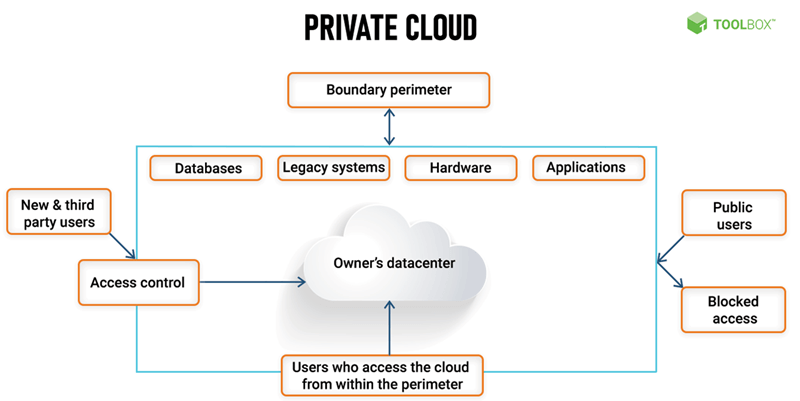
Beyond its single-tenant design, Private Cloud relies on the same building blocks as other cloud computing technologies. A Private Cloud architecture aggregates resources from across a data center into a single pool of compute, storage, and network capacity. Administrators raise efficiency and utilization by virtualizing the hardware with hypervisors and containers.
Private Cloud platforms use software-defined networking (SDN) and virtual machines (VMs), alongside Kubernetes clusters for containerized workloads. In this model, multiple server locations can be connected through high-speed links, or capacity can be leased in co-location facilities abroad. Many enterprises also extend the architecture to the edge with AWS Outposts or Azure Stack HCI nodes.
Characteristics of Private Cloud
The following characteristics make Private Cloud distinct from other cloud computing models:
- Employees can securely access data around the globe using a device of their choice.
- High availability and redundancy are built into the architecture by design.
- It gives the business better and more direct control over its data.
- Cloud computing acts as a transformational catalyst for digital business initiatives.
- It offers flexibility in delivering applications to internal users and partners.
- Built-in resource usage and audit logging tools support governance and chargeback.
- It integrates with IaaS, PaaS, and SaaS layers across Hybrid Cloud deployments.
Types of Private Cloud
There are several ways to host and operate a Private Cloud. Each implementation offers its own functionality and advantages. Here are three common types of Private Cloud:
- Virtual Private Cloud: A Virtual Private Cloud (VPC) is a cloud model that offers the benefits of a Private Cloud while using Public Cloud resources. A VPC carves an isolated environment out of a Public Cloud platform, so that workloads run independently from other tenants. Virtual logic keeps a customer’s compute resources private even when other organizations share the underlying server.
- Hosted Private Cloud: In this type, a Cloud Service Vendor dedicates servers to a single organization. The vendor manages the network plus hardware and software updates. Customers gain a support team, on-demand scalability, and a user-friendly dashboard to assist in server management.
- Managed Private Cloud: A Managed Private Cloud is a Private Cloud that does not share infrastructure with any other tenant. It is sometimes called a dedicated or single-tenant cloud. In most cases the organization owns the data center while a third-party vendor manages the platform. The vendor delivers support, upgrades, maintenance, and remote management of the Private Cloud.
Key difference between Public and Private cloud
The table below highlights the most important differences between Public Cloud and Private Cloud:
| Public Cloud | Private Cloud |
|---|---|
| Serves multiple clients on shared infrastructure. | Serves a single client on dedicated infrastructure. |
| Accessed over the general Internet. | Access is provided with specific boundaries, like firewall settings and VPN, and only employees of the organization can access it. |
| Hosted at the provider’s location. | Hosted at the provider or organization’s location. |
| Low cost and pay-as-you-go pricing. | Higher cost but stronger security and control. |
Private Cloud Service Providers Example
Below are popular Private Cloud service providers that organizations use today:
AWS: AWS Virtual Private Cloud lets you manage a virtual networking environment, including resource placement, connectivity, and security. AWS Outposts extends the same services to on-premises racks, so teams can run a Private Cloud with Amazon-grade APIs. It also lets you secure and monitor connections, inspect traffic, and restrict instance access inside your virtual network.
HPE: HPE GreenLake delivers software-driven infrastructure with leading partner cloud stacks so you can deliver IT services and solutions as a service. It offers strong Private Cloud capabilities through IT automation, AI-driven operations, and compliance with leading cloud stacks such as VMware Cloud Foundation and Red Hat OpenShift.
Google Private Cloud: Google Cloud VPC can auto-configure your virtual topology, prefix ranges for subnets, and network policies, or you can configure them yourself. Communication between organizations can be configured privately, without bandwidth bottlenecks or single points of failure. You can also share a VPC network across several projects in your organization, and extend services to your data center with Google Distributed Cloud.
Azure: A Private Cloud built on Microsoft Azure brings together compute resources for a single business or organization. The Private Cloud can live in your on-site data center or in a third-party facility, and Azure Stack HCI extends it with hyperconverged infrastructure. Azure Private Cloud also enables Hybrid Cloud workloads and protects them with streamlined security.
Dell: Dell APEX Cloud Platforms and the Microsoft Hyper-V Cloud Fast Track program offer a comprehensive approach to cloud computing. This Private Cloud solution combines Microsoft software, consolidated guidance, and validated configurations with Dell hardware, including computing power, network, storage architectures, and value-added software components.
Best Practices of Private Cloud
Adopt the following best practices to get long-term value from a Private Cloud:
- Select a hyper-scale Private Cloud provider that also offers managed services and clear SLAs.
- Establish robust policies for backup, disaster recovery, and ransomware protection.
- Make sure Private Cloud storage is interoperable with other cloud computing environments and Hybrid Cloud workflows.
- Bring uniformity into your application stack, hardware stack, and observability tooling.
- Leverage PaaS, Kubernetes, and Infrastructure as Code to speed up your cloud application roadmap.
- Integrate identity, secrets management, and zero-trust networking from day one.
Challenges of Private Cloud
The following challenges often appear when implementing a Private Cloud:
- Up-front costs: Private Cloud platforms hosted on-site require substantial capital up front to bring value to the organization. The hardware demands to run a Private Cloud can be costly and require an expert cloud engineer to set up, manage, and maintain.
- Capacity utilization: An organization cannot always maximize capacity utilization in this cloud computing model. An under-used cloud deployment can cause significant damage to the business case.
- Scalability: Sometimes the business needs additional computing power from the Private Cloud. Scaling internal resources takes extra effort and cost, and it is often slower than requesting capacity from a Public Cloud provider.
Other Challenges:
- Legal clauses that prohibit complete outsourcing.
- Indemnification and ensuring the availability of records for multiple years, which requires precise data handling.
- Business secrecy issues that force the company to own the hosting infrastructure.
- Audit concerns around access logs, data residency, and key management.
Advantages of Private Cloud
The following are essential pros and benefits of Private Cloud:
- It offers better performance with improved speed and storage capacity.
- Private Cloud can run in a completely isolated environment that adds an extra layer of security.
- It helps the business save time and money by eliminating conventional IT obstacles.
- IT infrastructure resources can be reallocated quickly with this solution.
- It offers greater visibility into security posture and access control.
- It supports stronger compliance with regulatory standards such as HIPAA, PCI DSS, and GDPR.
- The organization keeps complete control over hardware, software, and data placement.
Disadvantages of Private Cloud
The following are important cons and drawbacks of Private Cloud:
- The up-front cost is higher than a Public Cloud because setting up and maintaining hardware resources is expensive.
- Private Cloud is mostly accessible inside the organization, so the area of operations is limited.
- Private Cloud can be scaled only within the capacity of the internally hosted resources.
- The business needs a skilled cloud computing expert to manage and operate the platform.
Is a Private Cloud more secure Compared to Public Cloud?
A Private Cloud can be more secure than a Public Cloud. The model is protected by firewalls and can be reached through private, secure networks rather than the general Internet. Internal control of the Private Cloud also facilitates regulatory compliance and governance, since the business owns the policies, the keys, and the audit trail.
The catch is that the organization must proactively apply updates and security patches to the software and hardware stack. If it is not properly managed, the Private Cloud can be exposed to security risks that a managed Public Cloud might have handled automatically. As long as the organization invests in vulnerability management, identity controls, and continuous monitoring, the Private Cloud can deliver strong advantages to any enterprise.
