
Foreign Currency Revaluation in SAP: Month End Closing
 Editorial Team
⚡ Smart Summary
Foreign currency revaluation in SAP restates open items and foreign-currency balance sheet accounts at the month-end or year-end exchange rate, posting the resulting unrealized gains and losses so financial statements reflect current currency values.

Foreign currency revaluation is a month-end and year-end closing step in SAP that restates open items and foreign-currency balance sheet accounts at the current exchange rate, so the financial statements show realistic values before they are published.
What Is Foreign Currency Revaluation in SAP?
Before financial statements are prepared, every transaction posted in a foreign currency has to be valued at the exchange rate ruling on the closing date. These transactions can be bills receivable, bills payable, or inter-company transfers, and they involve general ledger accounts, customers, or vendors.
Line items can be open or cleared. For items that are already cleared, SAP uses the exchange rate of the date on which they were cleared, so the difference is already realized. For open items that are not yet cleared, the current or month-end rate is applied, and the valuation is run as a periodic closing activity.
Because exchange rates move, the revaluation produces a gain (revenue) or a loss (expense) that is reflected in the financial statements. The expense and revenue accounts for these differences are defined in Customizing (transaction SPRO), and the run posts the adjustment automatically.
- Applies to general ledger, customer, and vendor items posted in foreign currency
- Cleared items are already realized; open items are revalued at the closing rate
- Runs as a monthly and year-end closing activity feeding the balance sheet
How to Run Foreign Currency Revaluation in SAP (F.05)
With the configuration in place, the valuation is executed with transaction F.05. The steps below run it for a single company code and key date.
Step 1) Enter transaction code F.05 in the SAP command field, as shown below.

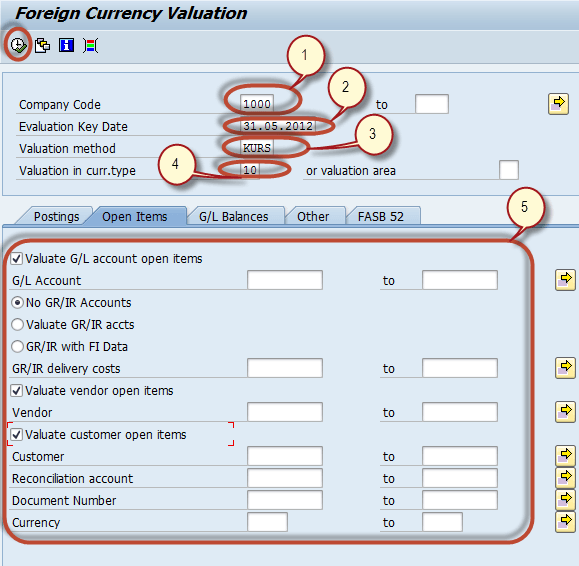
Step 2) On the next screen, enter the valuation parameters and press Execute.
- Company Code for which the foreign currency valuation is carried out
- Valuation (evaluation) Key Date, normally the last day of the period
- Valuation Method that sets how the exchange rate is considered
- Valuation in Currency Type (default 10, the company code currency)
- Optional filters on the G/L, customer, and vendor tab screens to narrow the run
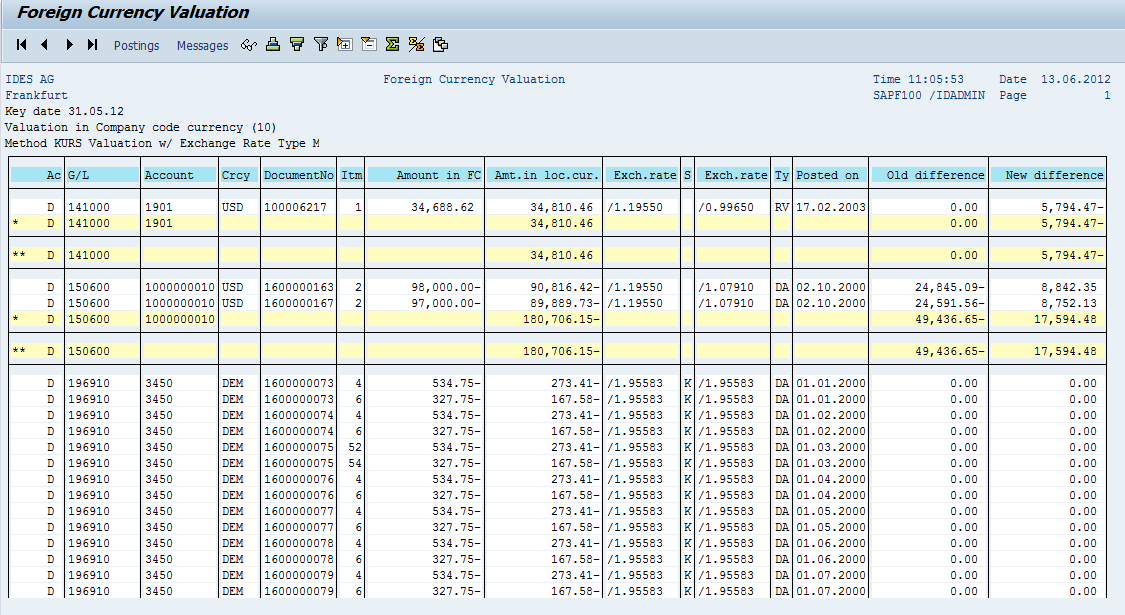
Step 3) SAP lists the G/L accounts selected for valuation and runs report SAPF100, which values the open items in foreign currency together with the foreign-currency balance sheet accounts.
Configuration for Foreign Currency Valuation (OB59, OBA1, OB08)
Foreign currency valuation depends on three pieces of Customizing, all reached from SPRO. Setting them once lets F.05 or FAGL_FCV run cleanly every period.
| T-code | Customizing step | Purpose |
|---|---|---|
| OB59 | Valuation method | Defines the exchange rate type, the valuation procedure, and how differences are posted |
| OBA1 | Account determination (keys KDB and KDF) | Assigns the gain, loss, and balance sheet adjustment accounts |
| OB08 | Exchange rates | The rates the valuation reads for the key date |
In OBA1, transaction key KDB covers exchange rate differences on foreign-currency balance sheet accounts that are not managed on an open item basis, while KDF covers open-item-managed accounts such as customer and vendor reconciliation accounts and bank sub-accounts. The exchange rates themselves are kept up to date in transaction OB08.
Realized vs Unrealized Exchange Rate Differences
A central idea in revaluation is the split between unrealized and realized results, because SAP treats them very differently.
An unrealized difference comes from the period-end valuation of an item that is still open. The gain or loss exists only on paper, so SAP posts it to an unrealized gain or loss account plus a balance sheet adjustment account, then reverses it at the start of the next period. A realized difference arises when the open item is actually cleared: the full exchange rate movement between posting and payment is posted to a realized gain or loss account and stays on the books.
| Aspect | Unrealized difference | Realized difference |
|---|---|---|
| Trigger | Period-end valuation of open items (F.05) | Clearing or payment of the item |
| Posting | Unrealized gain/loss and balance sheet adjustment | Realized gain or loss account |
| Reversal | Reversed in the next period | Permanent |
| OBA1 key | KDB and KDF valuation accounts | KDF clearing accounts |
Foreign Currency Revaluation in SAP S/4HANA (FAGL_FCV)
Transaction F.05 and report SAPF100 belong to the classic general ledger. With the new general ledger and SAP S/4HANA, the valuation moves to transaction FAGL_FCV, which is more flexible.
- Each run is stored, so it can be displayed, reset, and repeated, and it uses delta logic to post only the change since the last run
- It supports valuation areas, letting the same items be valued under several accounting principles, such as local GAAP and IFRS, in parallel
- Results post into the Universal Journal (table ACDOCA), and the reversal is written directly with an auto-reversal date instead of a separate batch-input session
F.05 still exists for compatibility, but FAGL_FCV is the recommended transaction on current releases and integrates with the SAP S/4HANA financial closing cockpit. The revalued balances then flow into the standard FI tables and reports.
