
FSV in SAP: Create Financial Statement Version Tcode
 Editorial Team
⚡ Smart Summary
Financial Statement Versions in SAP arrange general ledger accounts into a reporting hierarchy that produces the balance sheet and profit and loss statement, created and maintained with transaction code OB58 for statutory and management reporting.
What is a Financial Statement Version (FSV) in SAP?
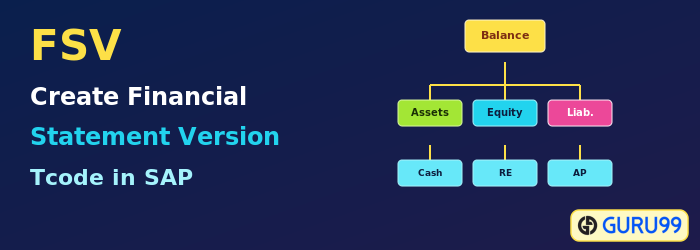
A Financial Statement Version (FSV) is a hierarchical arrangement of general ledger accounts that defines how the balance sheet and profit and loss statement are structured. Each node groups accounts, and SAP totals them into the statement lines used for reporting.
The FSV is created and maintained with transaction code OB58 (FSE2 to edit, FSE3 to display). In SAP S/4HANA, the Fiori Manage Global Hierarchies app provides a modern alternative.
Why Create a Financial Statement Version?
An FSV turns a long list of G/L accounts into a readable financial statement. By mapping accounts to assets, liabilities, equity, and the profit-and-loss result, finance teams can generate statutory and management reports from the same structure.
Because one version can serve both the balance sheet and the income statement, the FSV is a reusable foundation for period-end reporting.
Steps to Create a Financial Statement Version in SAP
The following steps create a financial statement version using the SPRO customizing path (transaction OB58).
Step 1) Enter Transaction code SPRO in the command field.

Step 2) In the next screen, select SAP Reference IMG.

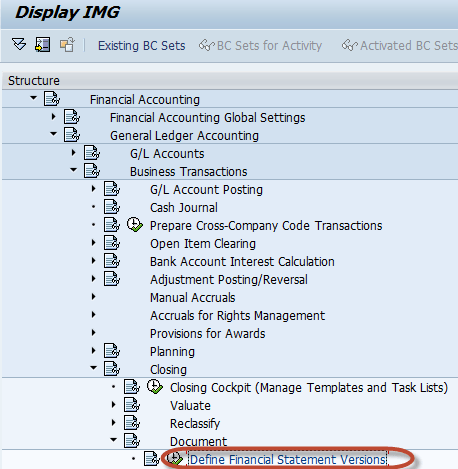
Step 3) In the next screen, “Display IMG”, navigate the following menu path: SAP Customizing Implementation Guide -> Financial Accounting -> General Ledger Accounting -> Business Transactions -> Closing -> Document -> Define Financial Statement Versions.
Step 4) In the next screen, select New Entries.

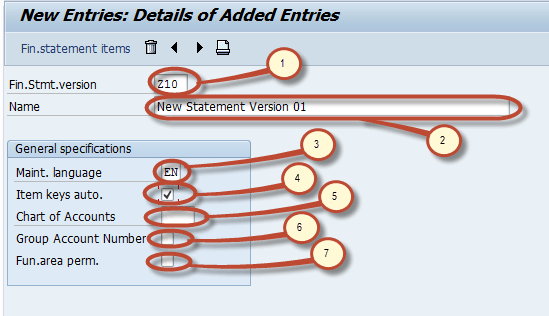
Step 5) In the next screen, enter the following:
- Enter the FSV Key.
- Enter the Description for the purpose of the FSV.
- Enter the language key, which designates the language in which you display texts, enter texts, and print documents.
- Set the indicator that specifies whether keys of financial statement items are assigned manually or automatically.
- If you specify a chart of accounts here, only accounts from that chart of accounts can be assigned; if you do not, accounts from several charts of accounts can be assigned.
- Set the indicator that assigns group account numbers instead of account numbers.
- Set the indicator that makes it possible to assign functional areas or accounts in the version.
Step 6) After maintaining the fields, press save  and enter your change request number.

Step 7) After the financial statement version is saved, you can edit its structure items by selecting the Financial statement items button  .
.
Step 8) In the next screen, you can maintain nodes in the version object. A new version has seven basic nodes by default, listed below:
- Financial Statement Notes
- Not Assigned
- P+L result
- Net result: loss
- Net result: profit
- Liabilities+Equity
- Assets
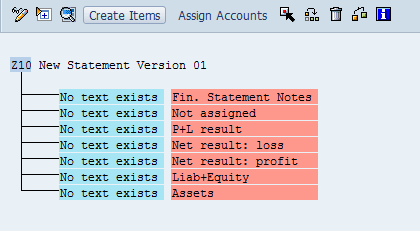
You can maintain node text by double clicking on the node. You can create subitems to a node by selecting the node and pressing the create items button  ; the new item is created as a subnode of the selected node. You can assign accounts or a group of accounts to a node by selecting the node and pressing Assign Accounts
  .
.
Below is an example of such an assignment:
- Primary node “Assets”.
- Subnode “Cash & Cash Equivalents” is assigned to Assets. “Petty cash” is a subnode assigned to Cash & Cash Equivalents. Other nodes such as Checking, Citibank Account, Mellon Bank, and Citibank Canada are also assigned to Cash & Cash Equivalents.
- Chart of account key used for assigning accounts.
- Range of accounts assigned to node Petty Cash.
- Range of accounts.

Step 9) After maintaining the structure, press Save , and you have successfully created a Financial Statement Version.
