
13 Best FREE Proxy Server List (2026)
 Editorial Team
Disclosure: Guru99 is reader-supported. We may earn a commission when you buy through links on this page. Learn more

Proxy server lists look simple until dead addresses, slow connections, confusing protocols, hidden renewals, weak privacy, and inconsistent locations start disrupting real work. A failed endpoint can break a scraper, expose an account session, or waste an afternoon of troubleshooting. Readers often compare headline pool sizes while missing authentication rules, bandwidth limits, sourcing, and trial conversion terms. A structured review separates permanent free access from temporary evaluations, making the next connection safer and easier to plan.
I spent 68+ hours researching 25+ services, reviewing official product pages, current access terms, dashboard evidence, and recurring user concerns. My in-depth research shortlisted 13 Best Free Proxy Server List options with distinct features, pros and cons, and backed-by current plan details. The guide separates free datacenter access, residential trials, paid evaluations, and managed APIs, helping you compare each option with realistic expectations. Read more…

Webshare offers fast datacenter proxies, static residential, residential proxies, and an enticing free plan for everyone to use for as long as needed. Its rotating datacenter proxies are a superior choice for anyone looking to scrape large data sets efficiently.
Best FREE Proxy Server Sites List: Top Picks!
| Name | IP Pool | Locations | Performance | Free Trial | Link |
|---|---|---|---|---|---|
👍 Webshare |
30M+ | 195+ Countries | 99.97% uptime | 10 free proxies | Learn More |
 👍 Oxylabs |
175M+ | 195+ Countries | 99.99% uptime | 7-Days Free Trial | Learn More |
 Decodo |
125M+ | 195+ Countries | 99.98% uptime | 3-Days Free Trial | Learn More |
 ManageEngine Firewall Analyzer |
N/A | On-premises | Real-time monitoring | 30-Day Free Trial | Learn More |
 Bright Data |
400M+ | 195 Countries | 99.99% uptime | 7-Day Free Trial | Learn More |
 Swiftproxy |
80M+ | 195+ Countries | 99.89% uptime | 500MB Free Trial | Learn More |
 Thordata |
100M+ | 190+ | 99.7% – 99.9% | 500MB Free Trial | Learn More |
 Floppydata |
65M+ | 195+ Countries | 99.99% uptime | 7-Days Money-Back Guarantee | Learn More |
1) Webshare
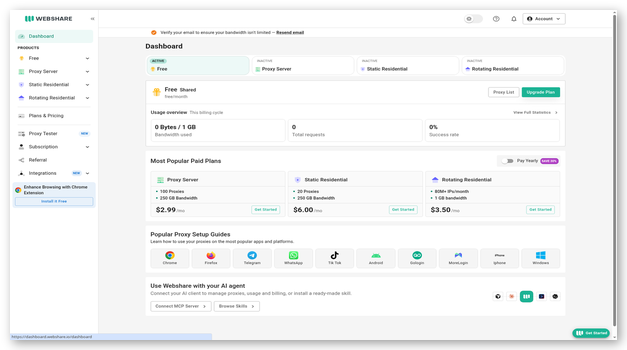
Webshare provides self-service proxy access through a compact dashboard and API. Its permanent free plan includes datacenter addresses rather than residential ones. That distinction matters when teams only need connection testing before buying residential bandwidth for regional research.
The account view groups proxy lists, authentication, bandwidth, and subscription controls. Residential plans add rotating home addresses and location options, while free users can validate integration syntax first. Webshare suits smaller teams that value clearly transparent limits, quick setup, and a low-risk path into paid proxy products.
Features:
- Free allowance: The permanent plan includes ten shared datacenter proxies and one gigabyte monthly. It tests integrations but does not provide free residential traffic.
- Proxy lists: Download or copy connection details from the dashboard in common formats. Developers can move credentials into scripts without manual reformatting.
- API access: Account APIs expose proxy information and configuration actions. Automation teams can refresh settings without repeatedly opening the browser dashboard manually.
- Authentication: Use username credentials or approved IP addresses depending on the product. This supports local tools, servers, and scheduled collection workers.
- Usage view: Bandwidth counters show consumption against the plan allowance. Small teams can identify unexpectedly heavy jobs before the monthly quota disappears.
- Residential pool: Paid residential plans rotate household addresses across many locations. Buyers should test target compatibility because the free addresses are datacenter based.
- Support path: Documentation, dashboard guidance, and chat-based escalation cover common setup questions. Phone support is not the main assistance channel for self-service accounts.
Pros
Cons
👉 How to Get Webshare for Free?
- Create a Webshare account without adding payment information.
- Open the proxy list and copy the available connection credentials.
- The permanent free plan supplies ten datacenter proxies and one gigabyte each month, not residential traffic.
10 free proxies and 1 GB monthly
2) Oxylabs
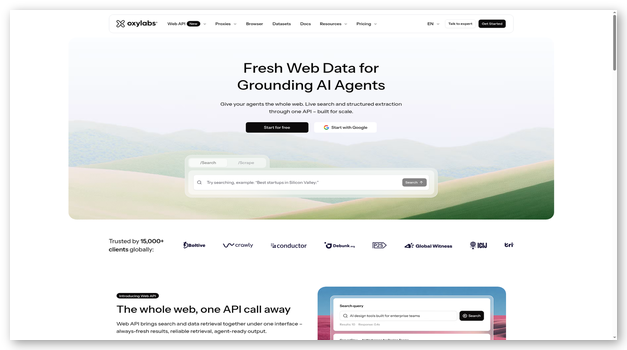
Oxylabs supplies rotating residential addresses for teams collecting public data across many locations. Its gateway supports per-request rotation and sticky sessions for multi-step flows. Retail researchers can request city-specific pages while keeping proxy routing outside their crawler code.
The dashboard screenshot shows endpoint generation, authentication, and usage controls in one workspace. Protocol choices include HTTP, SOCKS5, and HTTP3 through MASQUE. The service fits compliance-conscious organizations that need documented sourcing, broad targeting, and support beyond a basic public proxy list. Budget owners can track consumption throughout each run.
Features:
- Session control: Rotate the address per request or keep one session active for longer flows. This supports carts, logins, and multi-page checks.
- Location filters: Choose continent, country, state, city, ZIP, or ASN parameters where supported. Researchers can compare localized pages with fewer endpoint changes.
- Protocol choice: Connect through HTTP, HTTPS, SOCKS5, or HTTP3-compatible routes. Existing crawlers can select the protocol that matches their current networking stack.
- Endpoint builder: Generate credentials and connection strings inside the dashboard. Teams avoid hand-building proxy usernames when changing session or location settings repeatedly.
- Traffic scale: Unlimited concurrent sessions support parallel jobs without fixed thread caps. Project owners still need spending controls because bandwidth remains metered.
- Source policy: Oxylabs publishes residential proxy acquisition guidance and supplier requirements. Buyers can inspect how consent and network participation are addressed before deployment.
- Access testing: New accounts receive a one-time $5 credit, while approved trials vary by customer type. This gives teams several evaluation routes.
Pros
Cons
👉 How to Get Oxylabs for Free?
- Create an Oxylabs account from the residential proxy page.
- Open the dashboard and apply the welcome balance to a permitted test.
- Every new account receives a one-time $5 credit; self-service purchases are non-refundable.
One-time $5 welcome credit
3) Decodo
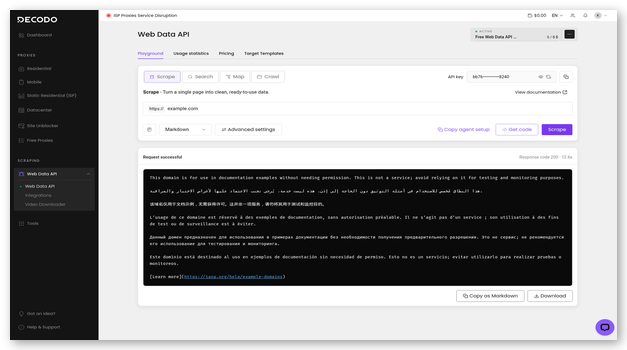
Decodo combines rotating residential proxies with a self-service dashboard, extensions, and integration guides. New users can test a limited residential allowance before the chosen subscription activates. Location filters suit price monitoring, advertising checks, and localized search research.
The dashboard screenshot presents endpoints, traffic use, and setup choices without crowding the main view. Sessions can rotate or remain sticky, while HTTP and SOCKS5 support broadens compatibility. Decodo fits beginners who want clear setup aids and experienced teams needing detailed targeting with predictable monthly options at scale.
Features:
- Residential pool: Plans provide access to a large residential address pool across many locations. Rotation distributes repeated requests when one identity is unnecessary.
- Precise targeting: Country, state, city, ZIP, and ASN filters support localized collection. Availability varies, so teams should test their exact markets first.
- Sticky sessions: Keep one address for session-sensitive tasks or rotate on each request. This flexibility supports both account flows and broad crawling.
- Protocol support: HTTP, HTTPS, and SOCKS5 connections work with common browsers and automation frameworks. Teams can retain their existing request libraries easily.
- Browser tools: Chrome and Firefox extensions simplify manual location switching during checks. They also help non-developers validate pages before coding a workflow.
- Traffic reports: Dashboard usage data shows bandwidth consumption and active products. Managers can compare projects before adding more wallet credits or plan capacity.
- Trial terms: New users receive 100 MB for three days, then the selected plan activates automatically. Cancellation is needed before that renewal point.
Pros
Cons
👉 How to Get Decodo for Free?
- Create a Decodo account and open Residential Proxies.
- Choose a subscription and select its trial option before checkout.
- The free trial provides 100 MB for three days and activates the chosen plan afterward unless cancelled.
3-day trial with 100 MB
4) ManageEngine Firewall Analyzer
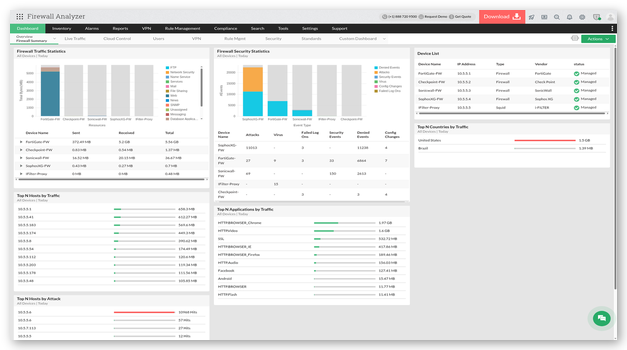
ManageEngine Firewall Analyzer examines logs from firewalls, VPNs, IDS systems, and proxy servers. Network teams can trace bandwidth spikes, denied requests, risky rules, and configuration changes. It does not supply proxy addresses, so readers should treat it as an operational monitoring companion.
Its dashboard brings traffic, security events, VPN activity, and compliance reports together. Scheduled reports support audits, while alerts flag unusual behavior. The 30-day evaluation suits administrators comparing multi-vendor visibility before licensing. This distinction keeps expectations realistic for proxy-list readers and busy security teams.
Features:
- Log analysis: Collects firewall, VPN, IDS, and proxy logs in one console. Teams can investigate traffic without switching between multiple vendor interfaces.
- Traffic reports: Breaks bandwidth down by user, application, protocol, and destination. Capacity reviews become easier because heavy consumers appear in scheduled reports.
- Rule audits: Identifies unused, risky, or conflicting firewall rules from configuration and activity data. Administrators can prioritize cleanup using evidence rather than assumptions.
- Change tracking: Records configuration updates and alerts teams when policies change. Incident reviews can connect unexpected traffic with the exact preceding modification.
- VPN visibility: Shows active VPN users, session histories, bandwidth, and failed connections. Security staff gain context when remote access behavior appears unusual.
- Compliance reports: Provides prepared reports for common security frameworks and internal audits. Teams can export supporting evidence without rebuilding every view manually.
- Vendor coverage: Supports many commercial and open-source security devices through agentless collection. Mixed networks can centralize monitoring while retaining their existing firewalls.
Pros
Cons
👉 How to Get ManageEngine Firewall Analyzer for Free?
- Open ManageEngine Firewall Analyzer and choose the download option.
- Register during installation to activate evaluation support and complete log setup.
- The fully functional trial lasts 30 days before licensing is required.
Visit ManageEngine Firewall Analyzer >>
30-day free trial
5) Bright Data
Bright Data combines a large residential network with detailed routing, compliance controls, and an open-source Proxy Manager. Teams can rotate every request or preserve sessions for workflows requiring continuity. ZIP, city, carrier, and ASN filters support granular regional research.
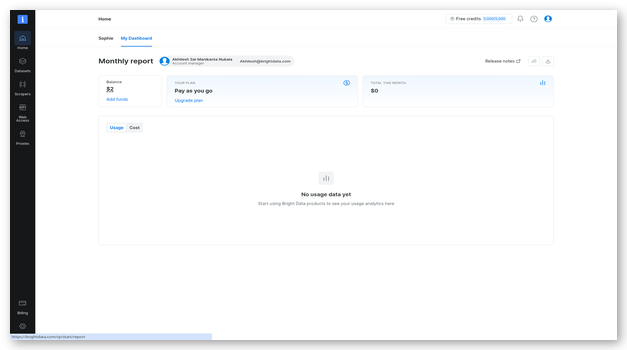
Its dashboard screenshot emphasizes active zones, credentials, traffic, and spend. Browser extensions and APIs serve both manual and coded workflows. Bright Data best matches organizations that need deep control, documented sourcing, and scaling options, although the product range and billing model require careful onboarding at scale.
Features:
- Proxy Manager: The open-source manager centralizes routing rules, credentials, and session behavior. Technical teams can control traffic before requests reach the residential network.
- Geo controls: Target countries, cities, ZIP codes, carriers, or ASN values where available. Local researchers can reproduce region-specific pages with greater precision.
- Session modes: Choose rotating addresses or sticky sessions based on workflow state. Shopping carts and account steps benefit from continuity across multiple requests.
- Usage limits: Dashboard spend and traffic controls help contain metered consumption. Teams should still monitor fast parallel jobs because charges follow transferred bandwidth.
- Integration paths: Use APIs, browser extensions, or the local Proxy Manager. This range supports analysts, developers, and infrastructure teams with different deployment preferences.
- Compliance review: Residential access can require identity or business verification. The review protects network use but may delay projects needing immediate production access.
- Trial access: The official page advertises a no-card free trial without publishing a fixed duration. Buyers should confirm limits inside the signup flow.
Pros
Cons
👉 How to Get Bright Data for Free?
- Open Bright Data Residential Proxies and select Start Free Trial.
- Create an account and complete any required business or identity verification.
- No card is advertised, but the official page publishes no fixed duration or allowance.
No-card free trial
6) Swiftproxy
Swiftproxy supplies rotating and static residential connections for scraping, verification, and regional research. Teams can choose sticky sessions when a workflow needs continuity. Standard HTTP, HTTPS, and SOCKS5 credentials fit browsers, scripts, and common automation frameworks without unusual connection methods.
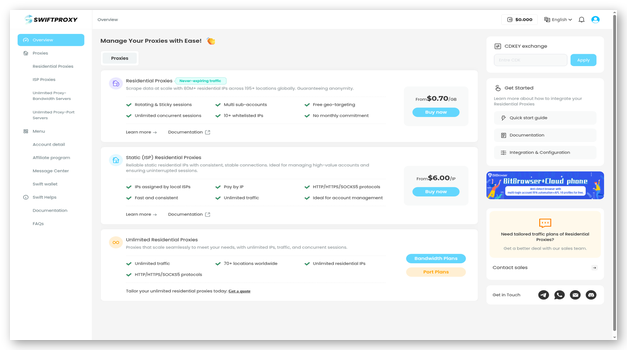
The account screen organizes traffic, products, and proxy endpoints for daily monitoring. API access supports scheduled collection, while country selection handles localized checks. New users may request 500 MB of evaluation traffic from support. Approval and duration depend entirely on the submitted project use case.
Features:
- Residential pool: Routes requests through household connections across many regions. Regional research gains more realistic location signals than shared datacenter addresses provide.
- Sticky sessions: Keeps one exit address for session-dependent tasks or rotates automatically. Teams can preserve carts, logins, and multi-step browsing when needed.
- Protocol support: Accepts HTTP, HTTPS, and SOCKS5 connections from common clients. Existing crawlers can adopt these credentials without replacing their transport libraries.
- API control: Exposes account and proxy functions for programmatic workflows. Scheduled jobs can create endpoints and manage sessions with less manual dashboard work.
- Location choice: Provides country and regional selection across a broad network. Researchers can compare public pages, prices, and search results from relevant markets.
- Usage tracking: Shows consumed bandwidth and active products inside the account. Project managers can spot unexpected traffic before a small evaluation allowance disappears.
- Trial request: Offers 500 MB of free traffic to approved new users. Support reviews the use case, so access is not an automatic permanent tier.
Pros
Cons
👉 How to Get Swiftproxy for Free?
- Create a Swiftproxy account and open its residential proxy page.
- Contact support with the target, locations, and expected evaluation workload.
- Approved new users receive up to 500 MB; no fixed duration is published.
Up to 500 MB trial traffic
7) Thordata
Thordata combines residential, mobile, ISP, and datacenter proxy products for automated data work. Its endpoint tools support rotation, sticky sessions, country selection, city filters, and ASN targeting. Developers can connect through standard credentials or official SDKs for several common languages.
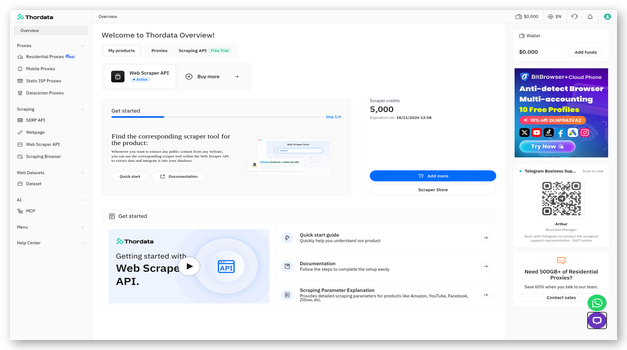
The dashboard displays products, remaining traffic, credentials, and account activity in one workspace. Integration material covers browser automation and data pipelines, including newer AI-oriented workflows. Eligible new users can request up to 500 MB of residential traffic. Availability should be confirmed before planning a pilot.
Features:
- Proxy types: Combines residential, mobile, static ISP, and datacenter access in one account. Teams can match address reputation and session behavior to each task.
- Geo controls: Filters endpoints by country, state, city, and ASN where available. Localized collection becomes more precise for advertising and market research.
- Session modes: Supports rotating requests and sticky connections for longer interactions. Operators can switch behavior without rebuilding the surrounding crawler or browser flow.
- Developer SDKs: Provides libraries and examples for Python, Node.js, Go, and Java. Development teams can integrate credentials using familiar package ecosystems.
- AI workflows: Documents connections for MCP, LangChain, and retrieval pipelines. These integrations can feed permitted public web data into downstream analysis systems.
- Usage dashboard: Displays traffic, products, and account balances for active projects. Teams can monitor consumption and separate short pilots from production workloads.
- Trial eligibility: Allows eligible new users to request up to 500 MB. The offer requires approval and should not be presented as permanent free capacity.
Pros
Cons
👉 How to Get Thordata for Free?
- Register with Thordata and open the residential proxy product area.
- Request evaluation traffic and describe the permitted public-data workflow.
- Eligible new users can receive up to 500 MB; confirm current terms first.
Up to 500 MB for eligible users
8) Floppydata
Floppydata sells rotating residential, mobile, and datacenter traffic through one prepaid balance. Users can switch proxy types without creating separate subscriptions. Static residential and datacenter addresses are also available for workflows that need stable endpoints and unrestricted bandwidth.
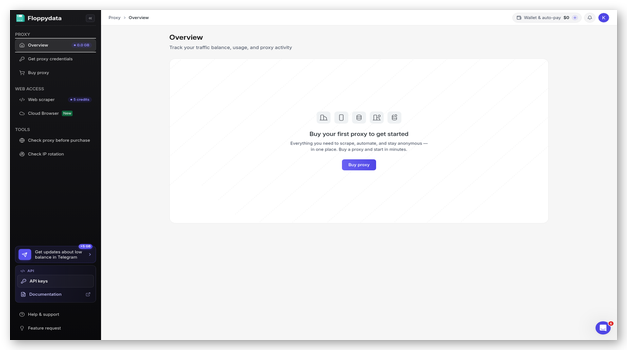
Its dashboard presents products, balances, credentials, and traffic controls in a compact layout. An API supports automation, while the optional cloud browser runs on purchased proxy traffic. The current pricing page does not advertise a standard free proxy trial. Buyers should budget for the displayed minimum purchase.
Features:
- Shared balance: Applies one prepaid traffic balance across three rotating proxy types. Teams can change address classes without maintaining separate wallets or subscriptions.
- Rotating access: Changes exit addresses automatically for independent public-page requests. Operators can distribute collection traffic while keeping their crawler configuration relatively simple.
- Static proxies: Offers ISP and datacenter addresses for tasks needing consistent endpoints. Monthly packages include unlimited bandwidth under the current published structure.
- API tools: Provides programmatic access for credential and traffic workflows. Developers can connect proxy management to scheduled jobs instead of relying only on the dashboard.
- Cloud browser: Runs an anti-detect browser with purchased proxy traffic. Users avoid separate browser licensing, although the underlying bandwidth still carries a cost.
- Traffic view: Shows balances and service activity in the account interface. Cost monitoring becomes simpler when several proxy types draw from one prepaid amount.
- Paid entry: Publishes paid traffic and per-IP options without a standard free trial. Readers should confirm package minimums before treating it as a test route.
Pros
Cons
👉 How to Get Floppydata for Free?
- Create a Floppydata account and review the current proxy pricing page.
- Choose the smallest suitable paid package and confirm its purchase minimum.
- No standard free proxy trial is currently published; paid access is required.
Paid access required
9) PrivateProxy
PrivateProxy sells static and rotating residential access for scraping, account management, and regional checks. Static addresses suit long-lived identities, while rotating pools distribute repeated requests. Its current evaluation routes differ by product, so buyers must read checkout labels carefully.
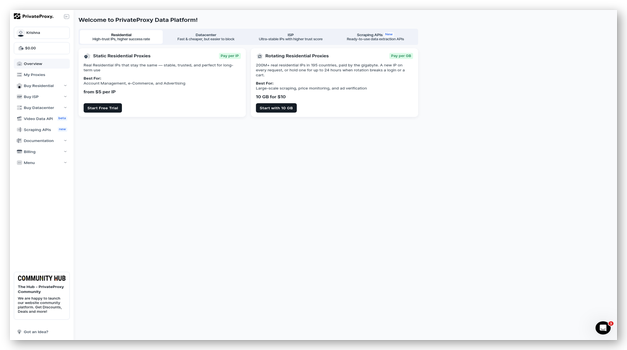
The dashboard screenshot keeps packages, locations, credentials, and billing within one account view. Rotating residential traffic supports country and city selection plus long sticky sessions. PrivateProxy suits buyers wanting low entry costs, but card requirements and renewal behavior deserve attention before any trial begins at scale.
Features:
- Static addresses: Dedicated residential addresses remain stable for long account sessions. One included monthly swap helps replace an unsuitable static assignment when necessary.
- Rotating pool: Rotating residential traffic can change every request or preserve an address temporarily. This supports both broad crawling and multi-step browser flows.
- City targeting: Country and city selection helps reproduce local pages and pricing. Premium ASN access is separate, so buyers should check targeting requirements first.
- Long sessions: Sticky options extend from short intervals through twenty-four hours. Teams can match session duration to forms, carts, or authenticated research workflows.
- Connection scale: Rotating plans allow many concurrent connections without separate thread upgrades. Application owners still need pacing controls to respect target rules.
- Protocol access: HTTP, HTTPS, and SOCKS5 options cover common browsers, crawlers, and automation tools. Static and rotating products may expose different configuration choices.
- Trial choices: Selected static residential addresses include a two-day no-charge trial with card details. Rotating residential uses paid introductory packages instead today.
Pros
Cons
👉 How to Get PrivateProxy for Free?
- Create a PrivateProxy account and choose Static Residential.
- Select the package explicitly labeled as the residential trial and add a card.
- The selected static trial is free for two days if cancelled in time; rotating trials are paid.
2-day static proxy trial
10) Geonix
Geonix is the current name for the service formerly called Proxy-Sale. It offers residential, ISP, mobile, IPv4, and IPv6 proxy products. Residential traffic supports rotation, sticky sessions, city selection, ISP targeting, password authentication, and IP allowlisting for varied workflows.
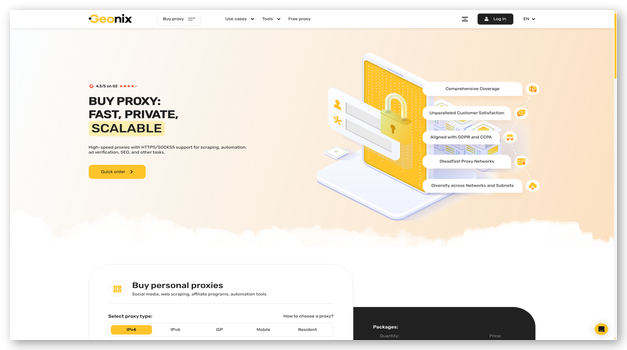
The supplied image reflects the earlier branding, while the active service and account remain Geonix. Its residential product includes a small paid evaluation rather than free traffic. Buyers can test 500 MB for three days at $1.99 before selecting a larger monthly package more carefully.
Features:
- Current brand: Operates as Geonix after the Proxy-Sale rebrand. Existing accounts and purchased addresses continued without requiring customers to change their authentication details.
- Residential traffic: Routes requests through consent-based household connections across many locations. Regional projects can request country, state, city, or specific ISP selection.
- Rotation controls: Changes addresses per request, on a timed interval, or through sticky sessions. Teams can match rotation behavior to each browser or crawler workflow.
- Authentication: Accepts username and password credentials or IP allowlisting. Administrators can select the method that fits local machines, servers, and scheduled jobs.
- Proxy catalog: Includes datacenter, residential, mobile, ISP, and IPv6 products. Buyers should verify each product because trial and bandwidth terms differ substantially.
- Free checkers: Provides utilities for speed, anonymity, ports, and DNS leak checks. These tools help screen endpoints before sending any permitted workload.
- Paid trial: Offers 500 MB of residential traffic for $1.99 over three days. It is a paid evaluation, not a permanent or no-cost plan.
Pros
Cons
👉 How to Get Geonix for Free?
- Open Geonix Residential Proxies and create an account.
- Select the three-day trial option beside the residential tariff controls.
- The paid trial costs $1.99 and includes 500 MB; no free trial is offered.
500 MB trial for $1.99
11) IPRoyal
IPRoyal provides residential, ISP, datacenter, mobile, and sneaker proxy products. Its residential service uses prepaid traffic that does not expire. Users can select locations, rotate addresses, preserve sessions, and authenticate through dashboard-generated credentials for public-data collection and regional checks.
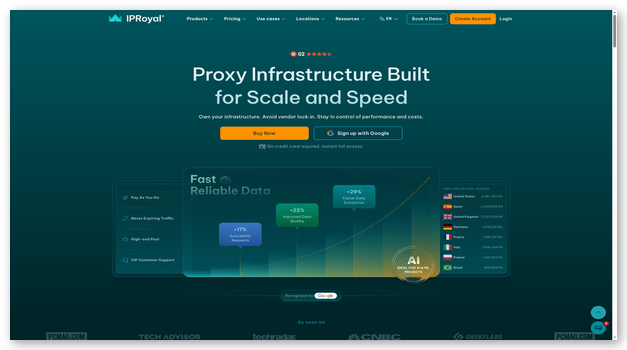
The account view centralizes orders, targeting, session behavior, and usage. A high-end pool option favors responsive addresses when an active subscription supports it. Standard residential plans do not include a free trial. Verified companies may request an enterprise evaluation after completing formal business ownership verification checks.
Features:
- Traffic balance: Keeps purchased residential traffic available without a normal expiration date. Occasional projects can pause without losing unused bandwidth at month end.
- Location filters: Supports country and available state or city selection through the dashboard. Teams can generate credentials for specific regional research requirements.
- Rotation modes: Randomizes addresses between requests or preserves a sticky session. Users can match identity continuity to browsing, crawling, or account-management tasks.
- Proxy range: Offers residential, ISP, datacenter, mobile, and specialist products. Each category has different billing and session behavior that buyers should review separately.
- High-end pool: Prioritizes faster residential endpoints for customers with qualifying subscriptions. This option can improve responsiveness when ordinary pool selection proves inconsistent.
- Dashboard setup: Generates proxy credentials after users choose location and session preferences. Clear order controls reduce manual assembly of long usernames and parameters.
- Enterprise trial: Allows verified companies to request a free enterprise evaluation. Individual residential users instead begin with a paid one-gigabyte minimum order.
Pros
Cons
👉 How to Get IPRoyal for Free?
- Create an IPRoyal account and open Residential Proxies.
- Business representatives can contact sales and complete company verification.
- Only verified companies receive enterprise trials; standard residential access starts with paid traffic.
Enterprise trial for verified companies
12) HydraProxy
HydraProxy sells non-recurring residential bandwidth for scraping and regional access. Customers can order a small traffic amount, rotate addresses automatically, or hold a sticky session. Purchased data remains available without a monthly subscription requirement.
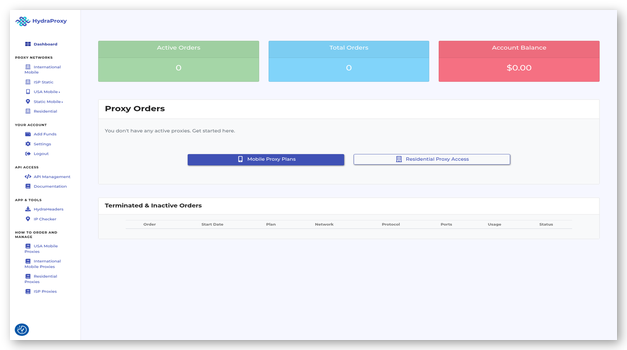
The dashboard screenshot groups orders, traffic balance, and endpoint setup in a compact view. Unlimited concurrency supports parallel workers, while country routing covers broad geographic checks. HydraProxy fits occasional projects that prefer prepaid traffic, though the service does not advertise a free residential trial for intermittent research with changing regional needs.
Features:
- No subscription: Residential traffic is purchased without a recurring monthly commitment. Buyers can add bandwidth when a project resumes instead of maintaining an idle plan.
- Sticky sessions: Keep an address for roughly thirty to sixty minutes where available. This supports forms and short authenticated flows that need continuity.
- Random rotation: Request a different residential address for broad collection jobs. Rotating identities can distribute traffic when a stable login is unnecessary.
- Country routes: Select from supported countries for localized page access. The service does not emphasize the same city-level depth as some larger providers.
- Concurrency: Residential plans allow many simultaneous connections without separate thread packages. Operators should still pace requests to protect targets and control bandwidth.
- Traffic retention: Purchased bandwidth remains available until used under current product terms. Irregular projects avoid losing data merely because a month ends.
- Entry purchase: HydraProxy does not publish a free trial for residential proxies. The smallest listed tier begins with one gigabyte of non-recurring traffic.
Pros
Cons
👉 How to Get HydraProxy for Free?
- Create a HydraProxy account and open Residential Proxies.
- Purchase the smallest one-gigabyte non-recurring traffic package.
- No free plan or trial is listed; entry residential access starts with a paid one-gigabyte package.
Paid access from 1 GB
13) ScrapingBee
ScrapingBee is a managed web-scraping API rather than a downloadable proxy list. Customers send a target URL, then the service handles proxy rotation, retries, browser rendering, and optional geotargeting. This model reduces infrastructure work for developers collecting permitted public pages.
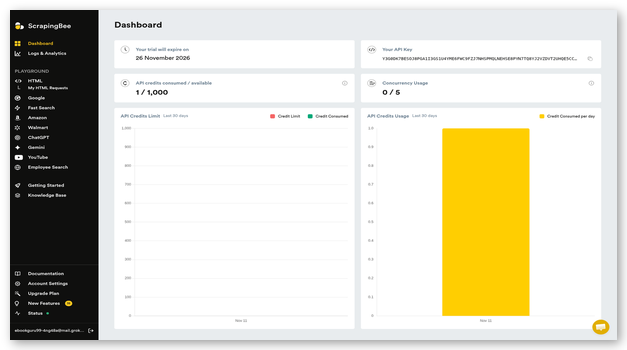
Its dashboard shows API credits, keys, request history, and configuration examples. Rendering options cover JavaScript sites, screenshots, extraction rules, and device settings. New accounts receive 1,000 free API credits without a payment card. Credit consumption varies considerably with selected optional features and proxy levels.
Features:
- Managed rotation: Selects and rotates proxy infrastructure behind each API request. Developers avoid maintaining their own address lists, health checks, and retry logic.
- JavaScript rendering: Loads dynamic pages in a managed browser when ordinary HTTP requests miss content. Optional scenarios can click, wait, scroll, or run scripts.
- Geo targeting: Routes supported requests through selected countries for localized public pages. Credit costs can increase when premium or stealth proxy options are enabled.
- Screenshot capture: Returns full-page or viewport images alongside scraping workflows. Teams can document visual changes without adding a separate browser automation service.
- Extraction rules: Converts selected page fields into structured output using declared rules. Downstream systems receive cleaner records and require less HTML post-processing.
- Workflow links: Connects through HTTP clients, Make, n8n, and documented language examples. Existing automation can call the API without operating a proxy fleet.
- Free credits: Adds 1,000 API credits to new accounts without requiring a card. The allowance is temporary testing capacity, not a recurring monthly free plan.
Pros
Cons
👉 How to Get ScrapingBee for Free?
- Open ScrapingBee and create a new account.
- Copy the dashboard API key and send a permitted test request.
- New accounts receive 1,000 free API credits with no payment card required.
1,000 free API credits
Feature Comparison Table of Top Proxy Server List
How Did We Choose Best Free Proxy Server?

At Guru99, our unwavering dedication to credibility drives our editorial focus on obtaining accurate, relevant, and objective information. We have rigorously created and reviewed content to ensure reliable resources that answer your questions. After researching over 25 best free proxy servers and dedicating more than 68 hours to this comprehensive guide, I included both free and paid options with unmatched features. This trusted list can help you discover the ultimate solution for your proxy needs. Choosing the best free proxy server requires careful consideration of various factors, and we aim to provide you with a reliable, secure, and efficient service only.
Here are a few key factors that we took into consideration while selecting the proxies:
- Security: We chose proxies that provide secure browsing and data protection. The proxies in this list also support multiple protocols, which helps in maintaining user safety.
- Speed: Fast servers allow you to access websites quickly. Hence, we have selected proxies that offer high speed and performance.
- Accessibility: Global coverage for a broader range of content access is an essential feature. Hence, we have shortlisted providers that support multiple countries; some even support over 210 regions.
- Usability: The best way to ensure a great experience is to select user-friendly options, this is why we made sure our list includes easily configurable, beginner-friendly proxies.
- Reliability: We also paid attention to uptime and performance consistency to make sure you experience uninterrupted browsing.
How do I connect to a Proxy Server from a Proxy List?
Step 1) Firstly, you need to find your connection setup menu. Go to your browser settings and search for “Proxy Setting.”

Step 2) It will redirect you to your computer’s Proxy Setting, or it will open a new window for that browser’s Proxy Setting. Check whether the Proxy server is on or off.

Step 3) Afterward, turn the Proxy on and fill in the address and port. Note that if the proxy List website gives you a number like 186.47.97.122:8080, as an example. You should fill in the address with 186.47.97.122 and fill in the port with 8080. Don’t forget to press the Save button.

Step 4) Now, test your connection to ensure it is working as intended. If you want to change the Proxy Server or deactivate it, you can revisit the same setting.
What is the difference between Proxy Lists and Proxy Servers?
Both Proxy Lists and Proxy Sites offer Proxy Servers. Proxy List websites have more settings and a lot of Proxy Servers that you can choose from, but you must connect them manually. On the other hand, there are also Rotating Proxy sites. You can also be anonymous by using them. They will automatically connect you to a Proxy Server, and then you can access a URL through their site.
Using a Proxy site is more convenient for simple usage because you don’t need to connect your computer to a Proxy Server. However, not all sites function well if you view them through a Proxy website, so it is more reliable to manually connect to a Proxy Server through a Proxy List for intermediate and advanced users.
What is a proxy server list, and how does it work?
A proxy server list contains connection addresses that relay requests between a device and a destination. Each entry usually includes an IP address, port, protocol, and sometimes login credentials. Public lists publish shared endpoints, while managed providers issue private credentials through dashboards or APIs. The destination sees the proxy address instead of the original network address. A proxy does not automatically encrypt every application or guarantee anonymity. Its behavior depends on protocol support, browser settings, authentication, operator practices, and whether other traffic bypasses the configured route.
Are free proxy server lists safe for everyday browsing?
Free proxy lists can support disposable experiments, but they carry meaningful privacy and reliability risks. Apply strict limits before connecting any browser, script, or application.
- Low-stakes tasks: Limit free endpoints to public pages without personal accounts. Never send banking, medical, workplace, or private login traffic.
- Operator risk: Unknown operators may log destinations, inspect requests, inject or resell activity. A working address proves nothing about safety.
- Technical checks: Test the exit IP, DNS behavior, HTTPS, and destination access. Discard addresses exposing the original network.
- Safer option: Choose documented providers for repeated work and support. A reputable VPN better protects whole-device traffic.
How can you test proxy speed, anonymity, and protocol support?
Begin by checking whether the exit address replaces your original IP. Inspect DNS and browser leak pages, then review forwarding headers for transparent proxy clues. Measure latency and throughput against a nearby endpoint several times because one result can be misleading. Test the exact destination your workflow needs, not only a generic status page. Confirm HTTP CONNECT for HTTPS traffic and complete the SOCKS handshake for SOCKS proxies. Finally, repeat requests for thirty minutes to catch silent failures, rotation changes, and unstable sessions.
Should you choose a free proxy, paid proxy, or VPN?
Choose according to traffic scope and risk. A free proxy fits disposable public-page tests without accounts or sensitive data. A paid proxy fits scraping, regional verification, automation, and workflows requiring rotation or stable sessions. A VPN encrypts device traffic through its tunnel and is usually better for personal privacy on public networks. Proxies operate at the configured application or request level, while VPNs normally cover more device traffic. None of these tools makes prohibited activity lawful or removes the need for careful data handling.
How can AI and automation work with proxy server lists?
Automation can validate addresses, classify protocols, record latency, remove duplicates, and rotate healthy endpoints. AI assistants can draft connection code, summarize failures, or suggest retry rules from sanitized logs. They should not receive proxy passwords, private URLs, personal records, or unrestricted destination lists. A human still defines lawful targets, request rates, data retention, and escalation rules. Managed APIs reduce infrastructure work by combining proxy rotation with rendering and extraction. Teams should audit generated code because incorrect concurrency or retry logic can waste bandwidth and overload target sites.
Can a proxy server hide all browser and application activity?
No. A proxy only handles traffic that the browser, script, or application actually sends through it. DNS queries, WebRTC connections, background services, or unsupported protocols may bypass the route. HTTPS protects content between the client and destination when configured correctly, but the proxy operator still observes connection metadata. Browser cookies and account logins can identify a user even after the IP changes. Test for leaks, isolate browser profiles, avoid sensitive accounts, and prefer a reputable VPN when whole-device encryption is the main requirement.
How much does a reliable proxy service cost?
Proxy costs depend on address type, location detail, bandwidth, session behavior, and volume. Datacenter addresses are often priced per IP or package. Residential traffic is commonly priced per gigabyte, while mobile access may use port or time-based billing. Free plans usually provide small datacenter allowances, promotional credits, or short trials. Compare the cost of successful requests rather than the headline rate. Retries, blocked destinations, heavy browser assets, and unused monthly traffic can make a cheap package cost more than a smaller reliable one.
What Problems Cause Free Proxy Connections to Fail, and How Can They Be Fixed?
Proxy failures usually come from endpoint health, authentication, reputation, routing, leaks, or bandwidth waste. Diagnose one layer at a time instead of changing every setting together.
- Issue: The endpoint times out because the public address has stopped responding or is overloaded.
Solution: The operator should retest availability, lower timeouts carefully, and replace the address with a recently verified endpoint. - Issue: A destination rejects requests because many users share the same flagged proxy address.
Solution: The team should reduce request rates, rotate responsibly, and choose authenticated private capacity for recurring permitted work. - Issue: The client returns authentication errors after credentials, allowlists, or ports change unexpectedly.
Solution: The administrator should regenerate credentials, confirm the gateway port, and update allowed source addresses before retrying. - Issue: Location results differ because database records lag behind current proxy routing information.
Solution: The researcher should compare multiple geolocation databases and confirm the exit location against the intended target page. - Issue: Browser traffic leaks directly through DNS, WebRTC, extensions, or unsupported connection protocols.
Solution: The user should disable unnecessary extensions, configure DNS safely, and run leak checks before sending sensitive requests. - Issue: Bandwidth disappears quickly because rendered pages download images, video, fonts, and trackers.
Solution: The developer should block unnecessary resources, cache stable responses, and monitor usage by target and project.
Are proxy server lists legal and ethical to use?
Proxy technology has legitimate uses, including security testing, regional quality checks, and permitted public-data research. Legality depends on the target, data, authorization, contracts, access method, and jurisdiction. A proxy does not grant permission to bypass authentication, purchase controls, paywalls, or technical restrictions. Respect website terms, robots guidance, request limits, privacy laws, and intellectual-property rights. Choose providers that explain sourcing and acceptable use clearly. Seek qualified legal advice before collecting personal, regulated, copyrighted, or commercially sensitive information at meaningful scale across borders.
What trends will shape proxy server services next?
Proxy services are adding clearer sourcing records, stricter account checks, automated compliance controls, and more granular usage reporting. Managed scraping APIs increasingly combine rotation, browser rendering, extraction, and retry logic behind one request. AI integrations will help classify failures and prepare workflows, but they also raise questions about destination control and data retention. Providers may offer more prepaid balances and smaller pilots as buyers resist large subscriptions. Readers should expect stronger separation between risky anonymous public lists and documented commercial networks with accountable operators.
Verdict
I reviewed each access model and found three options that stood out for practical testing, clear controls, and realistic paths from evaluation to paid work.
- Webshare: I valued its permanent ten-proxy datacenter allowance and no-card signup for learning connection basics without a recurring charge.
- Oxylabs: Its one-time welcome credit gave teams a controlled way to examine managed residential endpoints and targeting before buying capacity.
- Decodo: The three-day residential trial provided a focused 100 MB evaluation with familiar protocols, location controls, and dashboard setup.
