
13 Best FREE Residential Proxy Server (2026)
 Editorial Team
Disclosure: Guru99 is reader-supported. We may earn a commission when you buy through links on this page. Learn more

Residential proxy services can make regional research easier, but a weak choice brings blocked requests, unstable sessions, wasted bandwidth, confusing dashboards, hidden renewals, and inconsistent location results. Those failures can spoil price checks or interrupt account workflows. Readers often compare pool size while overlooking consent practices, session limits, target restrictions, and billing rules. A careful review clarifies what free access actually includes, separates residential trials from datacenter allowances, and makes the next test safer and easier to plan.
I spent 65+ hours researching 22+ services, reviewing official pages, access terms, dashboard evidence, and recurring user feedback. My in-depth research shortlisted 13 Best Free Residential Proxy Server options with distinct features, pros and cons, and backed-by current trial details. The guide separates permanent allowances from credits and paid evaluations, helping you continue with realistic expectations. Read more…

Oxylabs is a well-known proxy that offers a proxy switcher extension. It provides a secure HTTPS connection and includes options such as HTTPS and SOCKS5 proxies. Oxylabs has an advanced feature for gathering real-time data.
Best FREE Residential Proxies: Top Picks!
| Name | Proxy Type | Geographical Coverage | Success Rate | Free Trial | Link |
|---|---|---|---|---|---|
👍 Oxylabs |
Residential, Mobile, Rotating ISP proxies, Shared etc. | 195 Countries | 99.82% | 7-Days Free Trial | Learn More |
 👍 Webshare |
Residential, Static Residential, Datacenter proxies | 195+ Countries | 99.97% | 10 free proxies | Learn More |
 👍 Decodo |
Residential, Datacenter, Mobile, ISP, Web Unblocker | 195+ countries | 99.68% | 3-Days Free Trial | Learn More |
 Bright Data |
Datacenter, Residential, Mobile, ISP Proxies | 195 countries | 99.95% | 7-Day Free Trial | Learn More |
 NodeMaven |
Residential, Mobile, ISP (Static Residential) Proxies | 190+ Countries | 99.83% | 750MB for $3.50 | Learn More |
1) Oxylabs
Oxylabs supplies rotating residential addresses for teams collecting public data across many locations. Its gateway supports per-request rotation and sticky sessions for multi-step flows. Retail researchers can request city-specific pages while keeping proxy routing outside their crawler code.
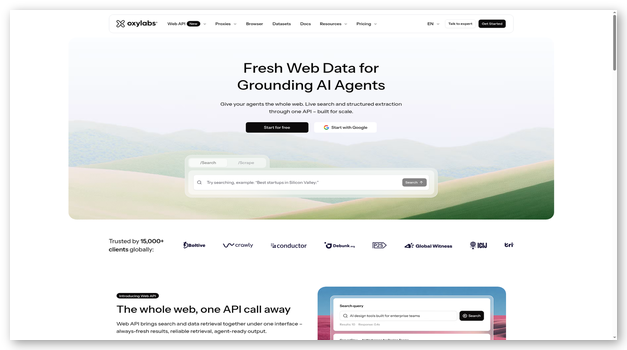
The dashboard screenshot shows endpoint generation, authentication, and usage controls in one workspace. Protocol choices include HTTP, SOCKS5, and HTTP3 through MASQUE. The service fits compliance-conscious organizations that need documented sourcing, broad targeting, and support beyond a basic public proxy list. Budget owners can track consumption throughout each run.
Features:
- Session control: Rotate the address per request or keep one session active for longer flows. This supports carts, logins, and multi-page checks.
- Location filters: Choose continent, country, state, city, ZIP, or ASN parameters where supported. Researchers can compare localized pages with fewer endpoint changes.
- Protocol choice: Connect through HTTP, HTTPS, SOCKS5, or HTTP3-compatible routes. Existing crawlers can select the protocol that matches their current networking stack.
- Endpoint builder: Generate credentials and connection strings inside the dashboard. Teams avoid hand-building proxy usernames when changing session or location settings repeatedly.
- Traffic scale: Unlimited concurrent sessions support parallel jobs without fixed thread caps. Project owners still need spending controls because bandwidth remains metered.
- Source policy: Oxylabs publishes residential proxy acquisition guidance and supplier requirements. Buyers can inspect how consent and network participation are addressed before deployment.
- Access testing: New accounts receive a one-time $5 credit, while approved trials vary by customer type. This gives teams several evaluation routes.
Pros
Cons
👉 How to Get Oxylabs for Free?
- Open the Oxylabs residential proxy page and create an account.
- Claim the one-time welcome credit or request the appropriate customer trial.
- New accounts receive $5 credit; trials last three days individually or seven days for verified businesses.
One-time $5 welcome credit
2) Webshare
Webshare provides self-service proxy access through a compact dashboard and API. Its permanent free plan includes datacenter addresses rather than residential ones. That distinction matters when teams only need connection testing before buying residential bandwidth for regional research.
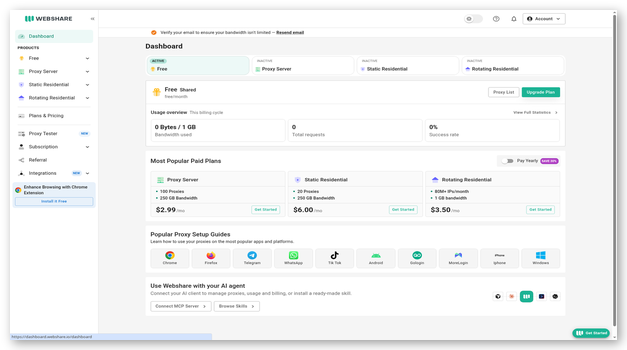
The account view groups proxy lists, authentication, bandwidth, and subscription controls. Residential plans add rotating home addresses and location options, while free users can validate integration syntax first. Webshare suits smaller teams that value clearly transparent limits, quick setup, and a low-risk path into paid proxy products.
Features:
- Free allowance: The permanent plan includes ten shared datacenter proxies and one gigabyte monthly. It tests integrations but does not provide free residential traffic.
- Proxy lists: Download or copy connection details from the dashboard in common formats. Developers can move credentials into scripts without manual reformatting.
- API access: Account APIs expose proxy information and configuration actions. Automation teams can refresh settings without repeatedly opening the browser dashboard manually.
- Authentication: Use username credentials or approved IP addresses depending on the product. This supports local tools, servers, and scheduled collection workers.
- Usage view: Bandwidth counters show consumption against the plan allowance. Small teams can identify unexpectedly heavy jobs before the monthly quota disappears.
- Residential pool: Paid residential plans rotate household addresses across many locations. Buyers should test target compatibility because the free addresses are datacenter based.
- Support path: Documentation, dashboard guidance, and chat-based escalation cover common setup questions. Phone support is not the main assistance channel for self-service accounts.
Pros
Cons
👉 How to Get Webshare for Free?
- Create a Webshare account without adding payment information.
- Open the proxy list and copy the available connection credentials.
- The permanent free plan supplies ten datacenter proxies and one gigabyte each month, not residential traffic.
10 free proxies and 1 GB monthly
3) Decodo
Decodo combines rotating residential proxies with a self-service dashboard, extensions, and integration guides. New users can test a limited residential allowance before the chosen subscription activates. Location filters suit price monitoring, advertising checks, and localized search research.
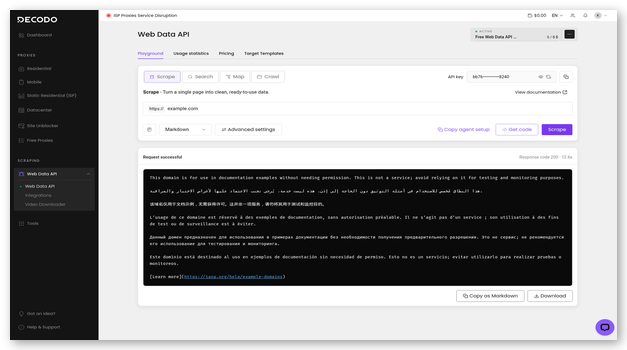
The dashboard screenshot presents endpoints, traffic use, and setup choices without crowding the main view. Sessions can rotate or remain sticky, while HTTP and SOCKS5 support broadens compatibility. Decodo fits beginners who want clear setup aids and experienced teams needing detailed targeting with predictable monthly options at scale.
Features:
- Residential pool: Plans provide access to a large residential address pool across many locations. Rotation distributes repeated requests when one identity is unnecessary.
- Precise targeting: Country, state, city, ZIP, and ASN filters support localized collection. Availability varies, so teams should test their exact markets first.
- Sticky sessions: Keep one address for session-sensitive tasks or rotate on each request. This flexibility supports both account flows and broad crawling.
- Protocol support: HTTP, HTTPS, and SOCKS5 connections work with common browsers and automation frameworks. Teams can retain their existing request libraries easily.
- Browser tools: Chrome and Firefox extensions simplify manual location switching during checks. They also help non-developers validate pages before coding a workflow.
- Traffic reports: Dashboard usage data shows bandwidth consumption and active products. Managers can compare projects before adding more wallet credits or plan capacity.
- Trial terms: New users receive 100 MB for three days, then the selected plan activates automatically. Cancellation is needed before that renewal point.
Pros
Cons
👉 How to Get Decodo for Free?
- Create a Decodo account and open Residential Proxies.
- Choose a subscription and select its trial option before checkout.
- The free trial provides 100 MB for three days and activates the chosen plan afterward unless cancelled.
3-day trial with 100 MB
4) Bright Data
Bright Data combines a large residential network with detailed routing, compliance controls, and an open-source Proxy Manager. Teams can rotate every request or preserve sessions for workflows requiring continuity. ZIP, city, carrier, and ASN filters support granular regional research.
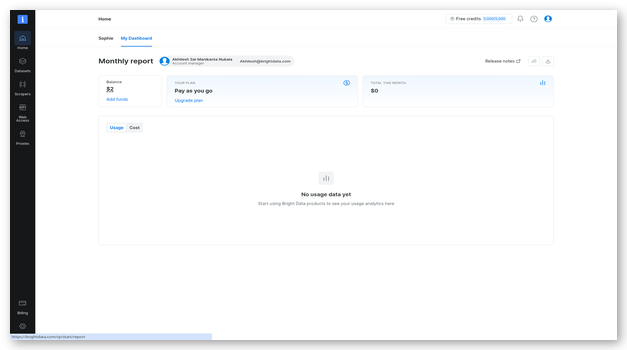
Its dashboard screenshot emphasizes active zones, credentials, traffic, and spend. Browser extensions and APIs serve both manual and coded workflows. Bright Data best matches organizations that need deep control, documented sourcing, and scaling options, although the product range and billing model require careful onboarding at scale.
Features:
- Proxy Manager: The open-source manager centralizes routing rules, credentials, and session behavior. Technical teams can control traffic before requests reach the residential network.
- Geo controls: Target countries, cities, ZIP codes, carriers, or ASN values where available. Local researchers can reproduce region-specific pages with greater precision.
- Session modes: Choose rotating addresses or sticky sessions based on workflow state. Shopping carts and account steps benefit from continuity across multiple requests.
- Usage limits: Dashboard spend and traffic controls help contain metered consumption. Teams should still monitor fast parallel jobs because charges follow transferred bandwidth.
- Integration paths: Use APIs, browser extensions, or the local Proxy Manager. This range supports analysts, developers, and infrastructure teams with different deployment preferences.
- Compliance review: Residential access can require identity or business verification. The review protects network use but may delay projects needing immediate production access.
- Trial access: The official page advertises a no-card free trial without publishing a fixed duration. Buyers should confirm limits inside the signup flow.
Pros
Cons
👉 How to Get Bright Data for Free?
- Open Bright Data's residential proxy page and choose Start Free Trial.
- Create an account and complete any requested access verification.
- The trial requires no card, but the official page does not publish a fixed duration or allowance.
No-card free trial
5) NodeMaven
NodeMaven focuses on screened residential and mobile addresses for scraping, verification, and account workflows. Its quality filter removes many low-trust candidates before assignment. Long sticky sessions help tasks that cannot tolerate frequent identity changes.
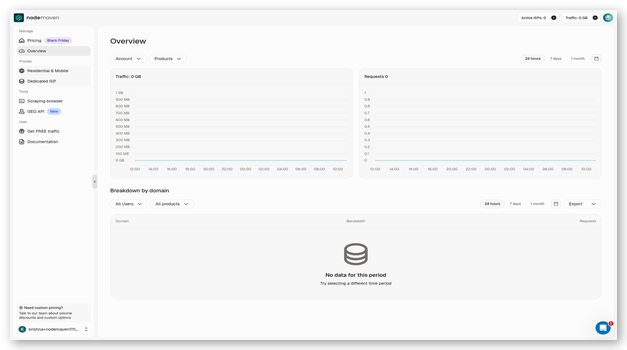
The dashboard screenshot groups traffic, proxy settings, and active products around a clean central view. City and ISP targeting support local checks, while unused traffic rolls forward. NodeMaven suits teams that already own crawler logic and want stronger address filtering rather than a managed extraction API for repeatable production traffic today.
Features:
- Quality filter: The network screens candidate addresses before assigning them to customers. Cleaner pools can reduce wasted retries, though no filter guarantees every target.
- Sticky routing: Sessions can retain one address for extended account or checkout flows. Teams can also rotate when each request should appear independent.
- Geo selection: Country, city, and ISP filters help reproduce local availability. Researchers can isolate markets without maintaining separate proxy providers for each region.
- Traffic rollover: Unused bandwidth carries into later periods under current plans. Variable projects avoid losing purchased traffic when monthly collection volume drops.
- Cashback model: Used bandwidth can earn account value under eligible plans. Buyers should review the exact calculation before treating it as a guaranteed discount.
- Protocol options: HTTP, HTTPS, and SOCKS5 credentials fit common crawlers and browsers. Existing automation can switch endpoints without replacing its request layer.
- Paid evaluation: A $3.50 trial includes 750 MB across residential and mobile pools. NodeMaven does not describe this offer as a free trial.
Pros
Cons
👉 How to Get NodeMaven for Free?
- Open NodeMaven's pricing page and register an account.
- Select the paid trial for residential and mobile proxy access.
- The trial costs $3.50 and includes 750 MB; no free plan or published duration is offered.
750 MB trial for $3.50
6) PrivateProxy
PrivateProxy sells static and rotating residential access for scraping, account management, and regional checks. Static addresses suit long-lived identities, while rotating pools distribute repeated requests. Its current evaluation routes differ by product, so buyers must read checkout labels carefully.
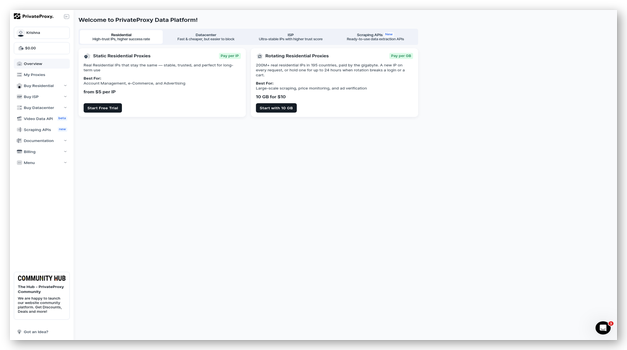
The dashboard screenshot keeps packages, locations, credentials, and billing within one account view. Rotating residential traffic supports country and city selection plus long sticky sessions. PrivateProxy suits buyers wanting low entry costs, but card requirements and renewal behavior deserve attention before any trial begins at scale.
Features:
- Static addresses: Dedicated residential addresses remain stable for long account sessions. One included monthly swap helps replace an unsuitable static assignment when necessary.
- Rotating pool: Rotating residential traffic can change every request or preserve an address temporarily. This supports both broad crawling and multi-step browser flows.
- City targeting: Country and city selection helps reproduce local pages and pricing. Premium ASN access is separate, so buyers should check targeting requirements first.
- Long sessions: Sticky options extend from short intervals through twenty-four hours. Teams can match session duration to forms, carts, or authenticated research workflows.
- Connection scale: Rotating plans allow many concurrent connections without separate thread upgrades. Application owners still need pacing controls to respect target rules.
- Protocol access: HTTP, HTTPS, and SOCKS5 options cover common browsers, crawlers, and automation tools. Static and rotating products may expose different configuration choices.
- Trial choices: Selected static residential addresses include a two-day no-charge trial with card details. Rotating residential uses paid introductory packages instead today.
Pros
Cons
👉 How to Get PrivateProxy for Free?
- Create a PrivateProxy account and choose Static Residential.
- Select the package explicitly labeled as the residential trial and add a card.
- The selected static trial is free for two days if cancelled in time; rotating trials are paid.
2-day static proxy trial
7) MarsProxies
MarsProxies offers prepaid rotating residential traffic for scraping, automation, and local market checks. Buyers can purchase a small bandwidth amount without committing to a monthly subscription. Traffic remains available until consumed, which suits irregular projects.
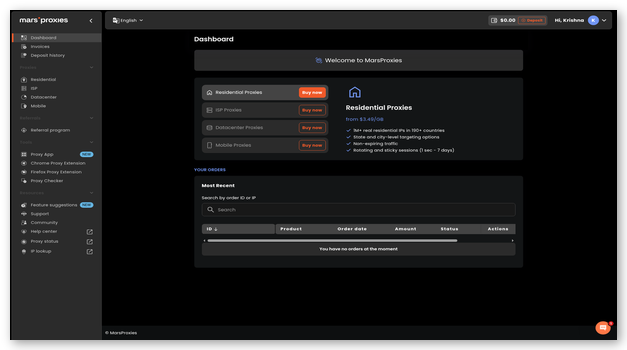
The dashboard screenshot centers on product orders, balance, and generated proxy credentials. Sessions can rotate or remain sticky, while city targeting narrows local research. MarsProxies fits budget-conscious users who can pay for initial traffic and prefer simple prepaid access over a timed trial without complex contract negotiations or sales approval.
Features:
- Prepaid traffic: Residential bandwidth uses a pay-as-you-go model without forced monthly renewal. Infrequent projects can buy traffic and consume it on their own schedule.
- No expiry: Purchased residential traffic does not expire under current terms. Seasonal researchers avoid losing unused bandwidth when collection pauses for several months.
- Session modes: Rotate addresses automatically or maintain a sticky session for continuity. The right choice depends on whether the target keeps state across pages.
- City targeting: Location controls include city-level selection within supported markets. Teams can check local pricing or advertising without buying separate country-specific products.
- Protocol support: HTTP, HTTPS, and SOCKS5 connections cover many scraping frameworks and browsers. Credentials can move between tools without rebuilding the entire workflow.
- Pool coverage: The residential network spans more than one million addresses across many locations. Availability still changes as participating devices join and leave.
- Minimum test: MarsProxies offers no free residential trial or refund. The recommended evaluation path is purchasing the smallest available one-gigabyte traffic amount.
Pros
Cons
👉 How to Get MarsProxies for Free?
- Create a MarsProxies account and open Residential Proxies.
- Purchase the smallest available one-gigabyte traffic package.
- No free plan or trial is available; the minimum paid evaluation currently starts with one gigabyte.
Paid evaluation from 1 GB
8) Novada
Novada provides residential proxies alongside a Web Unblocker and scraping services. Its location controls cover country, state, and city selection for regional data work. A shared account balance can support different testing paths after approval.
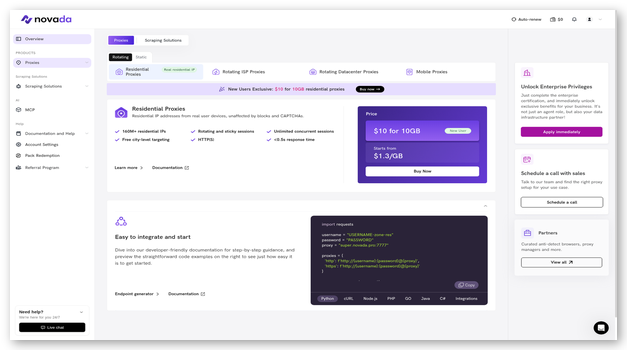
The dashboard screenshot shows products, usage, authentication, and account balance within a single workspace. Rotating sessions support broad collection, while targeted routes serve local checks. Novada fits teams willing to complete an unusual share-based promotion before receiving trial credit for the product they choose across short pilot projects and regions.
Features:
- Global routes: Residential endpoints cover many countries and subregions. Teams can request localized pages without operating physical devices in every target market.
- Geo controls: Country, state, and city filters narrow the requested exit location. Researchers should confirm address availability for small or less common markets.
- Session choice: Use rotating credentials for broad collection or sticky settings for continuous flows. Session behavior can be matched to the target's state requirements.
- Account balance: Approved trial credit appears in the account balance for eligible products. Usage reports help teams see which service consumes that credit.
- Web Unblocker: A separate unblocking product handles access barriers and CAPTCHA workflows. It can reduce custom retry logic when ordinary proxy requests fail.
- Scraping tools: Novada also offers API-based collection products for selected targets. Teams can compare managed responses against their existing proxy-led crawler architecture.
- Credit campaign: Applicants must share the campaign page three times and submit screenshots. Support then reviews the evidence before adding fifteen dollars credit.
Pros
Cons
👉 How to Get Novada for Free?
- Register with Novada and open its free-trial campaign page.
- Share the campaign to three groups or channels, then send screenshots to support.
- After approval, Novada adds $15 trial credit; the official page states no fixed duration.
$15 trial credit
9) Proxy-Sale
Proxy-Sale sells rotating residential bandwidth with location targeting and configurable session behavior. Its trial package is paid rather than free, but the small data allowance lowers initial commitment. Teams can test regional collection before buying larger monthly traffic packages.
The account dashboard image shows orders, balances, credentials, and proxy controls in a conventional account layout. Rotation intervals can change by request or remain sticky. Proxy-Sale suits users needing detailed ISP and city filters, provided a 500 MB evaluation is enough for their target checks quickly.

Features:
- Target filters: Country, state, city, and ISP controls support localized access. Teams can reproduce market-specific pages with more detail than country-only routing.
- Timed rotation: Addresses can rotate within a configured interval or remain sticky. This helps match identity behavior to a crawler, browser, or login flow.
- List creation: Users can generate large credential lists and create additional lists when needed. Structured output reduces manual copying across several collection workers.
- Authentication: Username credentials and approved-IP access support local or server deployments. Teams can choose the method that matches their infrastructure security model.
- Traffic plans: Bandwidth pricing falls as purchased volume increases. Buyers should compare total spend rather than quoting the lowest large-volume rate for small projects.
- Proxy mix: The account also covers IPv4, IPv6, ISP, and mobile products. One login can support different network requirements without separate vendor accounts.
- Paid trial: The residential evaluation costs $1.99 and includes 500 MB. The official product page does not publish a fixed trial duration.
Pros
Cons
👉 How to Get Proxy-Sale for Free?
- Open Proxy-Sale's residential proxy page and create an account.
- Choose the 500 MB trial option shown near the traffic selector.
- The paid trial costs $1.99; its official page does not state a fixed duration.
500 MB trial for $1.99
10) Proxy-Seller
Proxy-Seller provides rotating residential traffic with granular targeting and session controls. Teams can choose city and ISP filters, authorize server addresses, and generate multiple proxy lists. The platform supports small self-service purchases plus custom enterprise arrangements.
The dashboard screenshot emphasizes orders, traffic balance, locations, and connection details. Rotation and session TTL settings help match different collection patterns. Proxy-Seller fits distributed teams needing account controls and scalable volume, though its advertised entry test is paid and remains valid for thirty days across several regional research projects.

Features:
- Location depth: Country, region, city, ISP, and related filters support detailed geographic routing. Teams can separate market checks without creating many independent subscriptions.
- TTL controls: Session time-to-live settings determine how long an address remains active. This helps preserve identity during forms while allowing scheduled rotation afterward.
- IP authorization: Accounts can approve server addresses for proxy access. Credential controls reduce the risk of exposing reusable usernames inside shared automation code.
- Proxy lists: Generate multiple endpoint lists for workers, projects, or departments. Clear separation makes usage troubleshooting easier when several teams share one account.
- Team scale: Enterprise plans add unlimited seats, premium support, and custom configurations. Smaller buyers can begin with self-service bandwidth before negotiating larger commitments.
- Compliance claims: The provider publishes GDPR, CCPA, and ISO-related sourcing statements. Regulated buyers should still review current contractual evidence for their own obligations.
- Evaluation routes: A small paid residential package remains valid for thirty days. Enterprise prospects can request a proof of concept scoped by the sales team.
Pros
Cons
👉 How to Get Proxy-Seller for Free?
- Create a Proxy-Seller account and open Residential Proxies.
- Select the smallest Test It Out traffic package or request an enterprise POC.
- The paid test starts at $3.50 per GB and remains valid for thirty days.
30-day paid test from $3.50 per GB
11) Soax
Soax now combines residential and mobile traffic within a package-based control system. Teams can define authentication, routing rules, traffic caps, and allowed destinations for each project. Location selection reaches city, ISP, and ASN detail on eligible plans.
The account dashboard image reflects an earlier interface, while current accounts may show the rebuilt platform. Stateful sessions can persist as named objects and rotate under defined rules. Soax suits organizations that need delegated access and usage controls, but new users receive no free traffic credits during setup.

Features:
- Proxy packages: Each package receives separate credentials, routing rules, access limits, and usage tracking. Teams can isolate projects without maintaining entirely separate accounts.
- Stateful sessions: Named sessions remain configured until deleted and can be paused or rotated. They support repeatable automation without rebuilding connection strings each run.
- Geo tiers: Traffic pricing varies by exit-country tier under current plans. Buyers should model target locations because the same data volume can cost differently.
- Targeting rules: Country, region, city, ISP, and ASN filters are available according to plan. Exact routing rules can be stored inside a package.
- Traffic insight: Dashboard records show how credits were consumed and why requests failed. This helps separate network issues from routing or target-policy problems.
- Access controls: Package owners can cap traffic, restrict protocols, and allow or block domains. These guardrails reduce accidental spending across shared teams.
- Sandbox account: The free Sandbox has no subscription fee and includes zero credits. Users must purchase top-up credits before sending residential traffic.
Pros
Cons
👉 How to Get Soax for Free?
- Create a Soax account and select the Sandbox plan.
- Configure a proxy package with authentication, routing, and spending controls.
- Sandbox has no subscription fee but includes zero credits, so residential traffic requires a paid top-up.
Sandbox account available
12) HydraProxy
HydraProxy sells non-recurring residential bandwidth for scraping and regional access. Customers can order a small traffic amount, rotate addresses automatically, or hold a sticky session. Purchased data remains available without a monthly subscription requirement.
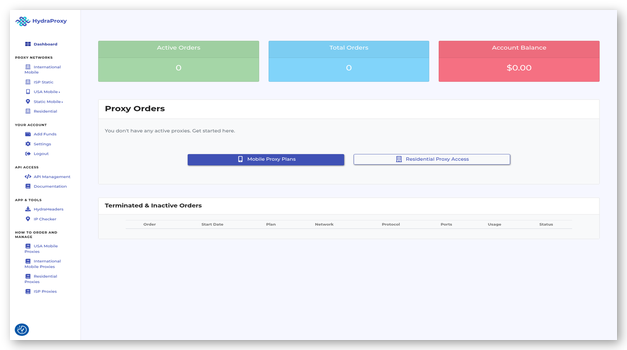
The dashboard screenshot groups orders, traffic balance, and endpoint setup in a compact view. Unlimited concurrency supports parallel workers, while country routing covers broad geographic checks. HydraProxy fits occasional projects that prefer prepaid traffic, though the service does not advertise a free residential trial for intermittent research with changing regional needs.
Features:
- No subscription: Residential traffic is purchased without a recurring monthly commitment. Buyers can add bandwidth when a project resumes instead of maintaining an idle plan.
- Sticky sessions: Keep an address for roughly thirty to sixty minutes where available. This supports forms and short authenticated flows that need continuity.
- Random rotation: Request a different residential address for broad collection jobs. Rotating identities can distribute traffic when a stable login is unnecessary.
- Country routes: Select from supported countries for localized page access. The service does not emphasize the same city-level depth as some larger providers.
- Concurrency: Residential plans allow many simultaneous connections without separate thread packages. Operators should still pace requests to protect targets and control bandwidth.
- Traffic retention: Purchased bandwidth remains available until used under current product terms. Irregular projects avoid losing data merely because a month ends.
- Entry purchase: HydraProxy does not publish a free trial for residential proxies. The smallest listed tier begins with one gigabyte of non-recurring traffic.
Pros
Cons
👉 How to Get HydraProxy for Free?
- Create a HydraProxy account and open Residential Proxies.
- Purchase the smallest one-gigabyte non-recurring traffic package.
- No free plan or trial is listed; entry residential access starts with a paid one-gigabyte package.
Paid access from 1 GB
13) Proxy-Cheap
Proxy-Cheap covers rotating residential, static ISP, mobile, and datacenter products through one account. Rotating traffic uses prepaid bandwidth, while static residential addresses support long sessions. The trial offer applies to static residential rather than rotating access.
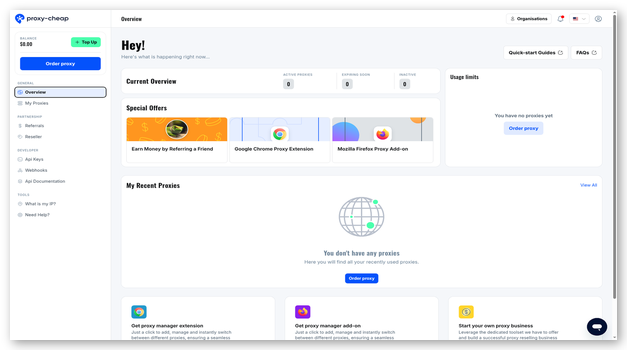
The dashboard screenshot places products, orders, generated credentials, and usage within a direct navigation structure. HTTP and SOCKS5 support common tools, and country or ISP filters guide static selection. Proxy-Cheap suits budget-focused buyers who understand which proxy type their paid trial actually covers before purchasing larger rotating traffic balances.
Features:
- Product range: One account includes rotating residential, static ISP, mobile, and datacenter options. Teams can match network type to different automation or research tasks.
- Static sessions: Static residential addresses remain consistent throughout the purchased term. They fit account access and workflows that cannot tolerate frequent identity changes.
- Rotating traffic: Pay-as-you-go residential bandwidth supplies changing household addresses. Users can start small without committing to a recurring rotating-proxy subscription or contract.
- Protocol support: Static residential plans support HTTP and SOCKS5 connections. Common browser extensions and automation libraries can connect without specialized transport code.
- Location choice: Country and ISP options appear during static purchase when inventory permits. Buyers should contact support when one exact carrier is essential.
- Thread capacity: Static plans advertise more than one hundred concurrent threads. Teams still need target-aware pacing because connection capacity does not grant collection permission.
- Paid trial: The seven-day $1.99 trial covers static residential IPv4. Rotating residential products offer pay-as-you-go access instead of free sample traffic today.
Pros
Cons
👉 How to Get Proxy-Cheap for Free?
- Create a Proxy-Cheap account and open Static Residential Proxies.
- Choose the Basic trial option and complete the $1.99 payment.
- The paid trial lasts seven days; rotating residential access has no free test allowance.
7-day trial for $1.99
Feature Comparison Table of Top Residential Proxy Server
How Did We Choose Best Residential Proxy Providers?

At Guru99, we are dedicated to delivering credible, accurate, and relevant information through rigorous content creation and review. After over 65 hours of research, I have reviewed 22 of the best free residential proxy services to provide you with trusted options. This guide covers both free and paid tools, offering detailed insights into features, pros and cons, and pricing. With so many proxy service providers available, finding the right one can be challenging. While there is no fixed rule for choosing a proxy, here are a few key points to consider when selecting a service.
- Range of IPs Offered: This includes the number of IP addresses you will be able to get from your proxy service provider for a specific price.
- Network Speed and Success Rate: You need to select a proxy server that has a reliable status with at least or around a 90% success rate.
- Ease of Integration: You need to select a proxy that provides easy integration.
- Server Location Variety: A wider range of server locations will give you more flexibility for accessing content across different regions.
- Reliability of Services: You need to select a proxy service that is ready to entertain your requests and satisfy your queries and be ready to help when you face any difficulty.
- Security Features: Check for encryption, IP leak protection, and no-log policies. Strong security features are crucial if you’re prioritizing anonymity and data protection.
- Pricing: Consider pricing plans and ensure they align with your budget. Some services offer free trials, which can help you test the service before committing.
- Customer Support: Reliable customer support is vital for resolving any issues quickly. Choose a provider with responsive, 24/7 support.
What is a residential proxy server, and how does it work?
A residential proxy sends an application's requests through an address assigned by an internet service provider to a household connection. The destination sees that exit address instead of the user's original one. A provider normally exposes a gateway, credentials, and location parameters. Rotating services choose another peer for each request or interval. Sticky sessions retain one address temporarily. This setup helps with public-data collection, regional page checks, and advertising verification. It does not encrypt every device connection like a VPN, and it does not grant permission to ignore website rules.
Are free residential proxies safe to use?
Free access can support controlled evaluation, but public residential proxy lists carry serious risk. These checks reduce avoidable exposure before any connection enters a browser, script, or shared automation environment.
- Provider identity: Choose a named company with clear ownership, support contacts, and acceptable-use terms.
- Traffic protection: Avoid passwords, financial records, private URLs, and confidential data during evaluation.
- Source consent: Check how residential addresses enter the network and whether participants knowingly opt in.
- Access limits: Confirm bandwidth, card, renewal, cancellation, and automatic conversion terms before connecting.
How do free trials differ from permanent free proxy plans?
A free trial expires after a set period or limited traffic allowance. Some trials require a card and activate a paid plan unless cancelled. Signup credits behave differently because they are one-time balances. A permanent free plan renews its allowance, but it may supply datacenter rather than residential addresses. Paid test packs also appear in free-proxy comparisons because their entry cost is small, yet they are not free. Readers should check proxy type, data limit, expiry, renewal, and payment requirements. These details reveal whether the offer supports ongoing work or only an initial compatibility test.
Should you choose rotating or static residential proxies?
Rotating residential proxies suit broad crawling, price monitoring, and jobs where each request can use another address. Rotation spreads traffic but may break carts, logins, or forms that expect one identity. Static residential or ISP proxies keep one address for longer periods, which suits account access and persistent sessions. Sticky rotating sessions sit between those models by retaining an address temporarily. Choose according to workflow state, not labels alone. Test session duration, replacement behavior, and location consistency against representative targets before production, because residential peers can disconnect even when a long session is requested.
What features matter most in residential proxy services?
Begin with the target, location depth, and session requirements. Large advertised pools matter less when the service cannot maintain the required route, protocol, or billing control during work.
- Targeting: Country, city, ZIP, ISP, and ASN filters determine whether the required market is available.
- Session behavior: Rotation rules and sticky durations should match crawlers, logins, carts, and stateful tasks.
- Protocols: HTTP, HTTPS, and SOCKS5 support determines compatibility with browsers, crawlers, and application frameworks.
- Cost controls: Dashboards, caps, alerts, and renewal terms reduce surprise charges during parallel residential traffic.
- Sourcing: Published consent and supplier policies explain how household addresses join the network.
How do residential proxies connect with scraping and automation tools?
Most services provide a gateway hostname, port, username, and password. The username often contains location and session parameters. A crawler sends HTTP or SOCKS traffic through that gateway, while the provider chooses an exit address. IP whitelisting can replace embedded credentials on approved servers. APIs may generate lists, update access rules, or report usage. Browser extensions simplify manual checks, but production workflows usually store credentials in a secrets manager. Teams should log response codes, retries, exit locations, and bandwidth consumption so failures can be traced without recording sensitive page content unnecessarily.
How can AI improve residential proxy workflows?
AI can classify failed requests, suggest location rules, summarize usage logs, and generate connection examples for common programming languages. An agent can also compare response patterns across markets or flag unexpected location drift. These capabilities reduce repetitive investigation, but they do not make a blocked request lawful or accurate. Models can misread error pages as real content and may expose credentials if prompts include secrets. Keep authentication outside the model context, validate extracted records against source pages, and require human approval before changing rotation, concurrency, or target scope in production workflows.
How should you test a residential proxy free trial?
Start with a small set of representative public pages rather than an unrestricted crawler. Verify the exit country, city, and ISP independently. Measure successful responses, latency, transferred bandwidth, repeated addresses, and session continuity. Test both rotation and sticky behavior when the workflow needs them. Record whether a card is required, when access expires, and what renews automatically. Avoid using personal accounts or sensitive credentials during evaluation. A useful trial confirms target compatibility and cost behavior under controlled load. It cannot prove performance for every website, country, or future peer in a changing residential pool.
Are residential proxies legal and ethically sourced?
Residential proxies can support lawful research, testing, and public-data collection. The network type does not decide legality by itself. Purpose, access method, consent, contracts, jurisdiction, and data handling affect the answer.
- Lawful purpose: Collect only data you may lawfully access and process for a defined purpose.
- Website terms: Review terms, robots guidance, account restrictions, and rate limits before automating requests.
- Participant consent: Prefer networks explaining how device owners opt in and leave the pool.
- Personal data: Minimize collection and secure records containing information tied to identifiable people.
- Qualified advice: Seek legal guidance for sensitive datasets, authentication, or projects spanning regions.
How do residential proxy costs change as projects scale?
Residential traffic is usually billed by transferred gigabytes, so rendered pages, images, retries, and large responses increase cost. A low per-gigabyte figure may require a large monthly commitment. Geo tiers, premium pools, session controls, and failed requests can also change effective spend. Calculate representative page weight and expected success rate before choosing a plan. Add bandwidth caps, worker limits, and alerts. Compare pay-as-you-go traffic with subscriptions using the same target mix. At higher volumes, negotiated pricing may help, but infrastructure quality and failure rates often matter more than the headline discount.
What Problems Cause Residential Proxies to Fail, and How Can They Be Fixed?
Residential proxy failures usually come from location drift, session changes, target defenses, authentication, or unexpected bandwidth consumption. Each fix should address the observed cause instead of increasing retries blindly.
- Issue: The requested city repeatedly returns addresses registered in a neighboring region.
Solution: The operator should verify exit locations independently, broaden targeting carefully, and report persistent mismatches to provider support. - Issue: Sticky sessions change addresses before a login or checkout flow finishes.
Solution: The team should shorten the workflow, reuse one session identifier, and confirm the provider's maximum retention behavior. - Issue: Requests receive CAPTCHAs or access denials despite regular address rotation.
Solution: The developer should reduce request frequency, preserve normal headers, and confirm that automated access follows the target's rules. - Issue: Trial bandwidth disappears much faster than the crawler's page count suggests.
Solution: The owner should disable unnecessary images, inspect response sizes, and count retries because billing includes transferred data. - Issue: Proxy credentials work locally but fail from a cloud server deployment.
Solution: The administrator should check IP authorization, firewall egress, protocol support, and whether credentials contain location formatting errors. - Issue: A free plan connects successfully but cannot reproduce residential user behavior.
Solution: The buyer should confirm the proxy type because many permanent free plans provide shared datacenter addresses instead.
What trends will shape residential proxy services next?
Residential proxy platforms are adding stronger consent records, traffic controls, and automated verification as scrutiny of network sourcing increases. Package-level policies will give teams finer limits by project, destination, and user. HTTP3 support may improve transport efficiency for compatible workflows, while AI agents will request current public pages through controlled proxy tools. Providers will also expose clearer failure reasons and location evidence. The useful trend is greater observability: buyers need proof of exit location, consent practices, bandwidth consumption, and renewal behavior. Larger pool claims alone will carry less decision value without that supporting detail.
Verdict
I reviewed access terms, targeting depth, session controls, and setup demands. Three providers offered the clearest starting points for different residential proxy buyers.
- Oxylabs: I favored its documented sourcing, detailed targeting, and several evaluation routes for compliance-focused teams.
- Webshare: My review placed it first for permanent free integration testing, provided readers understand the allowance uses datacenter addresses.
- Decodo: I selected its three-day residential trial for beginners needing precise targeting, familiar protocols, and clear dashboard controls.
