
7 Best Free Business Email Accounts (2026)
 Editorial Team
Disclosure: Guru99 is reader-supported. We may earn a commission when you buy through links on this page. Learn more

Business email tools promise professionalism, yet poor spam control, unreliable delivery, cramped storage, confusing interfaces, hidden trial limits, and inconsistent mobile access can waste hours. A missed renewal or DNS record may block customer replies and weaken trust. Several important differences remain buried beneath the word free. Comparing domain support, security, storage, protocols, and cancellation terms helps teams pick an address they can keep.
I spent 54+ hours researching 23+ email tools, checking free access, domain support, storage, authentication, administration, mobile use, migration, and recurring user concerns. My research shortlisted 8 Best Free Business Email Accounts. This guide compares features, pros, cons, and plan limits, so you can tell permanent mailboxes from trials and sending services. Read more…

Zoho Mail is a secure email hosting service provider. It easy to manage group aliases, add users, and set up policies to moderate email content. It is one of the most top-rated tools for business email.
Best Free Business Email Address for Company: Free/Paid
| Email Provider | Key Features | Free Trial / Guarantee | Link |
|---|---|---|---|
 👍 Zoho Mail |
100 GB, Secure hosting, CRM integration, and Task management | 15-day free trial | Learn More |
 👍 Proton Mail |
5 GB, End-to-end encryption, Admin controls, Privacy law compliance | 30-day money-back guarantee | Learn More |
 👍 Gmail |
30 GB, Google Workspace integration, Phishing protection, Smart replies | 14-day free trial | Learn More |
 SMTP |
50,000 emails/mo, Email API & SMTP relay, IP warm-up, and List verification | Plans start at $25/mo | Learn More |
 Campaigner |
1 GB, Advanced email automation, Analytics and reporting | 30-day free trial | Learn More |
 Hubspot |
2,000 emails/mo, Email performance analytics, Integration with HubSpot CRM | Free Forever | Learn More |
1) Zoho Mail
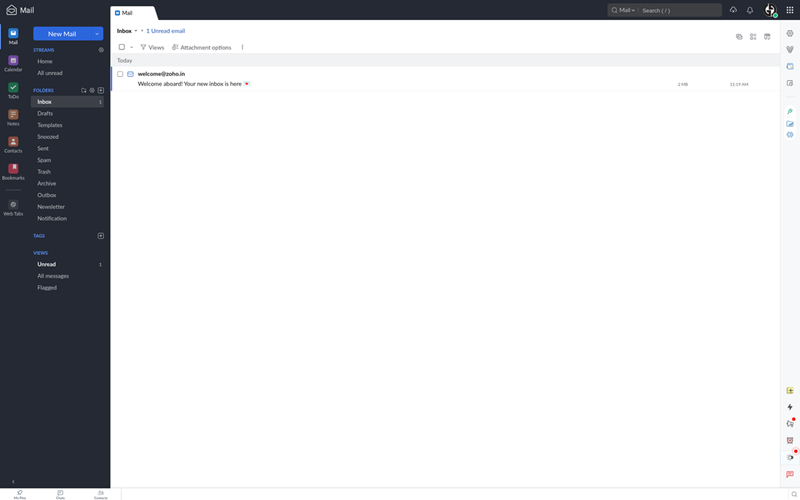
Zoho Mail gives eligible small teams custom-domain email without advertisements. Its free plan supports one domain, up to five users, and 5 GB per user. Administrators can create addresses, apply policies, and manage accounts from one console.
The free tier is available only in selected data centers. It also excludes IMAP, POP, and ActiveSync access. Browser and mobile apps remain available, making Zoho strongest for teams comfortable inside its own interface rather than third-party mail clients. Teams should test outside delivery before replacing an existing provider.
Features:
- Custom Domain: Eligible free accounts can host one business domain for five users, helping small teams replace provider-branded addresses with consistent company email.
- Admin Console: Administrators can add users, create aliases, reset passwords, and apply organization policies from one interface without managing a separate mail server.
- Ad-Free Inbox: Zoho removes advertising from business mailboxes, keeping the reading experience focused and avoiding promotional targeting inside company conversations.
- Mobile Apps: Dedicated Android and iOS applications support messages, calendars, contacts, and notifications when employees work away from their desks.
- Migration Tools: Built-in migration options move email from supported providers through IMAP or administrative methods, reducing manual forwarding during an account change.
- Security Controls: Two-factor authentication, spam filtering, and domain authentication settings help administrators protect accounts and improve legitimate message delivery across receiving providers.
- Plan Limits: The free tier omits IMAP, POP, and ActiveSync, so users cannot connect common desktop clients through those protocols.
Pros
Cons
How to Get It Free?
- Go to the Zoho Mail website, choose the free plan when it appears for your region, and create the organization administrator account without entering payment information.
- Add a domain you own, copy the verification record into its DNS settings, and wait until Zoho confirms ownership before creating employee mailboxes.
- Create up to five users, publish the recommended SPF and DKIM records, then send test messages to several outside providers before moving daily conversations.
Free plan: 5 users with 5 GB each
2) Proton Mail
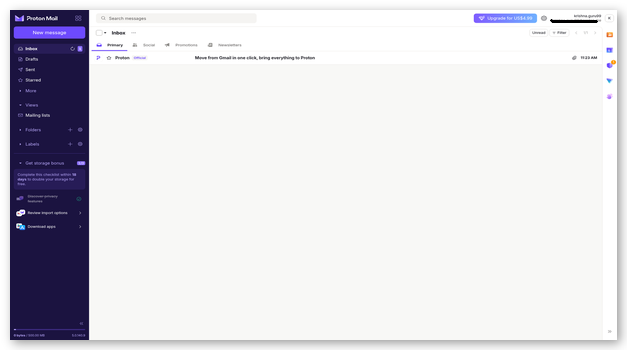
Proton Mail provides a private personal inbox with end-to-end and zero-access encryption. The free account starts with 500 MB and can reach 1 GB after onboarding tasks. Its apps are ad-free and supported across major devices.
A company domain requires a paid business plan, available through a 14-day trial. Business accounts add administration, more storage, aliases, and domain controls. Proton suits privacy-focused teams, but its free personal address is not a permanent custom-domain business mailbox. Teams should confirm migration and recovery workflows before committing sensitive archives.
Features:
- Encrypted Mail: Messages between Proton users receive end-to-end encryption, while zero-access encryption protects stored mailbox content from routine provider access at rest.
- Free Inbox: The free personal plan starts with 500 MB and can reach 1 GB after users complete the listed account setup actions.
- Custom Domains: Business plans connect company domains and include administrative controls, but the permanent free personal tier cannot host a custom domain.
- Secure Links: Password-protected encrypted messages can reach outside recipients through secure links, providing added privacy when contacts use another email provider.
- Device Apps: Web, desktop, Android, and iOS applications keep encrypted mail available across common devices without placing advertisements inside the daily inbox.
- Alias Controls: Eligible plans create extra addresses and hide-my-email aliases, helping users separate registrations, departments, and public contact points while reducing address exposure.
- Bridge Access: Proton Mail Bridge connects supported desktop clients through IMAP and SMTP, but this feature requires a paid subscription for access.
Pros
Cons
How to Get It Free?
- Go to the Proton Mail website and create the permanent free personal account if a provider-branded address meets your immediate needs. Save the recovery phrase and enable two-factor authentication immediately.
- Complete the displayed onboarding checklist within the allowed period to expand mail storage from 500 MB to 1 GB without purchasing a subscription.
- For company-domain testing, start the 14-day business trial, verify your domain, configure SPF, DKIM, and DMARC, then evaluate administration before billing begins.
👉 Grab up to 60% OFF Proton Mail during its Black Friday sale
Free personal plan / 14-day business trial
3) Gmail
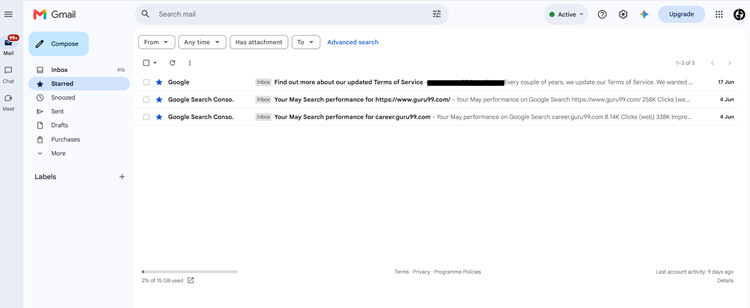
Gmail provides a familiar free personal inbox with 15 GB shared across Gmail, Drive, and Photos. Search, spam filtering, labels, and mobile apps make daily communication approachable. The free address always uses Google’s domain.
Google Workspace adds custom-domain email, administration, collaboration, and pooled business storage. Its 14-day trial supports up to ten users and requires billing details. Gmail fits teams already using Google tools, although permanent business-domain hosting is not included for free. Administrators should test retention, export, and full account recovery during the trial.
Features:
- Spam Filtering: Automated filters block common phishing, malware, and junk messages before they reach the inbox, though users should still inspect suspicious requests.
- Fast Search: Operators, labels, dates, senders, and attachment types help users find older conversations without maintaining complicated folder structures across large inboxes.
- Shared Storage: A free Google account includes 15 GB shared among Gmail, Drive, and Photos, so large files elsewhere reduce mailbox capacity.
- Workspace Trial: The 14-day Google Workspace trial adds custom-domain mail, administration, and collaboration for up to ten users after billing setup begins.
- Mobile Access: Android and iOS applications provide offline reading, multiple-account support, notifications, and integrated calendar and meeting tools for work on the move.
- Domain Security: Workspace administrators can publish SPF, DKIM, and DMARC records, monitor authentication, and reduce spoofing against company domains across receiving services.
- AI Assistance: Eligible plans provide Gemini features for drafting, summarizing, and searching, while administrators control availability and organizational data settings for business accounts.
Pros
Cons
How to Get It Free?
- Go to Gmail and create a free Google account when a provider-branded address is acceptable for the present workload. Choose a durable address because renaming options remain limited.
- Review storage usage across Gmail, Drive, and Photos, enable two-step verification, and test recovery options before using the account for important communication.
- To test custom-domain mail, start the 14-day Workspace trial, add billing details, verify the domain, and create up to ten trial users.
Free personal account / 14-day Workspace trial
4) SMTP
SMTP.com is an email delivery service, not a hosted employee inbox. Applications and websites send transactional or bulk messages through its SMTP relay or API. Reporting tools track deliveries, bounces, and engagement for operational monitoring.
SMTP.com has no free plan or trial; the Essential plan costs $25 a month for 50,000 emails. It fits system-generated mail better than staff conversations, shared calendars, or custom-domain inbox hosting. Start with noncritical traffic and a controlled sender domain.
Features:
- SMTP Relay: Applications authenticate with the relay and send messages without operating their own mail-transfer infrastructure, queues, or delivery monitoring systems internally.
- REST API: Developers can connect supported applications through an API when programmatic sending and structured delivery responses best suit the product workflow.
- Delivery Reports: Dashboards report accepted, delivered, bounced, and engagement events, helping operators identify list problems, failed application messages, and broader delivery trends.
- Domain Authentication: SPF and DKIM configuration helps receiving providers verify approved senders and reduces unauthorized use of the company sending domain.
- Shared IP: Entry plans may send through shared infrastructure, while higher tiers provide dedicated IP options for organizations needing greater reputation control.
- Reputation Tools: Optional monitoring and list-quality features can identify risky addresses before sending, but Reputation Defender adds 20% to the plan cost.
- Support Access: Plan-specific support assists with setup and delivery problems, although response options, onboarding depth, and response speed vary by subscription level.
Pros
Cons
How to Get It Free?
- Go to the SMTP.com pricing page and choose a plan; Essential covers 50,000 emails a month for $25.
- Authenticate a test domain with SPF and DKIM, then connect one noncritical application using your SMTP.com relay credentials. Keep production traffic on the existing provider meanwhile.
- Send only a small permission-based test list, review bounces and delivery reports, and cancel before renewal if the service does not match requirements. Remove unused credentials after the evaluation ends.
Plans from $25/month
5) Hostinger
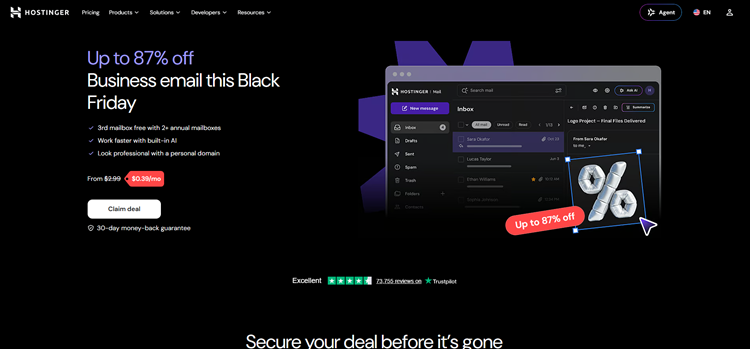
Hostinger supplies custom-domain mailboxes through eligible hosting or email purchases. A hosting-linked Business Email trial can last one month, three months, or one year, depending on the hosting billing period. Hosting-linked trial mailboxes include 1 GB of storage each.
Some eligible domain purchases may receive a separate 30-day Business Starter trial. Hostinger no longer offers its older permanent free email plan to new customers. The service works best for businesses already buying hosting, not users seeking independent free mail forever. Teams should record renewal pricing before connecting important public addresses permanently.
Features:
- Custom Domain: Mailboxes use a domain the business controls, creating consistent addresses for employees, departments, sales, and customer support across customer channels.
- Hosting Trial: Eligible hosting plans include an email trial whose duration follows the chosen monthly, quarterly, annual, or longer hosting billing period.
- Domain Trial: Selected domain purchases may include a 30-day Business Starter trial with one mailbox and more storage than hosting-linked trial mailboxes.
- Webmail Access: Browser mail supports everyday reading, folders, contacts, and settings without installing a separate desktop application.
- Migration Tools: Supported migration processes move existing messages and folders into Hostinger mailboxes, reducing disruption when a business changes its email provider.
- Authentication: DNS guidance covers SPF, DKIM, and related records that receiving services use to validate legitimate company messages and reduce spoofing.
- Refund Window: Eligible new purchases include a 30-day money-back guarantee, which remains separate from any free email trial conditions or subscription commitment.
Pros
Cons
How to Get It Free?
- Go to the Hostinger website and check that the selected hosting or domain purchase includes an email trial before completing checkout.
- Activate the included mailbox from the hosting panel, connect the chosen domain, and publish the recommended authentication records in the DNS zone. Wait for full verification before testing outside delivery.
- Test webmail, outside delivery, spam placement, and migration during the stated trial period, then cancel or upgrade before paid email renewal begins. Export all important messages before making either decision.
Email trial with eligible purchase
6) Godaddy
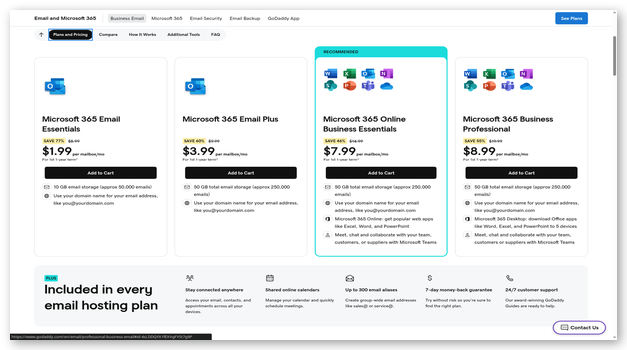
GoDaddy sells professional custom-domain email rather than a permanent free mailbox. Customers who buy a new domain and use GoDaddy Airo get a 30-day Professional Email trial. Certain GoDaddy hosting plans include a free year of Professional Email instead.
Current offers can include webmail, calendars, contacts, and mobile access. Some products use Microsoft 365, while migrated Professional Email accounts may use Titan technology. Paid Professional Email starts at $6 a month once the trial ends.
Features:
- Custom Domain: Professional addresses use a domain the business owns, creating recognizable contact points for staff, departments, invoices, and customer support channels.
- Airo Trial: Customers who buy a new domain and use GoDaddy Airo get a 30-day Professional Email trial.
- Webmail Tools: Browser access supports messages, folders, contacts, calendars, and common productivity controls without requiring local server administration.
- Mobile Access: Supported plans work on phones and tablets, helping employees read and send company messages reliably while away from office computers.
- Mailbox Security: Spam filtering and authentication guidance reduce common threats, though administrators must still protect accounts with strong sign-in controls and recovery methods.
- Platform Variants: GoDaddy email may use Microsoft 365 or Professional Email technology, so exact features and interfaces depend on the purchased product.
- Migration Support: Migration options help move existing mail into the new mailbox.
Pros
Cons
How to Get It Free?
- Go to the GoDaddy website, buy a new domain, and start the 30-day Professional Email trial through GoDaddy Airo.
- Choose the business domain, activate the trial mailbox, and record its storage, included applications, renewal price, and final cancellation date before proceeding.
- Publish the authentication records GoDaddy shows, test messages with outside providers, and cancel before renewal if the mailbox or underlying platform does not fit. Export trial messages before closing the account.
30-day email trial with a new domain
7) Outlook
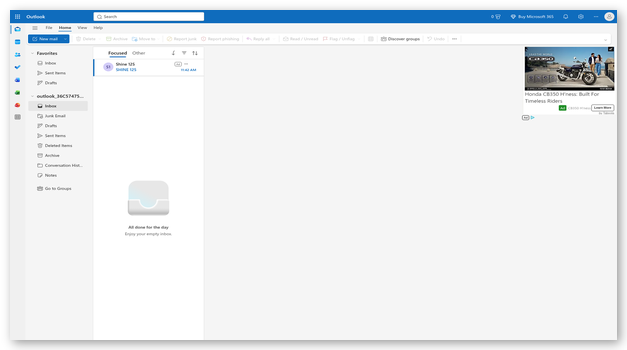
Outlook.com provides a free personal inbox with 15 GB of mailbox storage and 5 GB of cloud storage. Its web and mobile apps combine email, calendars, contacts, spam filtering, and Microsoft account services.
A company domain requires a Microsoft 365 business subscription. Eligible business plans provide a 30-day trial with custom-domain mail and administration. Outlook suits organizations centered on Microsoft tools, although the free consumer account cannot serve as permanent domain-branded business email. Teams should test all desktop clients, recovery, and exports before final trial expiration.
Features:
- Free Inbox: Outlook.com includes a 15 GB consumer mailbox and 5 GB of cloud storage without providing custom-domain hosting.
- Focused Inbox: Automatic sorting separates higher-priority conversations from other mail, while users can correct classifications through feedback when important senders appear elsewhere.
- Calendar Tools: Integrated calendars schedule appointments, meetings, reminders, and availability without moving between unrelated applications or copying event details manually during planning.
- Business Trial: Eligible Microsoft 365 business plans provide 30 days to test custom-domain email, administration, and supported productivity applications.
- Mobile Apps: Outlook applications for major platforms combine several email accounts, calendars, contacts, search, and notifications inside one interface for daily work.
- Security Controls: Microsoft filtering blocks common spam and malware, while business administrators gain stronger identity, policy, and compliance options by plan tier.
- Microsoft Integration: Business subscriptions connect Outlook with Teams, OneDrive, and Office applications, so shared files and meetings sit beside email.
Pros
Cons
How to Get It Free?
- Go to Outlook.com and create a free Microsoft account if a provider-branded address is enough for your business communication.
- Enable multifactor authentication, review mailbox and cloud quotas, then test calendar invitations and recovery methods before relying on the address publicly.
- For company-domain evaluation, start an eligible 30-day Microsoft 365 business trial, verify ownership, create trial users, and check the renewal date.
Free personal account / 30-day business trial
Comparison Table: Free Business Email Account
Here is a comparison table to help you get a quick glance at all the key features of the above free email account providers:
| Feature | Zoho Mail | Proton Mail | Gmail | Hostinger |
| Best For | Small businesses, professionals | Privacy, security, journalists | General use, business | Small businesses, cost-conscious users |
| Pricing | Free for up to 5 users; paid from $1/user/mo | Free plan; business from $6.99/user/mo | Free; Workspace after 14-day trial | Starter from $0.39/mailbox/mo (48-month plan) |
| Free Trial | 15-Day Free Trial | 14-Day Free Trial (business) + 30-Day Money-back Guarantee | 14-Day Free Trial | 30-Days Money-Back Guarantee |
| Mailbox Size | 5 GB per user | 1 GB (free); 15 GB (business) | 15 GB (shared with Drive and Photos) | 5 GB (Business Starter) |
| Attachment Size Limit | 30 MB (Mail Lite) | 25 MB | 25 MB | 25 MB |
| Email Alias | ✔️ | ✔️ | ✔️ | ✔️ |
| Scheduled Emails | ✔️ | ✔️ | ✔️ | ❌ |
| End-to-End Encryption | Optional (S/MIME, OpenPGP) | ✔️ | ❌ | ✔️ |
| Self-Destructing Emails | ❌ | ✔️ | ❌ | ❌ |
What Is a Free Business Email Account?
A free business email account supports work communication without an immediate subscription. Some services provide a provider-branded address, while fewer allow a company domain. Others only offer short trials or limited campaign testing. A proper business mailbox receives replies, stores conversations, and supports calendars or contacts. Marketing platforms and SMTP relays serve different jobs. Readers should verify domain ownership, storage, user limits, protocols, security records, renewal terms, and export options before publishing a new address to customers.
Can a Free Email Account Use Your Company Domain?
Yes, but permanent free custom-domain hosting is uncommon and sometimes region-limited. A company must already own the domain and control its DNS records. The provider then asks for verification before creating mailboxes. SPF, DKIM, and DMARC should follow immediately to protect delivery and reduce spoofing. Free personal accounts from major providers normally keep their own domain. Business trials may temporarily unlock custom addresses, but the mailbox stops or becomes paid after the trial ends. Plan the exit before activating any trial.
What Is the Difference Between a Mailbox and an Email Delivery Service?
A mailbox provider stores messages employees read, reply to, and organize. It often includes calendars, contacts, search, and mobile applications. An email delivery service sends automated receipts, password resets, alerts, or bulk messages from software. Marketing platforms manage subscriber campaigns, templates, segmentation, and unsubscribe controls. These categories can overlap, but they are not interchangeable. A sales team needs hosted inboxes for conversations, while an application may need an SMTP relay. Many businesses use both services together within one business stack.
Which Limits Matter Most in Free Business Email Plans?
Free email limits affect daily work long before a plan expires.
- Domain Access: Confirm whether company-domain hosting remains free or appears only during a temporary business trial.
- Mailbox Storage: Measure current attachments and yearly growth because small quotas can block new messages unexpectedly.
- User Count: Check whether aliases, shared addresses, and former employees consume separate paid licenses.
- Client Protocols: Verify IMAP, POP, SMTP, and mobile synchronization before choosing a preferred desktop application.
- Sending Limits: Review daily recipients, attachment sizes, automation restrictions, and anti-abuse policies for normal workloads.
Export and cancellation rules also matter before an address becomes public.
How Do SPF, DKIM, and DMARC Protect Business Email?
SPF lists servers allowed to send for a domain. DKIM adds a cryptographic signature that receiving systems can verify. DMARC tells receivers how to handle messages failing those checks and sends useful reports. Together, they reduce spoofing and improve legitimate delivery. They do not stop every phishing attempt or repair a poor mailing list. Administrators should publish records carefully, monitor reports, and tighten policies gradually. Incorrect DNS values can block valid messages, so test delivery to several outside providers after every change.
How Do IMAP, POP3, and SMTP Differ?
IMAP synchronizes messages and folders across devices while keeping mail on the server. POP3 mainly downloads messages and offers weaker multi-device coordination. SMTP sends outgoing mail from clients, applications, or servers. A webmail-only free plan may omit all three external protocols. That restriction matters when employees prefer Outlook, Apple Mail, Thunderbird, or another client. Before migrating, confirm protocol access, ports, encryption requirements, authentication methods, and whether two-factor security needs a separate application password.
Can AI Help Manage a Business Inbox Safely?
AI can draft replies, summarize threads, suggest searches, classify messages, and detect suspicious patterns. These features save time when users review every result. Sensitive contracts, customer details, and internal plans may still reach provider systems during processing. Administrators should read retention and model-training terms, limit access by role, and disable unnecessary assistants. Employees need clear review rules because generated replies can invent facts or promise unavailable services. Human approval remains necessary before important business messages leave the organization.
How Should a Small Team Migrate Business Email?
A careful migration protects messages, contacts, calendars, and customer replies.
- Inventory: Record every mailbox, alias, group, forwarding rule, device, protocol, and retention requirement.
- Prepare DNS: Lower DNS timing values, verify the domain, and configure authentication before changing mail delivery.
- Pilot: Migrate one low-risk mailbox and test old messages, folders, calendars, contacts, and outside delivery.
- Move: Transfer remaining accounts in batches while keeping the former service active during validation.
- Confirm: Test inbound and outbound mail, update applications, then preserve exports before canceling anything.
Keep both systems available until every important address passes signed-out testing.
What Happens When a Free Email Account Becomes Inactive?
Inactive-account rules differ by provider and can change over time. A service may suspend sign-in, reclaim an address, remove stored messages, or restrict recovery after warnings. Business trials can stop sending or convert to paid service when billing begins. Keep recovery details current and sign in regularly. Export important messages, contacts, and calendars before any deadline. Company domains provide better portability because the organization can move the same public addresses to another provider when a free account closes.
How Do We Select the Best Free Business Email Accounts?
Guru99 reviews current plans, official support material, and recurring user feedback to separate lasting free mailboxes from short trials, narrow test accounts, and unrelated delivery products.
- Free Access: We check whether an account remains free, needs billing information, restricts regions, or converts after a trial. We label consumer inboxes, business mailboxes, marketing systems, and relays separately.
- Domain Support: We check domain verification, aliases, user limits, DNS control, and portability. We favor services that explain ownership and let businesses keep public addresses during future migration.
- Delivery Security: We review SPF, DKIM, DMARC, encryption, spam filtering, multifactor authentication, and account recovery. We also check whether free plans remove important security or protocol features.
- Daily Usability: We examine webmail, mobile applications, search, folders, calendars, contacts, attachments, and accessibility. We consider whether ordinary employees can complete common tasks without lengthy administrator support.
- Administration: We compare user creation, password resets, policies, shared addresses, audit information, retention, and support. We distinguish useful small-team controls from enterprise features unavailable on free plans.
- Migration Value: We check imports, exports, forwarding, desktop-client access, storage, cancellation, and upgrade paths. We prefer services that reduce lock-in and preserve messages when businesses change providers.
- Evidence Quality: We compare official plan pages with repeated professional and user feedback. Outdated promotions, isolated complaints, and unverified landing pages never become product claims or rankings.
How Can You Troubleshoot Common Business Email Problems?
Business email failures usually involve DNS, authentication, quotas, clients, or account policies. Preserve exports while checking each cause, and avoid deleting working records during diagnosis.
Issue: New company messages reach spam folders even though ordinary replies still arrive correctly.
Solution: The administrator should verify SPF, DKIM, DMARC, list quality, content, and sending reputation before increasing volume.
Issue: Incoming email stopped after the organization changed providers and edited several DNS records.
Solution: The administrator should inspect MX priorities, propagation, old records, domain status, and provider verification before reversing changes.
Issue: A desktop client rejects the password although webmail sign-in continues working normally.
Solution: The user should confirm protocol access, modern authentication, two-factor settings, application passwords, ports, and encryption requirements.
Issue: Messages cannot be sent because the mailbox reached its storage limit unexpectedly.
Solution: The user should empty trash, remove large attachments safely, export important mail, and review shared storage usage.
Issue: Customers receive duplicate automated messages from one order or contact form submission.
Solution: The operator should inspect application retries, webhook handling, queue settings, provider logs, and duplicate automation rules.
Issue: A free trial renewed before the team completed migration and final evaluation.
Solution: The account owner should contact billing support, preserve cancellation evidence, and review refund terms without deleting active mailboxes.
What Future Trends Will Change Business Email?
Business email will add stronger passkeys, AI summaries, phishing detection, automated classification, and cross-channel collaboration. Providers will also face greater pressure to explain data handling and model training. Authentication standards will become stricter as receivers reject poorly configured domains. Small teams should value portability, open protocols, clear exports, and understandable security above novelty. AI may shorten routine work, but employees still need judgment for contracts, complaints, payments, and confidential discussions. Reliable identity and recoverable records will remain the long-term foundation.
Verdict
After comparing free access, domain support, security, storage, administration, and migration limits, I found these three options served distinct small-business needs most clearly.
- Zoho Mail: I preferred its eligible five-user custom-domain plan, ad-free inbox, and centralized administration for small teams willing to use Zoho applications.
- Proton Mail: Its privacy design, encrypted messaging, and ad-free personal inbox stood out, although company-domain hosting required the business trial and paid service.
- Gmail: I valued its search, spam controls, mobile experience, and Workspace integration for teams prepared to pay after the 14-day trial.
