
What is CodeIgniter? How Does PHP CI Framework Works?
 Editorial Team
⚡ Smart Summary
CodeIgniter is a lightweight PHP MVC framework for building web applications rapidly. With a small footprint, fast load times, and built-in libraries for databases, email, sessions, and uploads, it separates data, logic, and presentation through the Model-View-Controller pattern.

What is CodeIgniter?
CodeIgniter is a PHP MVC framework used for developing web applications rapidly. CodeIgniter provides out-of-the-box libraries for connecting to the database and performing various operations like sending emails, uploading files, and managing sessions.
CodeIgniter Features
Let us look at some of the features that make CodeIgniter great. The following list is not exhaustive but gives you an idea of what to expect when working with CodeIgniter.
Small Footprint
The entire source code for the CodeIgniter framework is close to 2 MB. This makes it easy to master CodeIgniter and how it works. It also simplifies deploying and updating it.
Blazing Fast
Users tend to favor applications that load very fast. If you have worked with some of the modern frameworks, you will realize that they take less than one second to load just after installation. CodeIgniter can load, on average, in less than 50 ms. The extra time spent optimizing, as is the case in other frameworks, is freed up when you work with CodeIgniter.
Loosely Coupled
The built-in features are designed to work independently without relying too much on other components. This makes it easy to maintain and upgrade.
MVC Architecture
The PHP CodeIgniter framework uses the Model-View-Controller architectural design. It is an industry-standard practice when working with web applications. MVC separates the data, business logic, and presentation.
Excellent Documentation
The framework is well documented, and there are good books, tutorials, and answered forum questions on CodeIgniter. This means that whatever challenge you have, chances are someone has already encountered the problem, solved it, and the solution is out there for you.
Application-Specific Built-in Components
CodeIgniter has components for sending email, database management, session management, and many more, as you will discover as we continue with the tutorials.
Extendable
CodeIgniter comes with some libraries and helpers out of the box. If what you want is not there, or you would like to implement an existing feature your way, you can do so easily by creating your own libraries, helpers, packages, and so on. You can also create a REST API in CodeIgniter.
Short Learning Curve
CodeIgniter is easy to master for anyone who is already familiar with PHP. Within a very short time, the student can learn CodeIgniter and start developing professional applications.
How CodeIgniter Works
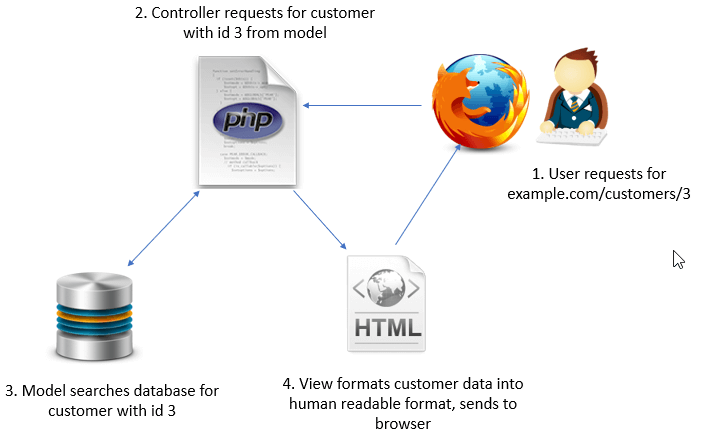
CodeIgniter is an MVC framework. MVC stands for Model View Controller. When a user requests a resource, the controller responds first. The controller understands the user request and then requests the necessary data if needed.
For example, if you want to retrieve a customer with the id = 3, the controller receives your request, then requests the CodeIgniter models to retrieve the record with the id of 3. The models return the record to the controller. The controller then forwards the result to the view, which formats it into a human-readable format. The results are then returned to the user in the browser.
The following image shows how CodeIgniter works:
CodeIgniter vs Full-Stack Frameworks
CodeIgniter is often chosen over heavier PHP frameworks when speed and simplicity matter more than a large feature set. The table below places it against Laravel, the most common alternative.
| Aspect | CodeIgniter | Laravel |
|---|---|---|
| Footprint | Very small, about 2 MB | Larger, many dependencies |
| Learning curve | Short | Steeper |
| Configuration | Minimal, convention-light | Convention-heavy |
| Best for | Fast, lightweight apps | Large, feature-rich apps |
In short, reach for CodeIgniter when you want a lean framework that loads fast and is easy to learn, and for a larger project pick a full-stack framework instead.
CodeIgniter Release History
| Year | Version |
|---|---|
| 2006 | EllisLab released the first public version of CodeIgniter on 28 February. |
| 2009 | ExpressionEngine 2.0 launched. |
| 2014 | British Columbia Institute of Technology took ownership of the project. |
| 2019 | Stewardship passed to the newly formed CodeIgniter Foundation, which still maintains the framework. |
| 2020 | On 24 February, CodeIgniter 4 was officially launched. |
| 2021 | On 6 September, CodeIgniter 4.1.4 was released. |
| 2024 | CodeIgniter 4.5 arrived in April, raising the minimum requirement to PHP 8.1. |
| 2025 | The 4.6 series shipped, extending support up to PHP 8.4; 4.6.4 followed on 12 December. |
| 2026 | CodeIgniter 4.7 launched in February, with 4.7.4 — the current stable release — arriving on 7 July. |
