
Software Quality Assurance(SQA): Plan, Audit & Review
 Thomas Hamilton
⚡ Smart Summary
Software Quality Assurance reviews the management process behind a project rather than the product itself, giving the Management Board documented evidence that a Test Manager followed the agreed standards from planning through release.

After the seven phases of testing, the results look good. No significant issues occurred in the project Guru99 Bank, and you were proud of how it finished. Unfortunately, the Management Board thinks differently.

You have no evidence that you managed the project well, so you ask an advisor. The answer points straight at a management review.

That answer is a start, but it leaves three questions open — what a review and audit actually are, why the process needs them, and how to run them:

What Are Test Management Reviews and Audits?
- Management review: A management review is also known as Software Quality Assurance, or SQA. It focuses on the software process rather than on the software work products. Quality Assurance is a set of activities designed to confirm that the project manager follows the standard process defined in advance. Quality Assurance makes sure the Test Manager is doing the right things in the right way.
- Audit: An audit is the examination of the work products and related information to assess whether the standard process was actually followed.
The review looks at behaviour; the audit looks at the paper trail it leaves.
Why Do We Need SQA in the Test Management Process?
Consider the following scenario. The project Guru99 Bank runs through a chain of test management phases, from risk analysis to the final test report:

As a Test Manager, you are the person in charge of these activities. However, you sit at the top of the project team. Who then reviews your tasks and checks that the project management activities are executed to the highest standard?
The SQA auditor does. The auditor checks that project management activities meet the required standard and interviews you to benchmark the project against it. Only through that review can the Management Board judge your project handling. Three benefits follow:

How to Implement Quality Assurance
Quality assurance is implemented in three steps. The diagram labels the middle stage Preparation — the preparation of the standards and methodology covered in Step 2:

Step 1) Develop the SQA Plan
A testing activity needs a test plan; an SQA activity likewise needs an SQA plan. It sets out the processes and procedures that keep the delivered product or service at the expected quality level. The Test Manager writes it during project planning and schedules the audits periodically.
The Test Manager completes three sub-steps:

Step 1.1) Identify the Roles and Responsibilities of the SQA Team
In a project team, every member is responsible for the quality of their own work and must make sure it meets the QA criteria.
The SQA team leads that effort, so the Test Manager must state the responsibility of each SQA member in the SQA plan:
- Review and evaluate the quality of project activities against the QA criteria.
- Coordinate with the Management Board and project teams to assess requirements and take part in project review and status meetings.
- Design, track and collect metrics that monitor project quality.
- Measure the quality of the product and ensure it meets customer expectations.
For example, the SQA plan of the project Guru99 Bank lists the SQA team as below.
| No | Member | Roles | Responsibility |
|---|---|---|---|
| 1 | Peter | SQA Leader | Develop and document the quality standard and process for every management process
Manage software quality assurance activities for the project |
| 2 | James | SQA auditor | Perform SQA tasks and report the result of each SQA review to the SQA Leader. |
| 3 | Bean | SQA auditor | Perform SQA tasks and report the result of each SQA review to the SQA Leader. |
Step 1.2) List the Work Products the SQA Auditor Will Review and Audit
The Test Manager should
- List every work product of each test management process.
- Define which facilities or equipment the SQA auditor may access to perform SQA tasks such as process evaluations and audits.
For Guru99 Bank, list the work products of each test management process and set access permissions for SQA members:
| No | Management Phases | Work product | Path | Permission | Grant to Person |
|---|---|---|---|---|---|
| 1 | Risk analysis | Risk Management document | [Server path] | Read | All SQA team members |
| 2 | Estimation | Estimation and Metrics report | … | Read | Peter |
| 3 | Planning | Test Planning document | … | Read | All SQA team members |
| 4 | Organization | Human resource plan, training plan | … | Read | All SQA team members |
| 5 | Monitoring and Control | Collected metrics of project effort | … | Read | Bean |
| 6 | Issue Management | Issue management report | … | Read | James |
| 7 | Test report | Test Report document | … | Read | All SQA team members |
Step 1.3) Create the Schedule to Perform the SQA Tasks
The Test Manager describes the tasks the SQA auditor will perform and the work product each task produces.
The SQA schedule is normally driven by the project development schedule, so each task is timed against the development activity taking place. An example management-review schedule follows.
| Date | SQA Tasks | Person in charge | Description | Output |
|---|---|---|---|---|
| 30-Oct-2025 | Evaluate project planning, tracking and oversight processes | James | – Software Specification Review – Estimation, Master Schedule and Project Plan Review |
SQA planning report, SQA review minutes |
| 15-Dec-2025 | Review requirement analysis | James | – Review the software requirement development | Process audit report |
| 30-Mar-2026 | Review and evaluate test design | James | – Review the Test Design document | SQA report, SQA review minutes |
| 30-Mar-2026 | Review release | Bean | – Process Audit: Final Release | SQA process audit report |
| 2-Apr-2026 | Review project closing | Bean | – External review after final delivery to customer | SQA process audit report |
Step 2) Define the Standards and Methodology
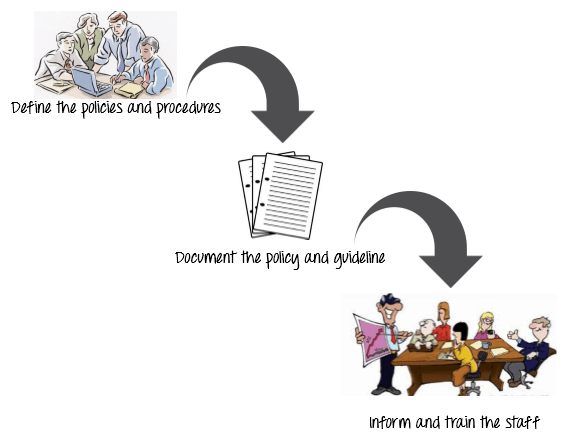
To review management activities against a standard process, the standard must exist in writing first:
- Define the policies and procedures intended to prevent defects from occurring in the management process.
- Document the policies and procedures.
- Inform and train the staff to use them.
The diagram traces that sequence:
Step 3) Review the Process
Review project activities to verify compliance with the defined management process. In a management review, the SQA members perform five reviews, labelled SQA0 to SQA4:

Review timing depends on the development lifecycle model. For Guru99 Bank, the checkpoints map onto the test lifecycle as follows:

In each SQA phase, the SQA members review the project plans, work products and procedures against the defined organizational policy. During an audit they should work from an SQA review checklist, which scores each activity Yes, No or N/A and converts the result into a pass percentage.
After you walk through the three steps of software assurance implementation, you hold the result of the Test Management Review and Audit. That report is the evidence of management quality you show to your stakeholders.

Software Quality Assurance Best Practices
Here are proven habits for an effective SQA implementation.
- Continuous improvement: Every standard process in SQA should be improved regularly and made official so that others can follow it. Certify the process against a recognized model such as ISO 9001 or the CMMI Process and Product Quality Assurance (PPQA) practice area.
- Documentation: All QA policies and methods defined by the QA team should be documented for training and for reuse on future projects.
- Experience: Choosing seasoned SQA auditors is a reliable way to protect the quality of a management review.
- Tool usage: Using tools such as issue trackers and test management tools reduces SQA effort and project cost.
- Metrics: Metrics that track software quality in its current state, and compare it with previous versions, increase the value and maturity of the testing process.
- Responsibility: SQA is not the SQA member’s task alone. Everybody on the team is responsible for the quality of the product, not just the test lead or the manager.
