
SAP PP Reports: COOIS, MB52, CS15, CS12
 Editorial Team
⚡ Smart Summary
SAP PP reports read master data, production orders and goods movements that already exist in the system. Five standard transactions — COOIS, MB51, MB52, CS15 and CS12 — answer most shop floor questions.

What are SAP PP Reports?
Many standard reports are available in SAP covering master data, production orders and the goods movements posted against those orders.
- They let a user view the overall situation of the plant with ease.
- Through PP reports you can view production and consumption data for a material over a chosen period, and current plant stock in real time.
- You can also see the target order quantity still to be executed and track orders through their order status.
The five transactions below are the ones a planner opens most often, and every one is a standard SAP report.
How to Display the Order Information System (COOIS)
The order information system displays orders with their quantity, dates and status, and it also shows the goods movements posted on them.
It gives the shop floor a view to plan and execute priority orders, and to compare the actual delivered quantity against the plan.
Step 1) From the SAP Easy Access screen, open transaction COOIS.
- Select the option “Order Headers” in the List field.
- Flag the Production orders checkbox.
- Enter your manufacturing plant code.
- Enter the order type for which you want to fetch the production orders. Leaving it blank returns all order types in the plant.

After filling in all the fields, click Execute or press F8.
Step 2) In this screen, you see the list of orders.
- Orders are listed with the material code and the target quantity.
- The order basic start and finish dates are displayed for the planner.
- The order status identifies whether the order is delivered or is yet to be executed on the shop floor.

Press Back to exit the report.
Step 3) On the initial screen of the production order information system (COOIS), you can also view the goods movements that occurred against an order.
- Select “Documented goods movements” from the List field.
- Check the flag of “Production orders”.
- Enter your production plant code.
- Enter the production order type. Leaving it blank returns all order types in the plant.

Click Execute or press F8. The report opens another screen showing the goods movements.
Step 4) In this screen, the documented goods movements against the order are displayed.
- Orders are listed along with the parent material and its component materials.
- You can see movement types 261 and 101 posted against the order, along with the batch number.

Press Back to exit the report.
How to Display the Material Document List (MB51)
A material document is generated whenever you post a goods movement, such as a goods receipt or a goods issue against a production order.
The list shows production and consumption data for a plant over the posting periods you select.
Step 1) From the SAP Easy Access screen, open transaction MB51.
- Enter your manufacturing plant code.
- Enter movement type 101 to see production data (goods receipt) for all materials.
- Enter the posting periods for which you want to display the production.

Click Execute or press F8.
Step 2) In this screen, you see the production data of all materials.
- Material codes are listed along with movement type 101.
- The movement quantity is displayed along with the posting date.

Press F3 to exit and return to SAP Easy Access.
Step 3) Open transaction MB51 again, this time to read consumption.
- Enter your manufacturing plant code.
- Enter movement type 261 to see consumption data (goods issue) for all materials.
- Enter the posting periods for which you want to display the consumption.

Click Execute or press F8.
Step 4) In this screen, you see the consumption data for all materials.
- Material codes are listed with movement type 261, the movement quantity and the posting date.

Press F3 to exit the report.
How to Display Stock of Multiple Materials (MB52)
Every goods movement updates the stock of the material it touches, and this report returns real-time stock for many materials in one run.
Step 1) From the SAP Easy Access screen, open transaction MB52.
- Enter a single material code or a range of material codes, or keep it blank to pull the report for all materials.
- Enter your manufacturing plant code.
- Enter a storage location code, or keep it blank to pull the report at plant level for all storage locations.

Click Execute or press F8.
Step 2) In this screen, you see the stock of all selected materials.
Material codes are listed with the stock quantity and value at each storage location.

Press F3 to exit the report.
How to Display a “Where-Used List” in a BOM (CS15)
This report finds out whether a component exists in any bill of material. It returns the parent material in which the component is used as a BOM item.
It is a reverse BOM explosion: from the child component code you find the parent material code. Tread, for example, is an item in the BOM of a tire.
Step 1) From the SAP Easy Access screen, open transaction CS15.
- Enter the material code whose parent materials you want to see.
- Flag the “Direct” check box.
- Flag “Material BOM”, as you are looking the component up in a material BOM.

Press the Next button to move to the next screen.
Step 2) In this screen, enter the explosion data.
- Enter the required quantity as “1”.
- Enter your manufacturing plant.
- Flag “Multi-level”, which means you want to see all upper BOM levels for the component.
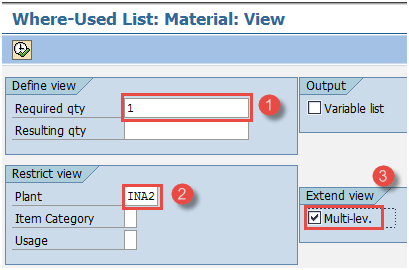
Click Execute or press F8.
Step 3) In this screen, the where-used result is displayed.
- You can see the different levels of BOM in which this component exists.
- You can see the parent material in which the component exists.

Press F3 to exit the report.
How to Display a Multi-Level BOM (CS12)
This report explodes the multi-level BOM for a product, so you see every component at every BOM level in one screen. Its companion CS13 summarizes the same components into one line each.
Step 1) From the SAP Easy Access screen, open transaction CS12.
- Enter the material code whose components you want at all BOM levels.
- Enter your manufacturing plant code.
- Enter BOM application “PP01”, which means you are going to explode the production BOM.

Click Execute or press F8.
Step 2) In this screen, the exploded structure is displayed.
Components are listed with their quantity at every BOM explosion level.

Press F3 to exit the report.
Troubleshooting SAP PP Report Errors
- If a report will not execute, check that the selection criteria are correct and that transaction data exists for the period you asked for.
- For BOM reports the material master and the BOM must already exist, because CS15 and CS12 only read them; a missing BOM returns no result.
- Be sure of the movement types before reading a production or consumption report: 101 is a receipt and 261 an issue, so the wrong key returns the wrong data.
- A report that runs for a long time is selecting too wide a range, so narrow the posting period or the material range.
