
PHP String Functions Explained with Examples
 Editorial Team
⚡ Smart Summary
Strings in PHP are ordered collections of characters and one of the language’s core data types. This walkthrough shows the four ways to create strings, single quotes, double quotes, heredoc, and nowdoc, then demonstrates the most useful built-in string functions with examples.
What is String in PHP?
A string is a collection of characters. String is one of the data types supported by PHP.
String variables can contain alphanumeric characters. Strings are created when:
- You declare a variable and assign string characters to it
- You directly use PHP strings with the echo statement.
- PHP string functions are language constructs that help you work with text.
- Learning how strings work in PHP and how to manipulate them will make you a very effective and productive developer.
PHP Create Strings Using Single quotes with Example
Let us now look at the four different ways of creating and manipulating strings in PHP.
Creating PHP strings using single quotes: the simplest way to create a string is to use single quotes.
Let us look at an example that creates a simple string in PHP.
<?php
var_dump('You need to be logged in to view this page');
?>
Output:
string(42) "You need to be logged in to view this page"
If the single quote is part of the string value, it can be escaped using the backslash.
The code below illustrates how to escape a single quote.
<?php
echo 'I \'ll be back after 20 minutes';
?>
Output:
I'll be back after 20 minutes
PHP Create Strings Using Double quotes with Example
Double quotes are used to create relatively complex strings compared to single quotes.
Variable names can be used inside double quotes and their values will be displayed.
Let us look at an example.
<?php
$name = 'Alicia';
echo "$name is friends with kalinda";
?>
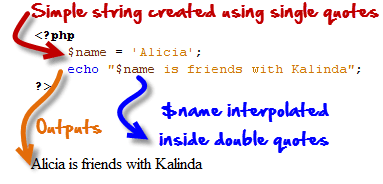
HERE,
- The above example creates a simple string with the value of Alicia.
- The variable name is then used in the string created using double quotes, and its value is interpolated at run time.
Output:
Alicia is friends with kalinda
In addition to variable interpolation, the double quote string can also escape more special characters such as “\n for a linefeed, \$ for the dollar sign” etc.
More examples. Let us suppose that we have the following code.
<?php $pwd = "pas$word"; echo $pwd; ?>
Output:
NOTICE : Undefined variable
pas
Executing the above code issues a notice, “Notice: Undefined variable”.
This is because $word is treated as a variable.
If we want the dollar sign to be treated as a literal value, we have to escape it.
<?php
$word = "word";
$pwd = "pas\$word";
echo $pwd; ?>
Output:
pas$word
PHP Heredoc with Example
The heredoc methodology is used to create fairly complex strings compared to double quotes.
Heredoc supports all the features of double quotes and allows creating string values with more than one line without PHP string concatenation.
Using double quotes to create strings that have multiple lines generates an error.
You can also use double quotes inside without escaping them.
The example below illustrates how the heredoc method is used to create string values.
<?php

$baby_name = "Shalon";

echo <<<EOT

When $baby_name was a baby,

She used to look like a "boy".

EOT;

?>
HERE,
<<<EOT is the string delimiter.
EOT is the acronym for end of text.
It should be defined on its own line at the beginning of the string and at the end.
Note: you can use anything you like in place of EOT.

Output:
When Shalon was a baby, She used to look like a "boy".
PHP Nowdoc with Example
The nowdoc string creation method is similar to the heredoc method but works the way single quotes work.
No parsing takes place inside the nowdoc.
Nowdoc is ideal when working with raw data that does not need to be parsed.
The code below shows the nowdoc implementation.
<?php

$baby_name = "Shalon";

$my_variable = <<<'EOT'

When $baby_name was a baby,

She used to look like a "boy".

EOT;

echo $my_variable;

?>
Output:
When $baby_name was a baby, She used to look like a "boy".
PHP String Function Examples
String functions in PHP are used to manipulate string values.
We are now going to look at some of the commonly used string functions in PHP.
| Function | Description | Example | Output |
|---|---|---|---|
| strtolower | Used to convert all string characters to lower case letters | echo strtolower(‘Benjamin’); | outputs benjamin |
| strtoupper | Used to convert all string characters to upper case letters | echo strtoupper(‘george w bush’); | outputs GEORGE W BUSH |
| strlen | The string length function is used to count the number of characters in a string. Spaces in between characters are also counted | echo strlen(‘united states of america’); | 24 |
| explode | Used to convert strings into an array variable | $settings = explode(‘;’, “host=localhost; db=sales; uid=root; pwd=demo”); print_r($settings); | Array ( [0] => host=localhost [1] => db=sales [2] => uid=root [3] => pwd=demo ) |
| substr | Used to return part of the string. It accepts three basic parameters: the string to be shortened, the starting position, and the number of characters to be returned. | $my_var = ‘This is a really long sentence that I wish to cut short’;echo substr($my_var,0, 12).’…’; | This is a re… |
| str_replace | Used to locate and replace specified string values in a given string. The function accepts three arguments: the text to be replaced, the replacement text, and the text that is analyzed. | echo str_replace (‘the’, ‘that’, ‘the laptop is very expensive’); | that laptop is very expensive |
| strpos | Used to locate and return the position of a character or characters within a string. This function accepts two arguments. | echo strpos(‘PHP Programming’,’Pro’); | 4 |
| sha1 | Used to calculate the SHA-1 hash of a string value | echo sha1(‘password’); | 5baa61e4c9b93f3f0682250b6cf8331b7ee68fd8 |
| md5 | Used to calculate the MD5 hash of a string value | echo md5(‘password’); | 5f4dcc3b5aa765d61d8327deb882cf99 |
| str_word_count | Used to count the number of words in a string. | echo str_word_count(‘This is a really long sentence that I wish to cut short’); | 12 |
| ucfirst | Make the first character of a string value upper case | echo ucfirst(‘respect’); | Outputs Respect |
| lcfirst | Make the first character of a string value lower case | echo lcfirst(‘RESPECT’); | Outputs rESPECT |
