
Memory Management in OS: Contiguous, Swapping, Fragmentation
 Editorial Team
⚡ Smart Summary
Memory Management is the operating system process of controlling and coordinating computer memory, assigning blocks to running programs to optimize performance. It tracks every memory location, moves processes between main memory and disk, and protects processes from one another.
What is Memory Management?
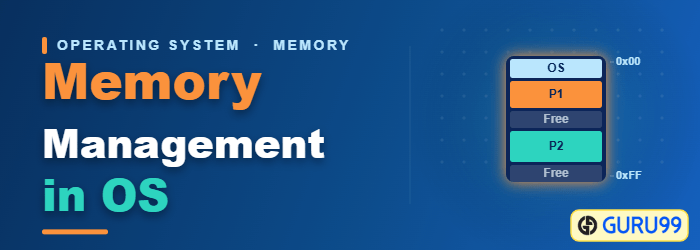
Memory Management is the process of controlling and coordinating computer memory, assigning portions known as blocks to various running programs to optimize the overall performance of the system.
It is the most important function of an operating system that manages primary memory. It helps processes to move back and forward between the main memory and execution disk. It helps the OS to keep track of every memory location, irrespective of whether it is allocated to some process or it remains free.
Why Use Memory Management?
Here are the reasons for using memory management:
- It allows you to check how much memory needs to be allocated to processes that decide which processor should get memory at what time.
- Tracks whenever inventory gets freed or unallocated, and updates the status accordingly.
- It allocates the space to application routines.
- It also makes sure that these applications do not interfere with each other.
- Helps protect different processes from each other.
- It places the programs in memory so that memory is utilized to its full extent.
Memory Management Techniques
Here are some of the most crucial memory management techniques:
Single Contiguous Allocation
It is the easiest memory management technique. In this method, all types of a computer’s memory, except a small portion which is reserved for the OS, is available for one application. For example, the MS-DOS operating system allocates memory in this way. An embedded system also runs on a single application.
Partitioned Allocation
It divides primary memory into various memory partitions, which are mostly contiguous areas of memory. Every partition stores all the information for a specific task or job. This method consists of allotting a partition to a job when it starts & deallocating it when it ends.
Paged Memory Management
This method divides the computer’s main memory into fixed-size units known as page frames. This hardware memory management unit maps pages into frames which should be allocated on a page basis.
Segmented Memory Management
Segmented memory is the only memory management method that does not provide the user’s program with a linear and contiguous address space.
Segments need hardware support in the form of a segment table. It contains the physical address of the section in memory, size, and other data like access protection bits and status.
What is Swapping?
Swapping is a method in which a process should be swapped temporarily from the main memory to the backing store. It will be later brought back into the memory for continued execution.
The backing store is a hard disk or some other secondary storage device that should be big enough in order to accommodate copies of all memory images for all users. It is also capable of offering direct access to these memory images.

Benefits of Swapping
Here are the major benefits/pros of swapping:
- It offers a higher degree of multiprogramming.
- Allows dynamic relocation. For example, if address binding at execution time is being used, then processes can be swapped to different locations. Otherwise, in the case of compile and load time bindings, processes should be moved to the same location.
- It helps to get better utilization of memory.
- Minimum wastage of CPU time on completion, so it can easily be applied to a priority-based scheduling method to improve its performance.
What is Memory allocation?
Memory allocation is a process by which computer programs are assigned memory or space.
Here, main memory is divided into two types of partitions:
- Low Memory – The Operating system resides in this type of memory.
- High Memory – User processes are held in high memory.
Partition Allocation
Memory is divided into different blocks or partitions. Each process is allocated according to the requirement. Partition allocation is an ideal method to avoid internal fragmentation.
Below are the various partition allocation schemes:
- First Fit: In this type of fit, the partition is allocated which is the first sufficient block from the beginning of the main memory.
- Best Fit: It allocates the process to the partition that is the smallest sufficient partition among the free partitions.
- Worst Fit: It allocates the process to the partition which is the largest sufficient freely available partition in the main memory.
- Next Fit: It is mostly similar to the First Fit, but this Fit searches for the first sufficient partition from the last allocation point.
What is Paging?
Paging is a storage mechanism that allows the OS to retrieve processes from the secondary storage into the main memory in the form of pages. In the Paging method, the main memory is divided into small fixed-size blocks of physical memory, which are called frames. The size of a frame should be kept the same as that of a page to have maximum utilization of the main memory and to avoid external fragmentation. Paging is used for faster access to data, and it is a logical concept.
What is Fragmentation?
Processes are stored in and removed from memory, which creates free memory spaces that are too small to be used by other processes.
After some time, those processes are not able to be allocated to memory blocks because of their small size, and the memory blocks always remain unused. This is called fragmentation. This type of problem happens during a dynamic memory allocation system when free blocks are quite small, so they are not able to fulfill any request.
Two types of Fragmentation methods are:
- External fragmentation
- Internal fragmentation
- External fragmentation can be reduced by rearranging memory contents to place all free memory together in a single block.
- Internal fragmentation can be reduced by assigning the smallest partition, which is still good enough to carry the entire process.
What is Segmentation?
The Segmentation method works almost similarly to paging. The only difference between the two is that segments are of variable length, whereas, in the paging method, pages are always of fixed size.
A program segment includes the program’s main function, data structures, utility functions, etc. The OS maintains a segment map table for all the processes. It also includes a list of free memory blocks along with its size, segment numbers, and its memory locations in the main memory or virtual memory.
What is Dynamic Loading?
Dynamic loading is a routine of a program which is not loaded until the program calls it. All routines should be contained on a disk in a relocatable load format. The main program will be loaded into memory and will be executed. Dynamic loading also provides better memory space utilization.
What is Dynamic Linking?
Linking is a method that helps the OS to collect and merge various modules of code and data into a single executable file. The file can be loaded into memory and executed. The OS can link system-level libraries into a program that combines the libraries at load time. In the Dynamic linking method, libraries are linked at execution time, so program code size can remain small.
Difference Between Static and Dynamic Loading
| Static Loading | Dynamic Loading |
|---|---|
| Static loading is used when you want to load your program statically. Then, at the time of compilation, the entire program will be linked and compiled without the need for any external module or program dependency. | In a Dynamically loaded program, references will be provided and the loading will be done at the time of execution. |
| At loading time, the entire program is loaded into memory and starts its execution. | Routines of the library are loaded into memory only when they are required in the program. |
Difference Between Static and Dynamic Linking
Here are the main differences between Static vs. Dynamic Linking:
| Static Linking | Dynamic Linking |
|---|---|
| Static linking is used to combine all other modules, which are required by a program, into a single executable code. This helps the OS prevent any runtime dependency. | When dynamic linking is used, it does not need to link the actual module or library with the program. Instead, it uses a reference to the dynamic module provided at the time of compilation and linking. |
