
Levels of Software Testing
 Editorial Team
⚡ Smart Summary
Levels of Testing in software testing organize quality checks into four sequential stages that validate a system from its smallest unit to final user acceptance. This resource explains unit, integration, system, and acceptance testing and their distinct purposes.

4 Levels of Testing
There are mainly four Levels of Testing in software testing :
- Unit Testing : checks if software components are fulfilling functionalities or not.
- Integration Testing : checks the data flow from one module to other modules.
- System Testing : evaluates both functional and non-functional needs for the testing.
- Acceptance Testing : checks the requirements of a specification or contract are met as per its delivery.
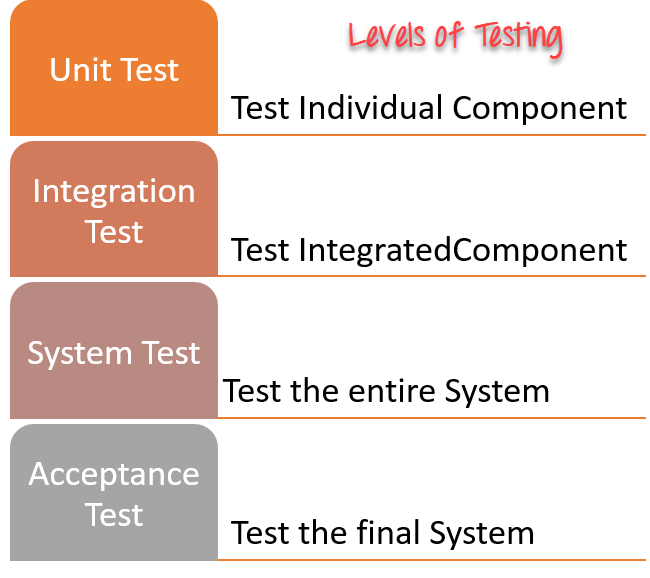
Each of these testing levels has a specific purpose. These testing level provide value to the software development lifecycle.
Each Testing Level Details
Unit testing:
A Unit is the smallest testable portion of system or application which can be compiled, liked, loaded, and executed. This kind of testing helps to test each module separately.
The aim is to test each part of the software by separating it. It checks that component are fulfilling functionalities or not. This kind of testing is performed by developers.
Integration testing
Integration means combining. For Example, In this testing phase, different software modules are combined and tested as a group to make sure that integrated system is ready for system testing.
Integrating testing checks the data flow from one module to other modules. This kind of testing is performed by testers.
System Testing
System testing is performed on a complete, integrated system. It allows checking system’s compliance as per the requirements. It tests the overall interaction of components. It involves load, performance, reliability and security testing.
System testing most often the final test to verify that the system meets the specification. It evaluates both functional and non-functional need for the testing.
Acceptance testing
Acceptance testing is a test conducted to find if the requirements of a specification or contract are met as per its delivery. Acceptance testing is basically done by the user or customer. However, other stockholders can be involved in this process.
