
Symbolic Account to G/L Mapping Table in SAP
 Editorial Team
⚡ Smart Summary
Symbolic accounts in SAP link payroll wage types to the general ledger, letting the system post salary expenses and payables to the correct accounts using transactions OBYG, OBYE, and OBYU during the payroll posting run.
Mapping a symbolic account to a general ledger account is the configuration step that lets SAP Payroll hand its results to Financial Accounting. Each wage type points to a symbolic account, and each symbolic account points to a real G/L account through transactions OBYG, OBYE, and OBYU.
What Is a Symbolic Account in SAP?
A symbolic account is a short, four-character key that acts as a bridge between SAP Payroll (part of SAP HR) and Financial Accounting. Payroll does not post directly to a general ledger account. Instead, every wage type that must reach the books is first assigned to a symbolic account, and the symbolic account is then mapped to the actual G/L account.
This two-step design keeps the payroll configuration independent of the chart of accounts. If the finance team renumbers a G/L account, only the symbolic-account mapping changes, and no wage type has to be touched. SAP stores the symbolic accounts and their assignment characteristics in table T52EK.
Each symbolic account carries an account assignment type that tells SAP what kind of account sits behind it:
- Expense (cost) accounts for the salary and benefit costs the company incurs
- Balance sheet accounts for the net pay, tax, and social-insurance amounts owed
- Vendor accounts when a payable is settled through a third party
Symbolic Account Assignment Types and Their T-codes
The account assignment type recorded against each symbolic account decides which transaction is used to map it. Expense items are handled by OBYE, balance sheet items by OBYG, and vendor items by OBYU. The table below summarises the main types you will meet.
| Assignment type | Posts to | Mapping transaction |
|---|---|---|
| C — Expense | Payroll expense and cost accounts in the profit and loss statement | OBYE |
| F — Balance sheet | Payable and liability accounts such as net pay or tax payable | OBYG |
| Q — Balance sheet with personnel number | Employee-level balance sheet accounts | OBYG |
| K — Vendor | Vendor accounts in accounts payable | OBYU |
Because expense accounts are grouped by employee grouping, OBYE asks for the employee grouping in addition to the symbolic account and G/L account. OBYG and OBYU need only the chart of accounts, the symbolic account, and the target G/L or vendor account.
How to Map Symbolic Account to G/L Account
The following procedure maps a symbolic account to a balance sheet account with OBYG, then shows the small difference for OBYE. Both transactions open the same account-determination view; only the required fields differ.
Step 1) Enter transaction OBYG in the SAP transaction code box, as shown below.

Step 2) Enter the Chart of Accounts, then click Enter to confirm the entry shown in the next screen.

Step 3) In the next SAP screen, click Create to add a new symbolic-account assignment.

Step 4) Enter the Symbolic account and the G/L account, then click Save to complete the mapping.
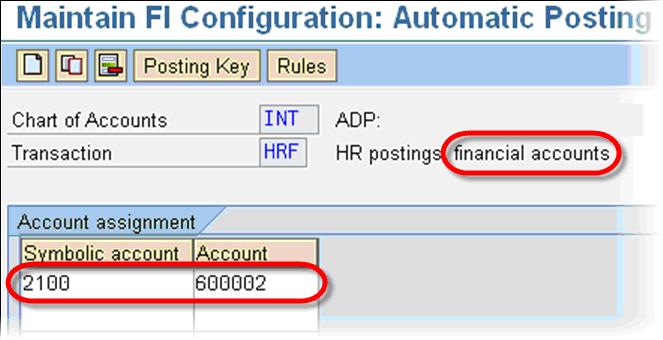
Step 5) For transaction OBYE the process is the same, except that you must also enter the Employee Grouping, as shown below.

Once every symbolic account is mapped, the payroll-to-accounting link is complete and results can be posted to the ledger.
Posting Payroll Results to Accounting (PC00_M99_CIPE)
Mapping the accounts is configuration; transferring the numbers is a separate run. After a payroll is exited, the posting program reads each result, translates every wage type through its symbolic account into a G/L, vendor, or customer line, and creates an accounting document.
The usual sequence is straightforward:
- Run PC00_M99_CIPE to create the posting run, starting in simulation mode
- Review the simulated document for balance and account-determination errors
- Switch to a productive run so SAP creates the posting run in the background
- Use PCP0 to check, release, and post the run to Financial Accounting
The most common errors at this stage are a wage type with no symbolic account, a symbolic account that was never mapped, or a target G/L account that is blocked for posting. Each is fixed in the mapping transactions above, after which the run is repeated. The resulting documents then feed the standard FI reports and are visible in the FI tables that hold financial documents.
