
MMBE: How to get SAP Stock Overview
 Editorial Team
⚡ Smart Summary
Stock overview in SAP, produced by transaction MMBE, shows the quantity of a material across every organizational level and stock type. This resource explains the stock types it displays and how MMBE compares with reports MB52 and MB5B.

What Is MMBE Stock Overview in SAP?
MMBE is the SAP transaction that displays the stock overview of a single material across every organizational level in one screen. Instead of checking plants and storage locations one by one, you enter the material once and the report shows how much stock exists and where it sits. The view is hierarchical, so it starts at the company level and can be expanded down to plant, storage location, and batch.
The overview is read-only, which means it never changes stock; it simply reports the current position at the moment you run it. This makes MMBE one of the most-used transactions in Materials Management, because warehouse teams, planners, and sales staff all need a fast answer to the question of how much of a material is on hand and available. Alongside the quantities, MMBE also separates stock by its status, so you can immediately see how much stock is usable and how much is tied up in inspection or blocked.
Stock Types Shown in the MMBE Overview
MMBE does not just show a single total; it breaks the quantity down by stock type, so you can tell usable stock apart from stock that is restricted. The common stock types displayed are:
- Unrestricted-use stock: Stock that is available for use, sale, or consumption without any restriction.
- Quality inspection stock: Stock that has been received but is waiting for a quality check before it can be used.
- Blocked stock: Stock that is not usable, often because it is damaged or placed on hold.
- Reserved stock: Quantity already committed to orders or reservations, and therefore not freely available.
- Stock in transit or transfer: Stock moving between plants or storage locations that has not yet arrived.
- On-order stock: Quantity expected from open purchase orders that has not yet been received.
Reading these categories together gives a true picture of availability, because normally only unrestricted-use stock can be promised to a customer straight away, while the other types must clear inspection, release, or receipt first.
Steps to Check Stock in SAP
Follow these steps to view the stock overview of a material in transaction MMBE.
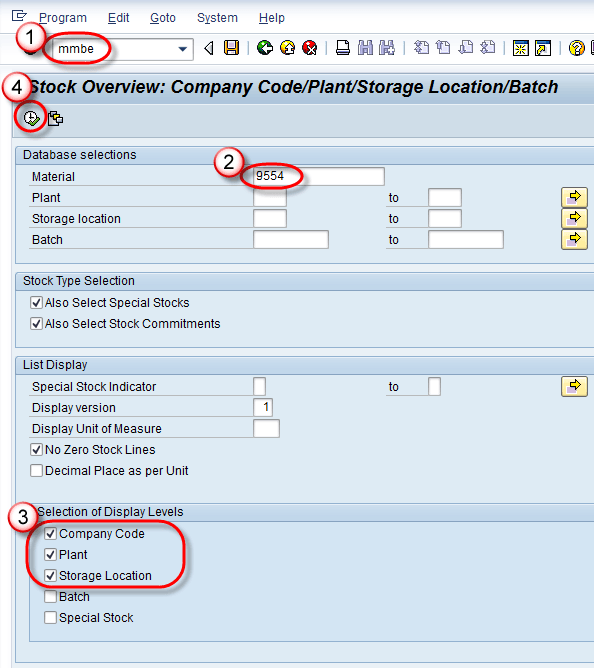
Step 1) Run the transaction and enter the selection.
- Enter T-Code MMBE in the command bar.
- Enter the Material number.
- Select the display level for which you want to see the stock overview.
Then click the Execute  button.
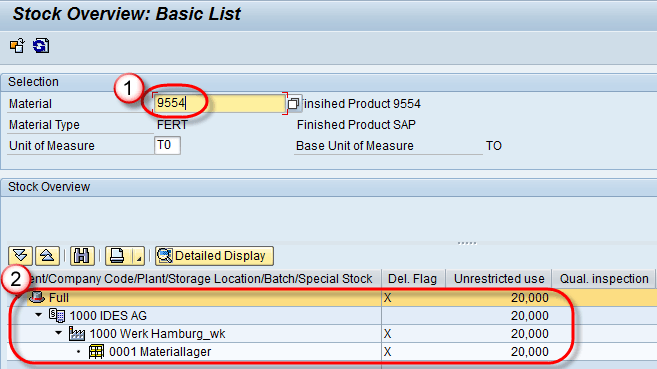
Step 2) The output is displayed as below:
- The stock overview for material 9554 is displayed.
- Stock at the Company, Plant, and Storage Location levels is displayed. By double-clicking each level, you can see the stock overview at that level.
For example, if you double-click the company level, you get the detail at company level, as below:
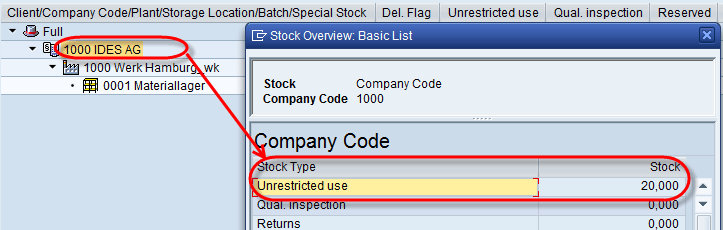
Similarly, you can get the stock overview at the plant or storage location level after double-clicking the plant or storage level.
MMBE vs MB52 vs MB5B: Choosing a Stock Report
MMBE is ideal for one material, but SAP offers other transactions when you need a list of materials or a historical view. The table below compares the three most common stock reports so you can pick the right one for the task.
| Transaction | What it shows | Best used for |
|---|---|---|
| MMBE | Stock overview of one material across all levels and stock types | Checking a single material quickly |
| MB52 | Warehouse stock list of many materials at plant and storage level | Reviewing current stock for a range of materials |
| MB5B | Stock on a posting date or over a date range | Historical or period-end stock reporting |
Use MMBE when you care about one material and want to drill into where its stock sits. Choose MB52 for a multi-material snapshot, and MB5B when you need the stock figure as of a specific date, such as for audits or month-end reconciliation. In practice, most users start with MMBE and only move to MB52 or MB5B when a single-material view is not enough.
